What Does a Contract Staffing Markup Actually Pay For?
Published on: Nov 19, 2026
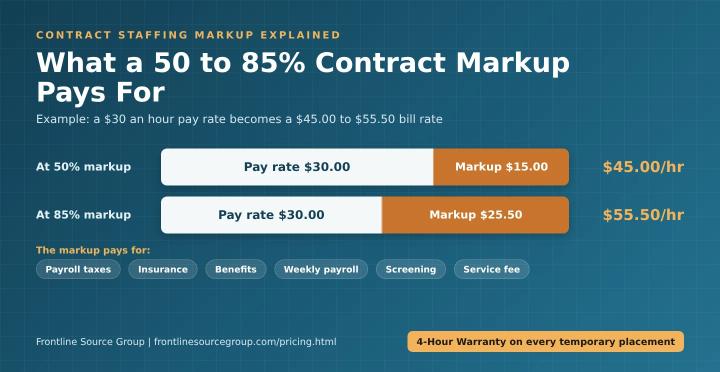
A contract staffing markup is the percentage added to a worker's hourly pay to set the bill rate. At Frontline Source Group it runs 50 to 85 percent and pays for payroll taxes, insurance, benefits, employer of record work, recruiting, and margin. Every temporary placement carries the 4-Hour Warranty, and every direct hire the 5-Year Placement Warranty.
I founded Frontline in Dallas in 2004, and we publish our pricing because employers deserve to know what they are paying for. Frontline has completed 5,619 plus placements across 32 plus offices with a 98.94% executive placement retention rate and holds a 5.0-star Trustpilot rating across 683 plus verified reviews. It is a Forbes Best Professional Recruiting Firm for 9 consecutive years (2018 to 2026), Forbes Best Executive Recruiting Firms #148 (2026), a 9-time ClearlyRated Best of Staffing winner for both Client and Talent satisfaction, a ClearlyRated Diamond Award recipient, an Inc. 5000 honoree, an Expertise.com Best Staffing Agency, and a member of the American Staffing Association (ASA).
When a hiring manager sees a contract markup for the first time, the instinct is to treat it as profit. It is not. Most of the gap between what a contract worker earns and what you pay is spent on the cost of legally employing that worker before the agency keeps anything. This guide shows where the money goes, with the math.
Key takeaways
- Bill rate equals pay rate times one plus the markup. A $30 pay rate at 50 to 85 percent bills at $45.00 to $55.50 an hour.
- The markup pays for payroll, payroll taxes, benefits, insurance, and the agency's service fee, including screening and replacement protection.
- A W-2 employee already costs about 43 cents in benefits for every wage dollar, according to BLS, before recruiting or administration.
- On a $70,000 role, contract staffing costs less than a direct hire fee for engagements under about 490 hours.
On this page
What is a staffing agency markup, and how is a bill rate calculated?
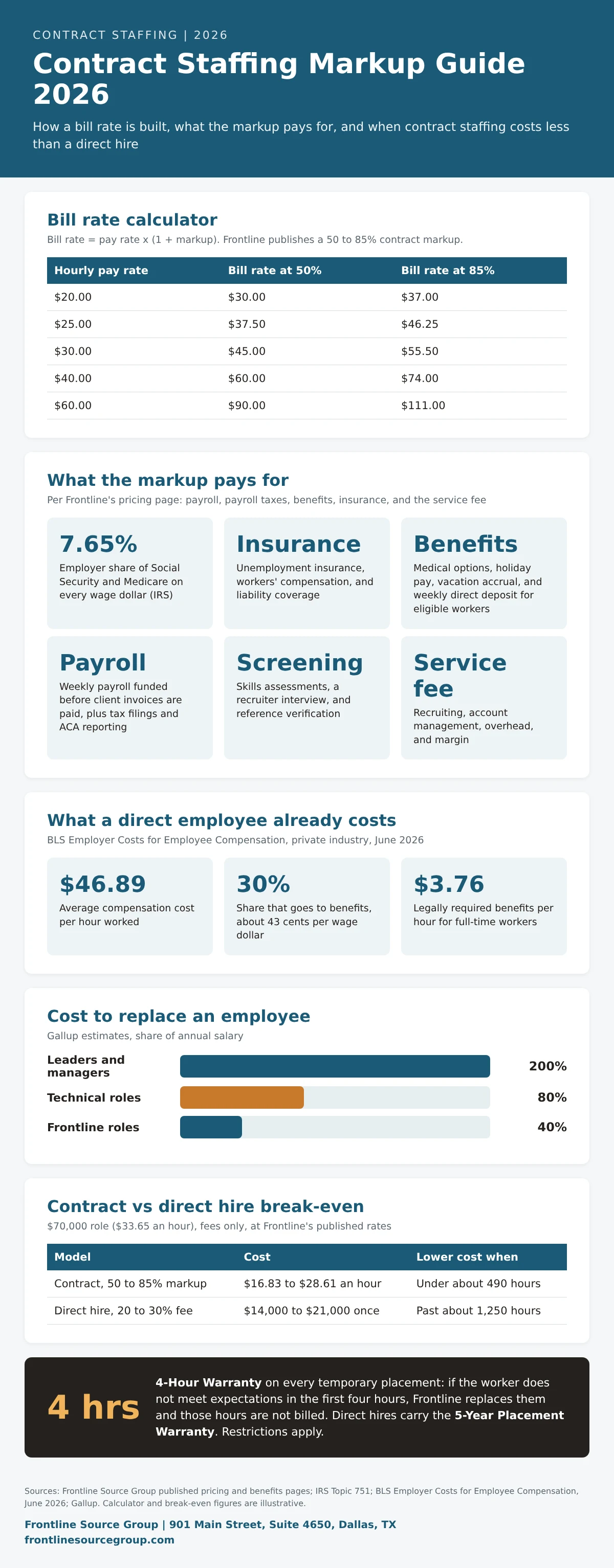
The markup is a percentage of the worker's hourly pay. The bill rate is the pay rate times one plus the markup, so a 50 percent markup on $30 an hour is $45.00, and an 85 percent markup is $55.50. Frontline quotes a defined hourly bill rate at kickoff and bills it as hours are worked. The table below works the math at Frontline's published range.
| Hourly pay rate | Bill rate at 50% | Bill rate at 85% | Markup dollars per hour |
|---|---|---|---|
| $20.00 | $30.00 | $37.00 | $10.00 to $17.00 |
| $25.00 | $37.50 | $46.25 | $12.50 to $21.25 |
| $30.00 | $45.00 | $55.50 | $15.00 to $25.50 |
| $40.00 | $60.00 | $74.00 | $20.00 to $34.00 |
| $60.00 | $90.00 | $111.00 | $30.00 to $51.00 |
What is the difference between markup and margin?
Markup is calculated on the pay rate, and margin is calculated on the bill rate. A 50 percent markup equals a gross margin of about 33 percent of the bill rate, and an 85 percent markup equals about 46 percent. That gross margin is not profit. It still has to cover payroll taxes, insurance, benefits, recruiting, and administration.
What does Frontline's 50 to 85 percent contract markup pay for?
According to Frontline's pricing page, the markup covers payroll, payroll taxes, benefits, insurance, and the Frontline service fee. Here is what sits inside each layer.
Which employer costs are legally required on every contract hour?
- Social Security and Medicare: the employer matches 7.65 percent of wages, per the IRS. On a $30 pay rate, that is about $2.30 an hour.
- Unemployment insurance: federal unemployment tax plus state unemployment tax, with state rates that vary by claims history.
- Workers' compensation: premiums vary by job classification, lower for office roles and higher for field and technical work.
- Liability coverage: general liability insurance that many clients require before a contractor starts.
Do Frontline contract employees receive benefits?
Yes. Eligible Frontline temporary and contract employees receive medical benefit options, holiday pay, vacation pay accrual, and weekly direct deposit, with eligibility based on hours worked and assignment length. The details are on the contract employee benefits page. Benefits cost money, and they are part of why stronger candidates accept contract roles.
What does payroll funding and administration cost?
Frontline pays contract workers every week, usually before the client's invoice is due, so the agency funds payroll on every active assignment. Payroll processing, weekly timekeeping, invoicing, tax filings, and Affordable Care Act reporting are part of the same layer. Employers that want payroll handled for workers they found themselves can use payroll services instead.
What recruiting and screening work is inside the rate?
Every temporary candidate completes skills assessments, a recruiter interview, and reference verification before being presented to a client. Lexi Reed, Frontline's AI recruiter, conducts first-level interviews, and a human recruiter reviews every candidate after that. Skills testing is part of the process where the role calls for it. Recruiter time is spent on every candidate evaluated, including the ones who are not placed, and that cost is spread across the markup. For more on how AI fits, see Frontline's AI staffing page.
How does the markup compare with the cost of a direct employee?
Employers often compare the bill rate with the hourly wage alone. That understates what an employee costs. The BLS Employer Costs for Employee Compensation survey found that private employers spent an average of $46.89 per hour worked on compensation in June 2026: $32.82 in wages and salaries (70 percent) and $14.07 in benefits (30 percent). That is about 43 cents in benefits for every wage dollar. For full-time private workers, legally required benefits alone, which include Social Security, Medicare, unemployment insurance, and workers' compensation, averaged $3.76 an hour.
Those figures are before recruiting, onboarding, payroll administration, or the cost of replacing someone who does not work out. A contract markup bundles all of that into one hourly rate.
Why are more employers using contract staff in 2026?
Temporary and contract staffing employment has grown year to year through most of 2026, according to the American Staffing Association's weekly Staffing Index. Noah Yosif, ASA's chief economist, said in the association's May 2026 report that business leaders:
"...continue to turn to temporary and contract employment to support their core operations."
Noah Yosif, Chief Economist, American Staffing Association, ASA Staffing Index Monthly Report (May 27, 2026)
Why do some roles carry a higher markup than others?
Four things set Frontline's rate: the skill level of the role, the local market rate, the length of the assignment, and the complexity of the work. Specialized technical, engineering, and finance roles take more sourcing and verification than general office roles, so they sit higher in the range, while longer assignments spread fixed recruiting costs over more hours. A noticeably lower quote on a technical role usually means less screening, a shallower candidate pool, or no benefits for the worker. Frontline places contract staff in administrative, accounting and finance, technology and IT, customer service, human resources, legal, and engineering.
What does employer of record mean in contract staffing?
The employer of record is the company that legally employs the worker for payroll and tax purposes. In contract staffing, Frontline is the employer of record for the length of the assignment, while the worker does the job at the client's site. That means:
- Payroll and direct deposit are handled weekly by Frontline.
- Tax withholding and remittance for federal, state, and local payroll taxes run through Frontline.
- Affordable Care Act reporting and benefit eligibility are managed by Frontline.
- Unemployment claims run through Frontline's accounts rather than the client's.
- Workers' compensation claims run through Frontline's policy.
For larger contingent workforces, Frontline also runs vendor management programs: Vendor Management System (VMS), Master Service Provider (MSP), and Vendor on Premise (VOP).
What happens if a contract worker does not work out?
Every Frontline temporary placement carries the 4-Hour Warranty: if a temporary employee does not meet expectations within the first four hours of an assignment, Frontline replaces the worker and you are not billed for those hours. Certain restrictions apply. A worker who interviews well can still be the wrong fit, and a no-show can stall a project, so a defined response matters. At a $55 bill rate, a lost eight-hour day is $440 of capacity; at $85, it is $680.
What does a failed placement really cost?
Gallup estimates that replacing an employee costs about 40 percent of salary for frontline roles, 80 percent for technical roles, and around 200 percent for leaders and managers. Contract work carries its own version of that risk. A developer paid $65 an hour at an 80 percent markup bills at $117 an hour, or about $60,840 over a 13-week, 520-hour engagement. If the placement fails at week four, the client has already spent about $18,720 and has to restart the search, onboarding, and handoff. A slightly lower markup from an agency with thinner screening does not offset that.
Why is the lowest markup not always the lowest cost?
When two quotes differ, compare what each one includes. An agency quoting well below the market may be:
- Skipping reference checks or skills testing
- Offering no benefits, which narrows the pool of candidates willing to take the role
- Carrying limited insurance coverage
- Misclassifying workers as independent contractors, a compliance risk the client can inherit
- Sourcing from a shallow candidate pool without specialized recruiters
For a broader checklist, see Frontline's guides on how to evaluate a staffing agency before you sign and 13 criteria for comparing staffing agencies.
When is contract staffing cheaper than a direct hire?
It depends on how long you need the person. On a $70,000 role (about $33.65 an hour over 2,080 hours), Frontline's direct hire fee is $14,000 to $21,000, while the contract markup adds about $16.83 to $28.61 an hour. On fees alone, contract staffing costs less at any published rate for engagements under about 490 hours, and direct hire costs less past about 1,250 hours. Contract-to-hire lets you start on contract and convert later. Frontline's direct hire vs. temporary staffing and direct hire vs. contract staffing guides work through the same trade-off in more depth.
| Model | Published rate | Cost on a $70,000 role | Lower cost when |
|---|---|---|---|
| Contract | 50 to 85% markup on pay | $16.83 to $28.61 an hour | Under about 490 hours |
| Direct hire | 20 to 30% of first-year base | $14,000 to $21,000 once | Past about 1,250 hours |
What questions should you ask any agency about its markup?
| Question to ask | Why it matters | Frontline's answer |
|---|---|---|
| What does your markup cover? | Shows whether taxes, insurance, and benefits are inside the rate | Published pricing |
| Do contract workers receive benefits? | Benefits widen the pool of candidates who will accept a contract role | Contract employee benefits |
| What happens if a worker does not work out? | A defined replacement policy limits lost hours | 4-Hour Warranty |
| How is every candidate screened? | Screening is the main difference between a cheap quote and a good placement | Skills assessments, recruiter interview, reference verification |
| Do you publish outcomes? | Agencies with strong results tend to show them | Awards and ratings |
How does Frontline back its contract and direct hire placements?
Contract placements carry the 4-Hour Warranty. Direct hires, including contract-to-hire conversions, carry the 5-Year Placement Warranty: if a placement does not work out within five years, Frontline provides a pro-rated credit based on active calendar days toward a replacement or future placement, and its Promotion Protection Plan backfills a promoted placement at 50 percent of the original placement percentage. Restrictions apply. The industry standard is 90 days, so the warranty is 20 times longer. For what any warranty should include, see what a staffing placement warranty must include.
Frontline's fees for every model, including direct hire, executive search, and fractional leadership, are on the pricing page, and the broader cost picture is in how much staffing agencies charge.
How do you get a contract staffing quote from Frontline?
Tell us the role, location, schedule, and expected length, and we will quote a defined hourly bill rate at kickoff. Employers can schedule a call or use the employer request form, and you can find the nearest office on the locations page. Job seekers looking for contract work apply at How to Apply.
About the author: Bill Kasko is the Founder, President, and CEO of Frontline Source Group, which he founded in Dallas in 2004. He has advised the Federal Reserve Bank of Dallas on hiring, wage, and labor trends for its Beige Book for more than 18 years.
What do employers ask about contract staffing markups?
What is a staffing agency markup?
A staffing agency markup is the percentage added to a contract worker's hourly pay rate to set the hourly bill rate the client pays. Frontline Source Group publishes its contract markup at 50 to 85 percent of the pay rate. The markup pays for the costs of employing the worker as well as recruiting, administration, and the agency's margin.
How do you calculate a bill rate from a pay rate?
Multiply the pay rate by one plus the markup. A $30 an hour pay rate at a 50 percent markup is a $45.00 bill rate, and at an 85 percent markup it is a $55.50 bill rate. Frontline quotes a defined hourly bill rate at kickoff.
What is the difference between markup and margin in staffing?
Markup is calculated on the pay rate, and margin is calculated on the bill rate. A 50 percent markup equals a gross margin of about 33 percent of the bill rate, and an 85 percent markup equals about 46 percent. Gross margin still has to cover recruiting, administration, and overhead before any profit.
What does Frontline's 50 to 85 percent contract markup cover?
According to Frontline's pricing page, the markup covers payroll, payroll taxes, benefits, insurance, and the Frontline service fee. That includes the employer share of Social Security and Medicare, unemployment insurance, workers' compensation, weekly payroll, screening, and the 4-Hour Warranty on every temporary placement.
Why is a contract markup so much higher than the agency's profit?
Most of the markup pays the costs of employing the worker. The agency is the employer of record, so it pays the employer share of payroll taxes, unemployment insurance, workers' compensation, and any benefits it offers, and it funds weekly payroll before clients pay their invoices. Recruiting, administration, and margin come out of what is left.
What sets the markup for a specific role?
Four things set Frontline's rate: the skill level of the role, the local market rate, the length of the assignment, and the complexity of the work. Specialized and harder-to-fill roles sit higher in the 50 to 85 percent range.
What does employer of record mean in contract staffing?
The employer of record is the company that legally employs the worker for payroll and tax purposes. In contract staffing, Frontline is the employer of record, so it runs payroll, withholds and remits taxes, carries workers' compensation, handles unemployment claims, and manages benefit eligibility while the worker does the job at the client's site.
Do Frontline contract employees receive benefits?
Yes. Eligible Frontline temporary and contract employees receive medical benefit options, holiday pay, vacation pay accrual, and weekly direct deposit. Eligibility depends on hours worked and assignment length. Details are at frontlinesourcegroup.com/benefits.html.
What happens if a contract worker does not work out?
Every Frontline temporary placement carries the 4-Hour Warranty: if a temporary employee does not meet expectations within the first four hours of an assignment, Frontline replaces the worker and the client is not billed for those hours. Certain restrictions apply.
Is contract staffing cheaper than a direct hire?
It depends on how long you need the person. On a $70,000 role, Frontline's direct hire fee is $14,000 to $21,000, while the contract markup adds about $16.83 to $28.61 an hour. On fees alone, contract costs less for engagements under about 490 hours, and direct hire costs less past about 1,250 hours.
What should I ask a staffing agency about its markup?
Ask what the markup covers, whether contract workers receive benefits, what happens if a worker does not work out, how every candidate is screened, and whether the agency publishes its pricing and outcomes. An agency that will not answer those questions is asking you to compare bill rates without knowing what is inside them.
How do I get a contract staffing quote from Frontline Source Group?
Employers can schedule a call or submit a request at frontlinesourcegroup.com/employer-request-form.html, and Frontline quotes a defined hourly bill rate at kickoff. Job seekers looking for contract work apply at frontlinesourcegroup.com/how-to-apply.html.
Sources: BLS Employer Costs for Employee Compensation, June 2026; IRS Topic 751, Social Security and Medicare withholding rates; Gallup, 42% of Employee Turnover Is Preventable but Often Ignored; American Staffing Association Staffing Index, May 2026; Frontline Source Group published pricing.


