How Does the Executive Search Process Work for Employers?

Published on: Nov 16, 2026
Updated on: November 16, 2026
The executive search process moves a senior hire through ten overlapping stages, from a role scorecard and market mapping to confidential outreach, structured assessment, the offer, and onboarding. SHRM puts the median executive time to fill at 45 days. Frontline Source Group publishes its C-suite fees and backs every placement with a 5-Year Placement Warranty.
Frontline Source Group has completed 5,619 placements since it was founded in Dallas in 2004, reports a 98.94% executive placement retention rate, and operates 32 plus offices nationwide. The firm holds a 5.0-star Trustpilot rating across 683 verified reviews and a 5.0 rating on G2 from validated reviewers. It is a Forbes Best Professional Recruiting Firm for 9 consecutive years (2018 to 2026), ranked #148 on the Forbes Best Executive Recruiting Firms list (2026), a 9-time ClearlyRated Best of Staffing winner for both Client and Talent satisfaction, a ClearlyRated Diamond Award recipient, an Inc. 5000 honoree, an Expertise.com Best Staffing Agency, and a member of the American Staffing Association (ASA).
Key takeaways
- An executive search runs through ten stages, and several of them overlap.
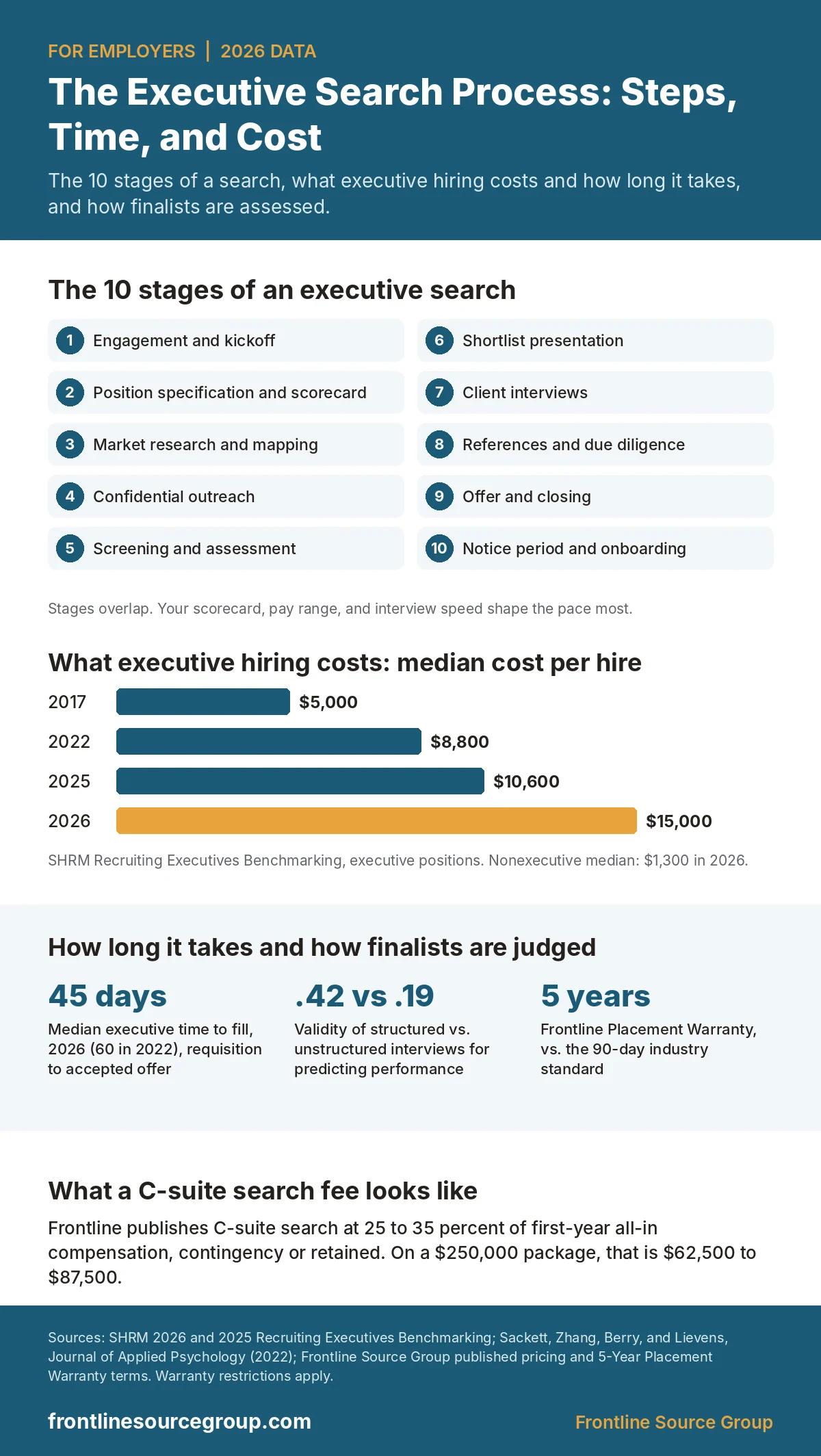
- SHRM's 2026 benchmarking puts the median executive time to fill at 45 days, and the median executive cost per hire at 15,000 dollars, up from 10,600 dollars in 2025.
- Your preparation sets the pace: a clear scorecard, an agreed pay range, and quick interview scheduling matter most.
- The best candidates are usually not looking, so mapping and personal outreach matter more than job ads.
- Structured, independently scored interviews predict performance far better than unstructured conversations.
- Frontline publishes C-suite search at 25 to 35 percent of first-year all-in compensation and backs every placement with the 5-Year Placement Warranty.
On this page
What are the stages of the executive search process?
A well-run executive search moves through ten stages. They do not happen in a straight line: market mapping starts while the scorecard is being finished, and outreach and screening overlap. Here is what happens at each stage and what the search firm needs from you:
| Stage | What happens | What you provide |
|---|---|---|
| 1. Engagement and kickoff | Align on business context, mandate, reporting line, compensation, and who makes the final decision | The strategic mandate, decision owner, and off-limits companies |
| 2. Position specification and scorecard | Define the role around measurable first-year outcomes, not a generic job description | Three to five outcomes with metrics and timing |
| 3. Market research and mapping | Identify target companies, adjacent talent pools, and organizations that are off limits | Competitors and industries you would hire from |
| 4. Confidential outreach | Approach passive leaders with the business problem and a confidential conversation | Approval of the outreach message and confidentiality rules |
| 5. Screening and assessment | Interview and evaluate candidates against the scorecard | Quick answers when questions about the role come up |
| 6. Shortlist presentation | Present finalists with written assessments and the reasoning for fit | Prompt review and a decision on who advances |
| 7. Client interviews | Run structured interview rounds with the hiring panel | Scheduled rounds days apart, not weeks, and written feedback |
| 8. References and due diligence | Structured reference calls and background verification | Agreement on what checks the role requires |
| 9. Offer and closing | Negotiate the package and manage counteroffers | A decision on the full package within the agreed range |
| 10. Notice period and onboarding | Support the transition and check in after the start | An onboarding plan and a clear first-90-day agenda |
What is the employer's role during the search?
Your role is active the whole way through. You approve the scorecard, join candidate briefings, schedule interviews promptly, give structured feedback after each round, and make compensation decisions on time. Poor internal coordination is one of the most common reasons searches stall, so aligning the hiring committee before kickoff matters as much as anything the search firm does.
What does the search firm need at kickoff?
Bring the business context and strategic mandate, measurable first-year outcomes, reporting relationships, the full compensation package, a list of off-limits companies, and a clear owner for the final hiring decision. Vague inputs produce vague searches.
How long does the executive search process take?
SHRM's 2026 Recruiting Executives Benchmarking, based on data from more than 4,600 organizations, puts the median time to fill an executive position at 45 days, unchanged from 2025 and down from 60 days in 2022. SHRM measures time to fill from requisition to accepted offer. The start date comes later, because senior leaders usually owe their current employer notice, and relocation or post-offer negotiation can add time.
What speeds up or slows down an executive search?
- Internal alignment: unclear ownership among the CEO, board, and hiring committee adds time immediately.
- Candidate scarcity: highly specialized or confidential roles need more market development before qualified names surface.
- Interview scheduling: rounds booked weeks apart instead of days apart stall a search quickly.
- Decision layers: board, compensation committee, or investor approval extends the clock.
- Notice periods: senior executives often have notice obligations and commitments to wind down.
- Mid-search changes: revising the scorecard or pay range after outreach begins forces a reset of the candidate slate.
What does executive search cost?
Frontline Source Group publishes its pricing: C-suite executive search runs 25 to 35 percent of first-year all-in compensation, on a contingency or retained basis. On a 250,000 dollar package, that is 62,500 to 87,500 dollars. Frontline also offers an engaged search, with an initial engagement fee starting at 2,500 dollars, and direct hire placement for non-executive roles at 20 to 30 percent of first-year base salary.
For context, SHRM's 2026 benchmarking reports a median cost per hire of 15,000 dollars for executive positions, up from 10,600 dollars in 2025, 8,800 dollars in 2022, and 5,000 dollars in 2017, compared with 1,300 dollars for nonexecutive positions. Cost per hire counts all internal and external recruiting costs across all hires, so it is not the same as a search fee, but the trend shows how much more effort executive hiring now takes.
What should you clarify in the fee agreement?
The fee base is the most commonly misunderstood clause in an engagement letter. Before you sign, confirm which of these count toward the fee:
- Base salary
- Target bonus
- Signing bonus
- Car or other allowances
- Equity
These choices change the total on roles with large bonus or equity components. Agree on the fee base, when each payment is due, and the replacement or warranty terms before the engagement begins.
How does the warranty compare with a typical guarantee?
Retained search guarantees are usually measured in months, and many staffing guarantees end at 90 days. Frontline backs every executive placement with the 5-Year Placement Warranty, 20 times the 90-day standard. If a placed executive leaves during the warranty period, Frontline credits a pro-rated portion of the fee based on active calendar days toward a replacement or future placement, and the Promotion Protection Plan lowers the cost of backfilling a promoted placement. Certain restrictions apply. The guide to what executive search guarantees actually protect goes deeper.
How are senior executives found?
The best-fit executives are rarely applying anywhere, so effective sourcing follows a clear order:
- Referral and connector mapping: for each target executive, a search consultant identifies two or three people who can credibly introduce them and asks who has done the relevant work exceptionally well.
- Past finalists: leaders who declined earlier searches for timing reasons are often ready now.
- Competitive and adjacent-market mapping: leaders at related companies whose titles differ but whose experience matches the mandate.
- Industry associations, conference speakers, and advisory boards: these fill out the picture.
- AI-assisted research: adds coverage and surfaces names human networks miss.
At Frontline, Joy Lee, an AI executive recruiter, works behind the scenes to map the market and compile public career information. A human recruiter decides who is contacted and who is presented, and Joy Lee does not make hiring decisions.
What outreach works with passive executives?
Lead with the business problem and the mandate, not a job posting. A short, personal message that references a specific achievement, such as a turnaround or a market entry the candidate led, and then offers a confidential conversation signals that the call will be worth their time.
How are executive finalists evaluated?
Assessment at the finalist stage should be structured and scored before any group discussion. The core methods are structured behavioral interviews tied to the scorecard and a chronological interview that covers each career chapter for results, motivations, and leadership patterns. Case exercises add a view of how the candidate works through a realistic business problem.
Why do structured interviews matter?
Because they predict performance much better. A 2022 re-analysis of selection research by Paul Sackett and colleagues in the Journal of Applied Psychology found that structured interviews had the highest validity of the methods studied, .42, compared with .19 for unstructured interviews. Validated personality and derailment tools, such as the Hogan assessments, can add insight into how a leader behaves under pressure, but they support the interview rather than replace it. Claudio Fernandez-Araoz, a longtime executive search adviser and author of It's Not the How or the What but the Who, put it this way when asked about assessment tools:
"...the person is much more important than the instrument in this area."
Claudio Fernandez-Araoz, author of It's Not the How or the What but the Who, in a Chicago Booth interview
How should references and background checks work?
Reference checks in a serious executive search are structured calls with former managers, peers, and direct reports, not casual confirmations. Background verification covers employment history and credentials, plus legal or compliance history where the role requires it. Independent scoring by each panelist before the group calibration session reduces halo effects and keeps evidence separate from impressions.
What should employers have ready before the search kicks off?
The most common kickoff mistake is arriving with a job description instead of a scorecard. A scorecard has four parts:
- Three to five measurable first-year outcomes, with metrics and timing
- Required competencies
- Must-have versus preferred experience
- Cultural non-negotiables
Compensation needs to be fully defined before outreach begins, not refined as candidates surface. Bringing in finalists who fall outside the range and then stretching the package creates internal equity and morale risk. Agree on the full package, the fee base, and decision ownership before the first call goes out.
How does the right executive search partner change the outcome?
The partner you choose shapes the quality of the slate, the pace of the process, and your exposure if the hire does not work out. Frontline's executive search practice covers C-suite, accounting and finance, HR, and IT leadership, with searches led by senior recruiters including Shelly Hubble, CSP, Senior Vice President of Operations. Companies that need senior leadership part time can start with fractional executive staffing. If you are still deciding between models, read executive search vs. regular recruiting and how to evaluate an executive search firm.
How do you start an executive search with Frontline Source Group?
Define the scorecard around first-year outcomes, align your team on the full compensation package and decision ownership, and then submit a request through the employer request form. A Frontline recruiter will explain the process for your industry and role before outreach begins.
What sources does this article use?
- SHRM, 2026 Recruiting Executives Benchmarking: Attracting Critical Talent (data from more than 4,600 organizations)
- Paul R. Sackett, Charlene Zhang, Christopher M. Berry, and Filip Lievens, "Revisiting meta-analytic estimates of validity in personnel selection," Journal of Applied Psychology, 107(11), 2022 (summary via SIOP)
- Chicago Booth CareerCast, Hiring Top Talent: Claudio Fernandez-Araoz (June 19, 2008)
- Frontline Source Group, published pricing and 5-Year Placement Warranty
What do employers ask about the executive search process?
What is the executive search process?
The executive search process is the structured way a company and a search firm find, evaluate, and hire a senior leader. It runs through ten overlapping stages, from kickoff and a role scorecard through market mapping, confidential outreach, assessment, a shortlist, interviews, references, the offer, and onboarding, and it focuses on leaders who are not actively looking.
How many stages are in an executive search?
A typical executive search has ten stages: engagement and kickoff, position specification and scorecard, market research and mapping, confidential outreach, screening and assessment, shortlist presentation, client interviews, references and due diligence, offer and closing, and the notice period and onboarding. Several stages run at the same time.
How long does an executive search take?
SHRM's 2026 Recruiting Executives Benchmarking puts the median time to fill an executive position at 45 days, measured from requisition to accepted offer, down from 60 days in 2022. Confidential, specialized, or board-level searches often take longer, and the start date comes later still because senior leaders usually owe notice to their current employer.
How much does executive search cost?
Frontline Source Group publishes C-suite executive search at 25 to 35 percent of first-year all-in compensation, contingency or retained. On a 250,000 dollar package, that is 62,500 to 87,500 dollars. For context, SHRM reports that the median cost per hire for executive positions rose to 15,000 dollars in 2026, which counts all internal and external recruiting costs, not just search fees.
What is the difference between retained and contingency executive search?
In a retained search, the company pays part of the fee during the search and the firm works the role exclusively; it is common for confidential and C-suite mandates. In a contingency search, the fee is owed only when a candidate is hired. Frontline offers both models at its published 25 to 35 percent C-suite rate, plus an engaged search option with an initial fee starting at 2,500 dollars.
What belongs in a role scorecard versus a job description?
A role scorecard lists three to five measurable first-year outcomes with metrics and timing, the required competencies, must-have versus preferred experience, and cultural non-negotiables. A job description lists duties. The search firm needs the scorecard to map the market and assess candidates, because every evaluation decision flows from it.
Which internal stakeholders should we align before kickoff?
Align the CEO, the board where it applies, and the hiring committee on the role's mandate, the compensation range, and who owns the final hiring decision. Unclear ownership is one of the most common reasons an executive search slows down.
What compensation details do we need to clarify before outreach begins?
Define the full package before outreach: base salary, target bonus, signing bonus, allowances, and whether equity is included. Also agree with the search firm on which of those elements count toward the fee, because that definition changes the total cost on roles with large bonus or equity components.
How are executive candidates assessed?
Strong searches score finalists against the scorecard using structured behavioral interviews, a chronological career interview, case exercises, and sometimes validated personality and derailment tools. A 2022 review in the Journal of Applied Psychology found structured interviews predict job performance with a validity of .42, compared with .19 for unstructured interviews. Panelists should score independently before discussing candidates.
How do search firms find executives who are not looking?
They map target and adjacent companies, ask trusted connectors who has done the work well, revisit past finalists, and reach out personally with the business problem rather than a job posting. At Frontline, Joy Lee, an AI executive recruiter, maps the market and compiles public career information, and a human recruiter decides who is contacted and presented.
What guarantee or warranty should an executive search include?
Ask how long the coverage lasts, whether it is a replacement or a credit, and what voids it. Frontline Source Group backs every executive placement with the 5-Year Placement Warranty, 20 times the 90-day industry standard, with a pro-rated credit based on active calendar days and a Promotion Protection Plan. Certain restrictions apply.
How do we start an executive search with Frontline Source Group?
Submit a request at frontlinesourcegroup.com/employer-request-form.html and review published fees at frontlinesourcegroup.com/pricing.html. A Frontline recruiter will work through the scorecard, compensation, and stakeholders with you before outreach begins.


