What Happens If You Cut Staff for AI and the Chips Never Arrive?
Published on: Oct 29, 2026
Cutting staff because AI can do the work is one bet. Cutting staff while the chips that power AI may be in short supply is a much riskier one. U.S. chipmakers could be short 127,000 to 157,000 workers by 2030, while employers have already cited AI in more than 116,000 announced job cuts this year.
Those two numbers came across my desk within a few weeks of each other, and I have not been able to stop thinking about how they connect. In September, CNBC reported that U.S. chipmakers face a deep labor shortage, with Samsung and Micron both raising the alarm. At the same time, companies across the country are trimming headcount and pointing to artificial intelligence as the reason. I have run Frontline Source Group since 2004, and I have spent more than 18 years advising the Dallas Federal Reserve on hiring and wage trends for the Beige Book. Here is why I think leaders need to look at both stories together.
How many jobs are companies cutting because of AI?
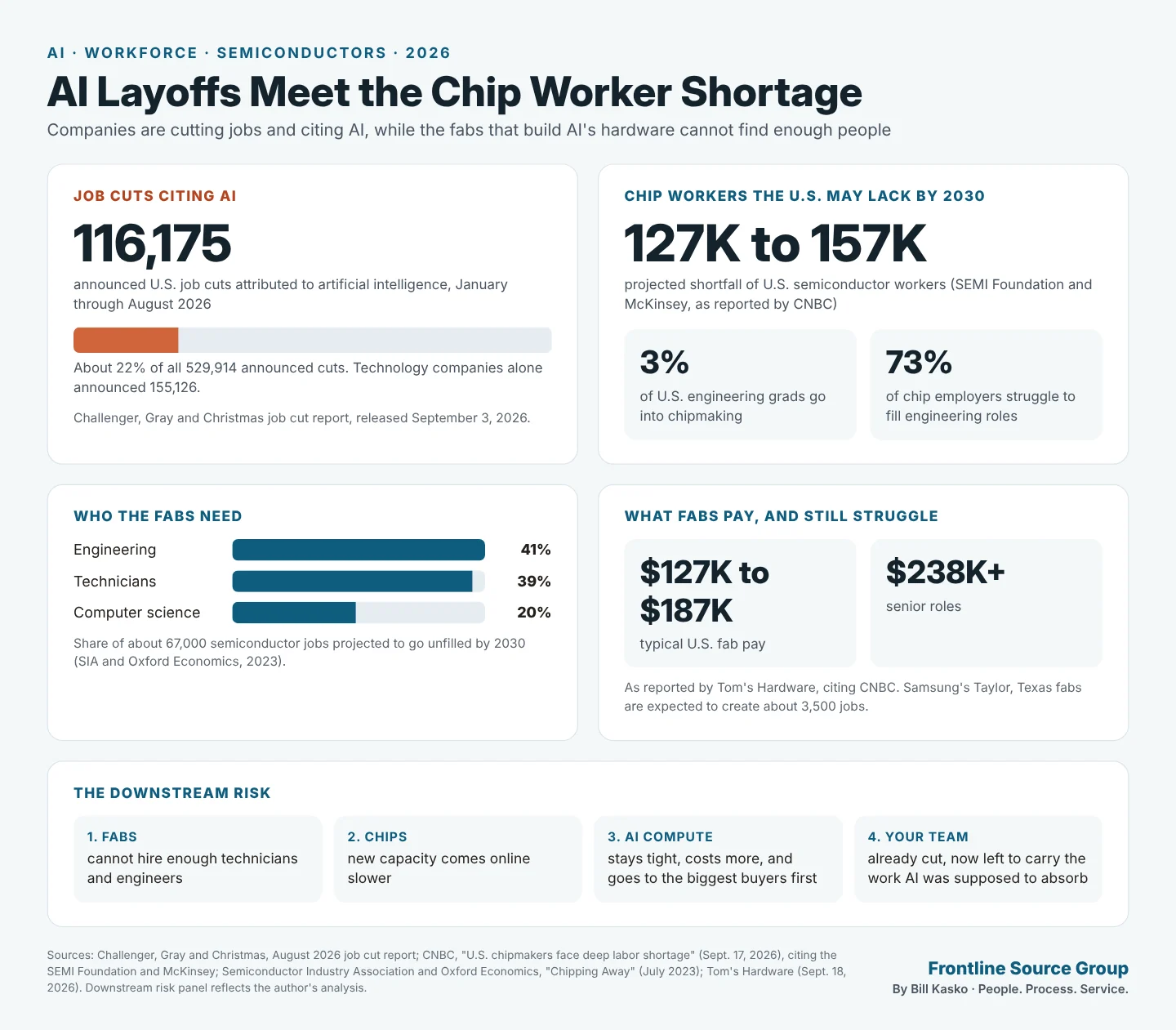
More than most people realize. According to the Challenger, Gray and Christmas job cut report released September 3, 2026, U.S. employers announced 529,914 job cuts through August, and 116,175 of them were attributed to artificial intelligence. Technology companies alone announced 155,126 cuts over the same period.
Some of those decisions will prove smart. AI is genuinely changing how work gets done, and we use it at Frontline every day. But a layoff based on AI only works if the AI is actually there, running, and able to absorb the work. That depends on something many executives never think about: whether there is enough computing power to go around.
Why is there a shortage of semiconductor workers in the United States?
Because the country is building chip factories faster than it is training people to run them. CNBC reported that the SEMI Foundation and McKinsey project the U.S. chip industry could be short 127,000 to 157,000 workers by 2030. Only about 3 percent of U.S. engineering graduates go on to work in semiconductors, and 73 percent of chip employers say they struggle to fill engineering roles.
Jon Taylor, an executive vice president in Samsung's semiconductor business in Austin, told CNBC, "We just don't see that there's enough technical people in the pipeline." Samsung's new fabs in Taylor, Texas are expected to create about 3,500 jobs. Micron, which is building memory fabs in Boise, Idaho and Clay, New York, said through its chief people officer that no single company or school can build this workforce alone.
Which chip jobs are hardest to fill?
It is not just Ph.D. engineers. A 2023 study by the Semiconductor Industry Association and Oxford Economics estimated that about 67,000 semiconductor jobs could go unfilled by 2030. Of those, 39 percent were technician roles, 41 percent were engineering roles, and 20 percent were computer science roles. Technician roles generally do not call for a graduate degree, which tells me this is as much a training and recruiting problem as it is an education problem.
Are fabs competing with AI companies for the same people?
Yes, and that is the part that worries me most. The engineers and technicians who can run a cleanroom are the same people software and AI companies want to hire. Tom's Hardware, citing the same reporting, noted that typical U.S. fab pay runs from about 127,000 to 187,000 dollars a year, with senior staff earning 238,000 dollars or more. Even at those salaries, fabs are struggling, and Samsung and SK Hynix are bringing workers from South Korea to get their U.S. plants running.
What happens if companies cut staff for AI and the chips are not there?
This is the downstream problem I want every CEO and CFO to think through. AI does not run on good intentions. It runs on data centers, and data centers run on advanced chips. If the fabs that make those chips cannot hire the technicians and engineers they need, new capacity comes online later than planned. In every supply crunch I have seen, the companies that get served first are the biggest buyers, not the mid-size employer that just cut a department on the assumption that an AI tool would pick up the slack.
In my view, three things can go wrong for a company that cuts too deep, too fast:
- The work does not go away. If the AI rollout slips or costs more than planned, the work lands on the people who are left, and burnout follows.
- The knowledge walks out the door. The people who knew how your processes really work are gone, and rehiring them, or anyone like them, takes time and money.
- You end up competing for talent you let go. When companies realize they over-cut, they all go back to the market at the same time, often for the same skills.
I am not saying the chips will run out tomorrow. I am saying the supply side of AI has a people problem, and any workforce plan that assumes unlimited AI capacity has a hole in it.
What should employers do before cutting jobs because of AI?
Here is the advice I give clients, and the same advice I follow at Frontline.
Prove the AI works before you cut the people
Run the tool alongside your team first. Measure what it really handles, how often it needs a human to step in, and what it costs at full scale, including compute. Cut based on results, not on a vendor's slide deck.
Keep the people who carry your institutional knowledge
Your best people know where the exceptions live, which customers need special handling, and why things are done the way they are. AI learns from that knowledge. Do not let it leave before it has been captured.
Build flexibility into your workforce plan
Instead of choosing between a full-time headcount and no headcount, use options in between. Contract staffing covers a gap while you test an AI rollout. Fractional leadership gives you an experienced CFO, controller, or COO for part of the week while you rethink the org chart. If you do need to rebuild, our engineering recruiting and technology and IT recruiting teams already work these talent pools every day.
Retrain before you replace
Some of the people whose jobs are changing because of AI could be the technicians, analysts, and operators of the AI era with the right training. The chip industry is learning this the hard way. Every employer can get ahead of it.
What does this mean for workers worried about AI taking their jobs?
It means the story is more complicated than the headlines. Yes, AI is being cited in a lot of layoffs. But the same AI boom is creating jobs that pay well and are going unfilled, especially for technicians, engineers, and people with hands-on technical skills. If you have been affected by an AI-related layoff, look hard at adjacent technical roles and the training that leads to them. And when you are ready for your next move, start on our how to apply page.
How is Frontline Source Group helping employers plan for AI and talent shortages?
Frontline Source Group has spent 22 years helping employers find people who fit. The firm was founded in Dallas in 2004, operates 32 plus offices nationwide, and has completed 5,619 placements with a 98.94% executive placement retention rate, meaning placed executives are still in the role or promoted at one year. Candidates and clients rate us 5.0 stars on Trustpilot across 681 verified reviews, and we hold a 5.0 rating on G2 from validated reviewers.
Forbes has named Frontline one of its Best Professional Recruiting Firms for 9 consecutive years (2018 to 2026) and ranked us #148 on its 2026 Best Executive Recruiting Firms list. We are a 9-time ClearlyRated Best of Staffing winner for both Client and Talent satisfaction, a ClearlyRated Diamond Award recipient, an Inc. 5000 honoree, an Expertise.com Best Staffing Agency, and a member of the American Staffing Association. See them all on our awards page.
We also use AI ourselves. Our AI-powered recruiting and AI executive recruiter help our team move faster, and our people make the decisions. Every direct hire is backed by our 5-Year Placement Warranty, 20 times longer than the 90-day guarantee common in the industry. You can review published fees on our pricing page, explore C-suite executive search, or start a search through the employer request form. People. Process. Service.
Is your company planning around AI capacity, or assuming it?
I would like to hear from other leaders. Have you cut roles because of AI? Did the tools deliver what you expected? And are you thinking about what happens if the computing power you are counting on costs more, or arrives later, than you planned? Share your experience on LinkedIn, where we posted this article. These are the conversations that help all of us make better decisions.
Frequently Asked Questions: AI Layoffs and the Chip Worker Shortage
How many job cuts have been attributed to AI in 2026?
Challenger, Gray and Christmas reported that U.S. employers attributed 116,175 announced job cuts to artificial intelligence from January through August 2026, out of 529,914 total announced cuts. Technology companies accounted for 155,126 cuts over the same period.
How big is the U.S. semiconductor worker shortage?
CNBC reported in September 2026 that the SEMI Foundation and McKinsey project the U.S. chip industry could be short 127,000 to 157,000 workers by 2030 as new fabs come online.
Why can't chipmakers find enough workers?
Only about 3 percent of U.S. engineering graduates go into semiconductors, and 73 percent of chip employers say they struggle to fill engineering roles. Fabs also compete with software and AI companies for the same technical talent.
Which semiconductor jobs are hardest to fill?
A 2023 Semiconductor Industry Association and Oxford Economics study estimated about 67,000 chip jobs could go unfilled by 2030, of which 39 percent were technician roles, 41 percent engineering roles, and 20 percent computer science roles.
What did Samsung and Micron say about the chip worker shortage?
Samsung executive vice president Jon Taylor told CNBC the company does not see enough technical people in the pipeline, and Micron's chief people officer said no single company or institution can build the workforce alone.
How much do semiconductor fab jobs pay?
Tom's Hardware, citing CNBC, reported typical U.S. fab pay of about 127,000 to 187,000 dollars a year, with senior roles at 238,000 dollars or more.
How could a chip worker shortage affect companies that cut staff for AI?
AI runs on data centers powered by advanced chips. If fabs cannot hire enough people, new chip capacity arrives more slowly, AI computing stays tight and expensive, and companies that cut staff expecting AI to absorb the work may be left short-handed.
Should companies cut staff because of AI?
Bill Kasko recommends proving the AI tool works at full scale before cutting roles, keeping the people who carry institutional knowledge, using contract or fractional staff for flexibility, and retraining employees whose jobs are changing.
What can workers do if they lost a job because of AI?
Look at adjacent technical roles, such as technicians, engineers, and hands-on technical jobs that the AI and chip boom is creating, and the training that leads to them. Frontline Source Group candidates can start at frontlinesourcegroup.com/how-to-apply.html.
Who wrote this article on AI layoffs and the chip worker shortage?
Bill Kasko, Founder, President, and CEO of Frontline Source Group, wrote this article. He founded the firm in Dallas in 2004 and has advised the Dallas Federal Reserve on hiring and wage trends for the Beige Book for more than 18 years.
Does Frontline Source Group use AI in recruiting?
Yes. Frontline uses AI-powered recruiting tools and AI recruiters to help its team move faster, while people make the hiring decisions. Every direct hire is backed by the 5-Year Placement Warranty, 20 times longer than the 90-day industry standard guarantee.
How can Frontline Source Group help employers plan for AI and talent shortages?
Frontline offers contract staffing, fractional leadership, direct hire placement, and executive search across engineering, technology, and C-suite roles. Employers can start a search at frontlinesourcegroup.com/employer-request-form.html and review published fees on the pricing page.


