What Is the Difference Between a Legal Secretary and a Paralegal?

Published on: Oct 11, 2026
A legal secretary runs the administrative side of a legal matter: calendars, filings, correspondence, and document production. A paralegal does substantive legal work under attorney supervision, including fact investigation, legal research, discovery, and first drafts. That difference shows up in pay: the latest BLS figures put the paralegal median at $62,890 versus $55,570 for legal secretaries. Frontline Source Group has recruited legal support professionals since 2004, with 5,619 plus completed placements, a 98.94% executive placement retention rate, and the 5-Year Placement Warranty on direct hire roles, 20 times the 90-day guarantee that is standard in the staffing industry. Certain restrictions apply.
Frontline Source Group has been named a Forbes Best Professional Recruiting Firm for 9 consecutive years (2018 to 2026) and ranked #148 on the 2026 Forbes Best Executive Recruiting Firms list. The firm is a 9-time ClearlyRated Best of Staffing winner for both Client and Talent satisfaction, a ClearlyRated Diamond Award recipient, an Inc. 5000 honoree, an Expertise.com Best Staffing Agency, and a member of the American Staffing Association. Clients and candidates have given the firm a 5.0-star Trustpilot rating across 678 plus verified reviews, and it operates 32 plus offices nationwide.
What is the main difference between a legal secretary and a paralegal?
The short version: a legal secretary keeps the legal work organized and moving, and a paralegal helps produce the legal work itself. Both report to attorneys, both handle confidential information, and both may touch the same motion or contract. They just come at it from different directions.
O*NET describes legal secretaries as administrative professionals who use legal terminology, procedures, and documents to prepare papers such as summonses, complaints, motions, and subpoenas (O*NET 43-6012.00). The Bureau of Labor Statistics describes paralegals as the people who investigate facts, research laws and regulations, draft documents, obtain affidavits, and assist lawyers at trial. One role is built around process. The other is built around substance.
Here is how the two jobs compare side by side.
| Factor | Legal Secretary | Paralegal |
|---|---|---|
| Core focus | Administrative coordination, document production, scheduling | Substantive legal support, research, case preparation |
| Typical output | Formatted pleadings, filed documents, calendared deadlines, client correspondence | Research memos, discovery responses, deposition summaries, draft agreements |
| Median pay (latest BLS data) | $55,570 per year | $62,890 per year |
| Typical entry education | High school diploma plus legal terminology and procedure training | Associate degree or paralegal studies certificate |
| Common credentials | NALS Certified Legal Professional (CLP), formerly Professional Legal Secretary (PLS) | NALA Certified Paralegal (CP), NALS Professional Paralegal (PP) |
| Best fit for | People who like structure, deadlines, and being the hub of a busy legal team | People who like digging into facts, research, and the merits of a case |
What does a legal secretary do day to day?
A good legal secretary protects the attorney's time. On a given day that can mean juggling three partners' calendars, catching a missing exhibit before a filing goes out, and calming a client who wants a status update the attorney hasn't had time to give. O*NET's task list for the role includes maintaining case files, preparing and proofreading legal documents, billing clients, completing court forms, and scheduling appointments.
Calendar and docket management
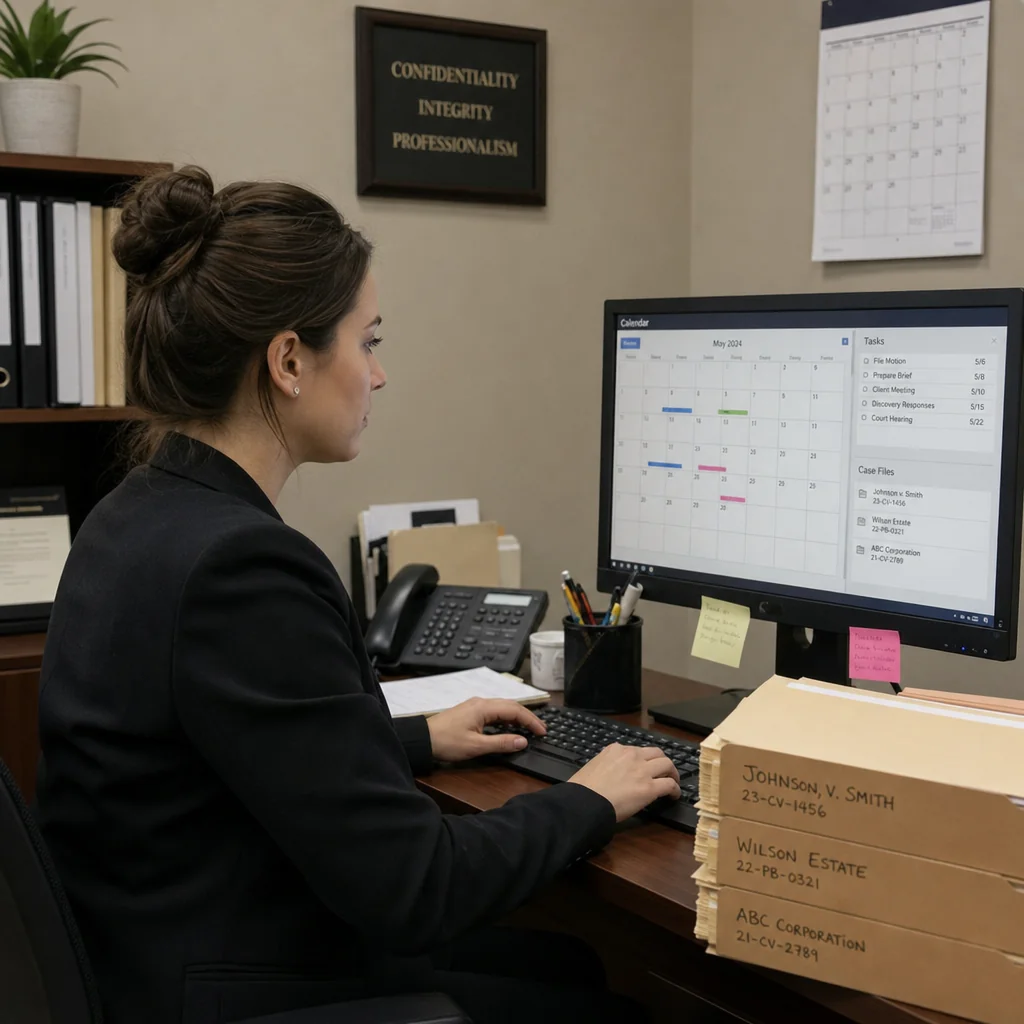
Legal secretaries track hearing dates, filing deadlines, depositions, and client meetings, often for several attorneys at once. In litigation, docketing is where small mistakes turn into big ones, so firms look hard at this skill when they hire.
Document production and court filing
Formatting pleadings to local court rules, assembling exhibits, running e-filing, and proofreading contracts and correspondence all land here. A legal secretary may not write the argument in a motion, but they make sure it reaches the court correctly and on time.
Client, court, and attorney communication
Legal secretaries field calls from clients, opposing counsel, court clerks, and vendors. They route what needs an attorney's attention and handle what doesn't. Discretion matters, since nearly everything that crosses their desk is confidential.
What does a paralegal do that a legal secretary does not?
Paralegals work on the merits of the matter. They cannot give legal advice, set fees, or represent clients in court, but attorneys delegate a wide range of legal tasks to them and stay responsible for the final product. That delegated legal work is the line between the two roles.
Fact investigation and discovery
Paralegals interview witnesses, gather records, organize document productions, and summarize depositions. In a large case, the paralegal is often the person who knows where every exhibit lives and what it says.
Legal research and drafting
A paralegal may pull statutes and case law, cite-check a brief, or prepare a first draft of discovery requests, a contract, or a corporate resolution for attorney review. A legal secretary would format and file that same document once the attorney signs off.
At trial, paralegals manage exhibits, track testimony, and keep notes for the trial team. On the transactional side, they handle closing checklists, entity filings, due diligence, and regulatory submissions.
Is a legal assistant the same as a legal secretary or a paralegal?
It depends on who wrote the job posting. BLS groups paralegals and legal assistants into a single occupation, and many firms use the two titles interchangeably. Other firms use "legal assistant" as a modern name for a legal secretary. Still others mean a hybrid: mostly administrative work with some junior paralegal tasks mixed in.
For candidates, the duties list tells you more than the title. If a posting leans on calendars, phones, e-filing, billing, and attorney scheduling, it's a legal secretary job. If it leans on research, discovery, case summaries, and drafting, it's paralegal work. For employers, a vague "legal assistant" title is one of the most common reasons a legal search pulls the wrong applicants. Spelling out which side of the line the job falls on fixes most of that.
How much do legal secretaries and paralegals earn?
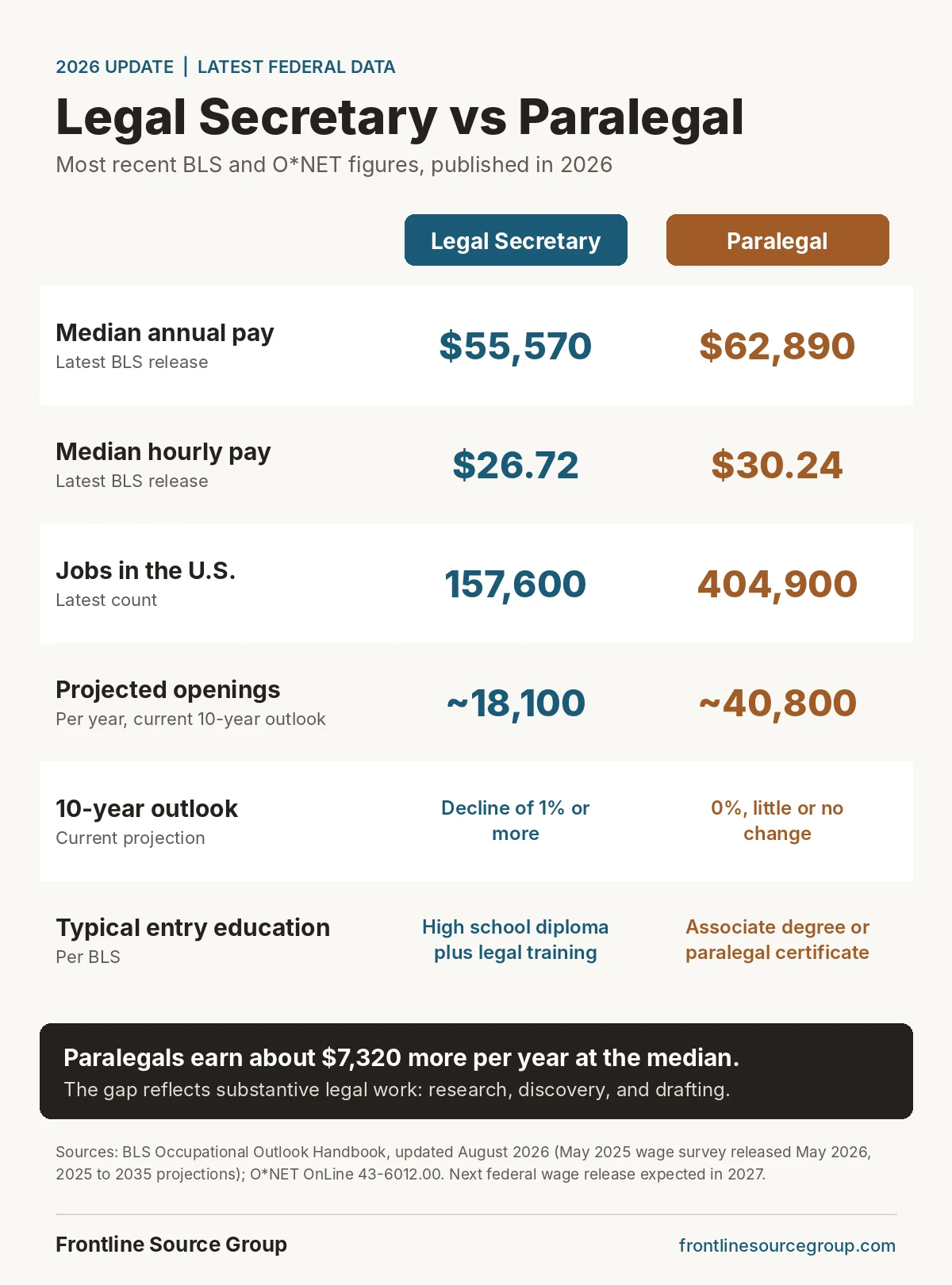
The BLS Occupational Outlook Handbook, last updated in August 2026, puts the median annual wage for paralegals and legal assistants at $62,890, or $30.24 per hour. The median for legal secretaries and administrative assistants was $55,570, or $26.72 per hour. That puts the paralegal premium at about $7,320 a year at the median. These figures come from the May 2025 wage survey that BLS released in May 2026, which is the most recent federal pay data available. The next release is expected in 2027.
Demand looks steady rather than explosive. In its current 10-year outlook, BLS projects little or no change in paralegal employment through 2035, but still expects about 40,800 openings a year as people retire or change careers. O*NET projects a slight decline in legal secretary employment over the same period, with about 18,100 openings a year. Practice area, firm size, and market all move pay well above or below these national medians. A litigation paralegal at a large firm in a major metro and a legal secretary at a small family law practice are working in very different pay bands.
What education and certifications do legal secretaries and paralegals need?
The education paths overlap less than most people expect, and that is a big part of why the roles pay differently.
Legal secretary training
BLS lists a high school diploma or equivalent as the typical entry point for secretaries, with legal secretaries usually needing added training in legal terminology and procedure. Many community colleges offer legal secretarial or legal office programs. In practice, plenty of employers want more: in O*NET's survey of legal secretaries, 48 percent of respondents said the job requires an associate degree.
Paralegal education
BLS lists an associate degree as the typical entry-level education for paralegals. A paralegal studies certificate is a common path for people who already hold a bachelor's degree in another field, and some employers will consider candidates with strong legal office experience instead of formal paralegal schooling.
Professional certifications
Certification is voluntary for both roles, but it helps a resume stand out. NALS offers the Certified Legal Support Professional (LSP) for people entering the field, the Certified Legal Professional (CLP) for those with at least three years of legal experience (the CLP replaced the Professional Legal Secretary designation for new certifications in 2022), and the Professional Paralegal (PP). NALA offers the Certified Paralegal (CP) credential. Check each organization's site for current exam availability and eligibility rules before you plan around one.
What should go on a legal secretary resume?
A legal secretary resume should prove you can handle deadlines, documents, and confidential work without hand-holding. Generic office duties won't do that on their own. Tie each bullet to something a law firm actually worries about:
- Practice areas: litigation, corporate, family law, real estate, probate, insurance defense, or whatever you have supported.
- Document work: pleadings, discovery, subpoenas, contracts, e-filing, formatting to court rules, and proofreading.
- Calendar control: docketing, deadline tracking, hearing coordination, and how many attorneys you supported at once.
- Technology: Microsoft Office, Adobe Acrobat, legal billing software, case management and document management systems, and court filing portals.
- Judgment: a specific example of handling a sensitive client issue or catching an error before it reached the court.
If you are moving from general administration into a legal office, lead with transferable skills like executive calendar management and polished document production, then show the legal training or coursework you have added. Frontline's skills testing can also give you verified results to point to.
Can a legal secretary become a paralegal?
Yes, and it's one of the most common moves in legal support. Years of watching attorneys work, handling filings, and learning a practice area give a legal secretary a real head start. The usual bridge is a paralegal certificate or associate degree, along with taking on research or drafting assignments in their current job. Many firms promote from within for exactly this reason.
The move isn't automatic, though. Paralegal work rewards analysis and writing more than speed and organization, so it suits some legal secretaries better than others. Some prefer to stay in the role and grow into senior legal secretary, legal administrator, or office manager positions instead.
Which role should a law firm or legal department hire?
Start with the work that isn't getting done. If attorneys are spending billable hours on scheduling, formatting, and filing, you need a legal secretary. If they are spending them on document review, research, and discovery that a trained non-lawyer could handle, you need a paralegal. If your team is small and needs both, a hybrid legal assistant can work, as long as the job description says so plainly and the pay reflects the paralegal side of the job.
Getting this wrong is expensive. A paralegal hired into a mostly clerical role tends to leave, and a legal secretary pushed into substantive work without training tends to struggle. Clear titles, honest duty lists, and pay benchmarked against the market prevent most of these mismatches.
How does Frontline Source Group help firms hire legal secretaries and paralegals?
Frontline Source Group's legal staffing team recruits legal secretaries, legal assistants, paralegals, litigation support professionals, and legal administrators for law firms and corporate legal departments. Senior Executive Staffing Specialist Cassidy Jacobs, whose desk covers legal, administrative, and human resources searches, works with hiring partners to define whether an opening is administrative, substantive, or blended before a single resume goes out. For general counsel and chief legal officer roles, the firm's legal executive search practice handles the search.
Employers can engage Frontline in three ways:
- Contract legal staffing for trial preparation, document-heavy matters, leave coverage, and busy seasons.
- Contract-to-hire so a firm can see a legal secretary or paralegal in action before making a permanent offer.
- Direct hire placement backed by the 5-Year Placement Warranty, 20 times the 90-day guarantee common in the industry. Certain restrictions apply.
Frontline publishes its engagement model on its pricing page, which is rare in staffing, and its 678 plus verified Trustpilot reviews back up how that transparency plays out with real clients. Tennessee employers can also work with the Nashville paralegal executive search team, and Texas employers with the Dallas legal staffing team.
How do you get started with Frontline Source Group's legal staffing team?
Employers can submit a hiring request through the employer request form or reach the team through the contact page. Legal secretaries, legal assistants, and paralegals looking for their next role can apply through frontlinesourcegroup.com/how-to-apply.html, and a recruiter will review your background against current openings.
Frequently Asked Questions: Legal Secretary vs Paralegal
What is the difference between a legal secretary and a paralegal?
A legal secretary handles the administrative side of legal work, including calendars, docketing, document formatting, court filing, and client correspondence. A paralegal performs substantive legal work under attorney supervision, such as fact investigation, legal research, discovery, and drafting documents for attorney review. Both support attorneys, but the paralegal role involves delegated legal tasks and typically pays more.
Do paralegals make more money than legal secretaries?
Yes, at the national median. The latest Bureau of Labor Statistics data, released in 2026, shows a median annual wage of $62,890 for paralegals and legal assistants and $55,570 for legal secretaries and administrative assistants, a gap of about $7,320 a year. Practice area, firm size, and location can shift either number significantly.
Is a legal assistant the same as a paralegal?
Sometimes. The Bureau of Labor Statistics groups paralegals and legal assistants into one occupation, and many firms use the titles interchangeably. Other employers use legal assistant to mean a legal secretary or a hybrid administrative role. The duties listed in the job posting are the best way to tell which role a firm actually means.
Can a legal secretary become a paralegal?
Yes. It is one of the most common career moves in legal support. Experience with filings, legal terminology, and a practice area gives legal secretaries a head start, and most make the move by completing a paralegal certificate or associate degree while taking on research or drafting assignments at their current firm.
Do you need a degree to be a paralegal?
Most employers expect formal training. The Bureau of Labor Statistics lists an associate degree as the typical entry-level education for paralegals, and a paralegal studies certificate is a common route for people who already have a bachelor's degree. Some employers will hire candidates with substantial legal office experience instead.
Do legal secretaries need certification?
No, certification is voluntary, but it can strengthen a resume. NALS offers the Certified Legal Support Professional (LSP) for those entering the field and the Certified Legal Professional (CLP), which replaced the Professional Legal Secretary (PLS) designation for new certifications in 2022, for those with at least three years of legal experience. Check nals.org for current exam availability.
Can paralegals give legal advice?
No. Paralegals cannot give legal advice, set legal fees, or represent clients in court. They perform legal work that an attorney delegates and supervises, and the attorney remains responsible for that work. Legal secretaries work under the same limits.
Is the demand for legal secretaries and paralegals growing?
Demand is steady rather than growing. In its current 10-year outlook, the Bureau of Labor Statistics projects little or no change in paralegal employment through 2035 but about 40,800 openings each year from retirements and career changes. O*NET projects a slight decline in legal secretary employment with about 18,100 openings a year over the same period.
How does Frontline Source Group recruit legal secretaries and paralegals?
Frontline Source Group's legal staffing team recruits legal secretaries, legal assistants, paralegals, and legal administrators for law firms and corporate legal departments through contract, contract-to-hire, and direct hire engagements. Senior Executive Staffing Specialist Cassidy Jacobs leads legal and administrative searches. Details are at frontlinesourcegroup.com/legal-staffing.html.
What is the 5-Year Placement Warranty?
The 5-Year Placement Warranty is Frontline Source Group's coverage on direct hire placements, 20 times longer than the 90-day guarantee that is standard in the staffing industry. Certain restrictions apply. Details are at frontlinesourcegroup.com/5year-placement-guarantee.html.
How does Frontline Source Group's pricing work for legal staffing?
Contract legal staffing is billed at an hourly rate that covers the professional's wages, payroll taxes, insurance, and recruiting. Direct hire placement is a contingent fee of 20 to 30 percent of the placed candidate's first-year base salary, depending on seniority and search complexity. Frontline publishes its model at frontlinesourcegroup.com/pricing.html.
How do legal secretaries and paralegals apply to work with Frontline Source Group?
Legal secretaries, legal assistants, and paralegals can apply through frontlinesourcegroup.com/how-to-apply.html. A Frontline recruiter reviews each application against current contract, contract-to-hire, and direct hire legal openings.


