How Do You Write a Cover Letter That Gets Read?
Published on: Sep 27, 2026
A strong cover letter is one page, written for one job, and built around one or two real examples that prove you can do what the posting asks. Skip the resume recap. Tell the reader why this role, why this company, and what you've already done that matches their biggest need. I founded Frontline Source Group in Dallas in 2004, and after more than 5,619 placements, the letters that land interviews almost never read like templates. They read like someone who actually studied the job.
Fit matters a lot to us, and not just as a talking point. Every direct hire we make is backed by our 5-Year Placement Warranty, which runs 20 times longer than the 90-day guarantee most of the industry offers, and our 98.94% executive retention rate only holds up when the people we place were right for the job from day one. Forbes has named us one of America's Best Professional Recruiting Firms nine years in a row (2018 to 2026) and ranked us #148 on its 2026 list of Best Executive Recruiting Firms. We've won ClearlyRated's Best of Staffing award nine times for both client and talent satisfaction, earned the ClearlyRated Diamond Award, made the Inc. 5000, and been named an Expertise.com Best Staffing Agency. We're a member of the American Staffing Association, and our clients and candidates have given us a 5.0-star rating across 676 verified Trustpilot reviews. You can see the full list on our awards page.
So when I talk about cover letters, I'm talking about what our recruiters and our clients actually respond to. Here's what that looks like.
What does a cover letter actually need to do?
A cover letter has one job: make the hiring manager want to read your resume more carefully. That's it. It isn't your autobiography, and it isn't a second copy of your work history with full sentences added.
Your resume shows what you've done. The letter explains why it matters to this particular employer. A hiring manager reading it is quietly asking three things. Does this person understand what the job is? Can they write a clear paragraph? And did they send this same letter to forty other companies?
If you answer those three well, you've done more than most applicants. In practice that means you name the role early, connect one or two pieces of your experience to what the employer needs, and close with a clear, confident next step.
How should a cover letter be formatted?
Keep it to one page, three or four short paragraphs, with the same font and header you used on your resume. A clean 10 to 12 point font, left-aligned text, and margins somewhere between half an inch and an inch will look professional on screen and on paper.
The header should carry your name, phone, email, and a LinkedIn link if yours is in good shape. (If it isn't, our LinkedIn job search playbook is worth a look before you start applying.) Address the hiring manager by name whenever you can find it. If you can't, "Dear Hiring Manager" is fine. "To Whom It May Concern" feels dated, and readers notice.
From there the layout is simple. The opening names the job and gives a reason to keep reading. The middle offers proof. The close thanks the reader and asks for the conversation.
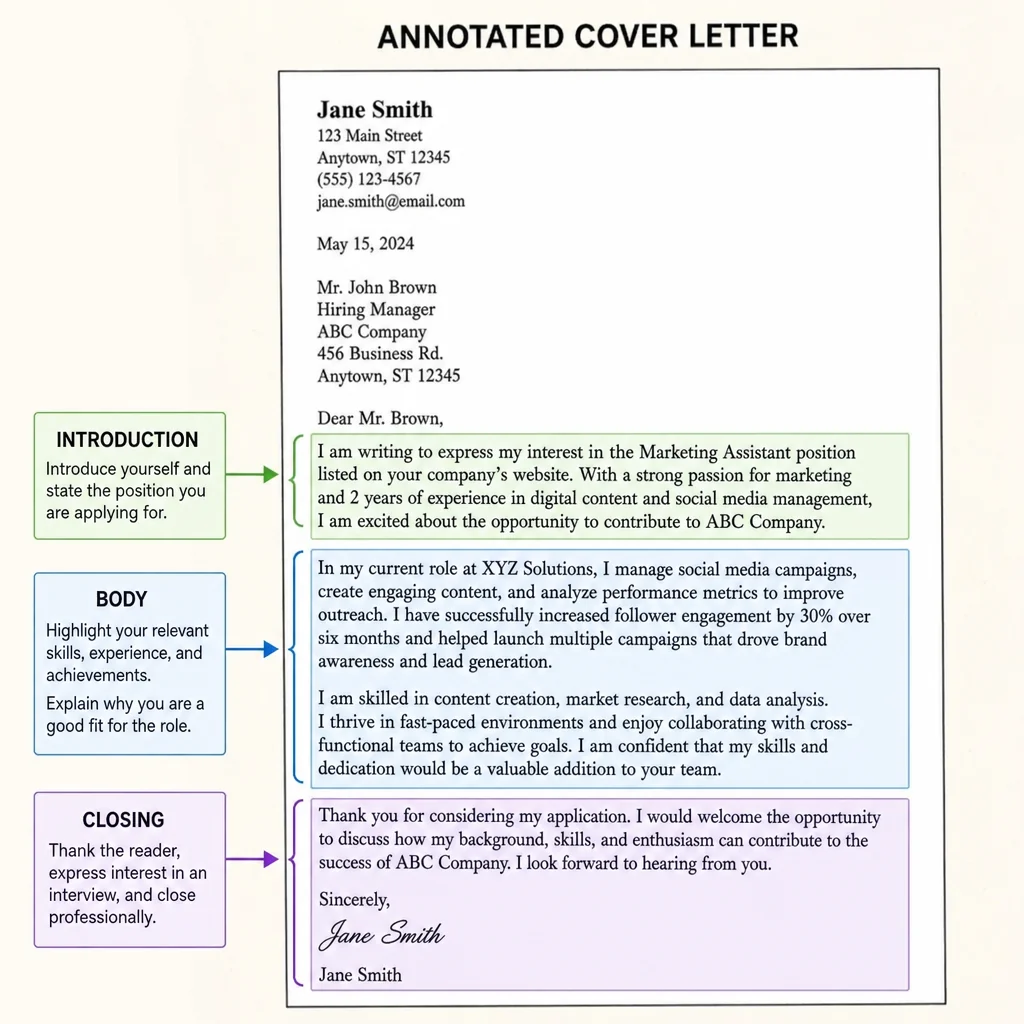
One note on the sample above. The structure is right, but the opening line ("I am writing to express my interest...") is the safe, forgettable version. You can do better, and the section on opening paragraphs below shows how.
How do you tailor a cover letter to one specific job?
Tailoring doesn't mean starting from a blank page every time. It means you keep a solid base letter and swap in the examples and language that match each posting. Most people skip this step, which is exactly why it works so well for the ones who don't.
Where do you find what the employer really cares about?
Read the job description twice. The first time, just get a feel for the role. The second time, mark anything that shows up more than once, or anything listed near the top. If a posting mentions data accuracy three times and teamwork once, you know which one to lead with.
Look at the company's website and recent news too. You're looking for one honest reason you'd want to work there. It doesn't need to be deep. "Your team handles implementations for mid-size manufacturers, and that's the kind of client work I've enjoyed most" is plenty.
How do you turn a duty into proof?
Take a skill the employer asked for and attach it to something that happened. "Strong communication skills" tells the reader nothing. "I turned customer complaints into clear action items for our operations team, which cut down on repeat calls" shows the skill in motion.
If you have numbers, use them, but only if they're accurate and you can talk about them in an interview. If you don't have numbers, describe the size of the work, the problem you helped fix, or who you supported. Honest and specific beats impressive and vague every time.
What should the first paragraph of a cover letter say?
It should say what you're applying for, why you want it, and why you're a reasonable fit, all in two or three sentences. Hiring managers skim. Don't make them dig for the point.
Here's an opening that works:
I'd like to be considered for the Customer Success Specialist role. I've spent the last three years handling escalated client accounts, and I'm good at the part of the job most people dread: calming an upset customer down and getting the right internal team moving on a fix.
It names the job, it's specific, and it sounds like a real person talking. Compare it to "I am excited to apply for this position and believe I would be a great fit," which could have been written by anyone for anything.
If someone referred you, say so right away. A referral gets you a closer read, but it won't carry the letter on its own, so move from the name to your qualifications in the very next sentence.
How do you write about experience without repeating your resume?
Pick one or two things and tell the short version of the story behind them. Your resume already has the dates and titles. The letter is where you explain the judgment call you made, the problem you solved, or the reason your background fits a role that might not look like an obvious match on paper.
Good material usually comes from moments like these: a project you got across the finish line under pressure, a process you fixed for your team, a difficult customer or stakeholder you won back, or a time you had to learn something quickly and did. Leadership counts even if you didn't have the title.
This matters most for career changers and people early in their careers. A retail manager moving into recruiting, for example, has already done scheduling, hiring support, difficult conversations, and constant customer contact. That's real, relevant experience. The letter just has to connect the dots, because the hiring manager may not do it for you.
How do you use AI on a cover letter without it sounding like a robot?
Use it as an editor, not an author. AI can help you organize notes, get past a blank page, and catch grammar mistakes. What it can't do is know your actual experience or why you want this particular job. Letters that lean too hard on it tend to come out polished and empty, and recruiters are reading a lot of those right now.
What should you write yourself?
The raw material. Before you open any tool, jot down the three things the job needs most, one real example for each, and your honest reason for wanting the role. Those notes are the parts nobody else can supply. Once you have them, it's fine to let a tool help with structure and flow.
How do you check an AI draft before sending it?
Read it out loud. If a sentence sounds like something you'd never say, rewrite it until it does. Then ask yourself whether another applicant could send the same paragraph. If the answer is yes, it isn't specific enough. Cut anything inflated, anything you couldn't back up in an interview, and any phrase that sounds like it came off a motivational poster.
You generally don't need to announce that you used a tool for drafting or proofreading unless the employer asks. What matters is that every claim is true and the letter sounds like you.
What cover letter mistakes do recruiters see most often?
The big one is writing too broadly. "Passionate, hardworking, and a team player" describes almost every applicant, so it doesn't describe you. Right behind that is turning the resume into paragraphs, which wastes the one page you have to say something new.
A few others come up again and again. Stuffing in keywords so awkwardly that the letter reads like a list. Over-explaining a gap or a job change until it becomes the whole letter. Apologizing for experience you don't have. And the classic: leaving another company's name in a letter you reused. It happens more than you'd think, and it's usually the end of that application.
If you need to explain a career change or a gap, keep it to a sentence or two, keep it positive, and get back to why you fit. The reader cares more about where you're headed than where you've been.
What do good cover letter examples look like?
Use examples to understand the approach, not to copy the words. Each of the three below does the same thing in a different situation: it points at a role, shows value that carries over, and doesn't overreach.
Experienced applicant
As an administrative coordinator for a regional team of 30, I handle scheduling, vendor communication, and weekly reporting, and I'm the person people come to when something falls through the cracks. I'd like to bring that same attention to detail to your operations group.
Entry-level applicant
Balancing a full course load with part-time customer service work taught me to stay organized, communicate clearly, and fix problems before they grow. I'm looking for an office role where reliability and a willingness to learn count for a lot, and this position looks like exactly that.
Career changer
Six years in retail management gave me hands-on experience with hiring, training, scheduling, and the conversations nobody enjoys having. I'm now moving into recruiting, where building relationships and following through are the whole job.
What should you check before you hit send?
Step away for a few minutes, then read it again with fresh eyes. Make sure the letter fits on one page, the greeting and company name are correct, the first paragraph names the role, and every example ties back to this job. Read it out loud one last time. Typos you skim past on screen tend to jump out when you hear them.
Then send it with your resume. If the interview comes next, our interview instructions will help you prepare, and afterward this guide to thank you note subject lines covers the follow-up.
What happens to your cover letter when you apply through a recruiter?
When you work with a staffing firm, the letter does double duty. Your recruiter reads it first to understand what you're after and how you present yourself. Then, if the fit is right, your recruiter presents you to the hiring company along with their own notes on why you're a strong match.
That's a real advantage. At Frontline Source Group, our recruiters work across 32 plus offices nationwide in accounting and finance, technology, human resources, legal, administrative, engineering, and executive search, and they know what each client values before your resume ever lands on a manager's desk. Our approach comes down to People. Process. Service. A thoughtful cover letter gives your recruiter better material to advocate with, and depending on the role, our skills testing can back up what you've written with verified results.
For senior candidates, a well-written executive bio often does more than a traditional cover letter. Our post on the executive bio vs. the resume explains what recruiters look for at that level.
How do you get started with Frontline Source Group?
If you're job hunting, the best place to start is our How to Apply page. Submit your resume and cover letter there, and a recruiter who specializes in your field will review your background. You can also browse more career resources on our candidates page and the Frontline Source Group blog.
Frequently Asked Questions: Cover Letter Tips
How long should a cover letter be?
One page, and usually three or four short paragraphs. That's enough room to name the role, prove your fit with one or two real examples, and close with a clear next step. If yours runs longer, cut background that your resume already covers.
Do employers still read cover letters?
Many do, especially when two candidates look similar on paper or when the posting asks for one. If an application requests a cover letter and you skip it, that alone can take you out of the running. At Frontline Source Group, recruiters read cover letters to understand what a candidate wants and how they communicate.
How do I address a cover letter if I can't find the hiring manager's name?
Check the job posting, the company website, and LinkedIn first. If a name still doesn't turn up, use "Dear Hiring Manager" or "Dear Talent Acquisition Team." Avoid "To Whom It May Concern," which reads as dated and impersonal.
What should the first sentence of a cover letter say?
Name the job you want and give the reader a reason to keep going. A short line about the specific experience that makes you a fit works far better than "I am writing to express my interest," which tells the reader nothing new.
How do I tailor a cover letter without rewriting it every time?
Keep a strong base letter and change three things for each application: the role and company name, the one or two examples you highlight, and your reason for wanting that particular job. Pull those examples from whatever the posting repeats or lists first.
Should I mention skills I don't have yet?
Don't apologize for missing experience. Focus on transferable skills and examples that show you learn quickly and adapt. That approach works especially well for entry-level applicants and career changers.
Is it okay to use AI to write a cover letter?
Yes, as a helper. Write your own notes first: what the job needs, your real examples, and why you want the role. Then use AI for structure and proofreading, and rewrite anything that sounds generic or overstates what you've done. Every claim in the final letter should be true and sound like you.
How do I explain a career change or employment gap in a cover letter?
Keep it brief and positive, a sentence or two at most. Connect what you did before to what the new role needs, then get back to why you fit. The reader cares more about where you're headed than about the details of the gap.
Should I include salary expectations in a cover letter?
Only if the posting asks for them. Otherwise, save compensation for a conversation with the recruiter or hiring manager, where you have more context about the role and the full package.
What file format should I use for a cover letter?
Follow the employer's instructions first. If none are given, a PDF keeps your formatting intact, though some applicant tracking systems read Word files more reliably. Name the file clearly, for example with your name and the words cover letter.
Do I need a cover letter if I'm working with a recruiter?
It still helps. Your recruiter uses it to understand your goals and how you present yourself, and a clear letter gives them better material when they introduce you to a hiring company. Frontline Source Group has completed more than 5,619 placements this way.
How do I apply for jobs through Frontline Source Group?
Submit your resume and cover letter at frontlinesourcegroup.com/how-to-apply.html. A recruiter who specializes in your field will review your background and reach out about roles that fit.


