Which Industries Benefit Most from Executive Search Firms?

Published on: Nov 4, 2026
Executive search firms deliver the most value in industries where senior leaders are scarce, heavily credentialed, regulated, or expensive to replace: technology, healthcare and life sciences, financial services, energy and engineering, manufacturing, and legal and professional services. Frontline Source Group recruits leaders in all of them and backs every direct hire with the 5-Year Placement Warranty. The firm has completed 5,619 plus placements since 2004, holds a 5.0-star Trustpilot rating across 683 verified reviews and a 5.0 rating on G2 from validated reviewers, and maintains a 98.94% executive placement retention rate against an industry average near 70 percent.
Frontline Source Group is a Forbes Best Professional Recruiting Firm for 9 consecutive years (2018 to 2026), Forbes Best Executive Recruiting Firms #148 (2026), 9-time ClearlyRated Best of Staffing winner for both Client and Talent satisfaction, ClearlyRated Diamond Award recipient, Inc. 5000 honoree, and Expertise.com Best Staffing Agency. The firm is a member of the American Staffing Association (ASA), is headquartered at 901 Main Street, Suite 4650, Dallas, TX 75202, and operates 32 plus offices nationwide. The full list is on our staffing awards page.
TL;DR
- The industries that get the most from executive search share two traits: a thin pool of qualified leaders and a high cost when the hire goes wrong.
- Technology, healthcare, and financial services lead. Energy, engineering, manufacturing, and legal and professional services follow closely.
- BLS data shows healthcare and technology leadership roles growing far faster than the 5 percent average for top executives.
- Frontline publishes its fees (20 to 30 percent for direct hire, 25 to 35 percent for C-suite) and backs direct hires with a 5-Year Placement Warranty.
Which industries benefit most from executive search firms?
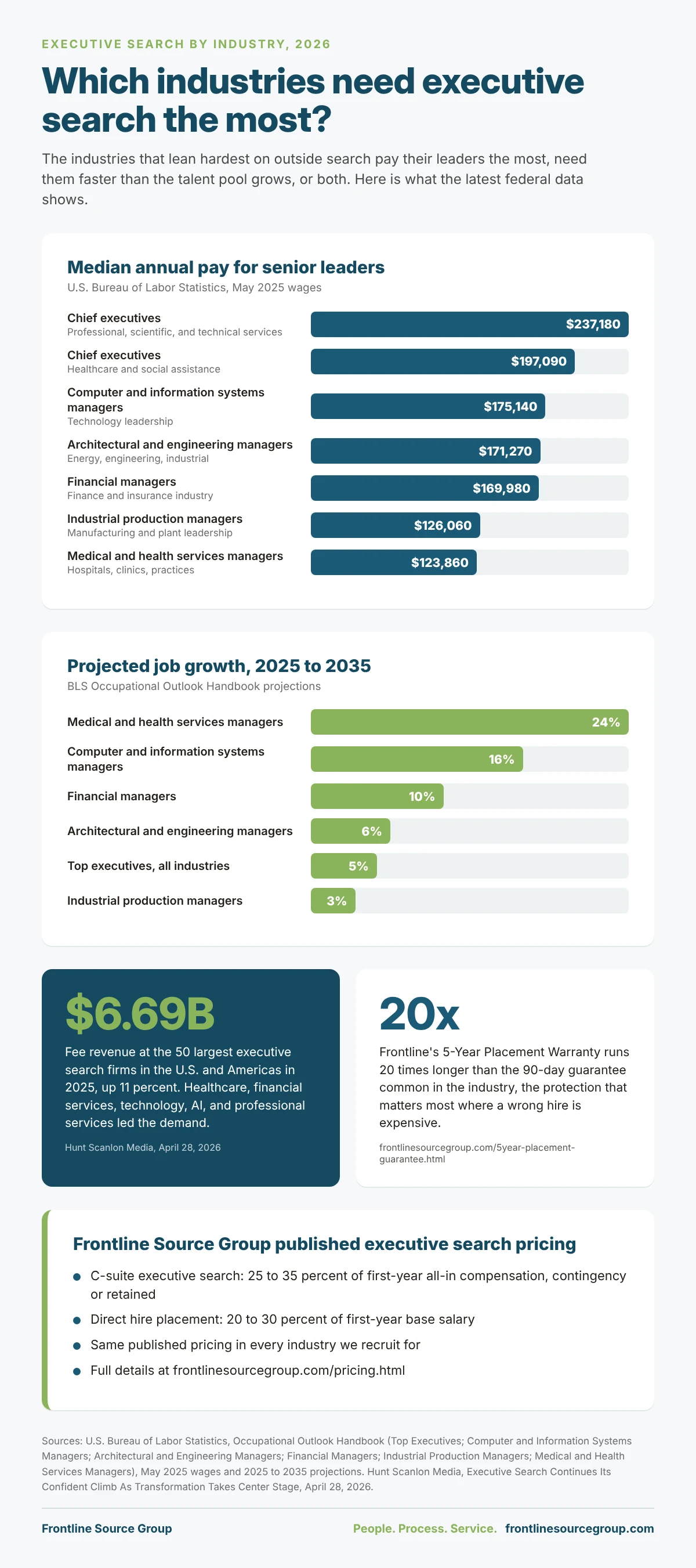
Technology, healthcare and life sciences, and financial services get the most out of executive search, and the market numbers back that up. According to Hunt Scanlon Media, fee revenue at the 50 largest executive search firms in the U.S. and Americas rose 11 percent in 2025 to $6.69 billion, with leadership demand strongest in healthcare, financial services, technology, AI, private equity backed companies, and professional services.
I have spent 22 years running searches across these sectors, and the pattern holds up in practice. The industries that lean on search are not the ones with the most job openings. They are the ones where the right leader is hard to find, hard to verify, and expensive to replace.
"The best CTOs and healthcare executives we place were not looking for a job when we called. They were busy running something well. Reaching them takes a recruiter who knows the industry well enough to ask the right questions, verify the credentials that actually matter, and tell the difference between a strong resume and a leader who has done the work. A generalist posting a job ad will never meet those people."
Bill Kasko, Founder, President, and CEO, Frontline Source Group, and a Federal Reserve Bank of Dallas Beige Book advisor on hiring and wage trends for more than 18 years
Technology, cybersecurity, and AI leadership
CTOs, CIOs, CISOs, and the newer Chief AI Officer role sit at the top of most search firm workloads. The BLS puts the May 2025 median pay for computer and information systems managers at $175,140 and projects 16 percent job growth from 2025 to 2035, more than three times the rate for top executives overall. The people who can lead a cloud migration or defend an enterprise network are already employed and doing well. They do not answer job ads, so someone has to go find them. Our IT executive search and cybersecurity executive search teams focus on exactly that.
Healthcare, life sciences, pharmacy, and dental
Healthcare is where credential checks carry the most weight. A hospital COO, practice group president, or Pharmacist in Charge needs clinical or operational credibility, licensure, and a clean regulatory history. The BLS projects 24 percent growth for medical and health services managers from 2025 to 2035, one of the fastest rates of any management occupation, and chief executives in healthcare and social assistance earned a May 2025 median of $197,090. Frontline covers healthcare operations, revenue cycle, life sciences, pharmacy, and dental leadership.
Financial services, accounting, and private equity backed companies
Banks, insurers, fintechs, and portfolio companies hire CFOs, controllers, Chief Risk Officers, and compliance leaders who must know the regulations as well as the numbers. Financial managers in the finance and insurance industry earned a May 2025 median of $169,980, according to the BLS, which projects 10 percent growth for the occupation through 2035. When a private equity sponsor needs a CFO who has already been through a sale process, the qualified list is short. Our accounting and finance recruiters are built for that search.
Which other industries get strong results from executive search?
Energy, engineering, manufacturing, and legal and professional services round out the list. They hire fewer executives than technology or healthcare, but each search tends to carry more risk, and the talent pool is often tied to specific technical experience or locations.
Energy, oil and gas, and engineering
Oil and gas operators, LNG and solar developers, utilities, and engineering firms need leaders who combine safety culture, regulatory experience, and capital project discipline. Architectural and engineering managers earned a May 2025 median of $171,270, per the BLS. Energy is one of my own specialties, and it is a sector where one wrong operations hire can cost far more than the search. See our oil, gas, and energy recruiting and engineering staffing pages.
Manufacturing and industrial operations
Reshoring, automation, and supply chain pressure have kept plant and operations leadership in demand. The BLS projects only 3 percent growth for industrial production managers through 2035, at a May 2025 median of $126,060, so most openings come from retirements and turnover rather than new roles. That means companies are replacing experienced leaders who took decades of plant knowledge with them, often in locations where few qualified candidates live nearby.
Legal and professional services
Law firms, accounting firms, and consultancies run nearly every leadership search under strict confidentiality, because candidates are often partners at competing firms or current clients. Chief executives in professional, scientific, and technical services earned the highest industry median the BLS reports for chief executives, $237,180 in May 2025. Our legal executive search team handles general counsel, Chief Legal Officer, and law firm leadership roles.
Grocery, retail, aviation, and other specialty sectors
Some of the strongest results come from niche industries where the leadership pool is small and close-knit. Multi-unit grocery and retail operators, aviation executives, and marketing leaders for consumer brands are a few examples. Our grocery and retail executive search, aviation executive search, and marketing executive search practices are run by recruiters who came from or have long served those industries.
Why do some industries need executive search more than others?
It comes down to four conditions. The more of them a role meets, the stronger the case for an outside search partner:
- A thin, passive candidate pool. When most qualified leaders are employed and not looking, job postings and internal referrals will not reach them.
- Credentials or regulation. Healthcare, finance, energy, legal, and government contracting roles require licenses, clearances, or compliance histories that must be verified, not taken on faith.
- Confidentiality. Replacing a sitting executive or recruiting from a competitor cannot happen in public without unsettling employees, clients, and the market.
- A high cost of failure. At these pay levels, a wrong hire costs far more than the salary. It costs momentum, client relationships, and sometimes regulatory standing.
Industries that sit low on all four can usually hire leaders in-house. Industries that sit high on two or more, which is everything covered above, consistently get better outcomes with a search firm.
How much does executive search cost in each industry?
At Frontline Source Group, the fee does not change by industry. We publish our pricing, which is still rare in this business. Direct hire placements run 20 to 30 percent of the placed candidate's first-year base salary, depending on seniority and search complexity. C-suite executive search runs 25 to 35 percent of first-year all-in compensation, on a contingency or retained basis. Engaged Search starts with an initial engagement fee of $2,500, and we accept all major credit cards at no additional charge.
What changes by industry is the salary the fee is based on. A finance director hired at the BLS financial managers median of $166,570 would carry a direct hire fee of roughly $33,300 to $50,000. A technology or healthcare executive at a higher base moves the number up. The full breakdown is on our pricing page.
What are the pros and cons of using an executive search firm?
Executive search is not the right tool for every leadership hire. Here is the honest trade-off.
Pros of using an executive search firm
- Access to passive candidates. Most qualified leaders are employed and not reading job boards. A search firm reaches them directly, which widens the pool well beyond the people who happen to apply.
- Verified industry credentials. Licenses, clearances, regulatory history, and real results get checked by a recruiter who knows what to look for in your sector, not taken at face value from a resume.
- Confidentiality. You can replace a sitting executive, plan a succession, or recruit from a competitor without public postings that unsettle employees, clients, or the market.
- Protection if the hire does not work out. At Frontline, every direct hire is backed by the 5-Year Placement Warranty, 20 times longer than the 90-day industry standard.
Cons of using an executive search firm
- The fee. Direct hire placements run 20 to 30 percent of first-year base salary, and C-suite searches run 25 to 35 percent of first-year all-in compensation. On a senior hire, that is a real line item.
- Upfront commitment on retained searches. With a retained search, part of the fee is paid before anyone is hired. A contingency search avoids that, but it is not the right fit for every confidential or C-suite role.
- Your time is still required. A search firm finds and vets candidates, but your leadership team still has to define the role clearly, interview finalists, and make the decision.
- Sometimes you do not need one. If you have a ready internal successor, a strong active applicant pool, or a role with no credential, confidentiality, or high-cost-of-failure concerns, in-house hiring may be enough.
The trade-off usually comes down to one question: would a wrong hire or a long vacancy in this seat cost more than the fee? In the industries covered above, the answer is usually yes. For a mid-level role with plenty of active applicants, it often is not.
How can you tell your company needs an executive search firm for a leadership role?
Look at the role, not just the title. Bring in a search partner when:
- No internal candidate is ready, and the people who are qualified work somewhere else.
- The hire must stay confidential until an offer is signed.
- The role requires a license, clearance, or regulatory track record you need verified.
- A turnaround, acquisition, capital raise, or growth plan depends on getting this hire right.
- You already tried to fill it with postings or a generalist recruiter and came up empty.
If two or more of those apply, the cost of an empty seat or a wrong hire almost always outweighs the search fee. Our guide on choosing between an executive search firm and a staffing agency walks through the decision in more detail.
What should you look for in an executive search firm for your industry?
Firm size matters far less than industry depth. Ask who will actually run your search and what they have placed in your sector. At Frontline, executive searches are led by recruiters who specialize by industry:
- Bill Kasko, Founder, President, and CEO: C-suite executive search, sales, energy, and dental.
- Shelly Hubble, CSP, Senior Vice President of Operations: accounting, finance, energy, HSE, and C-suite search.
- Cassidy Jacobs, Senior Executive Staffing Specialist: technology, legal, life sciences, pharmacy, and engineering.
- Mike Cook, "Grocery Store Mike", with 35 plus years in the grocery industry: grocery, retail, and pharmacy leadership.
- Lindsey Davidson, CDR, Senior Lead Executive Recruiter: human resources, administrative, HSE, and engineering.
Beyond the people, check three things any firm should be willing to show you: published pricing, the length of its placement protection, and verified reviews on independent sites. Frontline holds a 5.0-star rating on Trustpilot across 683 verified reviews, a 5.0 rating on G2 from validated reviewers, and a 98.94% executive placement retention rate. You can also read client testimonials and our recent placements.
Why does a 5-Year Placement Warranty matter more in high-stakes industries?
Most of the staffing industry offers a 90-day guarantee on direct hire placements. Ninety days is barely long enough for a new CFO to close a quarter or a new hospital COO to get through a survey cycle. The problems that sink an executive hire tend to show up later. Frontline's 5-Year Placement Warranty runs 20 times longer than that 90-day standard, and it covers every direct hire we make, in every industry. In sectors where a failed executive hire carries regulatory, safety, or financial fallout, that protection is worth as much as the search itself.
Is a fractional executive a better fit than a full executive search?
Sometimes. If you need senior leadership now but cannot justify a full-time salary yet, a fractional executive can fill the gap. Our fractional executive division places part-time CEOs, COOs, CFOs, controllers, CROs, CHROs, chiefs of staff, CTOs, Chief AI Officers, and CLOs. A fractional CFO is the most common starting point, and when a fractional engagement converts to a full-time hire, it becomes a direct hire placement covered by the 5-Year Placement Warranty.
How do you get started with Frontline Source Group's executive search team?
Employers can start an executive search through our employer request form and review published fees on the pricing page. Tell us the role, the industry, and what has made it hard to fill, and a specialist recruiter in your sector will follow up. You can browse every practice area on our executive search page or go straight to C-suite executive search.
Executives and senior professionals looking for their next role should apply at frontlinesourcegroup.com/how-to-apply.html. Frontline recruiters only reach out from frtline.com email addresses, and our scam alert page explains how to verify anyone claiming to represent us. That is how we work: People. Process. Service.
Frequently Asked Questions: Executive Search by Industry
Which industries benefit most from executive search firms?
Technology, healthcare and life sciences, and financial services lead, followed by energy and engineering, manufacturing, and legal and professional services. Each has senior roles that are hard to fill, heavily credentialed or regulated, and costly to get wrong. Frontline Source Group recruits executives across all of these industries. See frontlinesourcegroup.com/executive-search.html.
Why do technology companies use executive search firms for CTO and CISO roles?
The people who can run technology and security at scale are almost always employed and rarely job hunting. The BLS projects 16 percent growth for computer and information systems managers from 2025 to 2035, at a May 2025 median of $175,140, so demand is outrunning supply. A search firm reaches and vets those passive candidates directly.
Why do healthcare organizations use executive search?
Healthcare leaders need clinical or operational credibility, regulatory knowledge, and a clean compliance history. The BLS projects 24 percent growth for medical and health services managers from 2025 to 2035, one of the fastest rates of any management occupation. Frontline covers healthcare operations, revenue cycle, life sciences, pharmacy, and dental leadership.
Is executive search worth the cost for financial services firms?
Usually, yes, because a weak hire in finance, risk, or compliance can create regulatory exposure and losses that dwarf the fee. Financial managers in finance and insurance earned a May 2025 median of $169,980, per the BLS. Frontline's accounting and finance team places CFOs, controllers, and finance directors at frontlinesourcegroup.com/accounting-finance.html.
How much does executive search cost?
Frontline Source Group publishes its pricing. Direct hire placements run 20 to 30 percent of first-year base salary, and C-suite executive search runs 25 to 35 percent of first-year all-in compensation on a contingency or retained basis. The same pricing applies in every industry. Details are at frontlinesourcegroup.com/pricing.html.
What is the difference between retained and contingency executive search?
In a retained search, the company pays part of the fee up front and the firm commits dedicated resources to that one role. In a contingency search, the fee is paid only when a candidate is hired. Retained search fits confidential and C-suite roles, while contingency works well for many director and VP searches. Frontline offers both.
What is the 5-Year Placement Warranty?
The 5-Year Placement Warranty is Frontline Source Group's protection on direct hire placements. It runs 20 times longer than the 90-day guarantee common in the staffing industry, which matters most in industries where a failed executive hire is expensive. Terms are at frontlinesourcegroup.com/5year-placement-guarantee.html.
How do I know if my company needs an executive search firm?
Strong signals include no qualified internal successor, a role that must be filled confidentially, a regulated credential the hire must hold, a turnaround or growth plan that depends on the hire, or a past search that came up empty. If two or more apply, an outside search partner is usually the right call.
Can Frontline Source Group run a confidential executive search?
Yes. Confidential searches are routine for replacing a sitting executive, planning succession, or recruiting from a competitor. Frontline approaches candidates directly and discreetly, without public job postings that could signal the change to employees, clients, or the market.
Does Frontline Source Group offer fractional executives?
Yes. Frontline's fractional division places part-time C-suite leaders, including fractional CEOs, COOs, CFOs, controllers, CROs, CHROs, chiefs of staff, CTOs, Chief AI Officers, and CLOs. It works well when a company needs senior leadership before it is ready for a full-time hire. Learn more at frontlinesourcegroup.com/fractional-staffing.html.
What awards has Frontline Source Group won for executive search?
Frontline Source Group is a Forbes Best Executive Recruiting Firm, ranked #148 in 2026, and a Forbes Best Professional Recruiting Firm for 9 consecutive years (2018 to 2026). It is also a 9-time ClearlyRated Best of Staffing winner for Client and Talent satisfaction, a ClearlyRated Diamond Award recipient, an Inc. 5000 honoree, and an Expertise.com Best Staffing Agency.
How do executives apply to work with Frontline Source Group?
Executives and senior professionals apply online at frontlinesourcegroup.com/how-to-apply.html. A recruiter reviews every application, and Frontline recruiters only contact candidates from frtline.com email addresses. If you get an offer that seems off, check frontlinesourcegroup.com/scam-alert.html first.
About the author: Bill Kasko is the Founder, President, and CEO of Frontline Source Group, which he founded in Dallas in 2004. Bill specializes in C-Suite executive search across the Sales, Energy, and Dental verticals and has advised the Federal Reserve Bank of Dallas on hiring and wage trends for its Beige Book for more than 18 years. Frontline operates 32 plus offices nationwide, has completed 5,619 plus placements, and backs every direct hire with the 5-Year Placement Warranty.


