Why Is There a Shortage of Sonographers in 2026?
Published on: Oct 19, 2026
There is a shortage of sonographers because imaging demand is growing much faster than the workforce. The BLS projects 14 percent job growth through 2035, radiology managers report a 12.4 percent sonography vacancy rate, and training enrollment is flat. Frontline Source Group, backed by a 5-Year Placement Warranty, is recruiting a vascular sonographer in Corpus Christi now. If you hold an RVT or RVS credential, this market is working in your favor.
I founded Frontline Source Group in Dallas in 2004, and some of the toughest searches we see are for credentialed clinical specialists, where the license or registry line on the job description narrows the field fast. Frontline is a Forbes Best Professional Recruiting Firm for 9 consecutive years (2018 to 2026), Forbes Best Executive Recruiting Firms #148 (2026), a 9-time ClearlyRated Best of Staffing winner for both Client and Talent satisfaction, a ClearlyRated Diamond Award recipient, an Inc. 5000 honoree, and an Expertise.com Best Staffing Agency. We are a member of the American Staffing Association, hold a 5.0-star Trustpilot rating across 679 plus verified reviews, and have completed 5,619 plus placements with a 98.94% executive placement retention rate.
Key takeaways
- The BLS projects employment of diagnostic medical sonographers to grow 14 percent from 2025 to 2035, with about 6,000 openings a year.
- Radiology department managers reported a 12.4 percent sonography vacancy rate in the 2025 ASRT staffing survey, and vacancy rates in every imaging discipline remain above 2020 levels.
- Sonography program enrollment in the ASRT's 2025 enrollment survey was essentially flat, 5,501 students compared with 5,511 a year earlier.
- Frontline is recruiting a direct hire Vascular Sonographer in Corpus Christi, Texas, a good example of where demand is right now.
Why is there a shortage of sonographers right now?
Three things are happening at once. More patients need imaging, ultrasound is being used for more kinds of exams, and the training pipeline is not growing fast enough to keep up. Credentialed specialists, especially vascular sonographers, feel the squeeze first because every one of them takes years to train.
How fast is demand for sonographers growing?
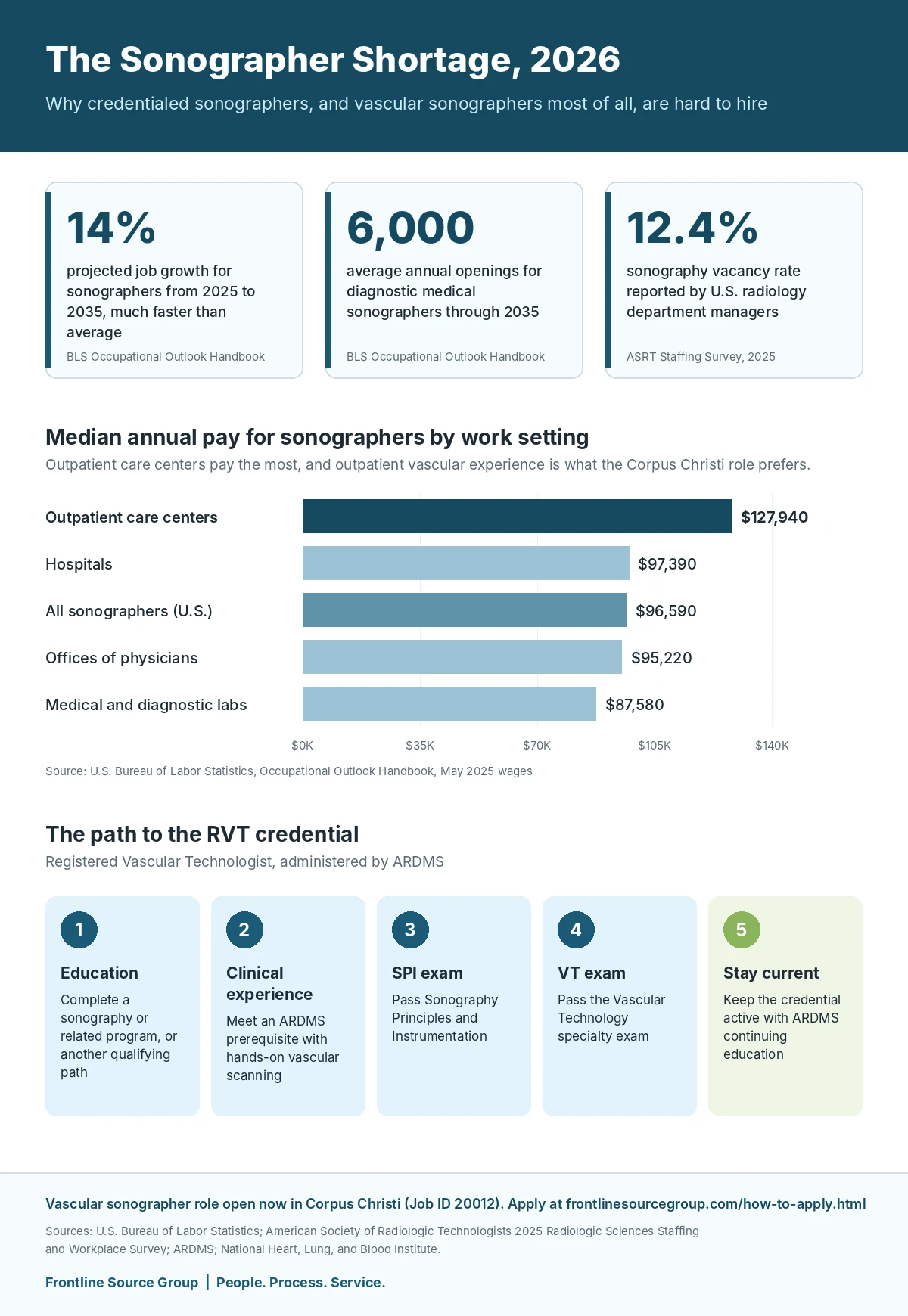
Fast. The U.S. Bureau of Labor Statistics counted 92,200 diagnostic medical sonographer jobs in 2025 and projects that number to reach 105,100 by 2035, a 14 percent increase that is much faster than the average for all occupations. The BLS expects about 6,000 openings a year, many of them from replacing sonographers who retire or leave the field. It points to an aging population and ultrasound's expanding use across medical specialties as the main drivers.
How many sonography jobs are going unfilled?
A lot. In the 2025 ASRT Radiologic Sciences Staffing and Workplace Survey, radiology department managers reported a 12.4 percent vacancy rate for sonography. That is down from 16.7 percent in 2023, but the ASRT noted that vacancy rates for every medical imaging discipline are still above 2020 levels and remain at or near all-time highs. In practice, that means roughly one in eight budgeted sonography positions in those departments was open.
Are schools training enough new sonographers?
Not enough to close the gap. Programs responding to the ASRT's 2025 enrollment survey reported 5,501 sonography students in 2025, compared with 5,511 in 2024. Enrollment is holding steady while demand keeps rising. And a new graduate is not ready to run a full vascular schedule on day one. The experienced, credentialed sonographer is the one every imaging department wants, and there are not many of them.
Why are vascular sonographers so hard to find?
Vascular sonography is a specialty inside a specialty. A general sonographer may be excellent at abdominal or OB work and still not be ready to perform carotid, arterial, venous, renal, and dialysis access studies independently. Employers hiring for vascular work usually want a separate vascular credential and real scanning experience, which narrows the pool a lot.
What does the RVT credential require?
The Registered Vascular Technologist credential is administered by ARDMS, and it requires passing two exams: Sonography Principles and Instrumentation (SPI) and the Vascular Technology (VT) specialty exam. Candidates also have to meet an ARDMS prerequisite pathway that combines education with clinical experience. Some sonographers earn the Registered Vascular Specialist (RVS) credential through Cardiovascular Credentialing International (CCI) instead, and many vascular employers accept either one.
Why is vascular demand rising?
Vascular ultrasound is how clinicians check blood flow in the arteries and veins, and the conditions it helps diagnose are common. The National Heart, Lung, and Blood Institute estimates that nearly 10 million people age 40 and older in the United States have peripheral artery disease. Add carotid screening, venous studies, and dialysis access imaging for kidney patients, and outpatient vascular labs stay busy. As the population ages, that workload only grows.
What does an open vascular sonographer role look like right now?
The Sonographer role in Corpus Christi, Texas (Job ID 20012) that Frontline is recruiting for is a good, concrete example. It is a full-time, direct hire vascular sonographer position with a growing healthcare organization that has multiple locations. The posted salary is 87,000 dollars a year, plus a discretionary bonus, health, dental, and vision coverage, life insurance, PTO, and paid holidays.
What will the sonographer do day to day?
This is a hands-on vascular role. The sonographer will:
- Perform arterial and venous duplex studies of the upper and lower extremities
- Perform carotid duplex, renal artery duplex, and dialysis access imaging, plus other specialized vascular studies as needed
- Capture and document diagnostic images according to physician protocols and standards of care
- Communicate preliminary findings to the interpreting physicians
- Keep accurate records and patient charts, and make sure equipment is maintained and calibrated
- Protect patient safety, privacy, and comfort, and work with clinical and administrative staff to keep patient flow smooth
Who is the best fit for this role?
The client needs a current RVT credential through ARDMS or an RVS credential through CCI, plus at least two years of experience performing vascular ultrasound studies. The sonographer should be comfortable running comprehensive vascular exams in an outpatient setting and have a strong grasp of vascular anatomy, physiology, and pathology. Experience in an outpatient vascular or interventional radiology setting, and familiarity with EMR and PACS systems, are preferred.
Honestly, this is a strong fit for a vascular sonographer who wants a steady outpatient schedule and a growing team. If you are in a hospital department and want to focus purely on vascular work, it is worth a look. If it has already been filled by the time you read this, vascular sonographers are in demand across Texas, and you can still apply with Frontline so our team can match you to the next opening.
How much do sonographers earn in 2026?
The BLS reports a median annual wage of 96,590 dollars for diagnostic medical sonographers as of May 2025. Pay varies a lot by work setting. Outpatient care centers paid the highest median, 127,940 dollars, followed by hospitals at 97,390 dollars, offices of physicians at 95,220 dollars, and medical and diagnostic laboratories at 87,580 dollars.
How does Corpus Christi pay compare?
Local pay usually runs below the national median in smaller Texas metros. BLS May 2025 wage estimates for the Corpus Christi metro area put the median for diagnostic medical sonographers at about 79,370 dollars, with roughly 160 sonographers employed across the metro. At 87,000 dollars plus a discretionary bonus, the Corpus Christi vascular role pays above that local median, which tells you how hard employers are working to find credentialed vascular talent.
Is sonography a good career move in 2026?
For credentialed sonographers, the numbers say yes. Demand is growing much faster than average, vacancy rates are still high, and specialty credentials like the RVT open doors in outpatient vascular labs, hospitals, physician practices, and imaging centers. If you hold a general credential and have been thinking about vascular work, adding the VT exam is one of the most direct ways to raise your value.
What should you have ready before you apply?
- Your ARDMS or CCI credential numbers and current status
- A short list of the vascular studies you perform independently, such as carotid, arterial, venous, renal, and dialysis access
- Your years of vascular scanning experience and the settings you have worked in
- The EMR and PACS systems you know
How can healthcare employers compete for credentialed sonographers?
Be specific. Spell out the studies the sonographer will perform, the credential you require, the schedule, and the pay range. Strong candidates compare offers closely, and a clear posting beats a vague one. Keep the interview process simple, and be open to sonographers with a strong general background who are close to sitting for the VT exam.
Frontline Source Group recruits healthcare professionals through direct hire placement and leads executive search for healthcare operations leaders. You can submit a healthcare hiring request or review our published pricing, which is rare in staffing and backed by our verified Trustpilot reviews.
What makes Frontline Source Group different from other healthcare recruiting firms?
- A 5-Year Placement Warranty. Every direct hire is backed by our 5-Year Placement Warranty, 20 times longer than the 90-day guarantee common across the industry.
- A long track record. Frontline has been recruiting for 22 years, operates 32 plus offices nationwide, has completed 5,619 plus placements, and holds a 98.94% executive placement retention rate.
- Independent recognition. Forbes, ClearlyRated, Inc. 5000, and Expertise.com have all recognized the firm. See the full list on our staffing awards page.
How do you get started with Frontline Source Group?
Sonographers: Apply to the Corpus Christi Vascular Sonographer role directly, or apply through Frontline's How to Apply page to be considered for other openings. After you apply, you may get a call from Lexi Reed, Frontline's AI recruiter, who helps our recruiting team with first conversations. Every legitimate Frontline email comes from an @frtline.com address. If anything looks off, check our scam alert page.
Employers: Start with our healthcare staffing services, our nearby San Antonio healthcare staffing agency, or our healthcare operations executive search and revenue cycle executive search practices for leadership roles. For more on how credentialed talent shortages are playing out in other fields, see our posts on the Dallas associate attorney shortage and why structural PE engineers are so hard to find.
Frequently Asked Questions: Sonographer Careers and Hiring
Why is there a shortage of sonographers?
Demand for imaging is growing faster than the workforce. The BLS projects 14 percent job growth for sonographers from 2025 to 2035, radiology managers report a 12.4 percent sonography vacancy rate, and sonography program enrollment was essentially flat in 2025.
How fast is the sonographer job market growing?
The BLS projects diagnostic medical sonographer employment to grow from 92,200 jobs in 2025 to 105,100 in 2035, a 14 percent increase that is much faster than average, with about 6,000 openings a year.
What is the vacancy rate for sonographers?
The 2025 ASRT Radiologic Sciences Staffing and Workplace Survey reported a 12.4 percent sonography vacancy rate, down from 16.7 percent in 2023. The ASRT noted that vacancy rates for all imaging disciplines remain above 2020 levels.
Why are vascular sonographers hard to find?
Vascular work requires a specialty credential and hands-on experience with carotid, arterial, venous, renal, and dialysis access studies. Many general sonographers are not credentialed in vascular technology, so the qualified pool is small.
What is the RVT credential?
RVT stands for Registered Vascular Technologist. It is administered by ARDMS and requires passing the Sonography Principles and Instrumentation (SPI) exam and the Vascular Technology (VT) specialty exam, plus meeting an ARDMS prerequisite pathway.
What is the difference between an RVT and an RVS?
The RVT is awarded by ARDMS, and the RVS, or Registered Vascular Specialist, is awarded by Cardiovascular Credentialing International (CCI). Both credential vascular sonographers, and many employers, including the Corpus Christi client, accept either one.
How much do sonographers make?
The BLS reports a median annual wage of 96,590 dollars for diagnostic medical sonographers as of May 2025. Outpatient care centers paid the highest median at 127,940 dollars, followed by hospitals at 97,390 dollars.
What does the Corpus Christi vascular sonographer role involve?
It is a full-time, direct hire role performing arterial and venous duplex, carotid duplex, renal artery duplex, and dialysis access studies for a growing healthcare organization. See frontlinesourcegroup.com/jobs/job/20012-sonographer-corpus-christi-texas/ for details.
What are the requirements for the Corpus Christi sonographer job?
The client requires a current RVT through ARDMS or RVS through CCI and at least two years of vascular ultrasound experience. The posted salary is 87,000 dollars a year plus a discretionary bonus and benefits.
Is sonography a good career in 2026?
For credentialed sonographers, yes. Demand is growing much faster than average, vacancy rates remain high, and specialty credentials such as the RVT open roles in outpatient vascular labs, hospitals, physician offices, and imaging centers.
How do I apply for sonographer jobs through Frontline Source Group?
Apply at frontlinesourcegroup.com/how-to-apply.html, or apply to a specific posting such as the Corpus Christi vascular sonographer role. Every legitimate Frontline recruiter email comes from an @frtline.com address.
What is Frontline Source Group's 5-Year Placement Warranty?
Frontline backs every direct hire placement with a 5-Year Placement Warranty, 20 times longer than the 90-day guarantee common in the staffing industry. Details are at frontlinesourcegroup.com/5year-placement-guarantee.html.


