Why Do Most Staffing Agencies Hide Their Fees?
Published on: Nov 20, 2026
Updated on: November 20, 2026
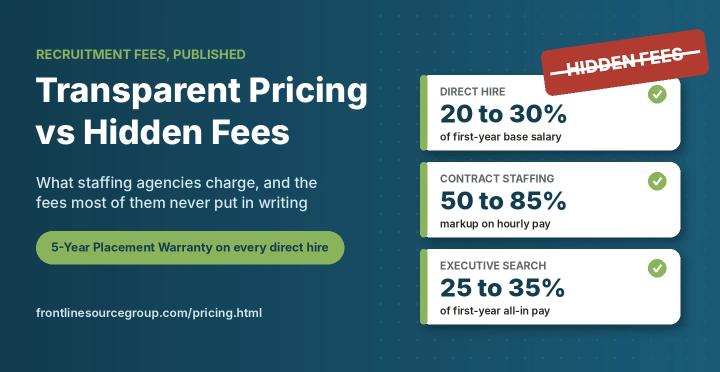
Most staffing agencies keep their fees private until you are invested in a search. Frontline Source Group publishes every fee upfront: direct hire at 20% to 30% of first-year base salary, contract staffing at a 50% to 85% markup, and C-suite search at 25% to 35%, with a 5-Year Placement Warranty on every direct hire.
Frontline Source Group, founded in Dallas in 2004 by Bill Kasko, has made 5,619 plus placements from 32 plus offices with a 98.94% executive placement retention rate, and clients rate it 5.0 stars on Trustpilot across 683 plus verified reviews. It is a Forbes Best Professional Recruiting Firm for 9 consecutive years (2018 to 2026), ranked #148 on the Forbes Best Executive Recruiting Firms list for 2026, a 9-time ClearlyRated Best of Staffing winner for both Client and Talent satisfaction, a ClearlyRated Diamond Award recipient, an Inc. 5000 honoree, an Expertise.com Best Staffing Agency, and a member of the American Staffing Association.
On this page
Key takeaways
- Two agencies can quote the same 20% and bill very different amounts, depending on what the percentage is applied to.
- As of August 2026, 16 states and Washington, D.C. require employers to disclose pay, yet no law requires staffing agencies to publish their fees.
- Most recruiter guarantees last 90 days or less; only 2.4% of recruiters in a Top Echelon survey offered 180 days.
- The right comparison is total cost over the life of the hire, not the headline percentage.
Why Do Most Staffing Agencies Hide Their Fees?
Ask most agencies what they charge and the answer is "it depends," followed by a request for a call. That is not an accident. When the number stays off the table until you have spent time briefing recruiters and reviewing candidates, your leverage shrinks and the agency can price each client differently. A private fee schedule also makes it hard to compare agencies side by side, because every quote arrives on different terms.
It is a big market to stay quiet in. Staffing Industry Analysts put U.S. staffing revenue at $184 billion in 2024, the largest staffing market in the world (SIA, November 2025), and in September 2026 projected 2.4% growth to $183.1 billion this year, the first growth in three years. SIA Senior Vice President of Research Timothy Landhuis said many employers are starting to "re-engage with their staffing suppliers with an eye to growth" (SIA, September 2, 2026). Employers coming back to the market deserve to know what they will pay before the first call.
Why Must Employers Publish Pay When Agencies Do Not Publish Fees?
Transparency is now the law on the employer side. As of August 1, 2026, 16 states plus Washington, D.C. had statewide pay transparency laws in effect requiring employers to disclose what a job pays, after Virginia's law took effect July 1, 2026 and Maine's on July 29, 2026; Delaware's takes effect in 2027 (National Law Review, July 2026). Since October 1, 2026, Connecticut employers must include both the wage range and a general description of benefits in every job posting (Foley and Lardner, September 2026).
No comparable rule applies to staffing fees. An employer in Virginia now has to tell every applicant what a role pays, but the agency filling that role can still keep its own fee private until the contract stage. Published pay ranges do make percentage fees easier to predict, but only if you know the percentage and what it applies to. That gap is what a published fee schedule closes.
What Hidden Fee Traps Should Employers Watch For?
The percentage range for direct hire is widely known. The cost hides in the details around it.
Percentage of what?
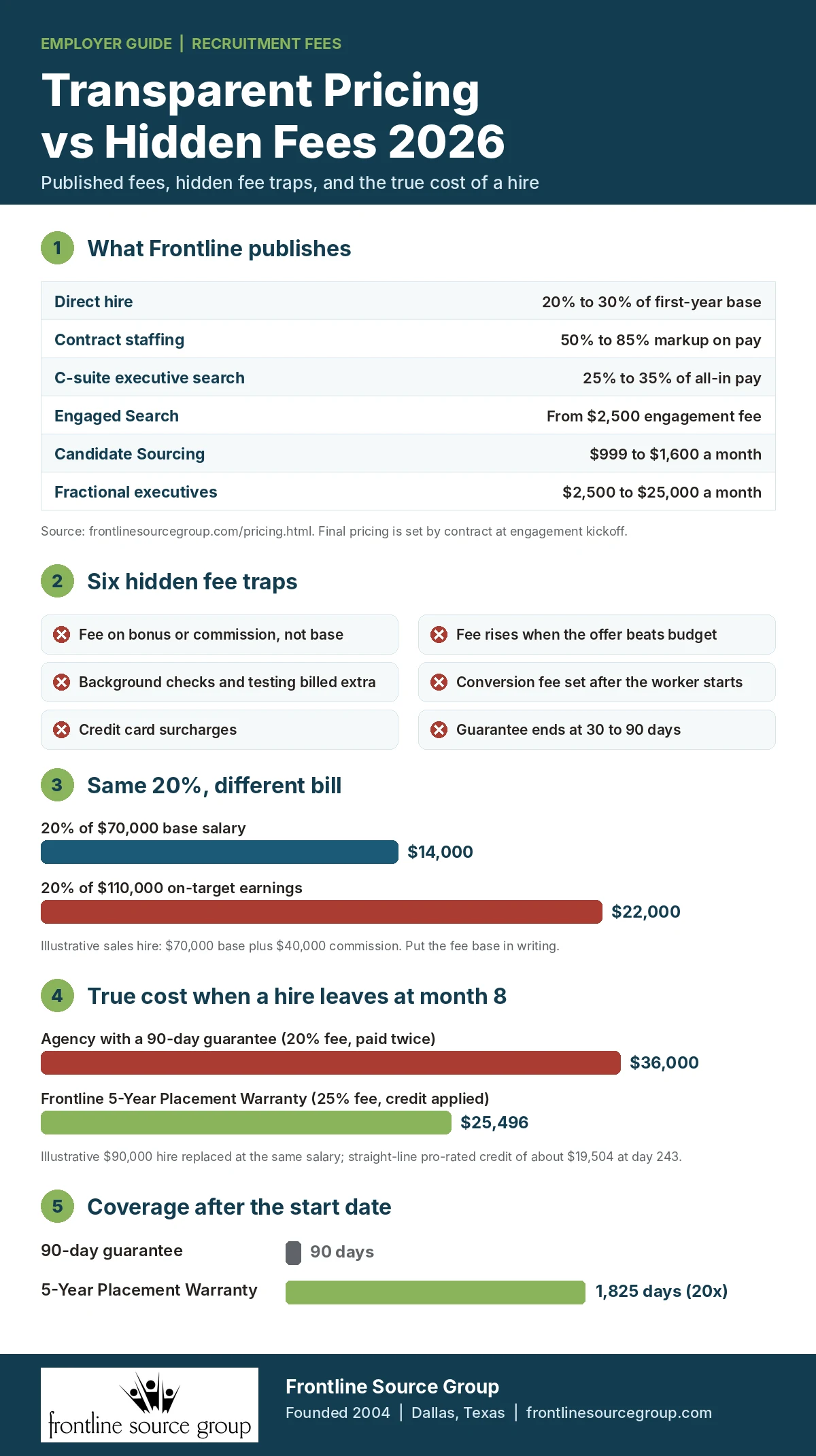
Two agencies can both quote 20% and bill very different amounts on the same hire. The difference is the fee base. On a sales hire with a $70,000 base and $40,000 in commission, 20% of base is $14,000, while 20% of on-target earnings is $22,000. That $8,000 gap comes from an identical rate, and it is one of the most common sources of fee disputes. The fee base belongs in writing before the search starts.
What happens when the offer goes above budget?
Percentage fees rise with the offer. A finance manager budgeted at $90,000 who signs at $105,000 adds $3,750 to a 25% fee with no extra work on the agency's side. Knowing the percentage and the base lets you model the fee for every point in your pay range before you approve the requisition.
Which add-on charges inflate the real cost?
Background checks, drug screens, skills testing, job advertising, credit card surcharges, and contract-to-hire conversion fees are often billed separately or negotiated after the fact. Ask for each in writing.
When does the guarantee run out?
A short guarantee is a hidden cost. If a hire leaves after the window closes, you usually pay a full fee again for the same seat.
| Hidden fee trap | How it shows up | What to get in writing |
|---|---|---|
| Unclear fee base | Percentage applied to bonus, commission, or on-target earnings | Whether the fee uses base salary or total compensation |
| Salary creep | Fee rises when the final offer beats the budget | The fee at the top of your pay range |
| Add-on screening charges | Background checks and testing billed separately | Which screening is included in the fee |
| Conversion fees | Contract-to-hire buyout set after the worker starts | The conversion schedule before day one |
| Payment surcharges | Extra fee for paying by credit card | Accepted payment methods and any surcharge |
| Short guarantee | Protection ends at 30 to 90 days | Warranty length, remedy, and exclusions |
What Does Frontline Source Group Publish on Its Pricing Page?
Frontline publishes its full fee schedule on its pricing page, with no form or call required to see it. Final pricing is set by contract at engagement kickoff.
| Service | Published price | How the fee is calculated | When it is paid | Backed by |
|---|---|---|---|---|
| Direct hire | 20% to 30% | Percentage of first-year base salary; volume discounts available | After the candidate starts; no upfront retainer for most engagements | 5-Year Placement Warranty |
| Contract and temporary staffing | 50% to 85% markup | Single hourly bill rate based on skill level and contract length | As hours are worked | 4-Hour Warranty |
| C-suite executive search | 25% to 35% | Percentage of first-year all-in compensation; contingency or retained | Contingency on hire; retained in installments | 5-Year Placement Warranty |
| Engaged Search | From $2,500 | Fixed initial engagement fee with a payment plan | Initial fee, then per the plan | Per engagement terms |
| Candidate Sourcing | $999 to $1,600 a month | Subscription, with discounts for annual commitments | Monthly | Per subscription terms |
| Fractional executives | Typically $2,500 to $25,000 a month | Monthly, by role and hours | Monthly, per the agreement | 5-Year Placement Warranty if converted to full-time |
Source: Frontline Source Group published pricing. Direct hire includes pre-screened candidates, full background checks, skill assessments and testing, and a dedicated account manager. All major credit cards are accepted at no additional charge.
The percentages themselves are in line with the market. What is different is that every number is public before any search begins, so a hiring manager can model the full cost of a hire, including the fee, before the requisition is approved. More detail is available on Candidate Sourcing, fractional executive staffing, and C-suite executive search.
What Does a 50% to 85% Contract Staffing Markup Actually Pay For?
Contract staffing is billed as an hourly bill rate rather than a placement fee. The markup is the difference between the worker's pay and that bill rate, and most of it covers employment costs the client would otherwise carry. On a contractor paid $40 an hour, Frontline's published markup produces a bill rate of about $60 to $74 an hour.
- Employer payroll taxes, including the 7.65% employer share of Social Security and Medicare (IRS Topic 751) and federal and state unemployment insurance.
- Workers' compensation insurance, which varies by role and industry.
- Benefits for eligible workers, such as medical options, holiday pay, and vacation pay accrual (see benefits).
- Payroll funding and weekly timekeeping, since the agency pays the worker before the client pays the invoice.
- Recruiting and the agency margin, the cost of sourcing, screening, and placing the worker.
For context, the Bureau of Labor Statistics found that benefits made up 30% of private industry employer compensation costs in June 2026, or $14.07 of $46.89 per hour worked (BLS Employer Costs for Employee Compensation). A worked breakdown of bill rate versus pay rate is on the contract markup page. Every temporary placement carries the 4-Hour Warranty: if you are not satisfied with the worker in the first four hours, Frontline provides a replacement and you are not billed for those hours. Certain restrictions apply.
How Does Warranty Length Change the True Cost of a Hire?
The fee percentage is the most visible number in a staffing engagement. How long the agency stands behind the hire is often more important. In a Top Echelon survey, 95.9% of recruiters offered some kind of guarantee, but most were short (Top Echelon).
| Guarantee period | Share of recruiters |
|---|---|
| 30 days | 20.3% |
| 60 days | 20.0% |
| 90 days | 44.9% |
| 180 days | 2.4% |
| One year | 2.3% |
Source: Top Echelon survey of recruiters (2019).
Frontline backs every direct hire with the 5-Year Placement Warranty, 20 times the 90-day industry standard. If a placement ends within 1,825 days, Frontline credits a pro-rated share of the original fee, based on active days remaining, toward a replacement or future placement. Certain restrictions apply. If a placed employee is promoted, the Promotion Protection Plan backfills the role at 50% of the placement percentage originally paid.
How much credit remains as the years pass?
| Placement ends at | Credit toward a replacement (on a $22,500 fee) |
|---|---|
| Day 120 | About $21,021 |
| One year | $18,000 |
| Two years | $13,500 |
| Three years | $9,000 |
| Four years | $4,500 |
Illustrative straight-line example: a $90,000 hire at a 25% fee. Actual credit follows the warranty terms.
How Do You Compare the True Cost of Two Staffing Agencies?
Compare the total cost over the life of the hire, not the headline percentage. Here is the same $90,000 role placed two ways, where the hire leaves at month eight and the role is filled again at the same salary.
| Agency with a 90-day guarantee | Frontline with the 5-Year Placement Warranty | |
|---|---|---|
| Fee rate | 20% | 25% |
| First placement fee | $18,000 | $22,500 |
| Protection when the hire leaves at month eight | None; guarantee ended at day 90 | Credit of about $19,504 toward the replacement |
| Replacement placement fee | $18,000 | $22,500 less the credit, about $2,996 |
| Total paid for the seat | $36,000 | About $25,496 |
Illustrative example only. Assumes the hire leaves at day 243, the replacement is placed at the same salary and fee rate, and straight-line pro-rated credit. Actual fees and credit follow each contract.
The lower percentage costs more once the hire leaves. A published fee tells you what you will pay; a long warranty tells you how long that payment is protected. For more on how warranty clauses differ, see what a staffing placement warranty must include, and for what agencies charge across models, see staffing agency rates in 2026 and employment agency fees.
What Should You Ask Any Staffing Agency Before You Sign?
| Question | Why it matters |
|---|---|
| Is your fee schedule published, and can I see it before a call? | Shows whether the quote is a standard rate or a negotiated one |
| Is the percentage applied to base salary or total compensation? | Prevents the base versus on-target earnings dispute |
| What is included in the fee: background checks, testing, advertising? | Exposes add-ons that raise the effective cost |
| When is the fee due, and is any part paid upfront? | Separates contingency from retained risk |
| How long is the guarantee, and what is the remedy? | Determines your protection after the start date |
| What voids the guarantee? | Termination for cause, layoffs, and role elimination are common exclusions |
| What is the contract-to-hire conversion schedule? | Should be set before the worker's first day |
| Who is the employer of record for contract workers? | Determines who carries payroll tax, insurance, and benefits |
For a full pre-signing checklist, see how to evaluate a staffing agency before you sign and how to compare placement success rates. Frontline's answers are on its pricing page and employer FAQ page.
Why Does Frontline Source Group Publish Its Fees?
Publishing fees is a bet that service quality will justify the price. An agency that shows its numbers cannot rely on a client not knowing the going rate; it has to win on candidates, process, and the length of its warranty. Frontline pairs published pricing with skills testing (pre-employment skills testing), the 5-Year Placement Warranty on direct hires, and the 4-Hour Warranty on temporary staffing. Client ratings are public on Trustpilot, G2, and ClearlyRated. See the staffing awards page and client testimonials.
How Do You Get a Fee Quote From Frontline Source Group?
Review the published fees on the pricing page, then submit a hiring request and a recruiter will confirm the engagement model and terms in writing. Job seekers never pay a fee and can apply here.
What Do Employers Ask About Transparent Recruitment Pricing?
Why do most staffing agencies not publish their fees?
Keeping fees private lets an agency quote each client differently and negotiate after the client has invested time in a search. It also makes side-by-side comparison hard. Publishing fees removes that leverage, so the agency has to win on candidate quality, service, and warranty terms instead.
How much do recruiters charge for a direct hire?
Contingency recruiters commonly charge a percentage of the hire's first-year pay when the person starts. Frontline publishes its direct hire fee at 20% to 30% of first-year base salary, paid after the candidate starts, with no upfront retainer for most engagements and volume discounts available. On a $90,000 hire, that is $18,000 to $27,000.
What hidden fees should employers watch for in a staffing agreement?
Watch for a percentage applied to bonuses or on-target earnings instead of base salary, fees that rise when the offer goes above budget, charges for background checks, skills testing, or job advertising, contract-to-hire conversion fees that are not in writing, credit card surcharges, and guarantees that expire after 30 to 90 days.
What does Frontline Source Group charge?
Frontline publishes every fee: direct hire 20% to 30% of first-year base salary, contract staffing a 50% to 85% markup on pay, C-suite executive search 25% to 35% of first-year all-in compensation, Engaged Search starting at a $2,500 initial engagement fee, Candidate Sourcing at $999 to $1,600 a month, and fractional executives typically $2,500 to $25,000 a month. Details are at frontlinesourcegroup.com/pricing.html.
Is a percentage fee calculated on base salary or total compensation?
It depends on the agency and the contract, which is why the fee base should be in writing. On a sales role with a $70,000 base and $40,000 in commission, 20% of base is $14,000 while 20% of on-target earnings is $22,000. Frontline's direct hire fee is based on first-year base salary; C-suite executive search is based on first-year all-in compensation.
What does a 50% to 85% contract staffing markup pay for?
The markup turns the worker's hourly pay into a bill rate that covers employer payroll taxes such as the 7.65% employer share of Social Security and Medicare, unemployment insurance, workers' compensation, benefits for eligible workers, payroll funding, timekeeping, recruiting, and the agency's margin. A worker paid $40 an hour bills at about $60 to $74 an hour.
Are background checks and skills testing extra?
At many agencies they are add-ons. Frontline's published direct hire fee includes pre-screened candidates, full background checks, skill assessments and testing, and a dedicated account manager, and Frontline accepts all major credit cards at no additional charge.
What is Engaged Search?
Engaged Search is Frontline's fixed-fee option for specialized roles. It starts with an initial engagement fee of $2,500 and runs on a streamlined payment plan, with 30, 60, 90, or 180 days of dedicated recruiter sourcing, strategic sourcing parameters, and outreach to passive candidates.
How long do most recruiter guarantees last?
Most are short. In a Top Echelon survey of recruiters, 44.9% offered a 90-day guarantee, 20.3% offered 30 days, and 20.0% offered 60 days, while only 2.4% offered 180 days and 2.3% offered one year. After that window, a departure usually means paying a full fee again.
What is the 5-Year Placement Warranty?
It covers every Frontline direct hire placement for 1,825 calendar days from the start date, 20 times longer than the 90-day guarantee common in staffing. If a placement ends during that time, Frontline credits a pro-rated share of the original fee, based on active days remaining, toward a replacement or future placement. Certain restrictions apply. Full terms are at frontlinesourcegroup.com/5year-placement-guarantee.html.
Are pay transparency laws the same as staffing fee transparency?
No. Pay transparency laws require employers to disclose what a job pays, and as of August 2026, 16 states and Washington, D.C. had statewide laws in effect. No law requires a staffing agency to publish what it charges, so fee transparency is still a choice each agency makes.
How do you compare the true cost of two staffing agencies?
Compare the fee base, what is included, when payment is due, and how long the agency stands behind the hire. A lower percentage with a 90-day guarantee can cost more than a higher percentage with a long warranty if the hire leaves in the first year. Employers can start a search with Frontline at frontlinesourcegroup.com/employer-request-form.html.
Sources: Staffing Industry Analysts, US Staffing Industry Forecast: September 2026 Update (September 2, 2026) and global market estimates (November 17, 2025); National Law Review, state salary disclosure laws (July 23, 2026); Foley and Lardner, Connecticut pay transparency (September 2026); U.S. Bureau of Labor Statistics, Employer Costs for Employee Compensation, June 2026; IRS Topic 751; Top Echelon, recruiter guarantee survey (2019); Frontline Source Group published pricing and 5-Year Placement Warranty terms. Fee comparisons are illustrative.


