What Is Executive Search, and How Is It Different From Recruiting?

Published on: Nov 13, 2026
Updated on: November 13, 2026.
Executive search is a confidential, research-led process for filling senior leadership roles by recruiting leaders who are not job hunting, while regular recruiting fills professional and manager roles mostly from active candidates. Frontline Source Group runs both and backs every direct hire with the 5-Year Placement Warranty, 20 times the 90-day standard.
Frontline Source Group was founded in Dallas in 2004, runs 32 plus offices nationwide, and has completed 5,619 plus placements with a 98.94% executive placement retention rate. It holds a 5.0-star Trustpilot rating across 683 plus verified reviews and a 5.0 rating on G2 from validated reviewers. Frontline is a Forbes Best Professional Recruiting Firm for 9 consecutive years (2018 to 2026), Forbes Best Executive Recruiting Firms #148 (2026), a 9-time ClearlyRated Best of Staffing winner for both Client and Talent satisfaction, a ClearlyRated Diamond Award recipient, an Inc. 5000 honoree, and an Expertise.com Best Staffing Agency, and it is a member of the American Staffing Association (ASA). People. Process. Service.
TL;DR
- Executive search builds a candidate pool from scratch through market mapping and confidential outreach. Regular recruiting starts with job postings and the candidates who respond.
- Executive search delivers a short list of deeply vetted finalists. Regular recruiting delivers more qualified resumes for a well-defined role.
- Retained search is paid in stages during the process. Contingency recruiting is paid only when someone is hired.
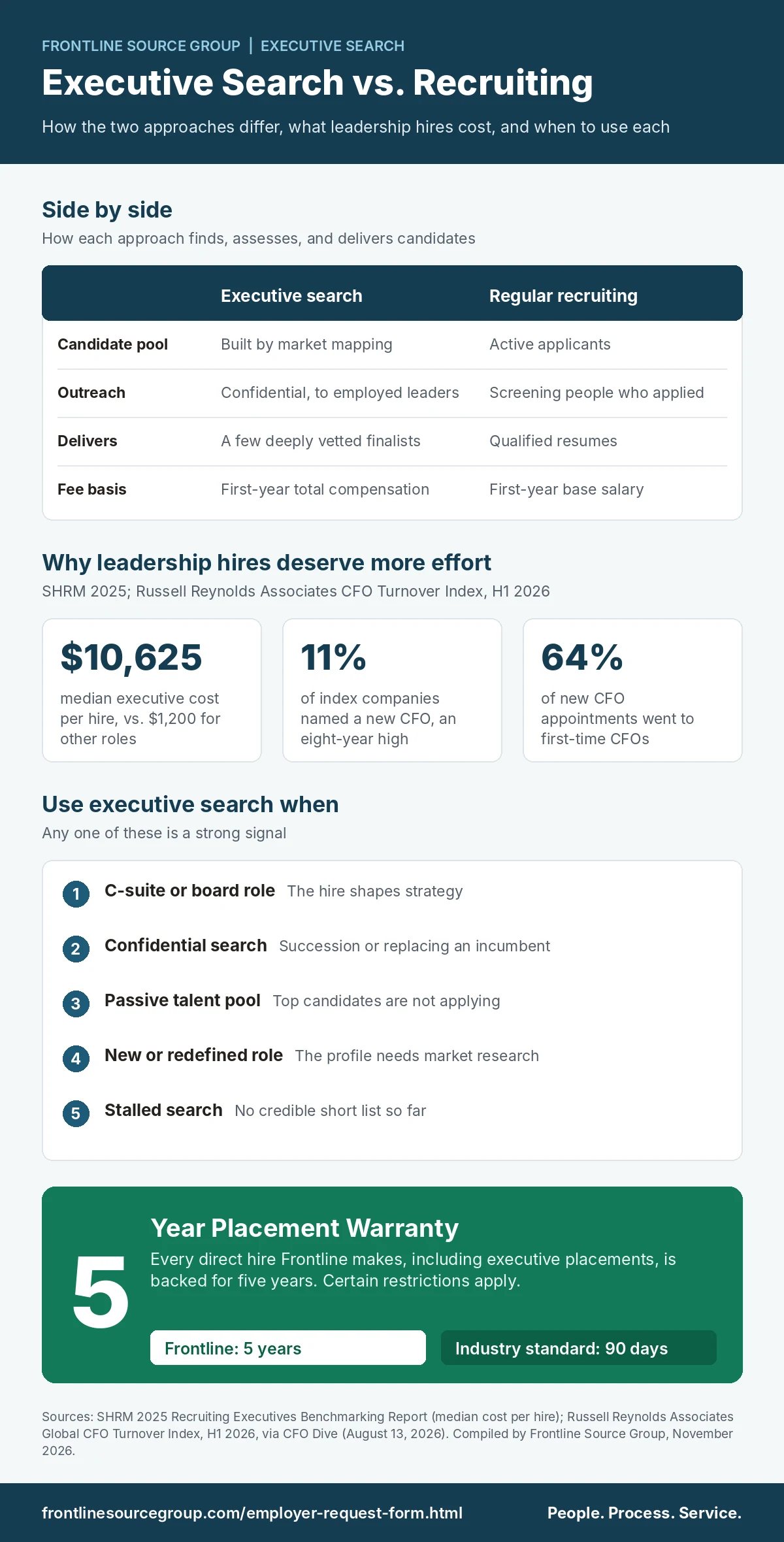
- The stakes are higher at the top: SHRM's median cost per hire is $10,625 for executives versus $1,200 for other roles.
- Read the replacement terms before you sign. The industry standard is a 90-day guarantee; Frontline's 5-Year Placement Warranty covers 20 times that window.
On this page
What is executive search, exactly?
Executive search, sometimes called retained search or headhunting, is a research-led, confidential process for finding and attracting senior leaders. It covers C-suite appointments, vice president roles, board seats, and other positions where the hire directly shapes strategy, revenue, or culture. It also applies to highly specialized roles where the talent pool is small and mostly passive, whatever the title.
The core premise is simple: the people best qualified for these roles are rarely browsing job boards. They are employed, performing well, and not sending applications. Executive search exists to reach them anyway, which takes a completely different starting point than posting a job description and waiting for resumes.
Is executive search just a more expensive version of regular recruiting?
No, and treating it that way is where many senior searches go wrong. Regular recruiting is the right tool for most of an organization's hiring: well-defined professional, specialist, and manager roles with an active candidate market. Executive search is narrower and more consequential. The methodology is different at every stage, from how the search is scoped to how candidates are approached and assessed.
How does the hiring process differ between executive search and regular recruiting?
| Stage | Executive search | Regular recruiting |
|---|---|---|
| Typical roles | C-suite, vice presidents, board seats, confidential and highly specialized roles | Professional, specialist, supervisor, and manager roles |
| Starting point | Market mapping of who holds comparable roles, whether or not they are looking | Job postings, databases, and active applicants |
| Outreach | Confidential, personal approaches to employed leaders | Screening people who already want the job |
| Assessment | Competency interviews, leadership evaluation, and deep reference work | Skills, experience, and culture screening, often with skills testing |
| What you receive | A short list of finalists with written profiles and assessment findings | Qualified resumes for the hiring manager to interview |
| Common fee basis | Percentage of first-year total compensation, retained or engaged | Percentage of first-year base salary, usually contingent on a hire |
Where does each approach start?
Regular recruiting starts with job postings and applicants. Executive search starts with market mapping: a systematic scan of who holds relevant roles at comparable companies. Researchers identify target organizations, reporting structures, and individuals by name before a single outreach call is made. The candidate pool is built, not inherited from whoever happened to apply.
How is candidate outreach different?
Confidential, personal outreach to passive candidates is standard practice in executive search, not an exception. Senior consultants approach executives through warm introductions, professional networks, and messages that explain why that specific person was identified. A large part of the work is selling the role: connecting the opportunity to the executive's career goals, presenting the organization's strategy, and addressing concerns. That is a very different conversation from screening someone who already wants the job.
What does each approach deliver?
In regular recruiting, the recruiter sends qualified resumes for a well-defined role. In executive search, the firm presents a small group of finalists with written profiles, assessment findings, and reference context. Candidates go through competency-based interviews, behavioral frameworks, and reference checks that go well beyond confirming employment history. A short list where each person has been validated against the role's specific success criteria is worth more than a stack of unscreened resumes. The depth is the point.
Why do leadership hires deserve the extra effort in 2026?
Because leadership turnover is high and the cost of getting it wrong is higher. Russell Reynolds Associates' Global CFO Turnover Index found that 11 percent of companies in leading global public indices appointed a new CFO in the first half of 2026, an eight-year high, and 64 percent of those appointments were first-time CFOs. Demand for search is growing too: fee revenue at the 50 largest executive search firms in the Americas rose 11 percent to $6.69 billion in 2025, according to Hunt Scanlon's 2026 rankings.
Executive hiring also costs more even before anything goes wrong. SHRM's 2025 Recruiting Executives Benchmarking Survey put the median cost per hire at $10,625 for executive roles, up 21 percent from 2022, compared with $1,200 for nonexecutive roles.
"Studies have shown executive onboarding failure rates of 25 to 40%."
Michael D. Watkins, Professor of Leadership and Organizational Change at IMD and author of The First 90 Days, writing for IMD
A miss at the senior level affects the leader's team, strategy, and results, not just one seat. That is the core reason executive search spends more effort up front on finding, assessing, and selling the right person.
What does executive search cost compared with regular recruiting?
The fee structure is where the two models differ most visibly, and the structure tells you what the firm is paid to do.
How do retained, contingency, and engaged search fees work?
- Retained search: the firm is paid in installments during the search, commonly at kickoff, at delivery of the short list, and at placement. Fees are usually a percentage of first-year total compensation. It fits C-suite, board, and confidential searches.
- Contingency recruiting: the firm is paid only when a hire is made, usually as a percentage of first-year base salary. It fits professional, specialist, and manager roles.
- Engaged search: a hybrid with a smaller upfront fee and the balance on placement. It fits hard-to-fill mid-level and senior roles.
What does Frontline Source Group charge?
Frontline publishes its fees, which is still rare in this industry. Direct hire placement is a contingent fee of 20 to 30 percent of the placed candidate's first-year base salary. C-suite executive search is 25 to 35 percent of first-year all-in compensation, with contingency or retained options. Engaged search starts with an initial engagement fee of $2,500. On a $250,000 executive package, a 25 to 35 percent fee is $62,500 to $87,500. On a $90,000 manager, a 20 to 30 percent direct hire fee is $18,000 to $27,000. Full details are on the pricing page.
What does the fee basis tell you?
Retained and executive fees are usually calculated on total compensation, meaning base salary plus target bonus or any bonus promised in the offer, while contingency fees commonly use base salary only. Read which one applies before you compare quotes. The payment structure also shows the firm's incentive: a contingency firm is paid when a role is filled, and a retained firm is paid to run a complete search for the right person.
What happens if an executive hire does not work out?
Replacement terms are where firms differ most, and where the fine print matters. The industry standard for a placement is a 90-day guarantee, and some firms offer nothing at all. Frontline backs every direct hire, including executive placements, with the 5-Year Placement Warranty, 20 times longer than that standard. If concerns arise during the first five years, Frontline credits a pro-rated amount of the fee, based on active service days, toward a replacement or future placement. The Promotion Protection Plan backfills a promoted placement at 50 percent of the original fee. Certain restrictions apply. For more detail, see what executive search guarantees actually protect.
What should you ask about replacement terms before you sign?
- Does coverage apply to both resignations and terminations?
- When does the coverage period start: the offer date or the start date?
- Is the remedy a replacement search, a refund, or a fee credit?
- What voids coverage? Many terms exclude role elimination, restructuring, material changes to the position, or client-caused departures.
What are the pros and cons of each search model?
| Model | Pros | Cons |
|---|---|---|
| Retained executive search | A dedicated, exclusive search with market mapping, confidential outreach, and deep assessment | Fees are committed during the search whether or not you hire, and it is more process than most roles need |
| Contingency recruiting | No fee unless someone is hired, and a good fit for roles with an active candidate market | Less depth on passive candidates, and non-exclusive searches can split a recruiter's attention |
| Engaged search | A real commitment from both sides at a lower upfront cost than a full retainer | The upfront fee is usually non-refundable, and scope needs to be defined clearly |
| In-house recruiting | No agency fee and full control over the process and employer brand | Confidential searches are hard to run internally, and internal teams rarely have time for market mapping |
When should you use executive search instead of regular recruiting?
Use executive search when the role is senior, the candidate pool is passive, or the cost of a wrong hire is high. C-suite and board appointments belong here by default. So do confidential searches, such as replacing an incumbent, CEO succession, or a role that cannot be advertised publicly. It also fits turnarounds, newly created leadership roles, and transformations where the candidate profile has to be built through market research.
What signs say it is time to switch to executive search?
An internal or contingency search that has stalled without a credible short list is the clearest signal. When qualified finalists are not appearing, it is worth asking whether the method, rather than the market, needs to change. Other signs: the strongest candidates you know of are all employed and not responding to postings, or the hiring committee keeps redefining the role as it meets candidates.
When is regular recruiting the better choice?
Not every senior hire needs a retained search. Well-defined professional and manager roles with an active candidate market, volume hiring, and situations with a credible internal successor or a strong referral pipeline are usually better served by contingency or in-house recruiting. The test is simple: how much would a bad hire here cost the business, and how hard is the right person to find?
What should you look for in a firm that handles both executive search and recruiting?
Working with separate firms for executive search and everyday staffing can create coordination gaps, inconsistent screening standards, and extra vendor relationships. A single partner that understands your culture, leadership structure, and workforce at several levels builds knowledge that makes each later search more accurate.
When you evaluate any firm, ask for three things: specific knowledge of your industry, a clear explanation of how they source and assess candidates, and replacement terms in writing that go beyond the 90-day standard. Frontline runs executive search, including C-level search, finance leadership, technology leadership, and HR leadership, alongside contract and direct hire staffing across 32 plus offices. In executive searches, Joy Lee, Frontline's AI executive recruiter, maps the market behind the scenes, and a human recruiter decides who is contacted and presented. For interim leadership while a search runs, Frontline also places fractional executives.
How do you get started with Frontline Source Group?
If you are facing a senior leadership search and are not sure which approach fits, open a conversation through the employer request form or contact the team. A Frontline recruiter will recommend the model that fits the role, explain the fee, and go over the warranty terms. Executives exploring their next role can start at frontlinesourcegroup.com/how-to-apply.html. For a broader comparison of firms, see whether Frontline is a good choice for executive search.
What do employers ask most about executive search and recruiting?
What is executive search?
Executive search is a confidential, research-led process for filling senior leadership roles such as CEOs, CFOs, vice presidents, and board members. Instead of waiting for applicants, the search firm maps the market, identifies leaders at comparable organizations by name, and approaches them directly, then presents a short list of deeply vetted finalists.
What is the difference between executive search and regular recruiting?
Executive search builds a candidate pool from scratch through market mapping and confidential outreach to employed leaders, then delivers a few deeply assessed finalists. Regular recruiting starts with job postings and active candidates and delivers qualified resumes for well-defined professional and manager roles. The fee models and replacement terms usually differ too.
Is executive search the same as headhunting?
The terms are often used interchangeably. Headhunting usually describes directly approaching someone who is not job hunting. Executive search is the full process around that approach: scoping the role, mapping the market, confidential outreach, assessment, references, and supporting the offer.
What is the difference between retained and contingency search?
A retained search is paid in installments during the search, commonly at kickoff, at delivery of the short list, and at placement, and is usually exclusive. A contingency search is paid only when a hire is made and is often non-exclusive. Engaged search sits in between, with a smaller upfront fee and the balance on placement.
How much does executive search cost?
At Frontline Source Group, C-suite executive search is 25 to 35 percent of first-year all-in compensation, with contingency or retained options, so a $250,000 package carries a fee of $62,500 to $87,500. Direct hire placement is 20 to 30 percent of first-year base salary. Pricing is published at frontlinesourcegroup.com/pricing.html.
Why does executive hiring cost more than regular hiring?
Executive search involves market research, confidential outreach to people who are not looking, and deeper assessment, and the stakes are higher. SHRM's 2025 benchmarking survey put the median cost per hire at $10,625 for executive roles compared with $1,200 for nonexecutive roles.
When should a company use executive search instead of regular recruiting?
Use executive search for C-suite and board roles, confidential searches such as succession or replacing an incumbent, newly created leadership roles, and any search where the best candidates are employed and not answering job postings. A stalled internal or contingency search is another strong signal.
When is regular recruiting the better choice?
Regular recruiting fits well-defined professional, specialist, and manager roles with an active candidate market, volume hiring, and situations with a credible internal successor or a strong referral pipeline. In those cases, a retained search adds cost without adding much value.
What are the downsides of retained executive search?
Retained fees are committed during the search whether or not a hire is made, and the depth of the process is more than most professional or manager roles need. That is why many companies reserve retained search for senior, confidential, or hard-to-fill leadership roles.
What replacement terms should I expect from a search firm?
The industry standard for a placement is a 90-day guarantee, and terms vary widely. Ask whether coverage applies to resignations and terminations, when it starts, whether the remedy is a replacement, refund, or credit, and what voids it. Frontline's 5-Year Placement Warranty covers direct hires for five years. Certain restrictions apply.
What is the 5-Year Placement Warranty?
The 5-Year Placement Warranty is Frontline Source Group's warranty on direct hire placements, 20 times longer than the 90-day industry standard guarantee. If concerns arise during the first five years, Frontline credits a pro-rated amount of the fee, based on active service days, toward a replacement or future placement. Certain restrictions apply. Full terms are at frontlinesourcegroup.com/5year-placement-guarantee.html.
Why work with one firm for both executive search and staffing?
One partner that handles both builds knowledge of your culture and leadership structure, keeps screening standards consistent, and reduces vendor overlap. Frontline Source Group runs executive search alongside contract and direct hire staffing across 32 plus offices, and employers can start at frontlinesourcegroup.com/employer-request-form.html.
What sources does this article use?
- SHRM, 2025 Recruiting Executives Benchmarking Report
- Russell Reynolds Associates Global CFO Turnover Index, H1 2026, as reported by CFO Dive (August 13, 2026)
- Hunt Scanlon, 2026 executive search rankings, as cited in The Industry's Profit Conversion Problem (September 3, 2026)
- Michael D. Watkins, IMD, Does your company really do a good job of onboarding new hires?
- Frontline Source Group, published pricing and 5-Year Placement Warranty terms


