How Do You Build a C-Suite Hiring Strategy That Lasts Past Day One?

Published on: Nov 7, 2026
Updated on: November 7, 2026.
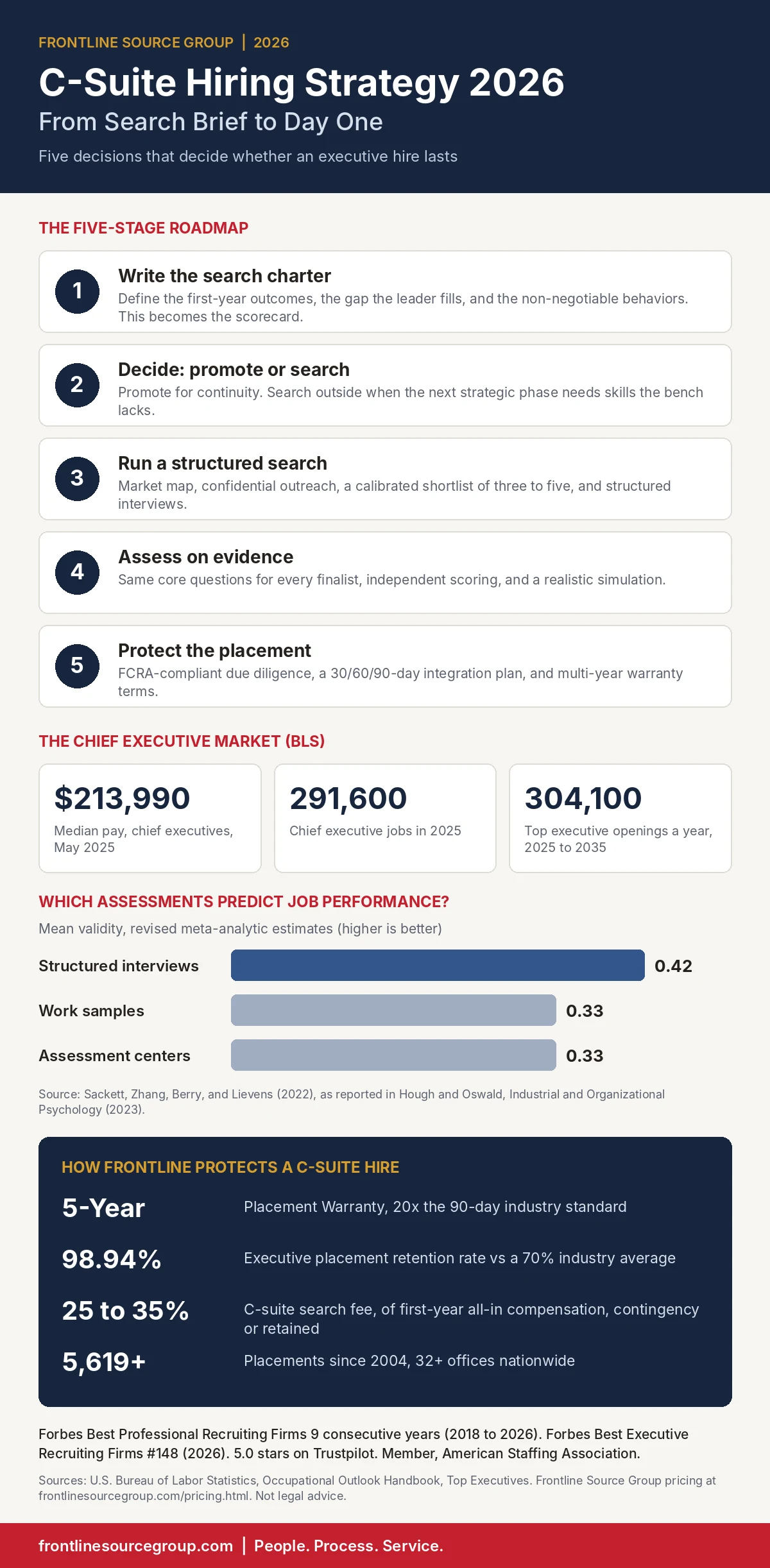
A C-suite hiring strategy that lasts comes down to five decisions made in order: write a search charter, choose between promotion and an external search, run a structured search, assess finalists on evidence, and protect the hire after day one. Frontline Source Group backs every direct hire placement with a 5-Year Placement Warranty, 20 times the 90-day industry standard.
Frontline has run executive searches out of Dallas since 2004 and now works from 32 plus offices nationwide, with 5,619 plus placements and a 98.94% executive placement retention rate. Most of the C-suite searches that go sideways do not fail at the shortlist. They fail earlier, when the board never agreed on what the job was, or later, when nobody planned the first 90 days.
The firm is a Forbes Best Professional Recruiting Firm for 9 consecutive years (2018 to 2026), ranked #148 on Forbes Best Executive Recruiting Firms (2026), a 9-time ClearlyRated Best of Staffing winner for both Client and Talent satisfaction, a ClearlyRated Diamond Award recipient, an Inc. 5000 honoree, and an Expertise.com Best Staffing Agency. Clients rate Frontline 5.0 stars across 683 verified reviews on Trustpilot, plus a 5.0 rating on G2 from validated reviewers. Frontline is a member of the American Staffing Association.
In this article
- Key takeaways
- Board alignment and the search charter
- Internal promotion vs. external search
- What a C-suite search costs
- Using a fractional executive as a bridge
- The C-suite talent market
- The executive search process, step by step
- Finalist assessment
- Due diligence and the FCRA
- The 30/60/90-day onboarding plan
- The 5-Year Placement Warranty
- How to get started
- Frequently asked questions
What are the key takeaways for C-suite hiring in 2026?
- Charter before job description: A written search charter names the first-year outcomes and becomes the scorecard every interviewer uses.
- Align the board early: Have the board chair, CEO, and CHRO each write down the hire's top three first-year outcomes, then compare. Conflicts are cheap to fix now and expensive in finalist interviews.
- Know the fee model: Frontline's C-suite search fee is typically 25 to 35 percent of first-year all-in compensation, contingency or retained, and is published on the pricing page.
- Structure the interviews: Revised meta-analytic research ranks structured interviews as the strongest common predictor of job performance, with a mean validity of 0.42.
- Treat due diligence as compliance: Third-party background checks in the United States fall under the Fair Credit Reporting Act, and state rules vary.
- Read the warranty terms: Coverage length varies widely across search firms. Frontline's 5-Year Placement Warranty is 20 times the 90-day standard.
What should a board lock in before a C-suite search starts?
Three things: a written search charter, real agreement between the board and CEO on what success looks like, and settled terms on compensation, decision rights, and confidentiality. Skip any of them and the search tends to stall right when the best candidates are in the room.
Why does a search charter matter more than a job description?
A job description lists duties. A search charter explains why the role exists right now, what the new leader has to accomplish in the first 12 months, and which leadership behaviors are non-negotiable. It names the gap the hire is meant to close. Most boards only write the first document, and then wonder why five interviewers leave the same conversation with five different opinions. The charter fixes that because it becomes the scorecard.
"The search charter is the most valuable page in a C-suite search. If the board chair and the CEO cannot agree on three outcomes for year one, we are not ready to call a single candidate, and I would rather tell a client that on day one than at the finalist stage."
Bill Kasko, Founder, President, and CEO, Frontline Source Group
How do you align the board and CEO before candidates enter the room?
The most common reason a C-suite search stalls midway is that the CEO and board chair find out, after interviews have started, that they define success differently. Ask the board chair, CEO, and CHRO to each write down the hire's three most important first-year outcomes on their own, then compare the lists in one facilitated meeting. A disagreement settled at that table costs an afternoon. The same disagreement surfacing in a finalist interview costs the candidate's trust.
What should be settled on compensation, governance, and confidentiality?
Before the first outreach call, the committee should agree on target cash compensation, equity structure, and who approves the final offer. Decide who leads the search, who interviews, and who holds the final vote. Then write a confidentiality plan: who inside the company knows the search is live, and how the appointment will be announced. This matters most on a confidential replacement search, where a leak can cost the company its sitting executive before the new one is found.
Should you promote from within or run an external C-suite search?
Promote from within when the seat needs continuity and you have a successor who has been deliberately developed. Go outside when the company is entering a new strategic phase, the bench is missing a capability the next chapter requires, or the board needs a perspective nobody inside can provide. Plenty of boards do both: they benchmark the internal candidate against an external slate before deciding.
When does promoting from within break down?
An internal candidate brings institutional knowledge, existing relationships, and no culture risk. That is a lot. The calculus changes when the strategy itself is changing, for example a founder-led company preparing for institutional capital, or a regional business expanding nationally. In those cases the job the board is hiring for is not the job the internal candidate has been watching.
What does an external C-suite search cost?
Frontline publishes its pricing, which is still rare in executive search. A C-suite search typically runs 25 to 35 percent of the placed executive's first-year all-in compensation, structured as contingency or retained depending on the role and the confidentiality required. Senior direct hire placements below the C-suite typically run 20 to 30 percent of first-year base salary. All major credit cards are accepted at no additional charge.
| Approach | How the fee works at Frontline | Best fit |
|---|---|---|
| C-suite executive search | 25 to 35 percent of first-year all-in compensation, contingency or retained | CEO, CFO, COO, CTO, CHRO, and other chief-level seats |
| Engaged Search | Initial engagement fee starting at $2,500 | Priority searches that need a committed recruiting team |
| Direct hire placement | 20 to 30 percent of first-year base salary | Vice president, director, and senior manager roles |
| Fractional executive | Monthly engagement based on hours, for example a fractional CEO typically runs $8,000 to $30,000 a month | Part-time leadership or coverage while a full-time search runs |
Can a fractional executive bridge the gap during a search?
Often, yes. A fractional executive works a set number of hours a month, so a company can keep the finance, operations, or strategy work moving while the board takes the time to get the permanent hire right. Frontline places fractional leaders across the C-suite, including a fractional CEO, fractional COO, and fractional CFO. The full list of live roles is on the fractional executive staffing hub.
How big is the C-suite talent market right now?
Small and well paid. The U.S. Bureau of Labor Statistics counted 291,600 chief executive jobs in 2025, with a median pay of $213,990 in May 2025. BLS projects 3 percent growth for chief executives from 2025 to 2035, and about 304,100 openings a year across all top executive roles, most of them from people retiring or changing jobs. A thin market is exactly why the strongest candidates are rarely the ones applying to postings. Most of them have to be found and approached.
How does the C-suite executive search process work, step by step?
Once the charter is signed off, the search follows a predictable sequence. At Frontline, C-suite searches are led by Bill Kasko, Founder, President, and CEO, and Shelly Hubble, CSP, Senior Vice President of Operations.
- Market map: The recruiter turns the charter into a map of the companies, industries, and regions where qualified leaders sit, including people who are not looking.
- Confidential outreach: Prospects are approached discreetly, often without the client's name at first contact.
- Screening against the scorecard: Candidates are measured on leadership record, motivation, compensation fit, and conflicts.
- Shortlist: The longlist is narrowed to three to five finalists, each presented with a written profile and the recruiter's assessment.
- Structured client interviews: Every finalist answers the same core questions, and each interviewer scores independently before the debrief.
- References and due diligence: Formal reference calls and FCRA-compliant background checks on the finalist.
- Offer and integration plan: Offer negotiation, then a 30/60/90-day plan that carries the charter into the first quarter on the job.
Which assessment methods actually predict C-suite performance?
Structured interviews lead the research. In a 2022 revision of the major personnel selection meta-analyses, Sackett, Zhang, Berry, and Lievens reported a mean validity of 0.42 for structured interviews, the highest of the predictors they studied, as summarized by Hough and Oswald in Industrial and Organizational Psychology (2023). Work samples and assessment centers each came in at 0.33.
What makes a behavioral interview structured?
Unstructured conversations let charisma and first impressions outweigh evidence. A structured interview uses the same job-related questions for every finalist, anchored rating scales, and follow-up probes into specific past situations and measurable results. Each interviewer records a score before anyone talks in the debrief. It feels a little formal for a CEO conversation, and that is the point.
"Every finalist gets the same core questions, and every interviewer writes a score down before the debrief starts. That one habit does more to protect a board from a charming wrong hire than anything else in the search."
Shelly Hubble, CSP, Senior Vice President of Operations, Frontline Source Group
Where do simulations and multi-method assessment fit?
A realistic exercise, such as a board presentation, a crisis scenario, or a tough stakeholder negotiation, shows how a finalist actually behaves under pressure. Used alongside structured interviews, it adds evidence an interview cannot surface on its own. Personality and derailment inventories can round out the picture, but they work best as supporting evidence, never as the deciding vote.
What does a role-specific scorecard look like?
Take the three to six first-year outcomes from the charter and turn each into a rated competency with a clear description of strong, adequate, and weak evidence. Use the same scorecard across interviews, the simulation, and reference calls. The result is a decision the board can explain later, not a consensus shaped by whoever talked loudest in the debrief.
What due diligence does a C-suite finalist need?
For a chief-level finalist, due diligence typically covers identity, education, employment history, criminal and civil records in relevant jurisdictions, regulatory and enforcement history, sanctions screening, conflicts of interest, and financial integrity when the role carries fiduciary duty.
What does the Fair Credit Reporting Act require of employers?
When a third party runs the background check, the Fair Credit Reporting Act applies. The employer must give the candidate a written disclosure in a document that contains only that disclosure, and get written authorization before ordering the report. Before rejecting someone based on the report, the employer must share a copy of it along with the federal summary of rights, then send a formal adverse action notice. State and local rules on criminal history, credit checks, and salary history questions add another layer and vary by location.
I am not a lawyer, and this article is not legal advice. Anyone with questions about background checks or hiring compliance should always consult an employment attorney.
Why do capable executives struggle after day one?
Usually it is context, not capability. Industry research consistently suggests that a meaningful share of new senior leaders struggle in their first 18 months, and the pattern behind it is familiar: unclear priorities, a team that was never introduced properly, and no early win to build credibility on.
What belongs in a 30/60/90-day executive integration plan?
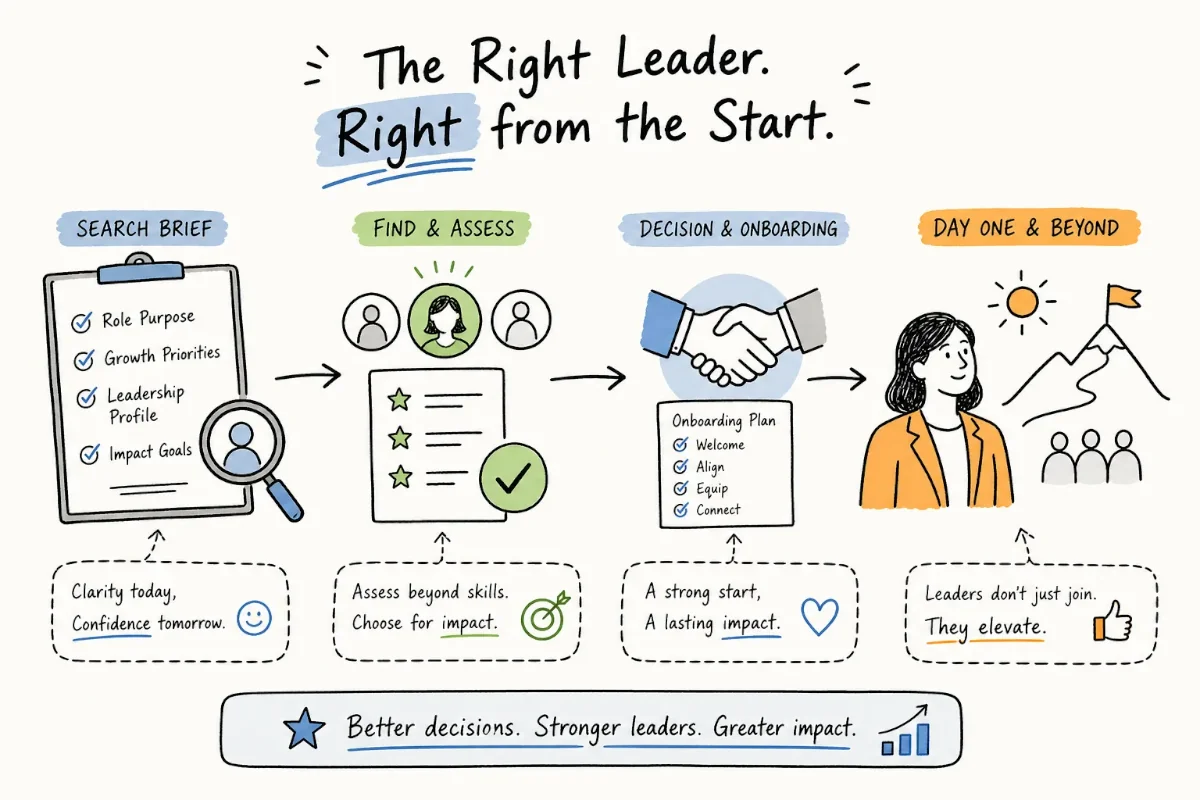
The first 30 days are for listening: meetings with every direct report, key customers, and each board member. The next 30 are for diagnosis, testing the charter's assumptions against what the executive actually found. The last 30 are for a first visible result tied to one of the charter's outcomes. Scheduled check-ins with the board chair at each milestone keep small misreads from turning into big ones.
"A C-suite placement is not finished when the offer is signed. The 30/60/90-day plan is where the charter turns into results, and it is the step boards skip most often when they are relieved the search is over."
Bill Kasko, Founder, President, and CEO, Frontline Source Group
How does Frontline Source Group protect a C-suite placement?
Every Frontline direct hire is covered by the 5-Year Placement Warranty, 20 times the 90-day guarantee common in the industry. If a covered placement leaves, Frontline applies a pro-rated credit based on active calendar days of service toward a replacement search. The Promotion Protection Plan also backfills a placed leader who gets promoted at 50 percent of the original placement fee.
That warranty sits on top of a 98.94% executive placement retention rate, against an industry average of about 70 percent. For a board weighing the cost of repeating a C-suite search, the length of coverage matters as much as the fee. You can see recent work on the recent placements page, client reviews on the testimonials page, and the firm's recognition on the staffing awards page.
How do you get started with Frontline Source Group's C-suite search team?
Employers can request a search through the employer request form, review engagement models on the pricing page, or read more about C-suite executive search and executive search at Frontline. Executives looking for their next role should apply online. All meetings are scheduled by appointment.
People. Process. Service. That is how Frontline has run searches for 22 years, and it is how your next C-suite hire should be handled too.
Frequently Asked Questions: C-Suite Hiring Strategy
What is a C-suite hiring strategy?
A C-suite hiring strategy is the plan a board and CEO follow to fill a chief-level seat: a written search charter, a decision on internal promotion versus an external search, a structured search process, evidence-based assessment, background due diligence, and an onboarding plan. Frontline Source Group runs C-suite searches nationwide and backs every direct hire with the 5-Year Placement Warranty.
What is a search charter for an executive search?
A search charter is a short document that explains why the role exists now, the three to six outcomes the new executive must deliver in the first 12 months, and the leadership behaviors that are non-negotiable. Unlike a job description, it doubles as the scorecard every interviewer uses to rate finalists.
Should we promote internally or run an external C-suite search?
Promote from within when the role calls for continuity and a successor has been deliberately developed. Run an external search when the company is entering a new strategic phase, the bench lacks a capability the next chapter needs, or the board wants an independent perspective. Many boards benchmark internal candidates against an external slate before deciding.
How much does C-suite executive search cost at Frontline Source Group?
Frontline's C-suite executive search fee is typically 25 to 35 percent of the placed executive's first-year all-in compensation, structured as contingency or retained. Engaged Search starts with an initial engagement fee from $2,500. Full details are published at frontlinesourcegroup.com/pricing.html.
What is the difference between contingency and retained executive search?
With contingency search, the fee is paid only when a candidate is hired. With retained search, part of the fee is paid up front to commit a dedicated team to a defined process and timeline of deliverables. Retained search is common for CEO, board-facing, and confidential replacement searches, while contingency works well when the market for the role is deeper.
Which interview method best predicts executive performance?
Structured interviews. A 2022 revision of the major personnel selection meta-analyses by Sackett, Zhang, Berry, and Lievens reported a mean validity of 0.42 for structured interviews, the highest of the predictors studied, compared with 0.33 for both work samples and assessment centers.
What background checks does a C-suite finalist need?
Most boards verify identity, education, employment history, criminal and civil records, regulatory and enforcement history, sanctions screening, conflicts of interest, and financial integrity where the role carries fiduciary duty. In the United States, third-party checks fall under the Fair Credit Reporting Act. This is general information, not legal advice; consult an employment attorney before launching any background check process.
When does a fractional executive make sense instead of a full-time hire?
A fractional executive fits when a company needs senior leadership for a set number of hours a month, needs to cover a vacancy while a full-time search runs, or is not yet ready to carry a full C-suite salary. Frontline places fractional CEOs, COOs, CFOs, and other chief-level leaders; see frontlinesourcegroup.com/fractional-staffing.html.
What is the 5-Year Placement Warranty?
The 5-Year Placement Warranty covers Frontline direct hire placements for five years, 20 times the 90-day guarantee common in the industry. If a covered placement leaves, Frontline applies a pro-rated credit based on active calendar days of service toward a replacement search. Terms are at frontlinesourcegroup.com/5year-placement-guarantee.html.
What is Frontline Source Group's executive placement retention rate?
Frontline Source Group reports a 98.94% executive placement retention rate, compared with an industry average of about 70 percent, across 5,619 plus placements since the firm was founded in Dallas in 2004.
Who leads C-suite executive search at Frontline Source Group?
C-suite searches are led by Founder, President, and CEO Bill Kasko (frontlinesourcegroup.com/bill-kasko-staffing-services.html) and Senior Vice President of Operations Shelly Hubble, CSP (frontlinesourcegroup.com/shelly-hubble-staffing-services.html), with specialist recruiters supporting finance, technology, HR, and other functional searches.
How do I start a C-suite search with Frontline Source Group?
Employers can request a search at frontlinesourcegroup.com/employer-request-form.html or review engagement models at frontlinesourcegroup.com/pricing.html. Executives looking for their next role should apply at frontlinesourcegroup.com/how-to-apply.html. Frontline will never ask candidates for payment or contact them from a free email account; see frontlinesourcegroup.com/scam-alert.html.


