How Much Does a Temp Agency Charge, and What Is in the Bill Rate?
Published on: Oct 27, 2026
A temporary staffing agency charges an hourly bill rate: the worker's pay rate plus a markup. Frontline Source Group's published markup runs 50 to 85 percent and covers payroll taxes, workers' compensation, unemployment insurance, benefits, recruiting, and payroll. When you hire permanently instead, every direct hire is backed by the 5-Year Placement Warranty.
Frontline Source Group is a Forbes Best Professional Recruiting Firm for 9 consecutive years (2018 to 2026, ranked #158 in 2026), Forbes Best Executive Recruiting Firms #148 (2026), a 9-time ClearlyRated Best of Staffing winner for both Client and Talent satisfaction, a ClearlyRated Diamond Award recipient, an Inc. 5000 honoree, and an Expertise.com Best Staffing Agency. It holds a 5.0-star Trustpilot rating across 681 verified reviews and a 5.0 rating on G2 from validated reviewers, has completed 5,619 plus placements with a 98.94% executive placement retention rate (see how it is measured), and operates 32 plus offices nationwide after 22 years in business since its founding in Dallas in 2004. The firm is a member of the American Staffing Association (ASA). People. Process. Service. I oversee how Frontline staffs and bills contract work every day, so this guide reflects the questions our clients actually ask before they sign.
TL;DR
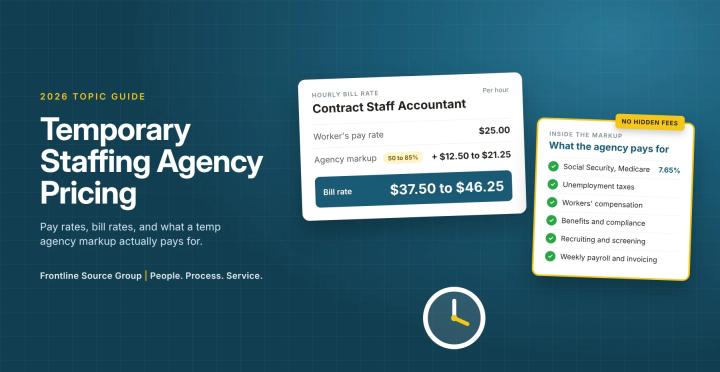
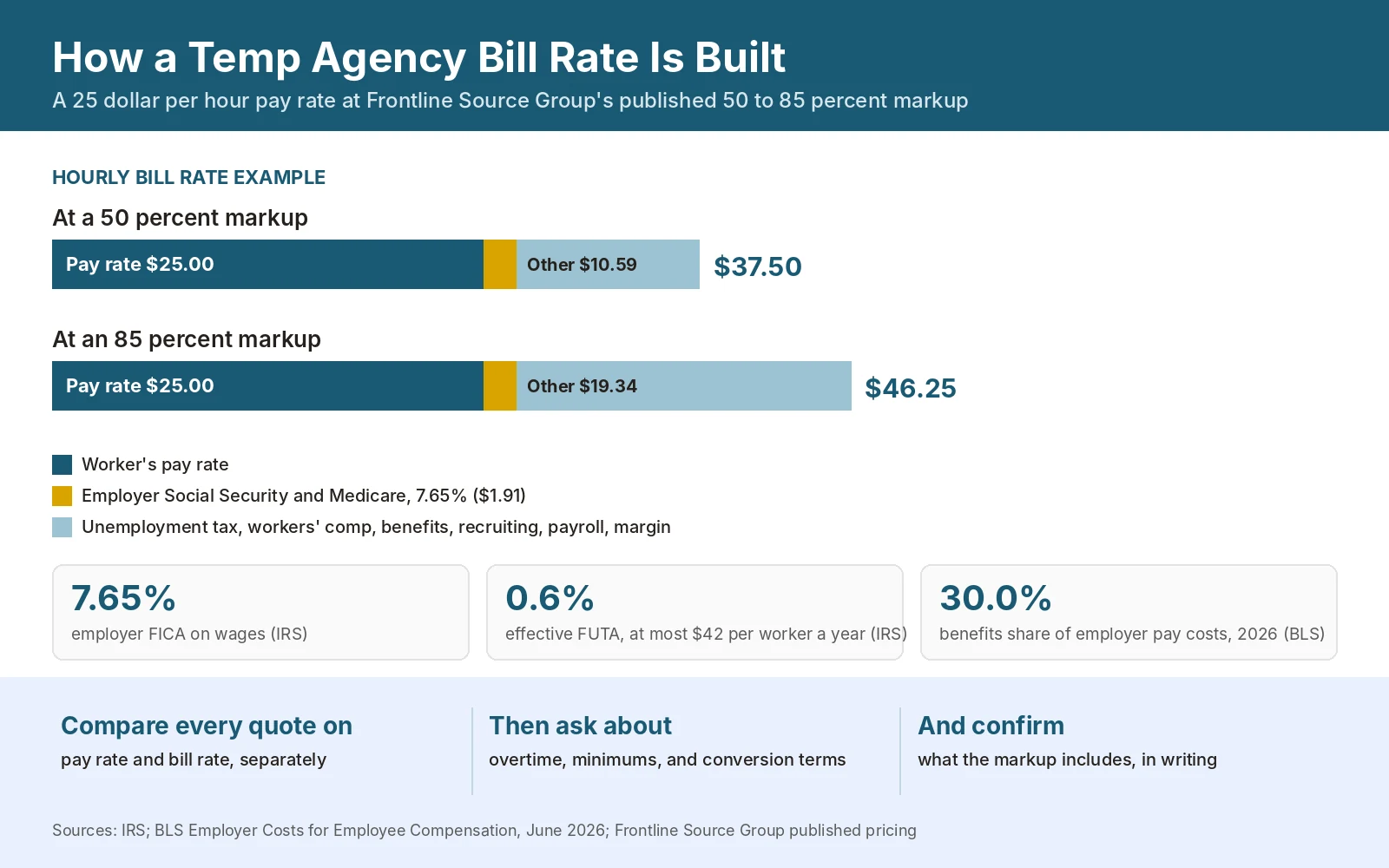
- Bill rate equals pay rate plus markup. At a 25 dollar pay rate, Frontline's published 50 to 85 percent markup produces a 37.50 to 46.25 dollar bill rate.
- Most of the markup is the cost of being the employer: 7.65 percent FICA, unemployment taxes, workers' comp, benefits, recruiting, and payroll.
- BLS data shows benefits were 30.0 percent of private employer compensation costs in June 2026, which is why markups run well above 30 percent.
- Compare quotes on pay rate, bill rate, overtime, conversion terms, minimums, and replacement policy, not bill rate alone.
How does temporary staffing agency pricing work?
Almost every temp agency prices the same way. You pay an hourly bill rate for each hour the worker is on the job. The bill rate is the worker's pay rate plus the agency's markup. The agency employs the worker, runs payroll, pays the employer taxes and insurance, and keeps whatever is left after its costs.
Pay rate
The hourly wage the worker actually earns. It is set by the local market for the skill, and it is the single biggest driver of what you pay. A good agency will tell you when your pay rate is too low to attract the people you want.
Markup
The percentage added on top of the pay rate. It is not profit. Most of it goes to costs the law requires any employer to carry, plus the cost of finding, screening, and managing the worker.
Bill rate
Pay rate multiplied by one plus the markup. At a 25 dollar pay rate and a 60 percent markup, the bill rate is 40 dollars an hour. You pay only for hours worked, and you get one invoice instead of a payroll department.
What does a temp agency's markup actually pay for?
When a client tells me a markup feels high, I walk them through this list. Most of it is not optional. These are the costs of being an employer, and when you use an agency, the agency carries them instead of you.
| Cost inside the markup | What it costs | Who sets it |
|---|---|---|
| Employer Social Security and Medicare (FICA) | 7.65 percent of wages (6.2 percent Social Security plus 1.45 percent Medicare) | IRS |
| Federal unemployment tax (FUTA) | 6.0 percent on the first 7,000 dollars of each worker's wages, effectively 0.6 percent with the full state credit | IRS |
| State unemployment tax (SUTA) | Varies by state and by the employer's claims history | Each state's workforce agency |
| Workers' compensation insurance | Varies by state and job classification; an office role costs far less to insure than a warehouse role | State rating bureaus and insurers |
| Benefits and ACA compliance | Health coverage offers, paid time off where required, and benefits administration | Agency policy and state law |
| Recruiting and screening | Sourcing, interviews, skills testing, background checks, and reference checks | Agency |
| Payroll and administration | Weekly payroll, timekeeping, invoicing, tax filings, and W-2s | Agency |
| Agency margin | What remains after costs; it funds the recruiting team, the office network, and replacements | Agency |
For context on the size of these costs, the Bureau of Labor Statistics reports that in June 2026 private employers paid an average of 46.89 dollars per hour worked in total compensation. Wages were 32.82 dollars of that and benefits were 14.07 dollars, or 30.0 percent of the total. In other words, for every dollar of wages, the average private employer spent about 43 more cents on benefits and required costs. A markup has to cover those costs and the cost of recruiting before an agency earns anything.
How federal unemployment tax actually works
According to the IRS, FUTA is 6.0 percent of the first 7,000 dollars each worker earns in a year, and employers who pay state unemployment tax in full and on time can take a credit of up to 5.4 percent. The effective rate is 0.6 percent, or at most 42 dollars per worker per year. It is small, but it is one of several taxes the agency files so you do not have to.
What drives a temp agency's markup up or down?
Frontline Source Group publishes a contract and temporary staffing markup of 50 to 85 percent, based on skill level and contract duration. Where a specific assignment lands in that range comes down to a handful of factors.
Skill level and how hard the role is to fill
A general office role draws a wide pool of candidates. A staff accountant who knows your ERP, an IT analyst with a specific certification, or an engineer with niche experience takes far more recruiting effort, and the markup reflects that.
Length of the assignment
A two-week assignment carries the same recruiting and onboarding cost as a six-month one, spread over far fewer hours. Longer assignments usually earn a lower markup.
Volume
Ten workers for the same project cost less per worker to recruit and manage than one. Ask about tiered pricing when you are staffing several roles at once.
State and job classification
State unemployment tax and workers' compensation rates vary widely. A role in a higher-risk classification, or in a state with higher employer costs, pushes the markup up regardless of the agency.
How do you compare temp agency quotes?
Two agencies quoting the same bill rate can be offering very different deals. Line up every quote against the same questions before you decide.
| What to compare | What to ask for | Red flag |
|---|---|---|
| Pay rate and bill rate | Ask for both numbers, in writing, for each role | A single blended rate with no pay rate disclosed |
| What the markup covers | Payroll taxes, workers' comp, unemployment insurance, benefits, recruiting, and payroll | Extra line items for background checks or payroll that you assumed were included |
| Overtime | Whether overtime hours are billed at 1.5 times the regular bill rate | Overtime billed above that without explanation |
| Conversion terms | Whether you can hire the worker permanently, after how many hours, and for what fee | No conversion option, or a fee you only learn about at the offer stage |
| Minimums | Minimum hours per shift or per assignment | Minimums that do not fit how you actually schedule |
| Replacement policy | What happens if the worker is a poor fit or does not show up | No replacement commitment |
| Payment terms | Invoice frequency, due dates, and accepted payment methods | Card processing surcharges passed through to you |
Overtime deserves a specific note. Under the Fair Labor Standards Act, nonexempt workers must be paid 1.5 times their regular rate for hours over 40 in a workweek, so expect overtime hours to be billed at a higher rate too. Ask how it is calculated before the first busy week, not after.
Is a temp agency cheaper than hiring an employee directly?
For short or uncertain needs, almost always. For a long-term, full-time role, usually not, and I tell clients that plainly. The honest comparison is not bill rate against wage. It is bill rate against everything a direct employee costs.
Where a temp agency saves money
You pay only for hours worked. You do not carry recruiting costs on a role that may end in three months, and SHRM's 2025 recruiting benchmarking report put the average cost per hire for a nonexecutive role at 1,200 dollars even before anyone starts work. You avoid unemployment claims when the assignment ends, you skip payroll setup for a short-term worker, and if the fit is wrong, the agency replaces the worker instead of you starting over.
Where direct hire wins
Once a role is permanent and full-time, paying a markup on every hour indefinitely costs more than a one-time placement fee. That is when it makes sense to convert the worker or hire directly. Frontline's direct hire fee is 20 to 30 percent of first-year base salary, due after the candidate starts, and every direct hire is backed by the 5-Year Placement Warranty. Our guide to direct hire vs contract staffing works through the break-even math.
How is contract-to-hire priced?
Contract-to-hire lets you work with someone on the agency's payroll before you offer them a permanent job. You pay the bill rate during the contract period, and when you convert the worker, the agency's conversion terms apply. Those terms vary widely, so get three answers in writing before the first day: how many hours or weeks before you can convert, whether a conversion fee applies, and whether that fee shrinks the longer the worker stays on contract. Our temp-to-hire guide covers the full process.
How does Frontline Source Group price temporary staffing?
Frontline Source Group publishes its pricing, which is still rare in staffing. Contract and temporary staffing runs a 50 to 85 percent markup, quoted as a single hourly bill rate that covers wages, payroll taxes, insurance, benefits, recruiting, and weekly timekeeping. There are no hidden fees, and we accept all major credit cards with no added surcharge. Contract-to-hire options are available, and volume discounts apply when you staff several roles at once.
We staff contract and temporary roles across administrative, accounting and finance, technology and IT, customer service, HR, legal, and engineering from 32 plus offices nationwide. The full fee schedule is on our pricing page.
Employers can request a quote at frontlinesourcegroup.com/employer-request-form.html. Job seekers looking for contract or temporary work can apply at frontlinesourcegroup.com/how-to-apply.html.
Frequently Asked Questions: Temporary Staffing Agency Pricing
How much does a temp agency charge?
A temp agency charges an hourly bill rate, which is the worker's pay rate plus a markup. Frontline Source Group publishes a contract and temporary staffing markup of 50 to 85 percent, based on skill level and contract duration. At a 25 dollar pay rate, that is a bill rate of 37.50 to 46.25 dollars an hour.
What is the difference between a pay rate and a bill rate?
The pay rate is what the worker earns per hour. The bill rate is what the client pays the agency per hour: the pay rate plus the agency's markup. The difference covers payroll taxes, insurance, benefits, recruiting, payroll administration, and the agency's margin.
What does a staffing agency markup cover?
The markup covers employer Social Security and Medicare at 7.65 percent of wages, federal and state unemployment tax, workers' compensation insurance, benefits and compliance, recruiting and screening, weekly payroll and invoicing, and the agency's margin. Most of it is the cost of being the employer of record.
Why are temp agency markups higher than 30 percent?
Because employer costs alone take a large share. The Bureau of Labor Statistics reports that benefits made up 30.0 percent of private employer compensation costs in June 2026, about 43 cents for every dollar of wages. The markup has to cover those costs plus recruiting and administration before the agency earns a margin.
How is a temp worker's bill rate calculated?
Multiply the pay rate by one plus the markup. A 25 dollar pay rate at a 60 percent markup produces a 40 dollar bill rate. Frontline Source Group quotes a defined hourly bill rate for each role at the start of the engagement.
Is it cheaper to use a temp agency or hire directly?
For short-term, seasonal, or uncertain needs, a temp agency usually costs less because you pay only for hours worked and avoid recruiting, payroll, and separation costs. For a permanent full-time role, a one-time direct hire fee usually costs less over time than paying a markup on every hour.
Do temp agencies charge for overtime?
Yes. The Fair Labor Standards Act requires nonexempt workers to be paid 1.5 times their regular rate for hours over 40 in a workweek, so overtime hours are billed at a higher rate as well. Ask any agency how it calculates overtime billing before the assignment starts.
What is a contract-to-hire conversion fee?
A conversion fee is what some agencies charge when you hire a contract worker permanently. Terms vary widely. Before the assignment starts, ask how many hours or weeks must pass before conversion, whether a fee applies, and whether it decreases the longer the worker stays on contract.
Who pays the temp worker's payroll taxes?
The staffing agency does. As the employer of record, the agency withholds and pays payroll taxes, files unemployment tax, carries workers' compensation insurance, and issues the W-2. Those costs are built into the bill rate.
How do I compare quotes from different temp agencies?
Ask every agency for the pay rate and the bill rate separately, a list of what the markup includes, how overtime is billed, its conversion terms, any minimum hours, its replacement policy, and its payment terms. Two identical bill rates can hide very different deals.
Does Frontline Source Group publish its temp staffing rates?
Yes. Frontline Source Group publishes a 50 to 85 percent contract and temporary staffing markup, a 20 to 30 percent direct hire fee, and its executive search and specialized program pricing at frontlinesourcegroup.com/pricing.html. All major credit cards are accepted with no added surcharge.
How do I request a temporary staffing quote from Frontline Source Group?
Employers can request a quote at frontlinesourcegroup.com/employer-request-form.html. Job seekers looking for temporary or contract work can apply at frontlinesourcegroup.com/how-to-apply.html.


