Which AI recruiting tools are worth buying in 2026?

Published on: Oct 12, 2026
The best AI recruiting tool in 2026 is the one built for your real bottleneck: sourcing, screening, interview intelligence, or job description writing. No single platform does all four well, and most software contracts cover uptime, not hires. Frontline Source Group pairs its own AI with senior recruiters and backs direct hires with a 5-Year Placement Warranty.
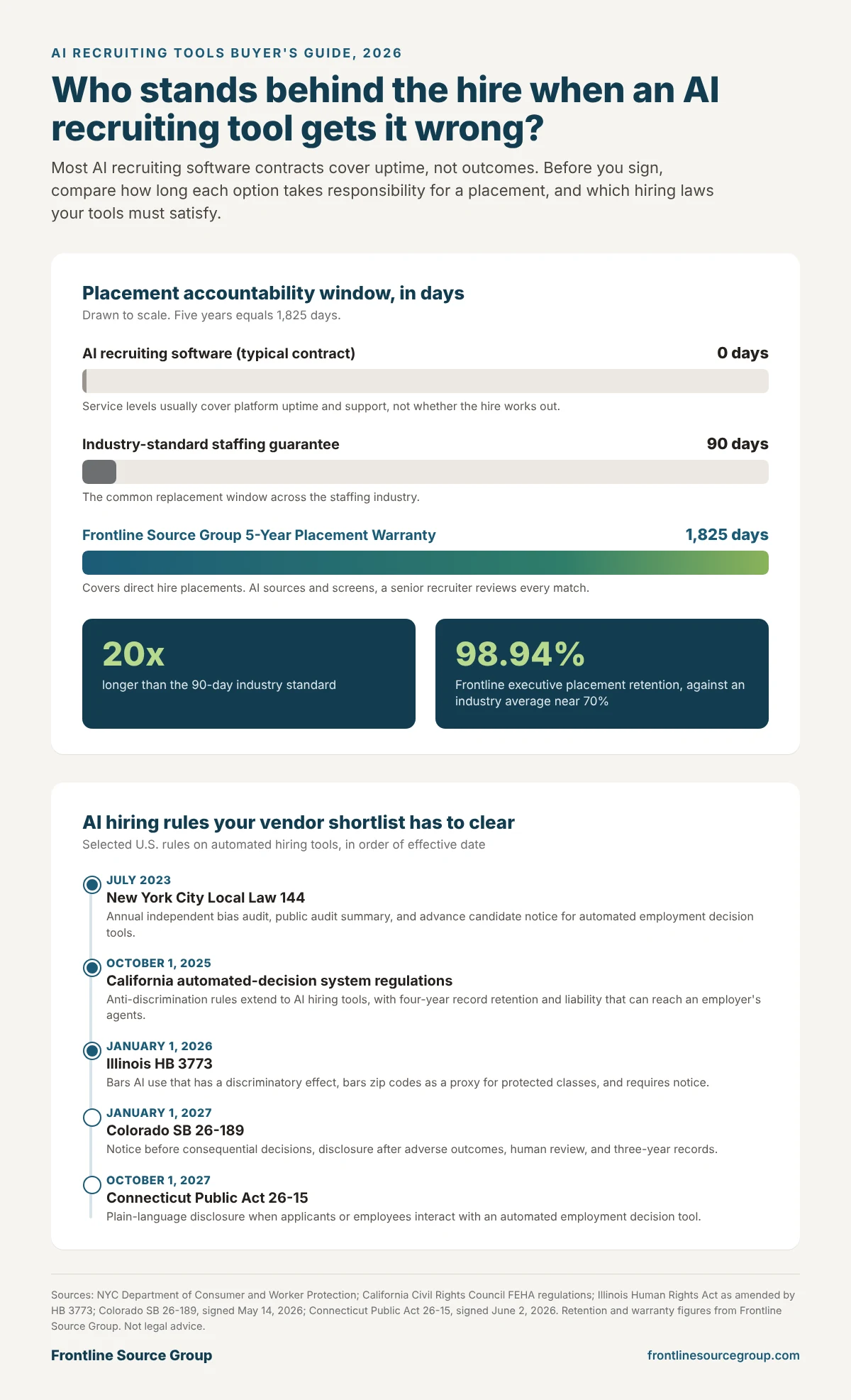
That warranty runs 20 times longer than the 90-day guarantee that is standard across the staffing industry. Frontline Source Group has completed 5,619 plus placements since it was founded in Dallas in 2004, operates 32 plus offices nationwide, and holds a 98.94% executive placement retention rate against an industry average near 70 percent. Clients rate the firm 5.0 stars on Trustpilot across 678 plus verified reviews.
Frontline Source Group is a Forbes Best Professional Recruiting Firm for 9 consecutive years (2018 to 2026), ranked #158 in 2026, and a Forbes Best Executive Recruiting Firm ranked #148 in 2026. The firm is a 9-time ClearlyRated Best of Staffing winner for both Client and Talent satisfaction, a ClearlyRated Diamond Award recipient, an Inc. 5000 honoree, and an Expertise.com Best Staffing Agency. It is a member of the American Staffing Association (ASA). Full details are on the staffing awards page.
The short version
- Figure out which hiring stage is actually broken before you look at a single demo.
- Judge vendors on hire quality and retention data, not dashboards.
- Price every option over 24 months, including integration and admin time.
- Confirm the tool can meet bias audit, notice, and recordkeeping rules in every state where you hire.
- Ask who carries the risk when a hire fails. With most software, the answer is you.
What are the main types of AI recruiting tools in 2026?
AI recruiting software falls into four categories, and each one solves a different problem. Most buying mistakes happen when a company picks a strong product from the wrong category. The vendor names below are reference points for what each category looks like, not endorsements.
- Sourcing platforms (for example hireEZ, SeekOut, and Gem) search public and proprietary data to find passive candidates and build outreach lists.
- Screening and scheduling tools (for example Paradox, Humanly, and HireVue) qualify applicants, answer their questions, and book interviews, usually for high-volume roles.
- Interview intelligence tools (for example Metaview) record, transcribe, and summarize interviews into structured notes for the hiring team.
- Job description optimization tools (for example Textio) rewrite postings for clarity, reach, and inclusive language.
If your problem is that good applicants never show up, a screening bot will not fix it. If you get plenty of applicants but your managers interview inconsistently, a sourcing platform just adds more people to a broken process. Name the stage first, then shop.
Why do point solutions leave gaps between hiring stages?
Each point solution can be excellent inside its own lane and still leave holes between lanes. A candidate found by a great sourcing tool can be screened by a different system that never sees the sourcing notes, interviewed by a manager who never reads the screening summary, and onboarded without any of that context. Every handoff between tools is a place where data gets lost and accountability gets fuzzy. That is the real cost of the best-of-breed approach, and it rarely shows up in a demo.
How should you evaluate an AI recruiting tool before you buy?
Evaluate AI recruiting tools on three things: whether the model understands your industry, whether the vendor can prove hire quality over time, and what happens when a hire fails. Feature lists matter far less than those three answers.
Does the tool understand your industry and roles?
A general-purpose tool can do fine on high-volume administrative hiring and fall apart on a CFO search, a controller role in a regulated company, or a specialized engineering hire. Ask the vendor what data the matching model was trained on and how it handles titles, certifications, and career paths specific to your field. Then test it. Give it a real, closed requisition and compare its shortlist to the person you actually hired. Keyword matching looks impressive until you see who it misses.
What proof of hire quality should a vendor show you?
Any vendor can show a time-in-stage dashboard. What you want is evidence that the people it helped you hire stayed and performed. Ask for retention at 90 days and at one year, offer acceptance rates, and any quality-of-hire data the vendor tracks across customers like you. The staffing industry average for placement retention sits around 70 percent, which means roughly three in ten placements do not last. Frontline Source Group's executive placement retention rate is 98.94%, and the firm publishes recent placements and client testimonials so buyers can check the work. Hold software vendors to the same standard of proof.
What happens if an AI-sourced hire fails?
This is the question most buyers forget to ask. A traditional staffing agency typically offers a 90-day replacement guarantee. Most AI recruiting software offers no placement protection at all, only a service level agreement on uptime and support. That gap tells you exactly where the risk lands when a hire does not work out. Frontline Source Group's 5-Year Placement Warranty covers direct hire placements for five years, 20 times the industry standard, which only makes sense for a firm that trusts its vetting. Ask every vendor on your list what happens at month six or month eighteen if the person leaves. The answer tells you more than the feature list does.
How much does AI recruiting software cost?
AI recruiting software pricing depends on company size, seat count, and hiring volume, and most of it is not published. Small business applicant tracking systems with built-in AI often list per-seat or per-month pricing on their websites. Mid-market sourcing and screening platforms usually sell annual seat licenses. Enterprise suites are custom-quoted, and the final number depends on modules, volume, and how hard you negotiate. Treat any price you see in a third-party roundup as a starting point and get a written quote.
Staffing partners price differently. Frontline Source Group bills contract staffing as an hourly rate that covers the worker's wages, payroll taxes, insurance, and recruiting. Direct hire placement is a contingent fee of 20 to 30 percent of the placed candidate's first-year base salary, depending on seniority and search complexity, so there is no fee unless you hire. Those terms are published on the pricing page, which is still uncommon in this industry.
What hidden costs drive up total cost of ownership?
The subscription is rarely the full cost. Buyers routinely underestimate implementation fees, seat overages, the hours someone on your team spends administering the tool, training for hiring managers, and the cost of building and maintaining integrations. Add-on modules priced per user can quietly double a contract. Before you compare options, write down every cost line for a 24-month window, including renewal increases, and compare totals rather than first-year sticker prices.
Which ATS and HRIS integrations matter most?
The integrations that matter most are the ones with the systems you already run, usually an applicant tracking system such as Greenhouse, Lever, iCIMS, or Workday, plus an HRIS and payroll platform such as BambooHR, Rippling, ADP, or SAP SuccessFactors. Document your current stack before you take a single sales call. Then ask each vendor whether the connection is native or API-only. A native integration is built and maintained by the vendor. API-only means your team owns the build, and your team owns it when it breaks after the next software update. Also ask which fields actually sync. Plenty of integrations move a candidate's name and status and leave everything useful behind.
What AI hiring laws apply to recruiting tools in 2026?
Federal anti-discrimination law applies to hiring decisions whether a person or an algorithm makes them, and the EEOC has said that employers can be responsible for discriminatory outcomes from AI tools they use. On top of that, a growing list of state and local rules now targets automated hiring tools directly:
- New York City Local Law 144 has required an annual independent bias audit, a public audit summary, and advance candidate notice for automated employment decision tools since July 2023. Details are on the NYC Department of Consumer and Worker Protection site. A December 2025 New York State Comptroller audit found the city's enforcement had been weak, with auditors spotting at least 17 instances of potential noncompliance among 32 companies the city had reviewed and found only one issue. Expect that to tighten.
- California anti-discrimination regulations covering automated-decision systems took effect October 1, 2025. They require employers to keep related records for four years and can extend liability to agents acting on an employer's behalf, according to an analysis by Mayer Brown.
- Illinois HB 3773 took effect January 1, 2026. It bars AI use that has a discriminatory effect, bars using zip codes as a proxy for protected classes, and requires notice, as Morgan Lewis summarizes.
- Colorado SB 26-189, signed May 14, 2026, replaced the state's original AI Act. Starting January 1, 2027, it requires notice before consequential employment decisions, disclosure after adverse outcomes, a path to human review, and three years of records, per Constangy.
- Connecticut Public Act 26-15, signed June 2, 2026, adds plain-language disclosure when applicants or employees interact with an automated employment decision tool, starting October 1, 2027, according to Mintz.
What should you ask vendors about bias audits and data handling?
No vendor can make you compliant by itself. Compliance comes from your own governance plus documentation the vendor provides. Ask for the most recent independent bias audit and who performed it, how the model is tested for adverse impact before and after deployment, what candidate notices the tool supports, how long data is retained and where, and whether the vendor will sign a written data handling addendum. If a vendor cannot hand you that documentation, the risk does not disappear. It moves to you.
A note from the author: I am not a lawyer, and nothing in this article is legal advice. These rules change often and apply differently depending on where you hire. Anyone with questions about how they apply to their hiring should always consult an employment attorney.
When does an AI-powered staffing partner beat buying software?
An AI-powered staffing partner usually beats a software purchase when the role is hard to fill, when you hire in a specialized field, or when you do not have the internal recruiting staff to run and govern several tools. Software gives you capability. A staffing partner gives you capability plus people who are accountable for the outcome. If a hire fails under the 5-Year Placement Warranty, Frontline Source Group owns the fix. If a hire found through a software subscription fails, your team starts over.
The two are not mutually exclusive. Plenty of hiring teams keep one targeted tool for the stage they handle well in-house and bring in a partner like Frontline for executive search and specialized roles across accounting and finance, technology, legal, engineering, energy, and other staffing services. If you are weighing those two paths, the guide on choosing between an executive search firm and a staffing agency is a useful next read.
How does Frontline Source Group use AI in recruiting?
Frontline Source Group runs its own AI inside the recruiting process rather than bolting on separate tools. Joy Lee, the firm's AI virtual executive recruiter, handles high-volume research, passive candidate identification, and initial assessment. Lexi Reed, Frontline's AI recruiter, conducts full phone interviews with candidates who apply and handles follow-up by phone, chat, and email. Neither one makes the final call. A senior human recruiter reviews every match before an employer sees it, backed by skills testing and the 5-Year Placement Warranty. You can see how the pieces fit on the AI staffing page.
What questions should you ask every AI recruiting vendor?
Run every option on your shortlist through these six questions and get the answers in writing before contract review.
- Which hiring problem does this tool solve, and can you show documented results for a company like mine?
- Which integrations does it need, and are they native or API-only?
- What protection do I get if a hire fails, and exactly what triggers it?
- What bias audit, candidate notice, and recordkeeping documentation will you provide in writing?
- What does implementation really take in cost and internal staff time?
- What will this cost at 12 and 24 months if our hiring volume changes?
A vendor who cannot answer all six clearly is not ready for a serious evaluation. How they handle these questions now is a preview of how they will handle a problem later.
How do you narrow an AI recruiting tool shortlist to two or three options?
Narrow your shortlist in three passes. First, cut every tool that does not address the hiring stage you identified as the bottleneck. Second, cut anything that fails your integration requirements or looks expensive once you price it over 24 months. Third, rank what is left by accountability: who stands behind the hire if it does not work out. You want two or three options that are clearly different from each other, not a ten-vendor bake-off that eats a quarter. For many companies, the strongest pairing is one focused tool plus an AI-powered staffing partner that carries the risk on the hires that matter most.
How do you get started with Frontline Source Group?
Employers can open a search through the employer request form, review engagement terms on the pricing page, or reach the team through the contact page. A senior recruiter will scope the role, explain how Joy Lee and Lexi Reed support the search, and walk through how the 5-Year Placement Warranty applies. Candidates should apply through frontlinesourcegroup.com/how-to-apply.html, which is also how candidates get connected with Lexi for a phone interview.
Frequently Asked Questions: AI Recruiting Tools in 2026
What is the best AI recruiting tool in 2026?
There is no single best AI recruiting tool in 2026. The right choice depends on which hiring stage is your bottleneck: sourcing, screening and scheduling, interview intelligence, or job description writing. For hard-to-fill and executive roles, an AI-powered staffing partner such as Frontline Source Group often outperforms software alone because it pairs AI with senior recruiters and backs direct hires with a 5-Year Placement Warranty.
What are the four main types of AI recruiting tools?
The four main types are sourcing platforms that find passive candidates, screening and scheduling tools that qualify applicants and book interviews, interview intelligence tools that record and summarize interviews, and job description optimization tools that improve posting language. Each solves a different problem, so buyers should identify their weakest hiring stage before comparing vendors.
How much do AI recruiting tools cost?
AI recruiting tool pricing depends on company size, seats, and hiring volume. Small business tools often publish per-seat or monthly pricing, mid-market platforms usually sell annual seat licenses, and enterprise suites are custom-quoted. Buyers should compare total cost of ownership over 24 months, including implementation, integrations, training, and renewal increases. Frontline Source Group publishes its staffing fees at frontlinesourcegroup.com/pricing.html.
Do AI recruiting tools replace human recruiters?
No. AI recruiting tools handle volume work such as searching profiles, screening applicants, and summarizing interviews, but people still need to judge fit, handle compensation conversations, and make the final decision. At Frontline Source Group, AI recruiters Joy Lee and Lexi Reed support the team, and a senior human recruiter reviews every match before an employer sees it.
Are AI recruiting tools legal to use in hiring?
Yes, but employers remain responsible for discriminatory outcomes, and several jurisdictions add specific rules. New York City Local Law 144 requires bias audits and candidate notice, California regulations took effect October 1, 2025, Illinois HB 3773 took effect January 1, 2026, Colorado SB 26-189 applies starting January 1, 2027, and Connecticut adds disclosure rules starting October 1, 2027. This is not legal advice. Consult an employment attorney about your situation.
What is a bias audit for an AI hiring tool?
A bias audit is an independent review that tests whether an automated hiring tool produces different selection rates for candidates by protected category, such as race, ethnicity, or sex. New York City Local Law 144 requires one within a year before use, plus a public summary of the results. Buyers anywhere should ask vendors for their most recent audit and who performed it.
What should I ask an AI recruiting vendor before signing a contract?
Ask which hiring problem the tool solves and for documented results, whether integrations are native or API-only, what protection you get if a hire fails, what bias audit and recordkeeping documentation the vendor provides in writing, what implementation really costs in money and staff time, and what pricing looks like at 12 and 24 months.
Is an AI-powered staffing agency better than buying AI recruiting software?
For specialized, senior, or hard-to-fill roles, often yes. Software gives you capability, but you carry the risk if a hire fails. An AI-powered staffing agency such as Frontline Source Group combines AI sourcing and screening with senior recruiters who are accountable for the result, and it backs direct hires with a 5-Year Placement Warranty, 20 times the 90-day industry standard.
How does Frontline Source Group use AI in recruiting?
Frontline Source Group uses Joy Lee, its AI virtual executive recruiter, for research, passive candidate identification, and initial assessment, and Lexi Reed, its AI recruiter, to conduct full phone interviews with candidates who apply. A senior human recruiter reviews every match before an employer sees it. Details are at frontlinesourcegroup.com/ai-staffing.html.
What is the 5-Year Placement Warranty?
The 5-Year Placement Warranty is Frontline Source Group's commitment on direct hire placements, covering five years, which is 20 times longer than the 90-day guarantee standard in the staffing industry. It is backed by a 98.94% executive placement retention rate. Details are at frontlinesourcegroup.com/5year-placement-guarantee.html.
How does Frontline Source Group's pricing work?
Contract staffing is billed at an hourly rate that covers the worker's wages, payroll taxes, insurance, and recruiting. Direct hire placement is a contingent fee of 20 to 30 percent of the placed candidate's first-year base salary, depending on seniority and search complexity, so there is no fee unless you hire. Frontline publishes these terms at frontlinesourcegroup.com/pricing.html.
What awards has Frontline Source Group won?
Frontline Source Group is a Forbes Best Professional Recruiting Firm for 9 consecutive years (2018 to 2026), a Forbes Best Executive Recruiting Firm ranked #148 in 2026, a 9-time ClearlyRated Best of Staffing winner for both Client and Talent satisfaction, a ClearlyRated Diamond Award recipient, an Inc. 5000 honoree, and an Expertise.com Best Staffing Agency. It holds a 5.0-star Trustpilot rating across 678 plus verified reviews.


