How Do You Choose an Energy Sector Recruiter That Delivers?

Published on: Oct 4, 2026
Choose an energy sector recruiter that knows your sub-sector, vets technical candidates against real credentials, matches the fee model to the role, and stands behind the hire for more than 90 days. Ask the 10 questions below before you sign. Frontline Source Group backs every direct hire with a 5-Year Placement Warranty.
Table of contents
- What does an energy sector recruiter do differently from a generalist?
- How thin are energy talent pools?
- Why does a mis-hire cost so much in an energy role?
- How should an energy recruiter vet technical candidates?
- Should you use contingency or retained search for energy roles?
- What placement protection should you expect from an energy recruiter?
- What 10 questions should you ask every energy sector recruiter?
- How does Frontline Source Group recruit for energy companies?
- How do you get started with Frontline's energy recruiting team?
- Frequently Asked Questions: Choosing an Energy Sector Recruiter
I have led energy and sales searches at Frontline Source Group since founding the firm in Dallas in 2004. Frontline has completed 5,619 plus placements from 32 plus offices, including Houston offices in the Galleria and Downtown, and holds a 98.94% executive placement retention rate against an industry average near 70 percent, with a 5.0-star Trustpilot rating across 677 plus verified reviews. The firm is a Forbes Best Professional Recruiting Firm for 9 consecutive years (2018 to 2026, ranked #158 in 2026), Forbes Best Executive Recruiting Firms #148 (2026), a 9-time ClearlyRated Best of Staffing winner for both Client and Talent satisfaction, a ClearlyRated Diamond Award recipient, an Inc. 5000 honoree, an Expertise.com Best Staffing Agency, and a member of the American Staffing Association (ASA).
What does an energy sector recruiter do differently from a generalist?
Why can't a generalist close the technical gap?
Energy hiring is narrow and unforgiving. A specialized recruiter knows the difference between a drilling engineer, a completions engineer, and a reservoir engineer, and why it matters on site. That shows up at intake: a good energy recruiter scopes the role correctly, benchmarks pay against niche market data, and maps where qualified people actually work before making a single call. A generalist often learns the difference after presenting the wrong candidates.
Which energy sub-sectors should a recruiter cover?
Energy companies are diversifying, so the recruiter should too. Strong firms work across upstream and midstream oil and gas, petrochemical, LNG, power generation, nuclear, solar, and wind. A recruiter who has never placed a utility-scale solar project manager or a nuclear safety engineer is missing a growing part of the market. Frontline covers this range through its oil, gas, and energy practice.
How thin are energy talent pools?
Thinner than most employers expect. According to May 2025 Bureau of Labor Statistics data, there are about 198,750 electrical engineers in the U.S., but only about 18,060 petroleum engineers and 15,280 nuclear engineers. Most of the best of them are employed and not reading job boards. In pools that small, a recruiter without long-standing relationships starts from zero on every search.
Electrical engineers ($120,630 median)
Solar photovoltaic installers ($53,140)
Power plant operators ($102,040)
Chemical engineers ($125,040)
Petroleum engineers ($144,910)
Nuclear engineers ($133,970)
Wind turbine service technicians ($64,120)
Why does a mis-hire cost so much in an energy role?
Because energy roles carry operational, safety, and regulatory risk on top of salary. A wrong hire at the senior engineer or director level can delay projects and disrupt field operations. Gallup estimates that replacing a leader or manager costs around 200 percent of their salary once lost productivity and ramp-up are included (Gallup). Against that number, the difference between a cheap search and a careful one is small.
How should an energy recruiter vet technical candidates?
What does rigorous technical vetting look like?
It goes well past the resume. Expect structured behavioral interviews, verification of licenses, certifications, and safety credentials, and role-specific screening questions built with the hiring team. For highly specialized roles, some firms bring in technical advisors. The goal is to separate a candidate who is qualified from one who only looks qualified on paper.
Which credentials should the recruiter recognize?
A recruiter working your sub-sector should know which credentials matter. For energy management and efficiency roles, that includes the Certified Energy Manager (CEM) and related designations from the Association of Energy Engineers. For solar, NABCEP certification is a meaningful signal. For oil, gas, offshore, and wind work, expect familiarity with OSHA, NEBOSH, OPITO, and GWO safety training. Industry memberships help, but only alongside real placement experience.
Should you use contingency or retained search for energy roles?
When does contingency search fit?
Contingency search is paid only when someone is hired, usually as a percentage of first-year pay. It works well for technical and mid-level roles when the recruiter already has relevant candidates in their network. At Frontline, direct hire fees run 20 to 30 percent of first-year base salary depending on seniority and complexity, and our pricing is published at frontlinesourcegroup.com/pricing.html. The tradeoff with any contingency firm is that you are rarely their only client on a given day.
When does retained or engaged search make more sense?
For VP-level and above, highly technical niche roles, and confidential leadership changes. Retained search is usually paid in stages and buys exclusivity, market mapping, outreach to passive candidates, structured assessment, and offer management. Frontline also offers Engaged Search, a fixed-fee model for specialized searches that sits between the two. For senior hires that affect operations or investor confidence, the extra process is worth it. See our executive search and C-suite search practices.
What placement protection should you expect from an energy recruiter?
The industry standard is a 90-day guarantee, which mostly protects the recruiter. In energy, a mis-hire often does not show up until a project hits a hard phase, long after 90 days. Frontline backs every direct hire with the 5-Year Placement Warranty, 20 times longer than the 90-day standard, and a 98.94% executive placement retention rate is why we can offer it.
| Typical 90-day guarantee | Frontline 5-Year Placement Warranty | |
|---|---|---|
| How long protection lasts | 90 days | 5 years |
| Who carries the risk after month three | Mostly the employer | Shared with the recruiter for five years |
| Covers a promotion out of the role | Rarely addressed | Yes, through the Promotion Protection Plan |
| What it signals about the firm | Confidence for one quarter | Confidence in long-term fit |
What 10 questions should you ask every energy sector recruiter?
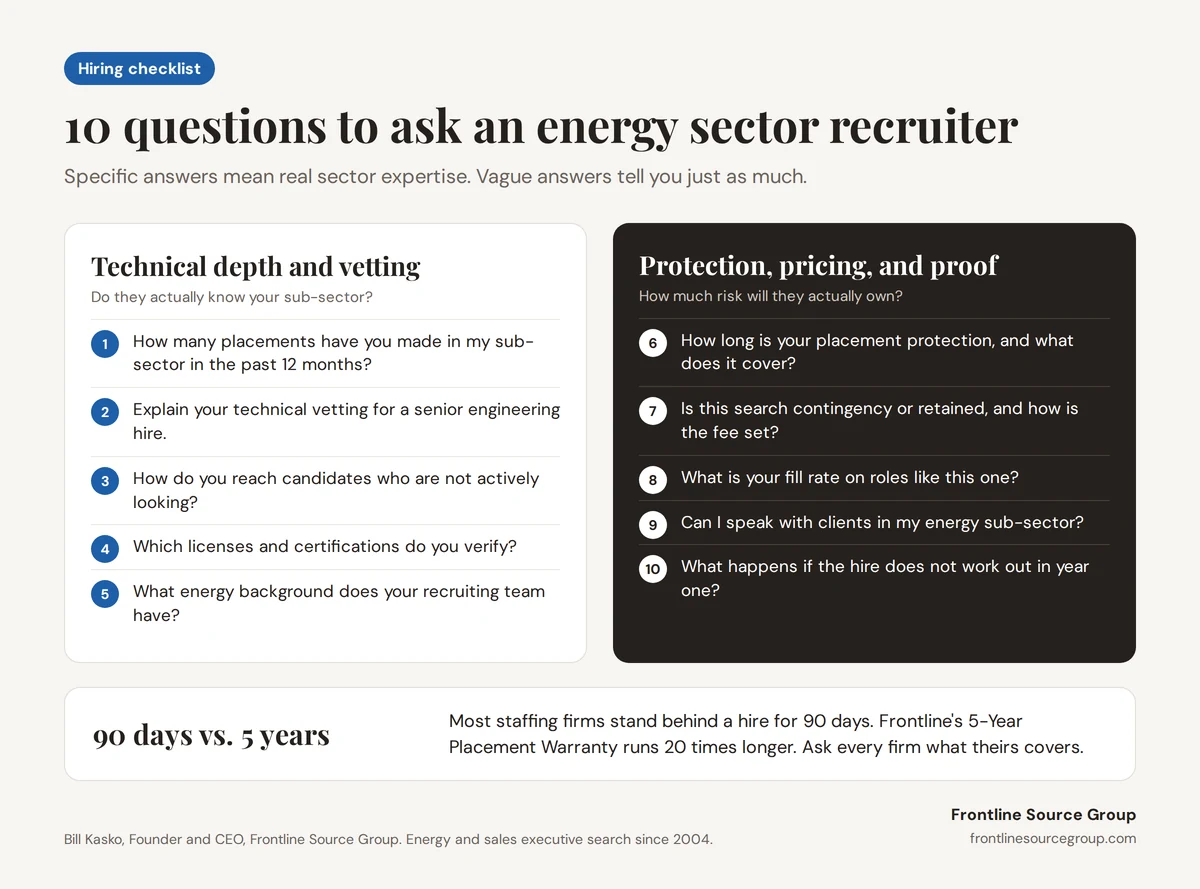
Questions 1 to 5: technical depth and vetting
- How many placements have you made in my specific sub-sector (oil and gas, solar, LNG, nuclear) in the past 12 months?
- Explain your technical vetting process for a senior engineering hire.
- How do you reach candidates who are not actively looking?
- Which licenses, certifications, and safety credentials do you verify before presenting someone?
- What energy background does your recruiting team have?
Vague answers are informative. A recruiter who cannot describe their vetting process in concrete terms does not have one.
Questions 6 to 10: protection, pricing, and proof
- How long is your placement protection, and what exactly does it cover?
- Is this search contingency or retained, and how is the fee structured?
- What is your fill rate on roles like this one?
- Can I speak with clients in my energy sub-sector?
- If the hire does not work out in the first year, what happens?
The protection question is the most revealing. How long a firm stands behind a hire tells you where it puts the risk.
How does Frontline Source Group recruit for energy companies?
We recruit across oil and gas, petrochemical, power, and renewables, from field engineers to sales and executive leadership, and I personally lead our energy and sales executive search work. You can see the kind of searches we run in a current example, our frontlinesourcegroup.com/placement-director-of-sales-oil-gas-insulation-houston-tx-14342932.html search, and in our frontlinesourcegroup.com/recent-placements.html. For context on why Houston matters to this work, read frontlinesourcegroup.com/blog-5-reasons-houston-is-critical-to-texas-oil-and-gas-jobs.html. It all comes back to our registered service mark, People. Process. Service.
How do you get started with Frontline's energy recruiting team?
Employers can start a search at frontlinesourcegroup.com/employer-request-form.html or review fees first at frontlinesourcegroup.com/pricing.html. Then ask us the same 10 questions in this article; our answers should tell you what you need to know. Energy professionals can apply at frontlinesourcegroup.com/how-to-apply.html.
Frequently Asked Questions: Choosing an Energy Sector Recruiter
What does an energy sector recruiter do?
An energy sector recruiter finds, vets, and places professionals in oil and gas, petrochemical, power, nuclear, solar, and wind roles. Unlike a generalist, a specialist understands the technical differences between roles, benchmarks pay against niche market data, and reaches passive candidates through long-standing industry relationships.
How do I choose an energy sector recruiter?
Look for proven placements in your specific sub-sector, a concrete technical vetting process, familiarity with the credentials your roles require, a fee model that fits the role, and placement protection well beyond the 90-day industry standard. Asking 10 direct questions before you sign will expose the differences quickly.
Why use a specialized energy recruiter instead of a generalist?
Energy talent pools are small and technical. In May 2025 there were about 18,060 petroleum engineers and 15,280 nuclear engineers in the U.S., according to the Bureau of Labor Statistics. A specialist with an existing network can reach those people; a generalist usually cannot.
How much does a bad hire cost in an energy role?
Gallup estimates that replacing a leader or manager costs around 200 percent of their salary. In energy, a mis-hire can also delay projects, disrupt field operations, and create safety or regulatory exposure.
What is the difference between contingency and retained search?
Contingency search is paid only when a candidate is hired and suits technical and mid-level roles. Retained search is paid in stages, buys exclusivity and a structured process, and suits VP-level, niche, and confidential searches. Frontline also offers Engaged Search, a fixed-fee option between the two.
How much do energy recruiters charge?
Fees vary by model and seniority. Frontline's direct hire fees run 20 to 30 percent of first-year base salary depending on seniority and search complexity, and its pricing is published at frontlinesourcegroup.com/pricing.html.
What credentials should an energy recruiter verify?
It depends on the role: professional licenses, Certified Energy Manager and related AEE designations for energy management, NABCEP for solar, and OSHA, NEBOSH, OPITO, or GWO safety training for oil, gas, offshore, and wind work.
What placement guarantee should an energy recruiter offer?
The industry standard is 90 days, which mostly protects the recruiter. Ask how long protection lasts and what it covers. Frontline's 5-Year Placement Warranty runs 20 times longer than the 90-day standard.
What questions should I ask an energy recruiter before signing?
Ask about recent placements in your sub-sector, their technical vetting process, how they reach passive candidates, which credentials they verify, their team's energy background, placement protection, fee structure, fill rate, client references, and what happens if a hire fails in year one.
Does Frontline Source Group recruit for renewable energy roles?
Yes. Frontline recruits across oil and gas, petrochemical, power generation, nuclear, solar, and wind, from field and engineering roles to sales and executive leadership.
Who leads energy recruiting at Frontline Source Group?
Founder, President, and CEO Bill Kasko leads Frontline's energy and sales executive search work. He founded the firm in Dallas in 2004, and Frontline has completed 5,619 plus placements from 32 plus offices, including two in Houston.
What is the 5-Year Placement Warranty?
The 5-Year Placement Warranty backs every Frontline Source Group direct hire for five years, which is 20 times longer than the 90-day industry standard guarantee. It is supported by a 98.94% executive placement retention rate. Terms are at frontlinesourcegroup.com/5year-placement-guarantee.html.


