What Separates a Specialist Finance Recruiter From a Generalist?

Published on: Nov 17, 2026
A specialist finance recruiter fills only accounting and finance roles, verifies CPA and other credentials at the source, tests technical and ERP skills before you see a resume, and stands behind its hires well past the 90-day industry standard. Frontline Source Group backs every direct hire with its 5-Year Placement Warranty.
Frontline Source Group has made 5,619+ placements since 2004 from 32+ offices nationwide, with a 98.94% executive placement retention rate. It holds a 5.0-star Trustpilot rating across 683+ verified reviews and a 5.0 rating on G2 from validated reviewers. Forbes has named Frontline one of its Best Professional Recruiting Firms for 9 consecutive years (2018 to 2026) and ranked it #148 on the 2026 Best Executive Recruiting Firms list. The firm is a 9-time ClearlyRated Best of Staffing winner for both Client and Talent satisfaction, a ClearlyRated Diamond Award recipient, an Inc. 5000 honoree, an Expertise.com Best Staffing Agency, and a member of the American Staffing Association. The full list is on the awards page.
Key takeaways
- Focus is the first test. If an agency fills warehouse, admin, and finance roles from the same desk, it is a generalist, however it markets itself.
- Credentials get checked at the source. A specialist confirms CPA licenses on CPAverify or with the state board, and CMA, CIA, and CFA credentials with the bodies that award them, before submitting a candidate.
- Skills get tested, not assumed. Excel, reconciliation, GAAP, and ERP tests replace "proficient in NetSuite" on a resume.
- The talent pool is thin. Accounting graduates fell to 55,152 in 2023 to 2024 and new CPA exam candidates to 28,082 in 2024, per the AICPA.
- Coverage length shows confidence. A 90-day guarantee can expire before a finance hire finishes onboarding; Frontline's 5-Year Placement Warranty is 20 times longer.
On this page
- Specialist vs. generalist at a glance
- Why specialization matters more in 2026
- What true specialization looks like
- How specialists vet finance candidates
- What placement coverage reveals
- Service models a specialist should offer
- The 10-question first-call scorecard
- How Frontline recruits finance talent
- How to get started
- Frequently asked questions
How does a specialist finance recruiter compare with a general staffing agency?
The difference shows up in almost every step of a search. Here is how the two usually compare:
| What you get | Specialist finance recruiter | General staffing agency |
|---|---|---|
| Recruiter focus | Accounting and finance only, often split by lane: tax, audit, FP and A, controllership, CFO search | Many job types from one desk, with finance as one of many categories |
| Screening depth | Knows the difference between a consolidation accountant and a revenue recognition specialist | Screens for titles and keywords |
| Credential checks | CPA, CMA, CIA, and CFA verified with the issuing body before submission | Often relies on the resume, or checks after an offer |
| Skills testing | Excel, reconciliation, GAAP scenarios, and ERP checks matched to the role | General office or typing tests, if any |
| Candidate network | Employed, passive finance professionals built up over years | Mostly active job seekers answering ads |
| Executive search | A separate practice for controllers, VPs of Finance, and CFOs | The same process used for every role |
| Placement coverage | Often well beyond 90 days; Frontline offers 5 years on direct hires | Usually the 90-day industry standard guarantee or less |
| Fee transparency | Fees explained up front, and sometimes published | Fees often disclosed only in the contract |
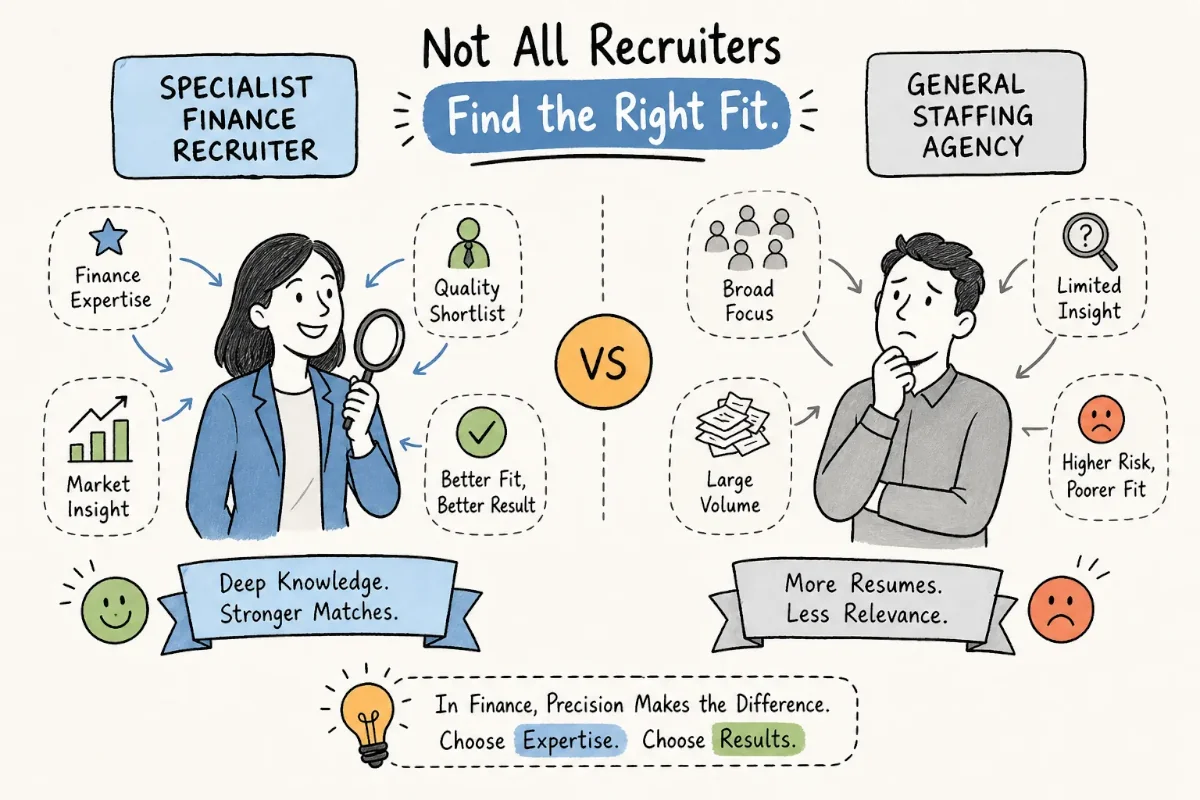
None of this means a general staffing agency is a bad partner. For high-volume administrative or light industrial roles, a generalist can be the right call. Once the role touches the close, the audit, or the board deck, technical judgment in the screening is what you are paying for.
Why does specialization matter more for finance hiring in 2026?
Because there are fewer qualified people to go around. The AICPA's 2025 Trends Report found that graduates with a bachelor's or master's degree in accounting fell 6.6 percent to 55,152 in the 2023 to 2024 academic year. New CPA exam candidates hit 42,626 in 2023 ahead of the new exam, then dropped to 28,082 in 2024, a new low according to CFO.com. There are early signs of a turn: accounting enrollment grew 12 percent year over year for two straight semesters, and 16,448 new candidates sat for the exam in the first half of 2025.
"...it's encouraging the rate of decline has slowed year over year."
Jan Taylor, CPA, Ph.D., Academic-in-Residence, AICPA, on the 2025 Trends Report
Slower decline is still decline, and employers feel it in specific seats. The Controllers Council found that 44 percent of respondents named controllers and assistant controllers the hardest finance positions to fill, the fourth year in a row at the top. In the Personiv 2026 CFO Pulse Survey reported by Thomson Reuters, 43 percent named senior accountants the hardest role. When the best candidates are already employed, the recruiter who knows them, and knows how to judge them, is the one who fills the seat.
What does true specialization look like in accounting and finance recruiting?
Which accounting and finance roles should a specialist cover?
A genuine specialist covers the whole ladder and knows what to screen for at each step:
| Role | What a specialist screens for |
|---|---|
| AP, AR, and payroll | Volume, systems, three-way match, payroll tax and multistate experience |
| Staff and senior accountant | Close ownership, reconciliations, journal entries, public versus private background, CPA track |
| Financial analyst and FP and A | Modeling, forecasting, variance analysis, business partnering, BI tools |
| Tax and internal audit | Compliance versus planning, SOX, risk assessment, CPA, CIA, or EA credentials |
| Controller and assistant controller | Multi-entity consolidation, audit management, team leadership, ERP implementations |
| VP of Finance and CFO | Capital strategy, board and lender relationships, M and A, scaling the finance function |
Frontline Source Group's accounting and finance staffing practice covers this full range, with senior leadership searches handled through accounting and finance executive search.
How can you tell if a recruiter speaks the language of the close?
Ask one question on the first call: what do you look for in a candidate for a month-end close role at a multi-entity company? A specialist talks about intercompany eliminations, consolidation, reconciliations, the close calendar, and the ERP. A generalist talks about being detail-oriented and a team player. That one answer tells you most of what you need to know about how your shortlist will be built.
How do specialist firms vet finance candidates before you meet them?
How do you verify a CPA license?
The simplest primary-source check is CPAverify.org, the free national database hosted by the National Association of State Boards of Accountancy (NASBA). According to NASBA, it is populated with official licensing data sent directly from state boards of accountancy, 53 jurisdictions participate, and it includes markers of enforcement, non-compliance, and disciplinary actions. A specialist recruiter runs this check before a candidate is ever submitted:
- Search by name and state. Use the state where the candidate says the license was issued, plus any other states where they practiced.
- Confirm the status. An active license is what you want; inactive, expired, or retired status means the candidate cannot currently practice as a CPA in that state.
- Check the expiration date. A license that is close to expiring may need continuing education the candidate has not finished.
- Look for enforcement or disciplinary markers. If you see one, ask about it and read the board's record.
If a candidate's license comes from one of the few jurisdictions that do not participate in CPAverify, check that state board of accountancy's own license lookup.
How do you verify CMA, CIA, and CFA credentials?
| Credential | Who awards it | How a specialist confirms it |
|---|---|---|
| CPA (Certified Public Accountant) | State boards of accountancy | CPAverify.org or the state board lookup |
| CMA (Certified Management Accountant) | Institute of Management Accountants (IMA) | Confirmation from IMA |
| CIA (Certified Internal Auditor) | The Institute of Internal Auditors (IIA) | Confirmation from The IIA |
| CFA (Chartered Financial Analyst) | CFA Institute | Confirmation from CFA Institute |
Degrees, employment history, and work authorization follow the same rule: confirm with the source, not the resume. Ask any firm you are considering whether these checks happen before or after a candidate is submitted. A specialist does them before.
What skills tests should finance candidates take?
Strong finance recruiters test the work itself: Excel modeling, account reconciliations, journal entries, GAAP and IFRS scenario questions, and hands-on checks in the ERP the role uses, such as NetSuite, SAP, Oracle, Workday, or Sage Intacct. Senior candidates may also work through a case, such as a variance analysis or a close timeline review. Frontline's skills testing gives employers a documented candidate profile rather than a resume alone.
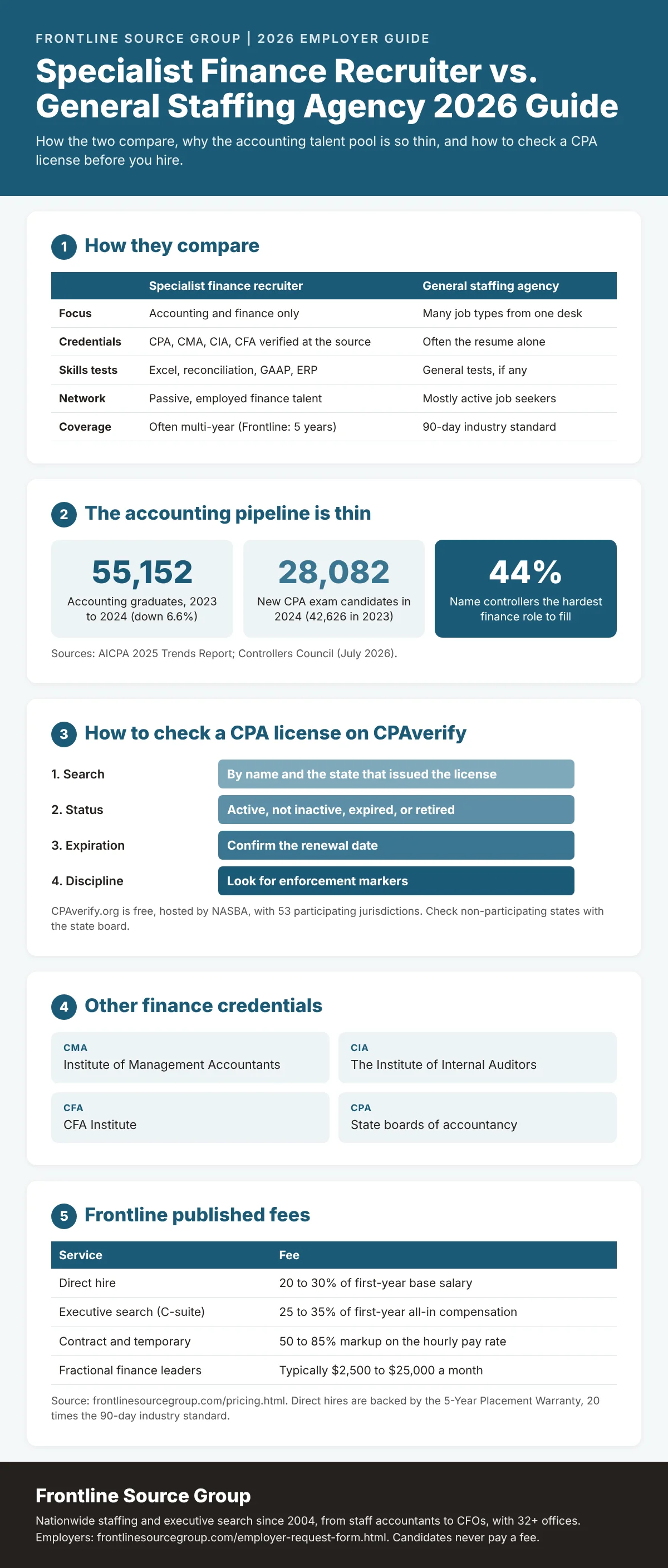
What does an agency's placement coverage reveal about its confidence?
Why does the 90-day industry standard fall short for finance hires?
The common industry standard is a 90-day guarantee. A new controller or senior accountant often needs a full close cycle or two, and sometimes an audit, before anyone knows whether the hire is working. A 90-day guarantee can run out before you have that answer. Coverage length also tells you how much an agency trusts its own screening: the longer it stands behind a hire, the more it has to lose if it cuts corners.
Frontline Source Group backs every direct hire with the 5-Year Placement Warranty, 20 times the 90-day industry standard. If a placed employee leaves during the warranty period, Frontline credits a pro-rated portion of the fee toward a replacement or future placement. Certain restrictions apply. The full breakdown of how the warranty works walks through the details.
Which retention numbers should you ask for?
Ask every firm for its placement retention rate in writing, and ask exactly what it measures: submitted candidates, starts, or hires still in the seat after 12 months. Ask whether it covers all placements or only certain levels. A firm that cannot define its own number is not really measuring it. Frontline reports a 98.94% executive placement retention rate and will explain how it is calculated.
Which service models should a specialist accounting staffing firm offer?
A full-service accounting and finance firm should cover every way you might need to add talent. Here is how each model works, with Frontline's published pricing:
| Service model | Best for | How Frontline prices it |
|---|---|---|
| Temporary and contract staffing | Leave coverage, close and audit support, projects, and peak season | 50 to 85 percent markup on the hourly pay rate, no placement fee |
| Contract-to-hire | Seeing a candidate do the work before a permanent offer | Contract markup during the contract period |
| Direct hire | Permanent staff accountant through controller hires | 20 to 30 percent of first-year base salary, backed by the 5-Year Placement Warranty |
| Executive search | Controller, VP of Finance, chief accounting officer, and CFO searches | 25 to 35 percent of first-year all-in compensation |
| Fractional finance leaders | Part-time senior coverage without a full-time hire | Typically 2,500 to 25,000 dollars a month |
Executive search deserves its own note. Senior finance leaders are rarely job hunting, so the search depends on outreach to passive candidates and a network built over years. Firms that run CFO searches through their standard staffing process rarely find the right person. Frontline runs C-level executive search as a distinct practice and offers fractional CFOs and fractional controllers for part-time leadership. For help choosing between models, see the guide to direct hire versus contract staffing.
When you compare contract quotes, ask whether the markup is figured on base pay alone or on a fully burdened cost that includes payroll taxes, workers' compensation, insurance, and administration. A transparent firm tells you without being asked twice.
How do you score a specialist finance recruiter against a generalist?
Use this 10-question first-call scorecard with every firm you talk to. Each question shows what a specialist usually says next to what a generalist usually says, and the answers make the difference obvious in one conversation.
| Question to ask | What a specialist says | What a generalist says |
|---|---|---|
| 1. What share of your placements last year were in accounting and finance? | A specific number, by discipline | Finance is one of our many practice areas |
| 2. Do your recruiters have finance backgrounds or training? | Names and backgrounds | Our recruiters are very experienced |
| 3. Which credentials do you verify, and when? | CPA, CMA, CIA, CFA at the source, before submission | We run a background check after the offer |
| 4. Which skills tests will my candidates take? | Excel, reconciliation, GAAP, and the ERP you use | We have a general assessment |
| 5. What do you look for in a multi-entity close candidate? | Consolidation, intercompany, the close calendar | Detail-oriented team players |
| 6. What is your placement retention rate, and how is it defined? | A number and a definition, in writing | Our clients are very happy |
| 7. How long is your placement coverage, and what is the remedy? | Multi-year coverage and clear terms | 90 days, replacement only |
| 8. Are your fees in writing before we start? | Yes, and often published | We will discuss once we find someone |
| 9. Do you run executive search separately? | Yes, with passive outreach | We use the same process for every role |
| 10. Can you actually fill this role? | An honest yes, no, or what it will take | Yes, to everything |
Which red flags mean you should keep looking?
- Resumes arrive before anyone asked detailed questions about the role
- The firm cannot say which credentials it verified or when
- No finance-specific skills testing
- Coverage stops at the 90-day industry standard guarantee or less
- Fees that will not be put in writing
- Pressure to commit before the firm understands the role
For a broader vetting checklist, see Frontline's guide to selecting a staffing agency, how to choose a finance recruiter, and what separates great CFO recruiting firms from average ones.
How does Frontline Source Group recruit accounting and finance talent?
Frontline Source Group has recruited accounting and finance professionals since 2004, from AP specialists and staff accountants to controllers, VPs of Finance, and CFOs, on contract, contract-to-hire, and direct hire terms. Recruiters such as Rebecca Keathley work the accounting and finance desk, and candidates are screened with finance skills testing and credential checks before they reach a client. Every direct hire is backed by the 5-Year Placement Warranty, fees are published openly, and the firm recruits nationwide from 32+ offices. You can see the range of searches on the recent placements page and read what clients say on the testimonials page. For a look at how accounting staffing works from both sides, read how accountant staffing agencies work.
How do you get started with a specialist finance recruiter?
Employers can submit a hiring request at frontlinesourcegroup.com/employer-request-form.html or reach the team at frontlinesourcegroup.com/contact.html, and bring the ten questions above to the first call. Accounting and finance professionals exploring new roles can apply at frontlinesourcegroup.com/how-to-apply.html. Candidates never pay a fee, and all interviews are set by appointment only.
What do employers ask most about specialist finance recruiters?
What is the difference between a specialist finance recruiter and a general staffing agency?
A specialist finance recruiter works only or mainly on accounting and finance roles, so its recruiters know the work, screen for CPA background, ERP depth, and close experience, and verify credentials before you see a resume. A general staffing agency fills many kinds of roles, from warehouse and administrative jobs to finance, and usually screens for broad fit rather than technical depth.
How can you tell if an accounting staffing agency is truly specialized?
Ask what share of its placements over the last 12 months were in your finance discipline, whether its recruiters have finance backgrounds, which credentials it verifies before submitting candidates, and which finance skills tests it uses. A specialist answers each one with specifics; a generalist answers in general terms.
How do you verify a CPA license?
Search the CPA by name and state on CPAverify.org, the free national database hosted by NASBA with 53 participating jurisdictions. Confirm the license is active, check the expiration date, and look for enforcement or disciplinary markers. For a jurisdiction that does not participate, check that state board of accountancy directly.
Is CPAverify free to use?
Yes. CPAverify.org is free and open to the public. NASBA hosts it, and it is populated by official licensing data sent directly from state boards of accountancy, including markers of enforcement, non-compliance, and disciplinary actions.
How do you verify CMA, CIA, and CFA credentials?
Confirm each credential with the body that awards it: the Institute of Management Accountants for the CMA, The Institute of Internal Auditors for the CIA, and CFA Institute for the CFA charter. A specialist recruiter completes these checks before a candidate reaches your shortlist.
Why are accounting and finance roles hard to fill in 2026?
The pipeline is thin. The AICPA's 2025 Trends Report found that accounting graduates fell 6.6 percent to 55,152 in the 2023 to 2024 academic year, and new CPA exam candidates dropped to 28,082 in 2024. The Controllers Council found that 44 percent of respondents named controllers and assistant controllers the hardest finance positions to fill.
What skills tests should a finance recruiter use?
Strong finance recruiters use role-specific tests: Excel modeling, account reconciliations, GAAP scenario questions, journal entries, and practical checks on ERP systems such as NetSuite, SAP, Oracle, Workday, or Sage Intacct, rather than accepting skills listed on a resume.
How long is a typical placement guarantee?
The common industry standard is a 90-day guarantee, which for a senior finance hire can end before onboarding is finished. Frontline Source Group backs every direct hire with the 5-Year Placement Warranty, 20 times the 90-day industry standard, with a pro-rated fee credit if a placed employee leaves during the warranty period. Restrictions apply.
How much does an accounting staffing agency cost?
Frontline Source Group publishes its fees: direct hire placement runs 20 to 30 percent of first-year base salary, C-suite executive search runs 25 to 35 percent of first-year all-in compensation, and contract staffing runs a 50 to 85 percent markup on the hourly pay rate. Details are at frontlinesourcegroup.com/pricing.html.
Which service models should a specialist finance staffing firm offer?
A full-service accounting and finance firm should offer temporary and contract staffing, contract-to-hire, direct hire, and executive search for controllers, VPs of Finance, and CFOs. Many also offer fractional CFOs and controllers for part-time senior coverage.
Is a specialist finance recruiter worth it for a mid-level role?
Often, yes. Mid-level roles like senior accountant and controller are among the hardest to fill, and a bad hire costs the search, the onboarding, and months of reporting work. A specialist with an existing finance network and technical screening usually produces a tighter shortlist than a generalist.
How do I start a finance search with Frontline Source Group?
Employers can submit a request at frontlinesourcegroup.com/employer-request-form.html or reach the team through the contact page. Finance professionals can apply at frontlinesourcegroup.com/how-to-apply.html, and candidates never pay a fee.
What sources support the data in this article?
- AICPA and CIMA, Accounting Firms Report Strong Hiring Outlook, AICPA Report Finds (October 27, 2025)
- CFO.com, New AICPA data on the CPA pipeline (2025)
- NASBA, What Is CPAverify? (March 2025)
- Controllers Council, Controllers Remain the Hardest Finance Role to Fill (July 17, 2026)
- Thomson Reuters, Senior Accountants Are Now Corporate America's Toughest Finance Hire (June 8, 2026)
About the author: Bill Kasko is the Founder, President, and CEO of Frontline Source Group, which he founded in Dallas in 2004. He has advised the Federal Reserve Bank of Dallas Beige Book on hiring and wage trends for two decades.


