How Do Retained and Contingency Executive Search Differ?

Published on: Nov 17, 2026
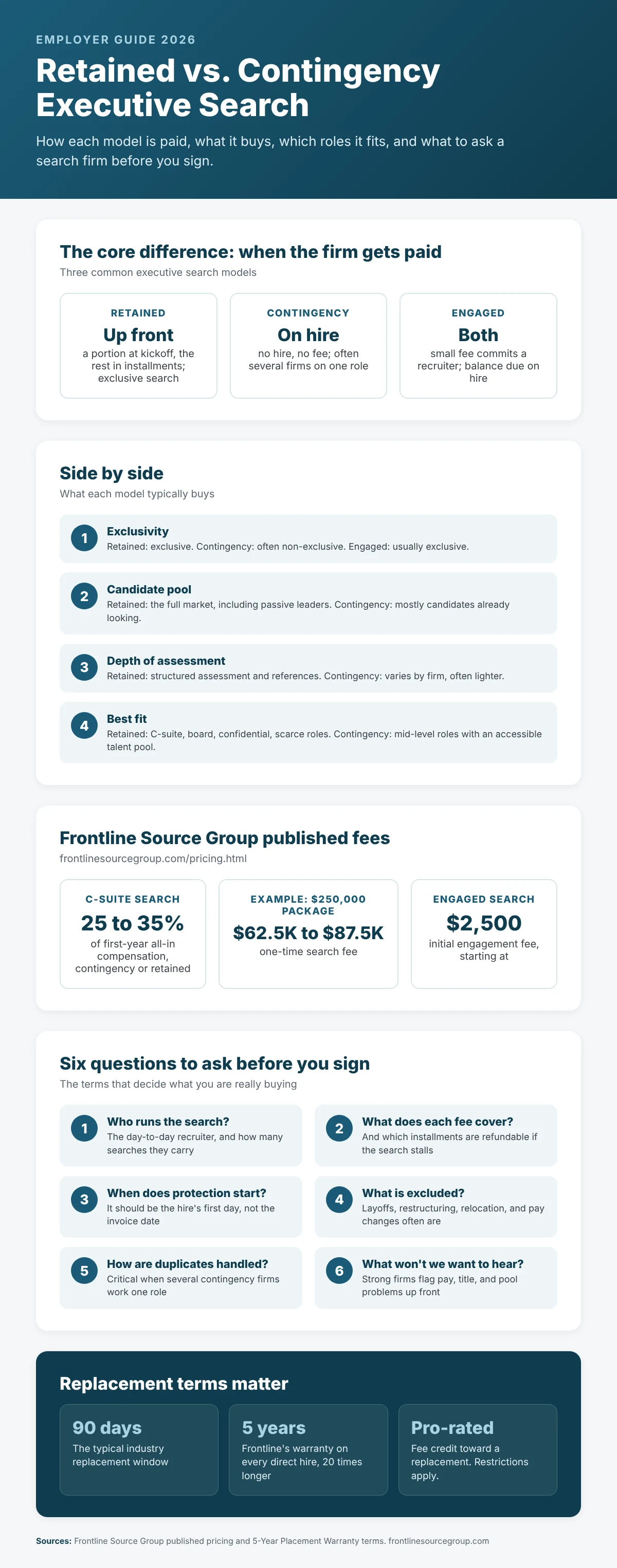
The difference between retained and contingency executive search is when the firm gets paid. In a retained search, the employer pays part of the fee up front and the rest in installments for an exclusive, research-driven search. In a contingency search, the firm is paid only if the employer hires a candidate it presented. Frontline Source Group offers both, backed by its 5-Year Placement Warranty.
That one difference in payment timing shapes everything else: how much of the recruiter's time goes to your search, which candidates they pursue, how deeply they vet, and how much risk you carry if the search stalls. Understanding both models before you sign protects you from a common mistake, choosing on upfront cost alone and then paying far more for a failed search or a mis-hire.
Frontline Source Group has made 5,619+ placements since 2004 from 32+ offices nationwide, with a 98.94% executive placement retention rate and a 5-Year Placement Warranty on every direct hire, 20 times longer than the 90-day industry standard. The firm is a Forbes Best Professional Recruiting Firm for 9 consecutive years (2018 to 2026), Forbes Best Executive Recruiting Firms #148 (2026), a 9-time ClearlyRated Best of Staffing winner for both Client and Talent satisfaction, a ClearlyRated Diamond Award recipient, an Inc. 5000 honoree, and an Expertise.com Best Staffing Agency. It holds a 5.0-star Trustpilot rating across 683+ verified reviews and is a member of the American Staffing Association. See every honor on the awards page.
Key takeaways
- Retained search: part of the fee is paid up front and the rest in installments for an exclusive search. The fee covers the process, so it is generally owed whether or not a hire is made.
- Contingency search: no hire, no fee. Firms often work the same role alongside other firms, which rewards volume over depth.
- Engaged search is a middle option: a smaller upfront fee secures a dedicated recruiter, and the balance is due on hire.
- Frontline's published fees: C-suite executive search runs 25 to 35 percent of first-year all-in compensation, contingency or retained; engaged search starts at $2,500.
- Replacement terms: the industry norm is 90 days. Frontline backs every direct hire with a 5-Year Placement Warranty, 20 times longer.
- Choosing: match the model to the role's scarcity, confidentiality, revenue impact, and your tolerance for a bad hire, not just the fee structure.
On this page
- How does each executive search model work?
- What is engaged executive search?
- How do retained and contingency search fees compare?
- How big is the executive search market in 2026?
- Which roles fit retained search and which fit contingency?
- What do guarantee and replacement clauses actually cover?
- What should you ask a search firm before you commit?
- What are the pros and cons of retained and contingency search?
- How does Frontline Source Group run executive searches?
- Retained vs. contingency search FAQs
How does each executive search model work?
How does retained executive search work?
Retained search is a service contract, not a success bet. The employer pays a portion of the fee when the search begins and the remainder in installments, often tied to milestones such as delivery of a shortlist and the accepted offer. The firm works the assignment exclusively, maps the full market, approaches passive candidates who are not looking, and delivers structured assessments of each finalist. Because the employer is paying for the process, the recruiter's financial interest is tied to doing the work thoroughly.
Kathleen Duffy, president and CEO of Duffy Group, a recruitment research firm in Phoenix, described the trade-off to SHRM: under a typical retained schedule billed in thirds, employers carry most of the risk because they
"are committed to paying two-thirds of the fee with or without a hire."
Kathleen Duffy, President and CEO, Duffy Group, in SHRM Online, "What Is Recruitment Research?" December 12, 2022
That is why retained search is worth its upfront fee mainly when the cost of a failed or leaked search is greater than the fee itself: a C-suite or board seat, a confidential replacement, or a role so scarce that only a full market search will find the right leader.
How does contingency recruiting work?
Contingency recruiting runs on the opposite logic: no hire, no fee. That sounds lower-risk, but the incentive structure encourages volume over vetting. Contingency recruiters often submit broadly and frequently work the same role alongside several other firms. The competition creates urgency, but the employer carries more coordination work and usually receives a lighter assessment of each candidate. Candidates also tend to be people who are already on the market.
What is engaged executive search?
Engaged search, sometimes called container search, sits between the two models. The employer pays a modest upfront fee that commits a dedicated recruiter and a defined sourcing plan, and the balance is due when a candidate is hired. It suits specialized roles below the C-suite where an employer wants more commitment than contingency offers without a full retainer. Frontline's engaged search starts with an initial engagement fee of $2,500 and includes dedicated recruiter sourcing on a set schedule.
How do retained and contingency search fees compare?
Both models usually charge a percentage of the hire's first-year compensation; what differs is when the fee is paid and what it buys. Retained fees cover market research, passive candidate outreach, structured assessment, reference checks, and ongoing search management. Contingency fees cover the presentation of candidates who are available and interested. Industry fee ranges vary by firm and by how compensation is defined, so always confirm whether a percentage applies to base salary alone or to total compensation including bonus.
Frontline Source Group publishes its fees on its pricing page: C-suite executive search runs 25 to 35 percent of first-year all-in compensation on either a contingency or retained basis, direct hire placement runs 20 to 30 percent of first-year base salary, and engaged search starts at $2,500. For a C-suite package of $250,000, a 25 to 35 percent fee works out to $62,500 to $87,500.
| Factor | Retained search | Contingency search | Engaged search |
|---|---|---|---|
| When the fee is paid | A portion up front, the rest in installments | Only on hire | Small fee up front, balance on hire |
| Owed if no hire is made | Generally yes | No | Upfront fee only |
| Exclusivity | Exclusive | Often non-exclusive | Usually exclusive |
| Candidate pool | Full market, including passive leaders | Mostly candidates already on the market | Targeted active and passive candidates |
| Depth of assessment | Structured assessment and references | Varies by firm, often lighter | Moderate to deep |
| Best fit | C-suite, board, confidential, and scarce roles | Mid-level roles with an accessible talent pool | Specialized roles below the C-suite |
| Frontline published fee | 25 to 35% of first-year all-in compensation | 25 to 35% for C-suite; 20 to 30% of base for direct hire | Initial engagement fee from $2,500 |
How big is the executive search market in 2026?
Executive search is growing. Fee revenue at the 50 largest executive search firms in the U.S. and the Americas rose 11 percent in 2025 to more than $6.69 billion, according to Hunt Scanlon's 2026 rankings. Retained search remains the dominant model for board and C-suite appointments, while contingency and engaged models are common for director and VP roles.
Which roles fit retained search and which fit contingency?
When is retained search the right choice?
C-suite and board appointments almost always warrant retained search. So do VP roles that lead revenue, product, or a business unit; confidential leadership replacements where discretion is essential; and specialized positions in sectors such as energy, life sciences, or healthcare where the qualified pool is narrow. In those searches, passive candidate reach and structured assessment are the whole point.
When does contingency recruiting make sense?
Contingency recruiting fits mid-level roles with an accessible active talent pool, such as sales managers, account executives, and repeatable professional positions where qualified candidates are already looking. At lower upfront cost, it is a legitimate use of the model.
What questions decide the model?
The real criteria are not job titles. A highly specialized engineer in a tight market may need a retained approach, while a VP with a widely available background may be filled on contingency. Ask four questions: How scarce are the candidates? Does the search require confidentiality? What is the revenue impact of the role? How much can the organization absorb a bad hire?

What do guarantee and replacement clauses actually cover?
The closest thing to an industry standard on recruiting guarantees is 90 days from the candidate's first day. Within that window, the usual remedy is a replacement search rather than a refund, and many agreements exclude departures caused by layoffs, restructuring, compensation changes, relocation, or mergers. That means a meaningful share of early failures may not trigger the guarantee at all.
What should a replacement clause spell out?
- When the protection period starts (it should be the candidate's first day, not the invoice date)
- What triggers a replacement
- Which departures are excluded
- Whether a refund or credit is available if a replacement cannot be found
- How many assignments the lead recruiter carries at once
- Who owns the candidate relationship after the search closes
How does Frontline's 5-Year Placement Warranty compare?
Every Frontline direct hire, including C-suite placements, is backed by the 5-Year Placement Warranty, 20 times longer than the 90-day norm. If a placement ends within five years, Frontline credits a pro-rated share of the fee toward a replacement or future placement, and certain restrictions apply. A firm that stands behind a placement for five years has every reason to assess candidates carefully. Read more in what executive search guarantees actually protect.
What should you ask a search firm before you commit?
Ask who will run the search day to day, not just who pitched the business, and how many other assignments that person carries. Ask what share of their placements come from passive candidates and how they will tell you if your compensation or title is not competitive. Strong firms act as advisers and will flag a brief that will not attract the candidates you want before you sign.
On fees and failure, get specific. For retained work, ask what each installment covers and which are refundable if the search stalls or is canceled. For contingency work, ask how duplicate submissions are handled when several firms present the same candidate. Ask how often their replacement terms have been invoked and what happened. The most revealing question of all: "What will you tell us that we probably don't want to hear about this role, our candidate pool, or our compensation?"
What are the pros and cons of retained and contingency search?
What are the pros and cons of retained search?
- Pros: a dedicated, exclusive search; access to passive leaders; structured assessment; confidentiality; a firm that acts as an adviser.
- Cons: upfront cost that is generally owed even if no hire is made; a longer commitment; less useful for roles with plenty of available candidates.
What are the pros and cons of contingency search?
- Pros: no upfront cost; pay only on success; works well when qualified candidates are already on the market.
- Cons: lighter vetting; less reach into passive candidates; duplicate submissions and coordination work when several firms compete; recruiters may prioritize the roles most likely to close.
How does Frontline Source Group run executive searches?
Frontline Source Group runs confidential searches across the C-suite and senior leadership through its C-level executive search practice and broader executive search services, including CFO and finance leadership. Clients can choose contingency, retained, or engaged terms, and every direct hire is backed by the 5-Year Placement Warranty. Interim and fractional leaders are available through fractional executive staffing.
To see how a search runs from start to finish, read the executive search process explained, how executive search differs from regular recruiting, and how to replace an executive without hurting morale. Employers can start through the employer request form or contact Frontline, and executives exploring their next role can apply at the how to apply page.
Retained vs. Contingency Search FAQs: What Do Employers Ask Most?
What is the difference between retained and contingency executive search?
The difference is when the firm gets paid. In retained search, the employer pays part of the fee up front and the rest in installments for an exclusive, research-driven search, and the fee is generally owed whether or not a hire is made. In contingency search, the firm is paid only if the employer hires a candidate it presented.
What is a retained search?
A retained search is an exclusive executive search in which the employer pays the firm a portion of the fee up front and the remainder in installments. The firm maps the market, approaches passive candidates, and delivers structured assessments of each finalist. It is the most common model for C-suite and board roles.
What is contingency recruiting?
Contingency recruiting is a model in which the search firm is paid only when the employer hires a candidate the firm presented. There is no upfront cost, but firms often compete on the same role, which tends to favor volume over depth of vetting.
What is engaged executive search?
Engaged search, also called container search, combines the two models: a modest upfront fee commits a dedicated recruiter, and the balance is due on hire. Frontline Source Group's engaged search starts with an initial engagement fee of $2,500.
How much does retained executive search cost?
Retained search is usually priced as a percentage of the hire's first-year compensation. Frontline Source Group publishes its C-suite search fee of 25 to 35 percent of first-year all-in compensation, on a contingency or retained basis, at frontlinesourcegroup.com/pricing.html. For a $250,000 package, that is $62,500 to $87,500.
Which roles should use retained search?
C-suite and board appointments, VP roles leading revenue, product, or a business unit, confidential replacements, and specialized roles with a narrow candidate pool are best suited to retained search. Mid-level roles with plenty of available candidates often fit contingency.
When does the guarantee period typically start?
The protection period should start on the candidate's first day, not the invoice date. Many agreements use a 90-day window counted from that first day, though some firms offer much longer terms.
What does a typical guarantee provide if a placement fails?
A typical guarantee provides a replacement search rather than a cash refund, and many agreements exclude departures caused by layoffs, restructuring, compensation changes, relocation, or mergers. Read the exclusions before you sign.
How does the 5-Year Placement Warranty work?
Every Frontline direct hire, including C-suite placements, is backed by the 5-Year Placement Warranty, 20 times longer than the 90-day guarantee most staffing agencies offer. If a placement ends within five years, Frontline credits a pro-rated share of the fee toward a replacement or future placement. Certain restrictions apply. Details are at frontlinesourcegroup.com/5year-placement-guarantee.html.
Who owns the candidate relationship after the search closes?
Ownership of the candidate relationship is a negotiable term. Ask before signing whether the recruiter keeps ongoing contact with the hire or whether the employer assumes the relationship once the hire is made, and whether the firm may recruit the hire away later.
How are duplicate candidate submissions handled when multiple firms present the same person?
Clarify this with any contingency firm before engagement. Most agreements credit the firm that submitted the candidate first, but terms vary, so ask how duplicates are handled and documented to avoid disputes and unexpected fees.
Does Frontline Source Group offer retained, contingency, and engaged search?
Yes. Frontline Source Group offers C-suite and executive search on contingency or retained terms at 25 to 35 percent of first-year all-in compensation, plus engaged search from $2,500, all published at frontlinesourcegroup.com/pricing.html. Employers can start at frontlinesourcegroup.com/employer-request-form.html.
What sources were used for this article?
- SHRM Online, Roy Maurer, What Is Recruitment Research? (interview with Kathleen Duffy, Duffy Group), December 12, 2022
- Hunt Scanlon Media, Executive Search Continues Its Confident Climb, April 28, 2026
- Frontline Source Group, Pricing and 5-Year Placement Warranty


