What Should You Check Before Signing With a Staffing Agency?

Published on: Nov 14, 2026
Before you sign with a staffing agency, get six things in writing: the replacement terms, first-year retention data, published fees, proof of insurance, the full contract, and references from clients like you. An agency that cannot document all six is asking you to carry the risk. Frontline Source Group backs every direct hire with a 5-Year Placement Warranty. That is 20 times longer than the 90-day industry standard guarantee. Restrictions apply.
Frontline Source Group has recruited for employers since 2004, with 5,619 completed placements, a 98.94% executive placement retention rate, and 32 plus offices nationwide. The firm holds a 5.0-star Trustpilot rating across 683 verified reviews and a 5.0 rating on G2 from validated reviewers. It is a Forbes Best Professional Recruiting Firm for 9 consecutive years (2018 to 2026), ranked #148 on the Forbes Best Executive Recruiting Firms list (2026), a 9-time ClearlyRated Best of Staffing winner for both Client and Talent satisfaction, a ClearlyRated Diamond Award recipient, an Inc. 5000 honoree, an Expertise.com Best Staffing Agency, and a member of the American Staffing Association (ASA).
Key takeaways
- Read the replacement terms before you talk price. Length matters, but the exclusions matter just as much.
- Ask for first-year retention broken out by role type and seniority, not one blended headline number.
- Compare pay rate, bill rate, and markup separately. An all-in rate hides the variables.
- Verify insurance from the certificate and the endorsements, not from a sales slide.
- Most disputes come from a short list of clauses: exclusivity, conversion fees, fee changes, indemnification, and data use.
- References from clients like you, plus independent reviews, tell you what a pitch will not.
On this page
What should you check before signing with a staffing agency?
Plenty of employers pick an agency on the strength of the pitch and the price, then learn the real terms after the first placement goes wrong. The details that decide whether an agency shares your risk usually sit deep in the agreement: the replacement clause, the conversion fee, the insurance exclusions. Run every finalist through the same six checks and the differences show up quickly.
| Check | What to ask for | Red flag |
|---|---|---|
| Replacement terms | Length, trigger events, exclusions, replacement or credit | Terms only shared after you sign |
| Retention data | First-year retention by role type and seniority | One blended number with no definition |
| Fees | Pay rate, bill rate, markup, conversion schedule | Pricing that changes from call to call |
| Insurance | Certificate of insurance plus endorsements | A "pending" certificate |
| Contract clauses | Termination, exclusivity, indemnification, data terms | One-sided protection for the agency |
| References | Clients with similar roles, size, and industry | Only the biggest logos, no specifics |
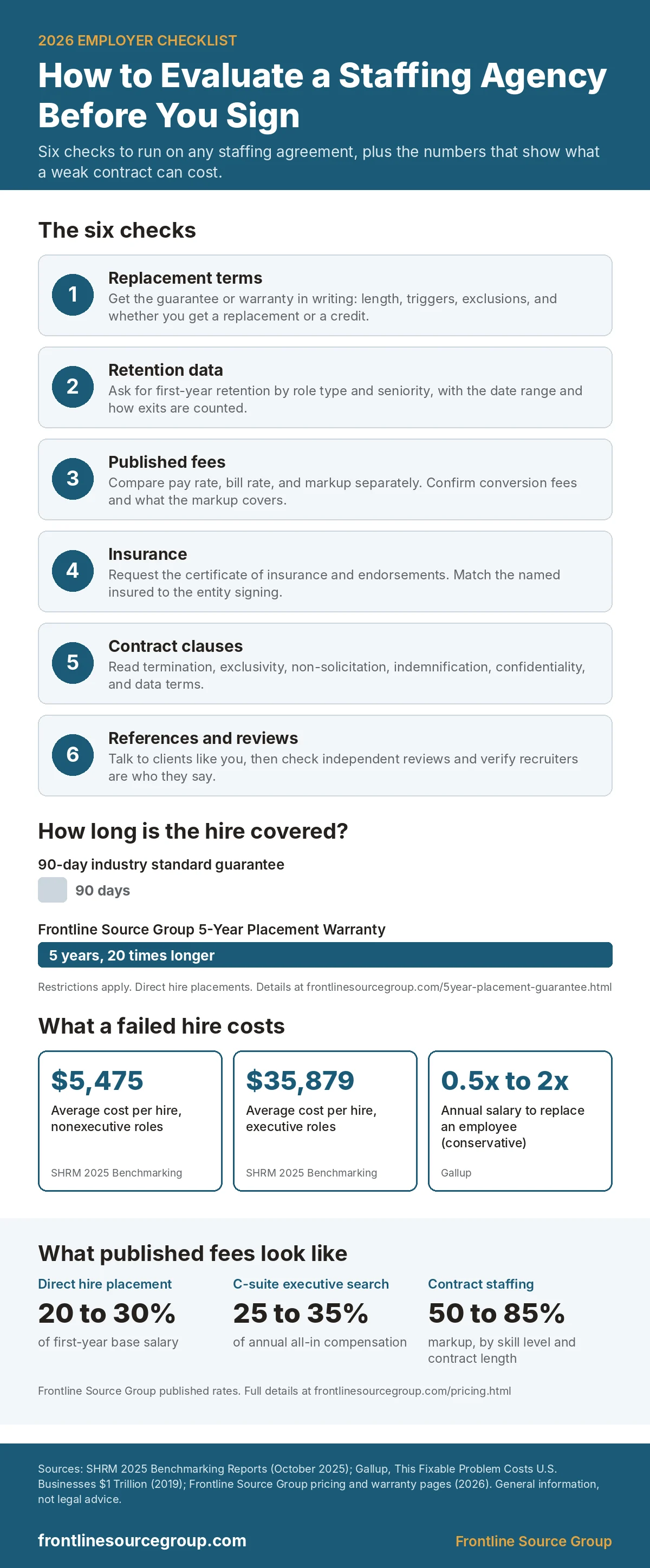
If you are still deciding what kind of partner you need in the first place, start with our guide to hiring partner selection or the seven criteria on how to select a staffing agency. This article picks up where those leave off, at the point where an agreement is on the table.
What do an agency's replacement terms tell you?
The replacement clause is the quickest read on whether an agency trusts its own screening. Ask for it in writing before you discuss fees. How long it runs, what triggers it, and what voids it will tell you more than any sales deck.
Why is the 90-day industry standard only a starting point?
Ninety days is the default replacement guarantee in staffing. For entry-level roles that may be enough. For professional, management, and executive hires it often runs out before the real test begins, because performance problems tend to surface once the new hire has finished onboarding and is expected to deliver on their own. A longer commitment means the agency is willing to absorb the cost of its own mistakes well after the invoice is paid.
Frontline Source Group backs every direct hire with the 5-Year Placement Warranty, 20 times longer than the 90-day industry standard, with a prorated credit toward a replacement or future placement. Restrictions apply. Use it as a yardstick when you compare any agency's terms.
What does a strong replacement clause include?
- Clear trigger events. Resignation, performance-based separation, and loss of a required license or credential should all count, not only termination for cause.
- No added fee. The replacement search should be covered by the original fee or a stated credit.
- Equivalent qualifications. The replacement candidate should meet the same requirements as the original search.
- A defined remedy. The clause should say whether you get a replacement, a credit, or a refund, and how the amount is calculated.
Which exclusions make a replacement guarantee hard to use?
Watch for language that voids coverage if you change the scope of the role, reduce headcount for any reason, pay late, or if the employee leaves under a narrow definition of "voluntary" that the agency controls. These exclusions are how a guarantee can exist on paper and still never pay out. If you have to read a clause three times to understand it, ask the agency to rewrite it in plain language.
Which performance numbers should an agency put in writing?
A well-run agency tracks its own results by role type, seniority, and location. If it cannot break the numbers out, it either does not track them or does not want you to see them. Either answer is useful to you.
Why ask for retention instead of fill rate?
Fill rate tells you how often an agency closes a search. Retention tells you whether the people it placed are still doing the job a year later, which is the outcome you are paying for. Ask for first-year retention on placements similar to yours, and ask how the agency defines it: the date range, how many placements are counted, and whether any type of exit is left out of the math.
How should the numbers be broken out?
A strong blended number can hide weak results in the exact function you are hiring for. Ask for retention, offer acceptance, and hiring manager satisfaction by role type and seniority level. Ask for reports or exports rather than screenshots, and make sure the satisfaction data separates the recruiting process from the new hire's actual performance on the job.
What does it cost when the numbers are wrong?
A failed hire is expensive even before you count lost productivity. SHRM's 2025 Benchmarking Reports put the average cost per hire at 5,475 dollars for nonexecutive roles and 35,879 dollars for executive roles. Gallup estimates that replacing an employee costs one-half to two times that person's annual salary, and calls that a conservative figure. That is the exposure a weak replacement clause leaves on your side of the table. In the same research, Gallup describes voluntary turnover among rare, hard-to-replace talent as
"...simply a nice way of saying, 'You just lost the future.'"
Shane McFeely, Ph.D., former Director of Hiring Analytics Research at Gallup, and Ben Wigert, Ph.D., Director of Research and Strategy, Workplace Management, Gallup, in "This Fixable Problem Costs U.S. Businesses $1 Trillion"
For more on lowering it, see how to hire the right person and reduce hiring risk.
How do you compare staffing agency fees fairly?
Fee transparency is the line between a pricing model and a pricing trap. Get the actual numbers before the relationship starts, not after the first invoice.
What do published staffing fees look like?
Few agencies publish their rates. Frontline Source Group does, on its staffing agency pricing page:
- Direct hire placement: 20 to 30 percent of the placed candidate's first-year base salary.
- C-suite executive search: 25 to 35 percent of annual all-in compensation, with retained options available.
- Contract and temporary staffing: a 50 to 85 percent markup, based on skill level and contract duration, covering wages, payroll taxes, benefits, insurance, and recruiting support.
- Engaged search: an initial engagement fee starting at 2,500 dollars.
Whatever agency you choose, ask for the pay rate, bill rate, and implied markup as three separate numbers. Comparing all-in bill rates removes the very variables that make one quote look cheaper than another.
Which billing terms cause disputes after signing?
Confirm whether the markup applies to base wages only or to a fully burdened rate. For contract-to-hire arrangements, ask for the conversion fee schedule in writing, ideally one that declines the longer the contractor has worked on your account. Then look for the terms that most often cause friction later:
- Fee increases the agency can make on its own through a "policy update"
- Late-payment interest that was never discussed up front
- Minimum billing commitments or administrative charges buried in the terms
- Vague scope language that lets work be reclassified and billed at a higher rate
How do you verify a staffing agency's insurance?
A certificate of insurance only protects you if you know what to look for on it. Taking one at face value is how employers find out mid-engagement that the coverage they assumed does not apply to them. Management-side employment attorney Zoe Bekas of Akerman LLP puts the first step plainly:
"Clients should require proof of workers' compensation insurance coverage before engaging a staffing agency."
Zoe Bekas, Special Counsel, Labor and Employment, Akerman LLP, a California-licensed employment attorney who defends and counsels employers, in "Reducing Risks Associated With Temporary Staffing Agencies," JD Supra
Which coverage should you ask about?
For contract and temporary workers, ask for workers' compensation covering every worker on assignment in every state where the work happens, under the correct job classifications. Ask about general liability and employment practices liability insurance (EPLI) as well, and whether your company can be named as an additional insured. Standard EPLI forms can exclude staffing-specific exposures, so get that confirmation in writing rather than assuming it.
How do you check a certificate of insurance?
- Request the certificate from the agency's broker or insurer, and do not accept a "pending" certificate for any required coverage.
- Match the named insured to the exact legal entity signing your contract.
- Verify policy numbers, limits, effective dates, and expiration dates.
- Ask for the endorsements themselves (additional insured, primary and noncontributory, waiver of subrogation), not just the certificate wording.
- Put expiration dates on your calendar and require updated certificates before each renewal.
Which staffing contract clauses carry the most risk?
The replacement clause and the fee schedule get discussed during the pitch. The clauses below decide what happens when something goes wrong, so read them before you countersign.
This guide is general information for employers, not legal advice. Cassidy Jacobs and Frontline Source Group are not attorneys. Have an employment attorney review any staffing agreement before you sign it.
What should service levels and remedies look like?
Service levels only mean something when they name a metric, a measurement window, and a consequence for missing it, such as service credits, a corrective action plan, or a right to terminate after repeated misses. "Best efforts" and "client satisfaction" with no number attached do not obligate the agency to anything.
Which termination, exclusivity, and non-solicitation terms are red flags?
Ask for a termination-for-cause clause with a defined cure period, plus immediate termination rights for serious breaches such as a data breach, insolvency, or loss of a required license. Treat exclusivity that blocks you from using other agencies for similar roles as a red flag unless it comes with clearly better terms. Read non-solicitation and conversion language closely so you know what it costs to hire a contractor directly and how long the restriction lasts.
How should indemnification, confidentiality, and candidate data be handled?
Indemnification should run in both directions, so the agency covers claims tied to its own employees and obligations and you cover claims tied to yours. Make sure candidate data, your job requirements, and compensation details fall under mutual confidentiality that survives the end of the engagement. If the agency uses AI in screening, ask what candidate data it keeps, for how long, and whether a human reviews the results. At Frontline, AI recruiter Lexi Reed conducts first-level interviews and a person reviews every candidate after that interview.
How do you check references and performance claims?
Agencies choose their own references. Your job is to test what those references say and notice what they leave out.
Which reference questions get honest answers?
- "What were your numbers before the engagement, and what were they at the end?"
- "What went wrong, and how quickly did the agency tell you?"
- "Did the people who pitched you actually work your account day to day?"
- "With the same budget and goals today, would you hire them again?"
Ask for references with similar roles, seniority, and company size. A great result for a household-name enterprise says little about how the agency will handle a specialized manager search at a 200-person company.
How do you verify claims on your own?
Send the agency's case study to the reference ahead of the call and ask whether it matches their internal numbers. Check independent review platforms such as Trustpilot and G2, confirm awards and memberships with the organizations that grant them, and look at third-party survey programs like the one behind highly rated staffing agencies on ClearlyRated. Confirm that any recruiter contacting you really works for the agency; Frontline explains how on its recruiter scam alert page. Treat a refusal to share comparable references or supporting data as a serious warning sign.
How does Frontline Source Group measure up on this checklist?
Frontline Source Group was built to pass these checks. Every direct hire carries the 5-Year Placement Warranty, 20 times longer than the 90-day industry standard. Fees are published on the pricing page for anyone to read before the first call. The firm reports a 98.94% executive placement retention rate across 5,619 placements, and its client and candidate reviews hold a 5.0-star rating on Trustpilot across 683 verified reviews, plus a 5.0 rating on G2 from validated reviewers. Its staffing awards include 9 consecutive years on the Forbes Best Professional Recruiting Firms list.
Bring this checklist to your next agency conversation and hold every finalist to the same standard, including us. For a broader look at the market, see the 2026 buyer's guide to top staffing agencies in the USA, or compare models in executive search firm vs. staffing agency.
How do you get started with Frontline Source Group?
Employers can submit a staffing request, review published fees, or contact a local office. Job seekers can apply online, and there is never a fee to candidates.
What do employers ask most about evaluating a staffing agency?
How do you evaluate a staffing agency before signing a contract?
Check six things in writing before you sign: the replacement terms, first-year retention data broken out by role type, published fees with pay rate, bill rate, and markup shown separately, a current certificate of insurance, the full contract, and references from clients with hiring needs like yours. If an agency cannot document all six, keep looking.
What questions should you ask a staffing agency before signing?
Ask how long it stands behind a placement and what voids that protection, what its first-year retention is for roles like yours, what the markup covers, what a conversion costs, who will work your account day to day, and whether it can really fill the role. Ask for a reference from a search that went sideways.
Is a 90-day placement guarantee enough?
For entry-level hires it may be. For professional, management, and executive roles, 90 days often ends before the real test does, because performance problems tend to show up once a new hire is working independently. Read the exclusions closely, since a short guarantee with broad exclusions protects very little.
What is the difference between a placement guarantee and a placement warranty?
Both describe what an agency owes you if a placed hire does not work out. Frontline Source Group calls its commitment a warranty and backs every direct hire for five years, 20 times longer than the 90-day industry standard guarantee, with a prorated credit toward a replacement. Restrictions apply. Details are at frontlinesourcegroup.com/5year-placement-guarantee.html.
What is a normal staffing agency markup?
Markups vary with the skill level of the role and the length of the assignment. Frontline Source Group publishes a 50 to 85 percent markup for contract staffing, which covers wages, payroll taxes, benefits, insurance, and recruiting support. Always ask for the pay rate, bill rate, and markup separately so you can compare agencies fairly.
What is a typical direct hire placement fee?
Direct hire fees are usually a percentage of the new hire's first-year base salary. Frontline Source Group publishes 20 to 30 percent for direct hire placements and 25 to 35 percent of annual all-in compensation for C-suite executive search. Current rates are at frontlinesourcegroup.com/pricing.html.
What insurance should a staffing agency carry?
For contract and temporary workers, ask for proof of workers' compensation in every state where the work happens, plus general liability and employment practices liability coverage. Request the certificate of insurance and the endorsements, and confirm the named insured matches the legal entity signing your agreement.
What are the biggest red flags in a staffing agency contract?
Watch for replacement terms with broad exclusions, exclusivity that blocks you from other agencies, fee changes the agency can make on its own, open-ended conversion fees, one-sided indemnification, vague service levels with no numbers attached, and no clear rules on how candidate and company data is stored or used.
Should a lawyer review a staffing agency agreement?
Yes. Indemnification, insurance, co-employment, and non-solicitation terms carry real legal and financial weight, and the rules vary by state. This article is general information, not legal advice, so have an employment attorney review any staffing agreement before you sign it.
How can you verify a staffing agency's reviews and performance claims?
Check independent review platforms such as Trustpilot and G2, look for third-party awards and memberships you can confirm, ask references whether the agency's numbers match their own, and request reports rather than screenshots. Frontline Source Group's reviews are collected at frontlinesourcegroup.com/testimonials.html.
Does Frontline Source Group publish its fees?
Yes. Frontline Source Group publishes its direct hire, executive search, contract staffing, engaged search, and fractional executive pricing at frontlinesourcegroup.com/pricing.html, so employers can see the terms before the first call. All major credit cards are accepted at no additional charge.
How do you start working with Frontline Source Group?
Employers can submit a request at frontlinesourcegroup.com/employer-request-form.html or reach a local office through frontlinesourcegroup.com/contact.html. Job seekers apply at frontlinesourcegroup.com/how-to-apply.html, and there is never a fee to candidates.


