Why Is Halloween Candy So Expensive in 2026, and How Can You Save?
Published on: Oct 28, 2026
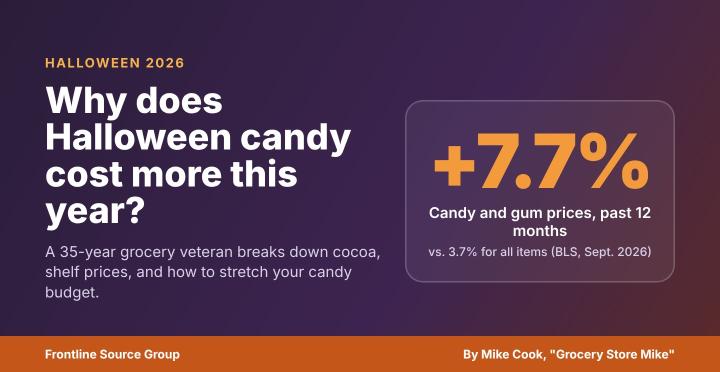
Halloween candy costs more in 2026 because chocolate makers are still working through cocoa bought near record prices, while packaging and other costs stay high. Candy and gum prices rose 7.7 percent in the 12 months through September, about double overall inflation, and seasonal Halloween packs averaged roughly 15 percent more than last year.
I started in grocery as a part-time courtesy clerk and spent more than 35 years in the business, working my way up through store leadership at traditional supermarkets and specialty food retailers before moving into executive search. Halloween candy has always been one of the most closely watched programs in the store. This year shoppers are noticing the price tag before they even reach the register, so here is what is actually going on in the candy aisle and how to stretch your budget.
At Frontline Source Group, I recruit store managers, category managers, district leaders, and pharmacy leaders for grocers nationwide. Frontline has completed 5,619 plus placements since 2004, holds a 98.94% executive placement retention rate, carries a 5.0-star Trustpilot rating across 681 plus verified reviews, and backs every direct hire with the 5-Year Placement Warranty. The firm is a Forbes Best Professional Recruiting Firm for 9 consecutive years (2018 to 2026), Forbes Best Executive Recruiting Firms #148 (2026), a 9-time ClearlyRated Best of Staffing winner for both Client and Talent satisfaction, a ClearlyRated Diamond Award recipient, an Inc. 5000 honoree, an Expertise.com Best Staffing Agency, and a member of the American Staffing Association (ASA), with 32 plus offices nationwide.
How much more does Halloween candy cost in 2026?
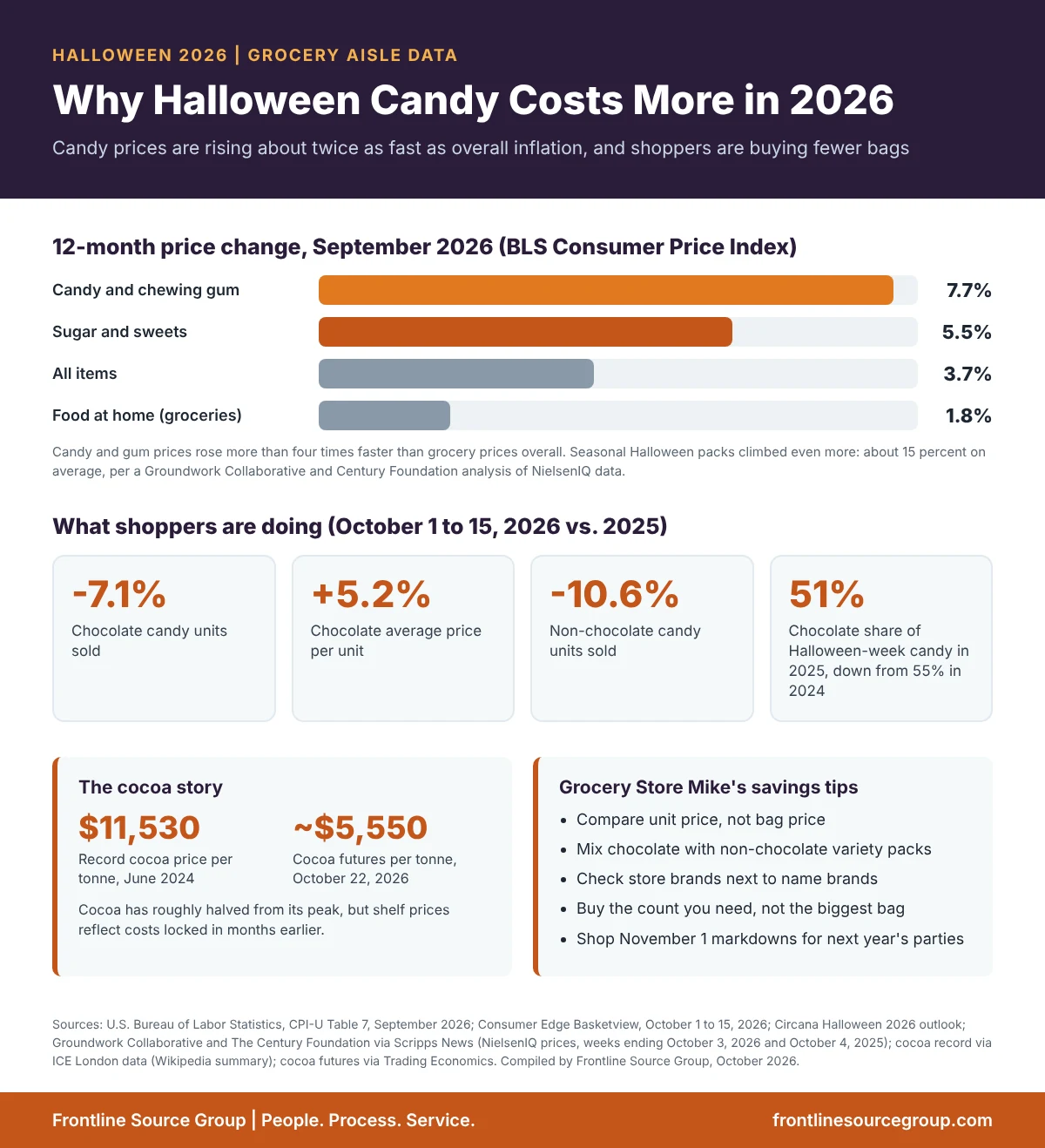
Measured by the government's own numbers, candy and chewing gum prices were up 7.7 percent in September 2026 compared with a year earlier, according to the Bureau of Labor Statistics Consumer Price Index. The broader sugar and sweets category rose 5.5 percent. For comparison, prices for all items rose 3.7 percent, and grocery prices overall (food at home) rose just 1.8 percent. Candy is climbing more than four times faster than the rest of the grocery cart.
Seasonal Halloween packs look worse than the category average. An analysis by the Groundwork Collaborative and The Century Foundation, reported by Scripps News, compared NielsenIQ average prices for the week ending October 3, 2026 with the same week in 2025 and found Halloween candy up about 15 percent. Their examples included a sour gummy variety pack that went from about $3.02 to $4.20, a 39 percent jump, and a seasonal peanut butter cup pack up 23 percent.
Is chocolate going up more than other candy?
Yes. Consumer Edge transaction data for October 1 to 15, 2026 shows the average price per unit of chocolate candy up 5.2 percent from the same stretch last year, compared with 1.6 percent for non-chocolate candy. Compared with the same period in 2023, chocolate unit prices are up 7.7 percent.
Shoppers are responding. Circana found chocolate's share of Halloween-week candy sales slipped from 55 percent in 2024 to 51 percent in 2025, with non-chocolate picking up the difference, and it expects more value-oriented and mixed-assortment buying this year.
Why is Halloween candy so expensive this year?
The short answer is cocoa, plus a long list of smaller costs that have not come back down. Candy pricing moves slowly. What you see on the shelf in October reflects ingredient and packaging costs that manufacturers locked in many months earlier.
Why are candy prices still high if cocoa prices have fallen?
Cocoa prices ran to records during the West African supply crisis that followed poor 2023 harvests. London cocoa futures peaked at $11,530 a tonne in June 2024, compared with roughly $2,500 a tonne for most of the prior four decades, according to the history of the cocoa crisis. Prices have since come down a long way. U.S. cocoa futures were trading around $5,550 a tonne on October 22, 2026, according to Trading Economics.
Two things keep shelf prices high anyway. First, large chocolate makers typically buy cocoa well ahead of time, so the candy in this year's Halloween bags was made with cocoa bought when prices were much higher. Second, cocoa is still about double its long-run level, and below-average rainfall in Ivory Coast and Ghana, plus crop disease concerns in Ghana, are keeping buyers cautious about the 2026 to 2027 crop.
What other costs are pushing candy prices up?
Packaging is a big one. The Groundwork and Century Foundation report linked higher packaging costs to aluminum tariffs. Not every input is rising, though. The same Scripps News report noted, citing BLS data, that wholesale sugar prices are down about 10 percent this year and corn syrup about 4 percent. That is why consumer groups argue candy prices should be easing faster than they are, while at least one major manufacturer says it did not pass the full impact of its higher costs on to shoppers. Both points can be true at once, and shoppers are left paying more either way.
Are shoppers buying less Halloween candy?
Early numbers say yes. In Consumer Edge's October 1 to 15 data, chocolate units sold fell 7.1 percent and non-chocolate units fell 10.6 percent compared with last year. Dollar sales fell less than units, which tells you people are buying fewer bags but paying more for each one. A LendingTree study cited by Scripps News found about a quarter of Americans expected to take on debt to celebrate Halloween, including 40 percent of parents with children under 18.
It is not a collapse. The National Retail Federation still expects shoppers to spend $4.1 billion on Halloween candy this year, with 96 percent of celebrants planning to buy sweets. And Consumer Edge notes that the day before Halloween and Halloween itself have historically run 1.5 to 2 times a typical October day in candy sales. With Halloween on a Saturday, Friday and Saturday will decide how this season finishes.
How do grocery stores handle Halloween candy pricing?
From the store side, Halloween candy is a planned seasonal program, not an everyday shelf. Grocers commit to seasonal candy orders months before October, set it on endcaps and in the seasonal aisle, and price it to compete for one of the busiest candy weeks of the year. According to Food Dive, citing the National Confectioners Association, Halloween generated $7.8 billion in confectionery sales last year, and the four big seasonal holidays account for 63 percent of the industry's annual sales. When it is that big, every bag counts.
That puts a lot of weight on a few people in the building and at the corporate office. Category managers decide the mix of chocolate, non-chocolate, and value packs. Pricing teams decide how hard to promote. Store directors and seasonal leads decide how much to set, when to restock, and when to pull the program. This year, getting the mix right between pricey chocolate and lower-cost alternatives is the whole game. A store that orders the same chocolate-heavy assortment it ran in 2023 is likely to be marking a lot of it down on November 1.
How can you save money on Halloween candy this year?
You do not have to skip treats to keep the cost reasonable. These are the same habits I would tell a family member.
- Compare the unit price, not the bag price. The shelf tag shows price per ounce or per piece. Bigger bags are not always the better deal, especially on promotion.
- Mix chocolate and non-chocolate. Variety packs that blend chocolate with gummies, lollipops, or hard candy usually cost less per piece than all-chocolate bags, and kids rarely complain.
- Check store brands. Many grocers carry their own Halloween candy and treat packs next to the name brands at a lower price.
- Use your grocer's app and digital coupons. Seasonal candy is often part of loyalty promotions this week.
- Buy for the count, not the fear. Estimate how many trick-or-treaters you actually get, add a cushion, and stop there.
- Consider non-candy treats. Small snack bags, stickers, or glow sticks are popular alternatives, and some manufacturers have added salty snacks to their Halloween lineups this year.
Is it cheaper to buy Halloween candy after Halloween?
For next year's needs, office candy dishes, or holiday baking, yes. Most grocers mark down leftover Halloween candy right after the holiday to clear room for the winter holiday set, often by half or more. Hard candy and gummies keep well; chocolate is best used within a few months. For candy you need for trick-or-treaters this Saturday, buy what you need now rather than gambling on the last bags left on Friday night.
What does candy inflation mean for grocery careers and hiring?
Seasons like this one show why grocers pay close attention to who runs their categories and stores. When a core category rises at twice the rate of inflation and units fall, the difference between a good season and a costly markdown comes down to buying, pricing, and in-store execution. Category managers, pricing analysts, store directors, and district leaders who can read the data and adjust are in demand.
Frontline Source Group's grocery and retail executive search practice places those leaders for independent supermarkets, specialty grocers, and regional chains, and every direct hire is backed by the 5-Year Placement Warranty, 20 times longer than the 90-day guarantee common in the industry. Grocers can start a search through the employer request form or review engagement models on the pricing page. Grocery professionals looking for their next role can apply through the How to Apply page.
Frequently Asked Questions: Halloween Candy Prices in 2026
Why is Halloween candy so expensive in 2026?
Chocolate makers are still using cocoa bought near record prices, and packaging costs remain high. Candy and gum prices rose 7.7 percent in the 12 months through September 2026, according to the Bureau of Labor Statistics, about double the 3.7 percent rise in overall prices.
How much have Halloween candy prices gone up?
The BLS Consumer Price Index shows candy and chewing gum up 7.7 percent year over year as of September 2026. Seasonal Halloween packs rose more, about 15 percent on average, according to a Groundwork Collaborative and Century Foundation analysis of NielsenIQ prices.
Is chocolate more expensive than other Halloween candy this year?
Yes. Consumer Edge data for October 1 to 15, 2026 shows the average price per unit of chocolate candy up 5.2 percent from last year, compared with 1.6 percent for non-chocolate candy.
Why are candy prices still high if cocoa prices have dropped?
Large chocolate makers typically buy cocoa well in advance, so this year's candy was made with cocoa bought at higher prices. Cocoa futures have fallen from a record $11,530 a tonne in June 2024 to around $5,550 in late October 2026, but that is still about double the long-run level.
Are people buying less Halloween candy in 2026?
Early data says yes. Consumer Edge found chocolate units sold down 7.1 percent and non-chocolate units down 10.6 percent from October 1 to 15, 2026, compared with the same period last year.
How much will Americans spend on Halloween candy in 2026?
The National Retail Federation expects shoppers to spend $4.1 billion on Halloween candy in 2026, with 96 percent of celebrants planning to buy sweets, as part of a record $13.5 billion in total Halloween spending.
What is the cheapest way to buy Halloween candy?
Compare the unit price on the shelf tag, choose variety packs that mix chocolate with non-chocolate candy, check store brands, use your grocer's app and digital coupons, and buy for the number of trick-or-treaters you actually expect.
Is Halloween candy cheaper after Halloween?
Usually. Most grocers mark down leftover Halloween candy right after the holiday, often by half or more, to make room for winter holiday products. It is a good time to stock up for office candy dishes or baking, though chocolate is best used within a few months.
When do most people buy Halloween candy?
A large share is bought at the end. Consumer Edge notes that the day before Halloween and Halloween itself have historically run 1.5 to 2 times a typical October day in candy sales. In 2026, with Halloween on a Saturday, that means Friday, October 30 and Saturday, October 31.
Who is Grocery Store Mike?
Mike Cook, known as Grocery Store Mike, is the Grocery, Retail, and Pharmacy Executive Recruiter at Frontline Source Group. He has more than 35 years of grocery industry experience, starting as a part-time courtesy clerk and rising through store leadership. His bio is at frontlinesourcegroup.com/mike-cook-staffing-services.html.
Does Frontline Source Group recruit grocery store leaders?
Yes. Frontline Source Group recruits store managers, category managers, district and regional managers, and pharmacy leaders for grocers nationwide, and backs every direct hire with the 5-Year Placement Warranty. Details are at frontlinesourcegroup.com/executive-search-grocery-store-and-retail.html.
How do grocery professionals apply with Frontline Source Group?
Grocery and retail professionals can apply at frontlinesourcegroup.com/how-to-apply.html. Grocers looking to hire can submit a request at frontlinesourcegroup.com/employer-request-form.html.
About the author: Mike Cook, known across the industry as Grocery Store Mike, is the Grocery, Retail, and Pharmacy Executive Recruiter at Frontline Source Group. He brings more than 35 years of grocery experience, from part-time courtesy clerk to in-store leadership at traditional and specialty food retailers, is a Brookshire University Charter Class salutatorian, and holds retail management credentials from Tyler Junior College developed with the Western Association of Food Chains.


