How Should You Answer 'What Are Your Salary Expectations?'

Published on: Oct 13, 2026
Updated on: October 13, 2026
The best answer to "What are your salary expectations?" is a short, researched salary range tied to the role, with a bottom number you would actually accept. Ask for the employer's budgeted range first when you can, leave room to talk about total compensation, and never anchor below your real minimum. That is the approach recruiters at Frontline Source Group coach every day, drawing on 5,619 completed placements since 2004, a 98.94% executive placement retention rate, and a 5-Year Placement Warranty on every direct hire, 20 times longer than the 90-day guarantee common across staffing.
Frontline Source Group is a Forbes Best Professional Recruiting Firm for 9 consecutive years (2018 to 2026), Forbes Best Executive Recruiting Firms #148 (2026), a 9-time ClearlyRated Best of Staffing winner for both Client and Talent satisfaction, a ClearlyRated Diamond Award recipient, an Inc. 5000 honoree, and an Expertise.com Best Staffing Agency. The firm holds a 5.0-star Trustpilot rating across 679+ verified reviews, operates 32+ offices nationwide, and is a member of the American Staffing Association (ASA). You can see the full list on the Frontline awards page.
TL;DR
- Research the going rate first, then build a range with a floor, a target, and a stretch number.
- Share a tight range, and make the bottom of it a number you would truly accept.
- When you can, ask whether the role has an approved salary range before you name yours.
- On applications, write "Negotiable" if the field allows text. If it forces a number, use your target, not your floor.
- More than a dozen states plus Washington, DC now require pay ranges in job postings, which gives you real data to work with.
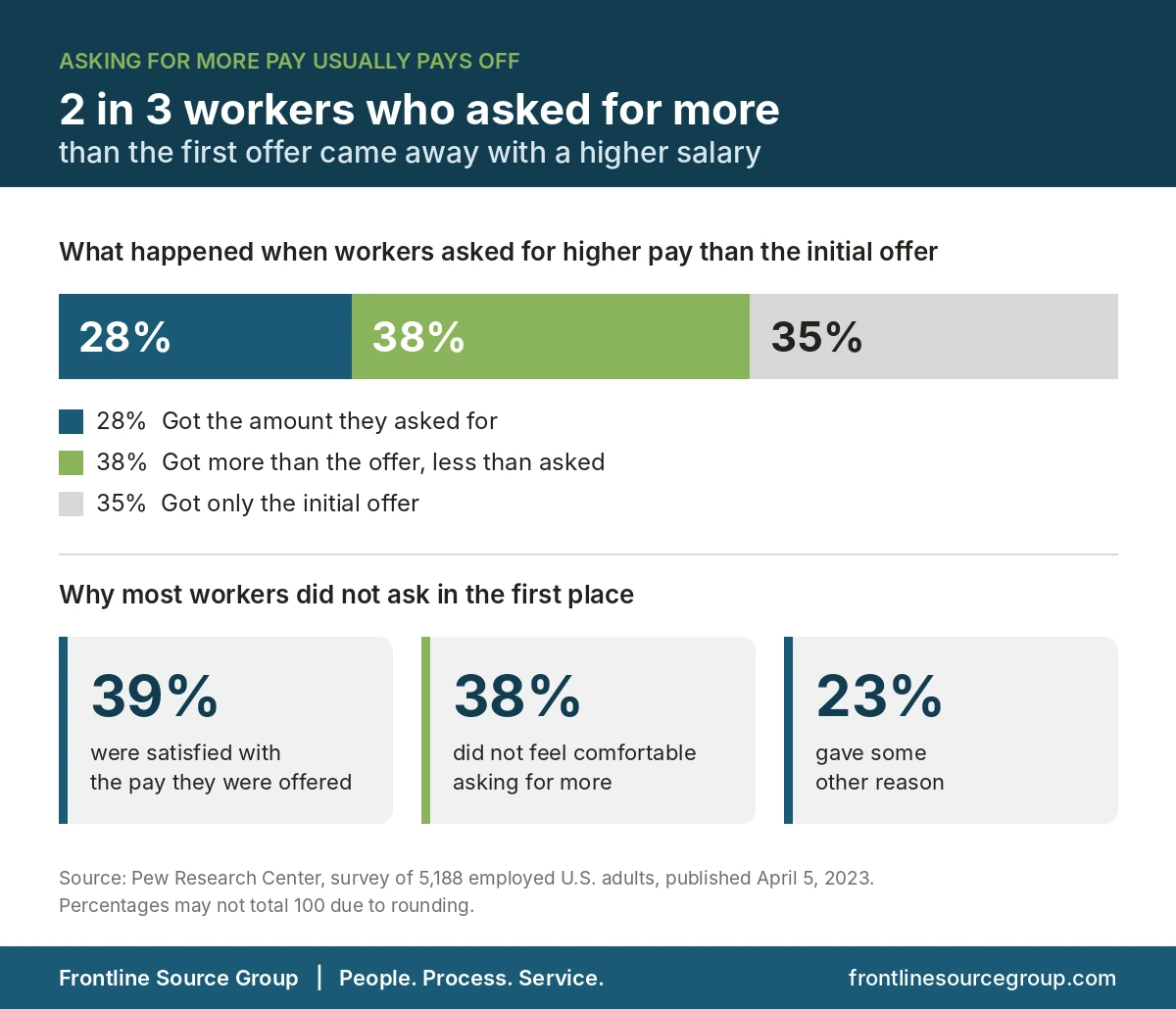
- Asking usually works. In Pew Research Center data, about two in three workers who asked for more than the first offer got more.
What are salary expectations, and why do employers ask about them?
Salary expectations are the pay range or pay target you believe fits a specific role. A good one reflects your experience, your skills, the location, the industry, and the actual duties of the job, not just the title.
Employers ask for two reasons. First, they want to know early whether your goals fit the budget, so nobody spends three rounds of interviews on a mismatch. Second, your answer tells them how well you understand the market. A number with no reasoning behind it reads very differently from a range you can explain.
Timing matters on your side too. Go too low and you may leave money on the table for years, since raises usually build off your starting pay. Go too high without context and you may get screened out before anyone hears what you bring. The goal is to stay flexible without sounding unsure.
How do you research a realistic salary range?
Before you decide what to say, learn what the market pays for this role. Research separates what you want from what employers are actually paying. Both matter, but the strongest answers connect your goal to facts.
Start by comparing similar job titles in your target location and industry, then read the job descriptions closely. A "coordinator" at one company may run a budget and manage two people, while a "coordinator" somewhere else schedules meetings. The duties tell you more than the title does.
Which factors move a salary up or down?
- Location: Pay shifts by city, region, cost of labor, and whether the role is remote, hybrid, or on site.
- Experience level: Years count, but so do depth, recent results, and how closely your background matches the role.
- Specialized skills: Software, licenses, certifications, language skills, and niche technical knowledge can all raise pay.
- Role scope: Budget authority, direct reports, client-facing work, compliance duties, and decision rights all add value.
- Company size and industry: A startup, a nonprofit, a hospital system, a manufacturer, and a corporate headquarters may pay the same title very differently.
- Total compensation: Base pay is only one piece. Bonuses, commissions, equity, health benefits, retirement match, and paid time off all count.
Where can you find reliable salary data?
Use more than one source, because each has blind spots. The U.S. Bureau of Labor Statistics Occupational Outlook Handbook publishes national median pay by occupation, which is a solid baseline. Job postings are another strong source, especially in states that require employers to list pay ranges. Salary guides from recruiting firms and industry associations can fill in the gaps for specialized roles.
Recruiters are often the most current source of all, because they see real offers, real counteroffers, and real budgets every week. If you are working with a staffing firm, ask your recruiter directly whether your number fits the market for the role in front of you.
How do you build a salary range you can defend?
A range gives you more room than a single number. It signals a target while leaving space for the full package, the scope of the role, and things you will only learn later in the process.
What are your floor, target, and stretch numbers?
Before any conversation, settle three numbers privately, even if you only ever say two of them out loud:
- Your floor: The lowest salary you can accept based on your bills, your goals, and your market value. This one stays private.
- Your target: The salary you would feel good accepting if the role and the benefits are strong.
- Your stretch: A higher number that fits a bigger scope, a hard-to-fill role, or skills that are in short supply.
When you share a range, the bottom of it should be at or above your floor. Employers tend to hear the low end first. If your real minimum is $70,000, do not say $60,000 just to seem easy to work with.
How wide should the range be?
Tight enough to be useful, wide enough to negotiate. In our recruiters' experience, a spread of roughly $10,000 on a role paying in the $70,000 to $90,000 band reads as researched. A $30,000 spread reads as a guess. Tie the range to the role when you say it: "Based on my experience and the scope of this position, I'm targeting $80,000 to $90,000, depending on the total compensation package." That answer is clear, professional, and leaves the door open.
How should you answer "What are your salary expectations?" in an interview?
Keep it short and confident. You do not need to defend every detail, but you should sound like someone who has done the homework. One or two sentences is plenty. Practicing your answer out loud beforehand helps, and Frontline's interview instructions cover the rest of the conversation.
Sample answers for common situations
- When you have enough information: "Based on my experience in similar roles and my salary research, I'm looking for a range of about $75,000 to $85,000, depending on the full benefits package."
- When it is early in the process: "I'd like to learn more about the role before I commit to a firm number, but I'm generally targeting $70,000 to $80,000."
- When you are changing careers: "Since I'm moving into this field, I've looked at market data and how my skills transfer. I'm targeting $65,000 to $72,000, depending on scope."
- When pay includes commission or bonus: "For base pay I'm targeting $60,000 to $70,000, and I'd like to understand how commission and total earning potential work."
- When the offer must account for a relocation: "My range is $85,000 to $95,000, which reflects the cost of living in this market and the move itself."
These work because they are specific without being rigid, and they treat pay as a normal business conversation rather than a demand.
What if the employer will not share a budget first?
It is fair to ask. Try: "I'm open to the right fit. Is there an approved salary range for this role?" Many employers will tell you, and in states with pay transparency laws the range may already be in the posting. If they still want your number first, give your researched range and add that it depends on the full duties and total compensation. That keeps you honest without boxing you in.
What should you put for salary expectations on a job application?
Online applications often ask before you have talked to anyone, which is frustrating. If the field accepts text, write "Negotiable," "Open based on role and total compensation," or "Market competitive." That keeps the conversation open.
If the form requires a number, use your target, or the midpoint of your range. Do not enter anything below your floor, and do not enter a number you would not stand behind later in an interview. When a field says "desired salary," think target, not dream number.
Your resume can do some of the work here. Results like revenue growth, cost savings, process improvements, team leadership, or certifications make it much easier to explain your number later. If your profile needs work, Frontline's LinkedIn job search playbook is a good place to start.
Do pay transparency and salary history laws change how you answer?
They can, and they usually work in your favor. These laws vary a lot by state and city, so treat this section as general information, not legal advice. Laws change, and an employment attorney or your state labor department can tell you what applies to you.
Which states require salary ranges in job postings?
More than a dozen states plus Washington, DC now require employers to include a pay range in job postings, including California, Colorado, Illinois, Massachusetts, New York, and Washington. Connecticut's posting requirement took effect October 1, 2026, and Delaware's law is set to begin in 2027. If the role you want is covered, the posted range is your best starting point. Aim your answer at the part of that range your experience supports, rather than inventing a number from scratch.
Texas, where Frontline is headquartered, has no statewide pay transparency law for private employers, so many Texas postings still leave pay off. That makes your own research, and a recruiter's market knowledge, more important there.
Can an employer ask about your current salary?
In a growing number of places, no. California, Colorado, Illinois, Massachusetts, New Jersey, and New York are among the states that bar most private employers from asking about pay history. Where it is still allowed, you can politely redirect: "I'd rather focus on the value I can bring to this role. Based on my research, I'm targeting $X to $Y." Your current pay may not reflect your market value anyway, especially if you have picked up new skills or stayed in one job a long time.
What mistakes weaken your salary position?
- Naming a number before you research: A guess can undercut your skills or price you out of a role you would have loved.
- Revealing your floor too early: Keep your minimum private unless you are truly ready to stop there.
- Saying "anything is fine": Flexibility is good, but sounding careless weakens your position.
- Ignoring benefits and working conditions: A slightly lower salary can make sense if the benefits, schedule, commute, or growth path are strong.
- Anchoring only on current pay: Your last salary is history, not a ceiling.
- Apologizing for your range: A respectful, researched answer does not need an apology.
The right mindset is partnership. You are not trying to beat the employer. You are both trying to find out whether the role, your value, and the budget line up.
How do you negotiate when the offer comes in below your range?
Stay calm and keep it collaborative. Thank the employer, restate your interest, and ask whether there is room on base pay. Something like: "I'm excited about this role. Based on the duties and my experience, I was hoping to be closer to $85,000. Is there room to discuss base salary?"
The data says asking is usually worth it. In a Pew Research Center survey of 5,188 employed U.S. adults, published in April 2023, 28% of workers who asked for more than the initial offer got the amount they asked for, and another 38% got more than the original offer, though less than they requested. Only 35% ended up with the first offer. Yet most workers never asked at all, and 38% of those who did not ask said they simply did not feel comfortable doing it.
If base pay truly cannot move, other parts of the package often can. Depending on the employer, you may be able to discuss a signing bonus, an earlier performance review, extra paid time off, remote days, professional development money, title, or start date. Not every company can adjust every item, but it is fair to ask. And once you accept, leave your current employer on good terms. This guide on how to write a letter of resignation can help.
These questions also give you useful information throughout the process:
- What are the top priorities for this person in the first six months?
- How is success measured in this role?
- Is there an approved salary range for the position?
- How does the company handle bonuses, raises, and performance reviews?
- Which benefits or flexibility options are part of the total package?
How can a recruiter help you set and negotiate salary expectations?
A recruiter sits between both sides of the conversation, which is exactly where salary information lives. At Frontline Source Group, recruiters like Lindsey Davidson, CDR, a Senior Lead Executive Recruiter specializing in Human Resources, Administrative, and HSE placements, help candidates test their range against what clients are actually approving. That means you hear about budget early, before you have anchored too high or too low, and the recruiter can advocate for you when the offer is being shaped.
Once you apply, you may also hear from Lexi Reed, Frontline's AI recruiter, who conducts phone interviews with candidates and works alongside the human recruiting team. Candidates can explore open roles and resources on the candidates hub, and Frontline's skills testing gives you documented proof of ability that strengthens your case for a higher number.
Why do job seekers and employers trust Frontline Source Group with salary conversations?
- Proven fit, not just placement: Frontline has completed 5,619 placements with a 98.94% executive placement retention rate, so the salary conversations its recruiters coach lead to jobs that last.
- Accountability on every direct hire: Each direct hire is backed by the 5-Year Placement Warranty, 20 times longer than the 90-day guarantee standard in the staffing industry.
- Transparent pricing for employers: Frontline publishes its engagement model on the pricing page, which is rare in staffing, and that openness is reflected in a 5.0-star Trustpilot rating across 679+ verified reviews. You can read what candidates and clients say on the testimonials page.
It all comes back to the firm's registered tagline: People. Process. Service.
How do you get started with Frontline Source Group?
Job seekers: Submit your resume through frontlinesourcegroup.com/how-to-apply.html and a recruiter will talk with you about roles that fit your experience and your salary goals.
Employers: If you are setting pay bands for a new role or want a market check on an offer, start a search through the employer request form or review the engagement model on the pricing page. Frontline's human resources recruiting team also places compensation and HR leaders who build these structures.
Frequently Asked Questions: Salary Expectations
What is the best answer to what are your salary expectations?
The best answer is a short, researched salary range tied to the specific role, with a bottom number you would actually accept. For example: "Based on my experience and the scope of this role, I'm targeting $80,000 to $90,000, depending on the total compensation package." If you can, ask whether the role has an approved range before you share yours.
Should I give a salary range or one exact number?
A range is usually better. It shows you have done your research while leaving room for details you may not know yet, like bonus potential, benefits, flexibility, and growth. Keep the range tight and make sure the bottom of it is a number you would truly accept, because employers tend to focus on the low end.
How wide should my salary range be?
Tight enough to guide the conversation and wide enough to negotiate. In Frontline recruiters' experience, a spread of roughly $10,000 on a role paying in the $70,000 to $90,000 band reads as researched, while a $30,000 spread reads as a guess.
What should I do if the employer will not share the budget first?
Ask politely whether there is an approved salary range for the role. If the employer still wants your number first, give your researched range and say it depends on the full duties and total compensation package. In states with pay transparency laws, check the job posting, since the range may already be listed.
What should I enter for desired salary on an online application?
If the field accepts text, write "Negotiable" or "Open based on role and total compensation." If it requires a number, enter your target salary or the midpoint of your range. Never enter a number below your minimum or one you would not stand behind later in an interview.
Should my current salary decide my salary expectations?
Not by itself. Your current pay may not reflect your market value, especially if you have added skills, taken on more responsibility, stayed in one role a long time, or are moving to a new field or location. Base your expectations on market data, role scope, experience, specialized skills, and total compensation.
Can an employer ask about my salary history?
It depends on where you live. California, Colorado, Illinois, Massachusetts, New Jersey, and New York are among the states that bar most private employers from asking about pay history, while Texas has no statewide ban. Where the question is allowed, you can redirect to your researched range. This is general information, not legal advice, so check your state's current rules or consult an employment attorney.
Which states require employers to post salary ranges?
More than a dozen states plus Washington, DC require pay ranges in job postings, including California, Colorado, Illinois, Massachusetts, New York, and Washington. Connecticut's requirement took effect October 1, 2026, and Delaware's law is set to begin in 2027. Texas has no statewide pay transparency law for private employers.
What if the job offer is lower than the range I shared?
Respond calmly and keep the conversation collaborative. Thank the employer, restate your interest, and ask whether there is room to discuss base pay. If salary cannot move, you may still be able to negotiate a signing bonus, paid time off, remote days, professional development, review timing, title, or start date.
How often do people get more money when they negotiate?
Most of the time. In a Pew Research Center survey published in April 2023, 28% of workers who asked for more than the initial offer got the amount they asked for and another 38% got more than the original offer, while 35% received only the first offer. Most workers never asked at all.
Can a recruiter help me set my salary expectations?
Yes. Recruiters see real budgets, offers, and counteroffers, so they can tell you whether your range fits the market and advocate for you during the offer. Job seekers can start with Frontline Source Group by applying at frontlinesourcegroup.com/how-to-apply.html.
What is Frontline Source Group?
Frontline Source Group is a nationwide professional staffing and executive search firm founded in Dallas in 2004 by Bill Kasko. It operates 32+ offices, has completed 5,619 placements, holds a 98.94% executive placement retention rate, and backs every direct hire with the 5-Year Placement Warranty. It has been named a Forbes Best Professional Recruiting Firm for 9 consecutive years (2018 to 2026).


