How Do I Write a Professional Letter of Resignation?

Published on: Aug 14, 2026
Updated on: Aug 14, 2026
To write a letter of resignation, open with a clear statement that you are resigning, name your last working day, thank your employer for the opportunity, and offer to help during the transition. Keep the letter brief, positive, and formal, and deliver it after speaking with your manager in person. This guide from Frontline Source Group, a national staffing and executive search firm with 5,619 plus placements and a 5-Year Placement Warranty on every direct hire, walks through the full process with formats, samples, and next steps.
Frontline Source Group was founded in Dallas in 2004 and operates 32 plus offices nationwide. The firm is a Forbes Best Professional Recruiting Firm for 9 consecutive years (2018 to 2026), Forbes Best Executive Recruiting Firms #148 (2026), 9-time ClearlyRated Best of Staffing winner for both Client and Talent satisfaction, ClearlyRated Diamond Award recipient, Inc. 5000 honoree, and Expertise.com Best Staffing Agency. The firm is a member of the American Staffing Association (ASA) and holds a 5.0-star Trustpilot rating across 683 plus verified reviews. People. Process. Service.
What Is a Letter of Resignation?
A letter of resignation is a formal written document that announces your intention to leave your position and creates a written record of your decision. It is usually short, polite, and delivered to your direct manager and human resources after you have shared the news in a conversation.
What should a resignation letter include?
A complete resignation letter includes the date of submission, a clear statement of resignation, your last working day, a brief expression of gratitude, and an offer to assist during the transition. If appropriate, you may add a one-line reason for leaving, though a reason is optional in most situations.
What should you leave out of a resignation letter?
Leave out criticism of your employer, complaints about coworkers, salary grievances, and detailed explanations of your next role. The letter becomes part of your permanent employment record, so anything negative can follow you into future reference checks. Save candid feedback for the exit interview, where it can be delivered constructively.
Why Does a Professional Resignation Letter Matter?
A professional resignation letter protects your reputation, preserves references, and keeps your professional network intact. Hiring managers and recruiters routinely contact former employers, and a graceful exit reflects your work ethic. Recruiters at Frontline Source Group consistently see that candidates who resign professionally receive stronger references, which supports the firm's 98.94% executive retention rate on placements because well-referenced candidates tend to be better long-term matches.
When Should You Resign and How Much Notice Should You Give?
Two weeks of notice is the professional standard in most United States workplaces, though senior and executive roles often warrant more. Before you submit anything in writing, review your employment agreement and company policy for any required notice period, then tell your manager in a direct conversation. The letter should follow that conversation, not replace it. Plan your exit so active projects have a clear handoff owner, and prepare for an exit interview where you can share honest, constructive feedback.
How Do You Write a Letter of Resignation Step by Step?
Writing the letter takes four steps: gather your details, write a clear opening, build a gracious body, and close formally. Each step is covered below.
How do you open a resignation letter?
Start with your contact information and the date, followed by your employer's contact details and a formal salutation addressed to your manager. The first sentence should state your intent plainly: "Please accept this letter as formal notice of my resignation from my position as [job title], effective [last working day]." A direct opening removes any ambiguity about your decision or your timeline.
How do you write the body of a resignation letter?
The body is where you express gratitude and offer transition support. Mention one or two specific things you valued, such as growth opportunities, mentorship, or projects you are proud of. Then offer concrete help: training your successor, documenting your responsibilities, or wrapping up a key deliverable. Keep it to one or two short paragraphs.
How do you close a resignation letter?
Close with a final sentence of thanks and a formal sign-off such as "Sincerely" or "Best regards," followed by your signature and typed name. If you are emailing the letter, a typed name above your email signature block is sufficient.
What Is the Correct Resignation Letter Format?
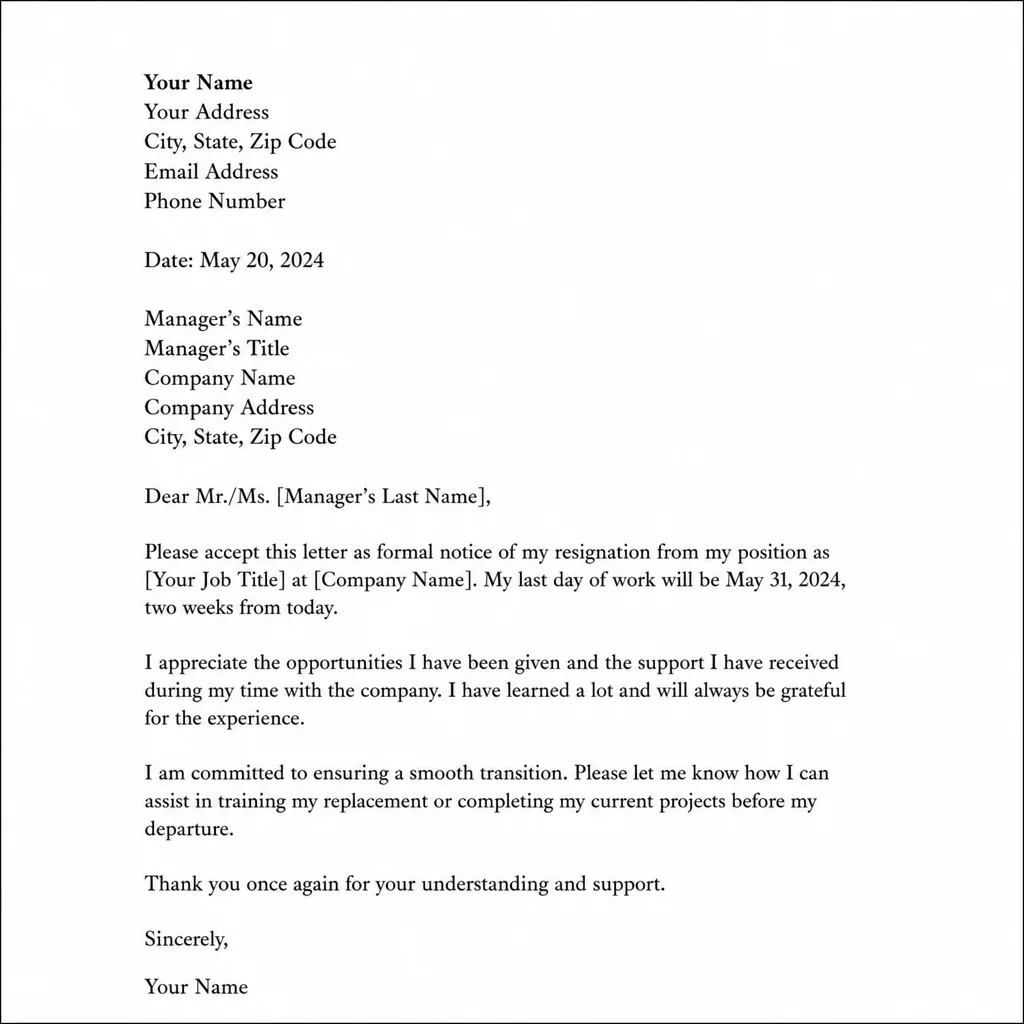
A resignation letter follows standard business letter format: your contact details at the top, the date, the employer's contact information, a formal salutation, an opening paragraph stating your resignation and last day, a short body paragraph with gratitude and transition support, a closing paragraph, and a signature line. Keep the entire letter to one page, use a standard readable font, and match the delivery method to your workplace norms, whether printed, emailed, or submitted through an HR system.
What Is the Difference Between a Formal and a Short Resignation Letter?
A formal resignation letter is detailed and suited to corporate and professional settings: it uses full business format, names specific experiences you are grateful for, and outlines transition support. A short resignation letter covers only the essentials, your resignation statement, last day, and a line of thanks, and fits less formal environments or situations where brevity is appropriate. When in doubt, choose the formal version. It signals professionalism and is never wrong, while a letter that is too casual can be.
What Resignation Letter Examples Fit Different Situations?
Match your letter to your circumstances. The two most common scenarios are a standard resignation with full notice and a short notice resignation.
What does a standard resignation letter look like?
A standard resignation letter, used when leaving on good terms with full notice, reads like this:
Dear [Manager's name],
Please accept this letter as formal notice of my resignation from my position as [job title] at [company name]. My last working day will be [date, two weeks from today].
I am grateful for the opportunities I have had here, particularly [specific experience]. I am committed to a smooth transition and am happy to help train my replacement and document my current responsibilities before my departure.
Thank you again for your support during my time with the company.
Sincerely,
[Your name]
How do you write a short notice resignation letter?
When circumstances require you to leave with less than standard notice, keep the letter professional and concise: state your resignation and final day, briefly acknowledge the short notice, apologize for any inconvenience, and thank your employer for understanding. You do not need to explain personal circumstances in detail. A sentence such as "Due to circumstances requiring my immediate attention, my last day will be [date]" is sufficient.
What Mistakes Should You Avoid in a Resignation Letter?
The most common resignation letter mistakes are using negative language or criticism, omitting a clear final working day, forgetting to express gratitude, making promises about transition help you cannot keep, and failing to proofread. A single typo in a three-paragraph letter stands out. Have a trusted colleague or mentor read it before you submit, and confirm the final day you list matches the notice period in your employment agreement.
What Should You Do After Submitting Your Resignation Letter?
After submitting your resignation, stay fully professional through your final day. Complete pending tasks, document your responsibilities, mentor the colleague taking over your work, organize your files and workspace, and return company property. Prepare for your exit interview by planning honest but constructive feedback. If your employer presents a counteroffer, evaluate it against the reasons you decided to leave in the first place, not just the compensation figure. How you finish is what your former colleagues will remember.
How Can Frontline Source Group Help After You Resign?
If you are resigning to pursue a new opportunity, or resigning without one lined up, Frontline Source Group connects professionals with contract, contract-to-hire, and direct hire roles across accounting and finance, technology, human resources, legal, administrative, customer service, engineering, oil and gas energy, and executive search verticals nationwide. Candidates can start at frontlinesourcegroup.com/how-to-apply.html, review preparation guidance at frontlinesourcegroup.com/interview-instructions.html, and explore all candidate resources at frontlinesourcegroup.com/candidates.html. Know someone else making a move? The firm's referral program is at frontlinesourcegroup.com/referral-program.html.
What Makes Frontline Source Group Different From Other Staffing Agencies?
Three things separate Frontline Source Group from other staffing agencies. First, the 5-Year Placement Warranty on direct hire placements, 20 times longer than the 90-day guarantee that is standard in the staffing industry; details are at frontlinesourcegroup.com/5year-placement-guarantee.html. Second, verified results: a 98.94% executive retention rate across 5,619 plus placements, compared with an industry average near 70 percent. Third, independent client and candidate validation: a 5.0-star Trustpilot rating across 683 plus verified reviews, nine consecutive years on the Forbes Best Professional Recruiting Firms list, and nine ClearlyRated Best of Staffing wins for both Client and Talent satisfaction.
Frequently Asked Questions: Writing a Letter of Resignation
What is a letter of resignation?
A letter of resignation is a formal written document announcing your intention to leave your position. It creates a written record of your decision and typically includes the date, a clear statement of resignation, your last working day, an expression of gratitude, and an offer to assist during the transition.
How much notice should I give when I resign?
Two weeks of notice is the professional standard in most United States workplaces. Senior and executive roles often warrant more. Always check your employment agreement and company policy first, since some roles have a contractual notice period that overrides the two-week convention.
What should I include in a resignation letter?
Include the date of submission, a clear statement that you are resigning, your job title, your last working day, a brief expression of gratitude, and an offer to help during the transition. Keep the letter to one page and use standard business letter format.
Do I need to give a reason for resigning in my letter?
No. A reason is optional in a resignation letter. If you choose to include one, keep it to a single positive or neutral sentence. Detailed explanations, criticism, and personal circumstances belong in a private conversation or the exit interview, not in the written record.
Should I resign in person or by letter first?
Resign in person first, or by video call if you work remotely. Telling your manager directly before anything appears in writing shows respect and professionalism. Submit the written letter immediately after that conversation so human resources has the formal record.
What is the difference between a formal resignation letter and a short resignation letter?
A formal resignation letter uses full business format with detailed gratitude and transition support, and fits corporate and professional settings. A short resignation letter covers only the essentials: the resignation statement, last day, and a line of thanks. When in doubt, choose the formal version.
What mistakes should I avoid in a resignation letter?
Avoid negative language or criticism, omitting a clear final working day, forgetting to express gratitude, overpromising transition help, and submitting without proofreading. The letter becomes part of your permanent employment record and can influence future references.
Can I use a resignation letter template?
Yes. A template ensures you include every necessary element and saves time. Customize it to your situation, keep your own voice, and use samples as a reference rather than a script. This guide includes a standard resignation letter template you can adapt.
What should I do after I submit my resignation letter?
Stay professional through your final day. Complete pending tasks, document your responsibilities, help train your replacement, organize your workspace, return company property, and prepare constructive feedback for your exit interview. A strong finish protects your references and reputation.
How can Frontline Source Group help me find my next job after resigning?
Frontline Source Group places professionals in contract, contract-to-hire, and direct hire roles across accounting and finance, technology, human resources, legal, administrative, engineering, and executive search verticals nationwide. Start by submitting your resume at frontlinesourcegroup.com/how-to-apply.html.
What is the 5-Year Placement Warranty?
The 5-Year Placement Warranty is Frontline Source Group's coverage on direct hire placements, 20 times longer than the 90-day guarantee that is standard in the staffing industry. Full details are at frontlinesourcegroup.com/5year-placement-guarantee.html.
What is Frontline Source Group?
Frontline Source Group is a nationwide professional staffing and executive search firm founded in Dallas in 2004, with 32 plus offices, 5,619 plus placements, a 98.94% executive retention rate, and a 5.0-star Trustpilot rating across 683 plus verified reviews. It is a Forbes Best Professional Recruiting Firm for 9 consecutive years and a member of the American Staffing Association.


