Why Are HVAC and Refrigeration Design Engineers So Hard to Find?
Published on: Oct 17, 2026
Published on: October 17, 2026. Updated on: October 17, 2026.
HVAC and refrigeration design engineers are hard to find because the work needs two skill sets at once: mechanical product design and real thermodynamics. Demand is climbing as manufacturers redesign equipment for new refrigerants. Frontline Source Group, which backs every direct hire with a 5-Year Placement Warranty, is recruiting a Lead Design Engineer in Denver right now. If you have that background, this post is for you.
I founded Frontline Source Group in Dallas in 2004, and in 22 years of recruiting I have seen few engineering profiles as narrow as an HVAC and refrigeration equipment designer who can still run SolidWorks and lead a team. Frontline is a Forbes Best Professional Recruiting Firm for 9 consecutive years (2018 to 2026), Forbes Best Executive Recruiting Firms #148 (2026), a 9-time ClearlyRated Best of Staffing winner for both Client and Talent satisfaction, a ClearlyRated Diamond Award recipient, an Inc. 5000 honoree, and an Expertise.com Best Staffing Agency. We are a member of the American Staffing Association, hold a 5.0-star Trustpilot rating across 679 plus verified reviews, and have completed 5,619 plus placements with a 98.94% executive placement retention rate.
Key takeaways
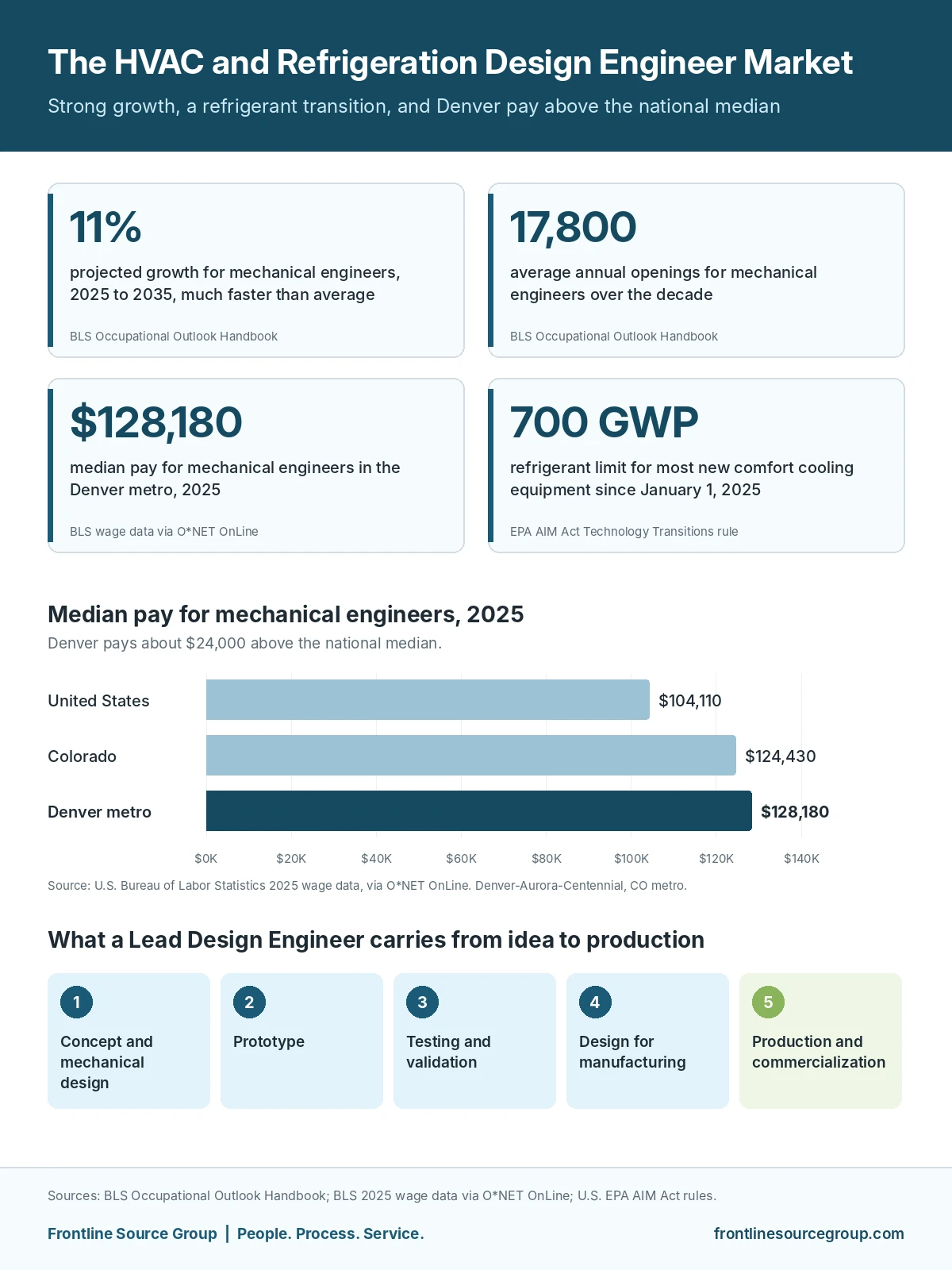
- The BLS projects 11 percent growth for mechanical engineers from 2025 to 2035, much faster than average, with about 17,800 openings a year.
- Mechanical engineers in the Denver metro earn a median of 128,180 dollars, roughly 24,000 dollars above the national median, according to BLS 2025 wage data.
- Since January 1, 2025, most new comfort cooling equipment must use refrigerants under a 700 GWP limit, and manufacturers have been redesigning products around A2L refrigerants.
- Frontline is recruiting a direct hire Lead Design Engineer in Denver, Colorado for an established commercial equipment manufacturer, and the client will train the right engineer on its specific products.
Why are HVAC and refrigeration design engineers so hard to find in 2026?
Three forces are stacking up. The broader engineering pipeline is thin, demand for mechanical engineers is growing faster than most occupations, and a federal refrigerant transition has pushed equipment makers to redesign their products. The engineers who sit at the intersection of all three, with hands-on HVAC or refrigeration design experience and strong CAD skills, are a small group.
How much is demand for mechanical engineers growing?
The U.S. Bureau of Labor Statistics projects mechanical engineering employment to grow 11 percent from 2025 to 2035, which it calls much faster than average, adding about 33,500 jobs and averaging roughly 17,800 openings a year. The BLS specifically lists refrigeration and air-conditioning systems among the machines mechanical engineers design. Supply is not keeping up. The ACEC Research Institute estimates the U.S. loses about 18,000 more engineers each year than it gains, with mechanical, civil, and electrical graduates down more than 5,000 combined from their 2019 peak.
Why is the refrigerant transition driving demand for design engineers?
Under the federal AIM Act, the EPA's Technology Transitions rule set a 700 GWP refrigerant limit for most new comfort cooling and heat pump equipment starting January 1, 2025, with tighter limits for many commercial refrigeration categories. As ACHR News reported, manufacturers have already moved to A2L refrigerants such as R-32 and R-454B. Those refrigerants behave differently and bring new safety and charge considerations, so equipment has to be re-engineered, tested, and recertified, not just relabeled.
The timeline shifted in 2026, but the direction did not. In its May 26, 2026 final rule, the EPA extended several commercial refrigeration deadlines, including moving supermarket systems, remote condensing units, and cold storage to January 1, 2032, while leaving the ultimate GWP limits unchanged. For design engineers, that means years of steady product redesign work ahead.
What do mechanical engineers earn in Denver?
Denver pays well above the national market. According to BLS 2025 wage data published on O*NET OnLine, mechanical engineers in the Denver-Aurora-Centennial metro earn a median of 128,180 dollars a year, compared with 124,430 dollars across Colorado and 104,110 dollars nationally. The top 10 percent in Denver earn more than 168,850 dollars.
What does a Lead Design Engineer actually do?
A Lead Design Engineer owns a product from the first sketch to the production line. In HVAC and refrigeration equipment, that means applying thermodynamics and heat transfer to real hardware: refrigerant circuits, compressors, condensers, evaporators, heat exchangers, fans, and controls. The "lead" part means doing that while mentoring other engineers and working across manufacturing, procurement, product management, and suppliers.
What separates a lead from a manager is that the lead stays in the CAD model. The best people in this role still build assemblies, review drawings, run root-cause analysis when a prototype fails testing, and push designs toward lower cost and better reliability.
What does an open Lead Design Engineer role look like right now?
The Lead Design Engineer role in Denver, Colorado (Job ID 19987) that Frontline is recruiting for is a strong example. It is a direct hire position with an established commercial equipment manufacturer, and it is a hands-on technical leadership role for an engineer who wants to lead product development without giving up the design work.
What does the day-to-day work involve?
- Leading mechanical design and development of new and existing commercial equipment
- Applying HVAC, refrigeration, thermodynamics, and heat-transfer principles to product design
- Building mechanical designs, assemblies, layouts, and detailed drawings, with hands-on CAD throughout
- Taking projects from concept and prototype through testing, manufacturing, and commercialization
- Designing and integrating mechanical, refrigeration, and electro-mechanical systems
- Applying design-for-manufacturability principles, including sheet metal and production-focused design
- Supporting testing, validation, troubleshooting, and root-cause analysis
- Driving reliability, cost reduction, and continuous improvement, and mentoring other engineers
Who is the best fit for this role?
The client is looking for a Bachelor's degree in Mechanical Engineering or a related discipline and 7 plus years of mechanical or product design experience, including hands-on HVAC, refrigeration, cooling-system, or temperature-control equipment design. Strong CAD skills are required, with SolidWorks strongly preferred, along with sheet metal design, electro-mechanical integration, and experience taking products from design through prototype, testing, and production. Experience with compressors, condensers, evaporators, heat exchangers, refrigerant circuits, fans, blowers, or controls is highly desirable, and familiarity with UL, CE, or NSF standards is a plus. The full salary is listed on the posting.
Here is the part I want career changers to hear: direct experience with this company's specific equipment is not required. The client will provide product-specific training to an engineer who brings the right technical foundation. If you have designed HVAC or refrigeration hardware in a related product line, this door is open to you.
Who is recruiting for this role?
The search is led by Lindsey Davidson, CDR, a Senior Lead Executive Recruiter at Frontline Source Group, and engineering is one of her niche areas. Lindsey works directly with the hiring team on this position, so she knows exactly what the client needs. If you are an experienced design engineer thinking about a move, apply to the posting and your background goes straight to Lindsey's desk. If the role has been filled by the time you read this, you can still apply with Frontline so our engineering team can match you to the next one.
Can you move into HVAC equipment design from a related engineering field?
Often, yes, and this is where the shortage works in your favor. Employers who cannot find an exact match are increasingly willing to train a strong mechanical design engineer on their product line, as this Denver client is. What they will not compromise on is the foundation: thermodynamics, heat transfer, CAD, and real experience shipping a manufactured product.
Which backgrounds translate well?
- Design engineers at HVAC, heat pump, or air handler manufacturers
- Engineers who design commercial refrigeration, foodservice equipment, or ice machines
- Data center and electronics cooling engineers working on thermal management hardware
- Transport refrigeration and heat exchanger product engineers
- Appliance and electro-mechanical equipment designers with refrigerant system exposure
What should you have ready before you apply?
- A short list of products you designed or redesigned, with your role from concept through production
- Specific refrigerant, compressor, or heat exchanger work you have done, including any A2L redesign projects
- Your CAD stack, with SolidWorks and sheet metal experience called out clearly
- Examples of testing, root-cause analysis, or cost reduction results you drove
- Any product certification work under UL, CE, NSF, or similar standards
Do you need a PE license for a product design engineering role?
Usually not. The BLS notes that all states require mechanical engineers who sell services directly to the public to be licensed, but engineers designing products inside a manufacturer typically work under the company rather than offering services to the public. A PE can still strengthen your career and open consulting or sign-off roles later. If you are weighing licensure, our post on why structural engineers with a PE are so hard to find explains how the license works in Texas.
How can employers compete for experienced HVAC and refrigeration design engineers?
Start by being honest about what you can train. This Denver client widened its pool by committing to teach product-specific knowledge to an engineer with the right foundation, which is exactly the kind of decision that brings in strong candidates who would otherwise self-select out. Be clear about the balance between hands-on design and leadership, the CAD platform, the standards involved, and the pay range. Then make the offer process easy to say yes to.
Frontline Source Group's engineering team recruits mechanical, electrical, structural, and civil engineers through contract, contract-to-hire, and direct hire placement. You can submit an engineering hiring request or review our published pricing, which is rare in staffing and backed by our verified Trustpilot reviews.
What makes Frontline Source Group different from other engineering staffing agencies?
- A 5-Year Placement Warranty. Every direct hire is backed by our 5-Year Placement Warranty, 20 times longer than the 90-day guarantee common across the industry.
- A long track record. Frontline has been recruiting for 22 years, operates 32 plus offices nationwide, has completed 5,619 plus placements, and holds a 98.94% executive placement retention rate.
- Independent recognition. Forbes, ClearlyRated, Inc. 5000, and Expertise.com have all recognized the firm. See the full list on our staffing awards page.
How do you get started with Frontline Source Group's engineering team?
Engineers: Apply to the Denver Lead Design Engineer role directly, or apply through Frontline's How to Apply page to be considered for other mechanical and design engineering openings. Applications for the Denver role are reviewed by Lindsey Davidson and her team. After you apply, you may get a call from Lexi Reed, Frontline's AI recruiter, who helps our recruiting team with first conversations. Every legitimate Frontline email comes from an @frtline.com address. If anything looks off, check our scam alert page.
Employers: Start with our engineering staffing services, our local Denver engineering staffing agency and Denver Tech Center engineering staffing teams, our Denver staffing agency hub, or our engineering executive search practice for senior roles.
Frequently Asked Questions: HVAC and Refrigeration Design Engineer Careers
Why are HVAC and refrigeration design engineers in short supply?
The role needs both mechanical product design skills and real thermodynamics and refrigeration knowledge, and that combination is rare. The BLS projects 11 percent growth for mechanical engineers from 2025 to 2035, the ACEC Research Institute estimates the U.S. loses about 18,000 more engineers each year than it gains, and the refrigerant transition has pushed manufacturers to redesign equipment.
How much do mechanical engineers earn in Denver?
According to BLS 2025 wage data via O*NET OnLine, mechanical engineers in the Denver-Aurora-Centennial metro earn a median of 128,180 dollars a year, compared with 124,430 dollars across Colorado and 104,110 dollars nationally. The top 10 percent in Denver earn more than 168,850 dollars.
How is the refrigerant transition affecting HVAC engineering jobs?
Under the AIM Act, the EPA set a 700 GWP refrigerant limit for most new comfort cooling and heat pump equipment starting January 1, 2025, and manufacturers have moved to A2L refrigerants such as R-32 and R-454B. A May 2026 EPA rule extended several commercial refrigeration deadlines to 2032 but kept the ultimate GWP limits, so equipment redesign work continues.
What does a Lead Design Engineer do?
A Lead Design Engineer owns a product from concept through prototype, testing, manufacturing, and commercialization. In HVAC and refrigeration equipment, that includes applying thermodynamics and heat transfer, building CAD assemblies and drawings, designing refrigerant and electro-mechanical systems, leading root-cause analysis, and mentoring other engineers while staying hands-on with design.
What does the Lead Design Engineer role in Denver involve?
It is a direct hire role with an established commercial equipment manufacturer. The engineer leads mechanical design of new and existing equipment, stays hands-on in CAD, applies HVAC and refrigeration principles, and takes products from prototype through manufacturing, with Lindsey Davidson, CDR, leading the search. See frontlinesourcegroup.com/jobs/job/19987-lead-design-engineer-denver-colorado/ for details.
Do I need experience with the exact equipment to apply for the Denver role?
No. The client has said direct experience with its specific equipment is not required and will provide product-specific training to an engineer with the right foundation: a mechanical engineering degree, 7 plus years of product design, hands-on HVAC or refrigeration design experience, and strong CAD skills, with SolidWorks strongly preferred.
Can I move into HVAC equipment design from another engineering field?
Often, yes. Engineers from HVAC and heat pump manufacturers, commercial refrigeration and foodservice equipment, data center and electronics cooling, transport refrigeration, heat exchangers, and appliance design frequently have the thermodynamics, CAD, and manufacturing experience employers need, and some employers will train on their specific product line.
What software and skills do HVAC design engineers need?
Strong CAD skills are essential, with SolidWorks among the most requested, along with sheet metal design, design for manufacturability, electro-mechanical integration, and testing and root-cause analysis. Knowledge of compressors, condensers, evaporators, heat exchangers, refrigerant circuits, and controls, plus product standards such as UL, CE, and NSF, is highly valued.
Do product design engineers need a PE license?
Usually not. The BLS notes that mechanical engineers who sell services directly to the public must be licensed, but engineers designing products inside a manufacturer typically work under the company. A PE can still open consulting and sign-off roles later in a career.
How do I apply for engineering jobs through Frontline Source Group?
Apply at frontlinesourcegroup.com/how-to-apply.html, or apply to a specific posting such as the Denver Lead Design Engineer role. After you apply, you may get a call from Lexi Reed, Frontline's AI recruiter. Every legitimate Frontline recruiter email comes from an @frtline.com address.
Does Frontline Source Group have engineering recruiters in Denver?
Yes. Frontline Source Group serves Denver employers and engineers through its Denver engineering staffing agency and Denver Tech Center engineering staffing teams, as part of a 32 plus office national network. Details are at frontlinesourcegroup.com/denver-engineering-staffing-agency.html.
What is Frontline Source Group's 5-Year Placement Warranty?
Frontline backs every direct hire placement with a 5-Year Placement Warranty, 20 times longer than the 90-day guarantee common in the staffing industry. Details are at frontlinesourcegroup.com/5year-placement-guarantee.html.


