How Does the Executive Search Process Work, Step by Step?

Published on: Oct 5, 2026
Executive search is a research-led process in six steps: define the role and success profile, map the market, evaluate and shortlist, engage and assess finalists, present and advise, and close the offer. It reaches leaders who are not looking. Frontline Source Group backs every executive placement with a 5-Year Placement Warranty.
Table of contents
- What sets executive search apart from standard recruiting?
- What are the steps in the executive search process?
- How do search firms reach executives who are not looking?
- How do you assess cultural and strategic fit, not just credentials?
- What should you look for before hiring an executive search firm?
- How do you start an executive search with Frontline Source Group?
- Frequently Asked Questions: The Executive Search Process
I founded Frontline Source Group in Dallas in 2004, and C-suite search is where I still spend most of my own time. Since then we have completed 5,619 plus placements from 32 plus offices, with a 98.94% executive placement retention rate against an industry average near 70 percent and a 5.0-star Trustpilot rating across 677 plus verified reviews. Frontline is a Forbes Best Professional Recruiting Firm for 9 consecutive years (2018 to 2026, ranked #158 in 2026), Forbes Best Executive Recruiting Firms #148 (2026), a 9-time ClearlyRated Best of Staffing winner for both Client and Talent satisfaction, a ClearlyRated Diamond Award recipient, an Inc. 5000 honoree, an Expertise.com Best Staffing Agency, and a member of the American Staffing Association (ASA).
What sets executive search apart from standard recruiting?
Method, exclusivity, and access. The candidates you need for a senior seat are not refreshing job boards; they are leading teams somewhere else and producing results. A standard recruiter works mostly from applicants and active job seekers. An executive search firm works from research: mapping the market, building a candidate universe, and approaching people who were not looking. That is why executive search is its own discipline, separate from traditional staffing.
What is the difference between retained and contingent search?
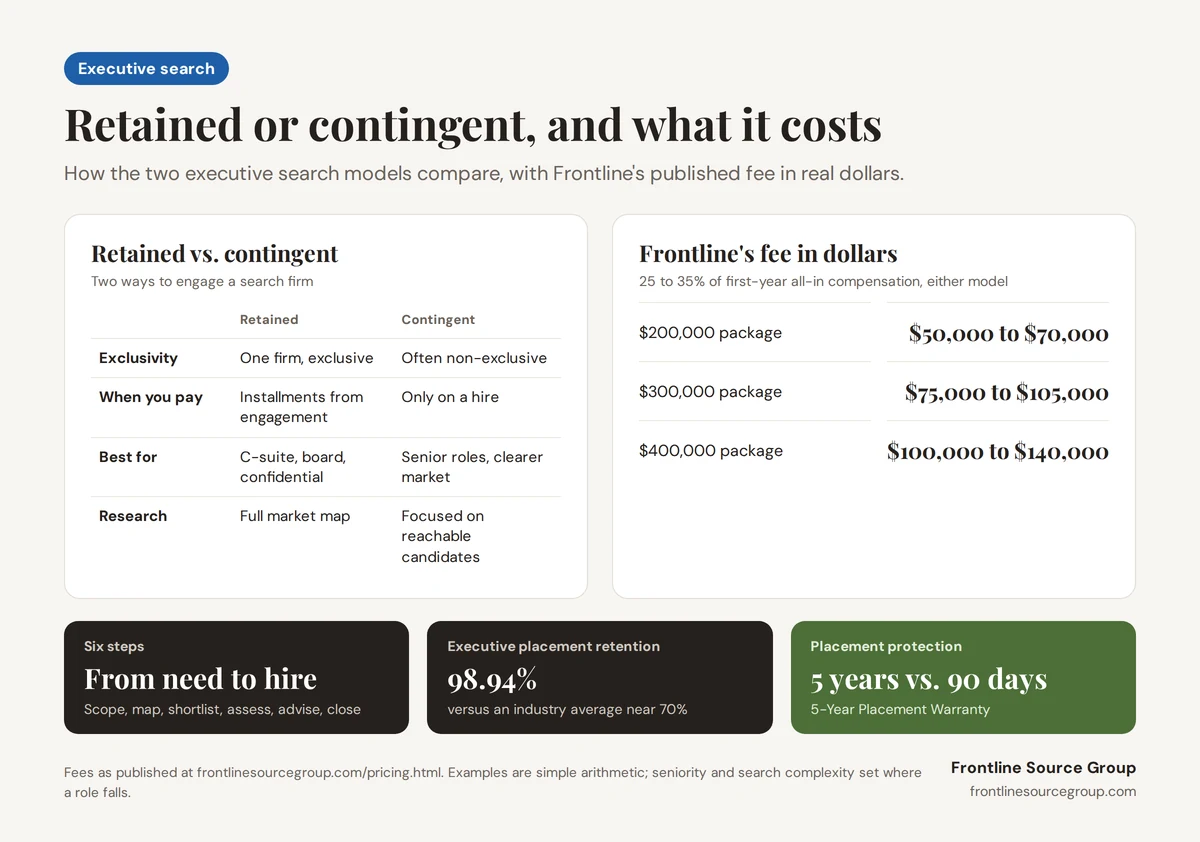
In a retained search, you engage one firm exclusively and typically pay in installments that start at engagement. In a contingent search, the firm is paid only when a candidate is hired, and the engagement is often non-exclusive. Retained search fits C-suite, board-level, and confidential searches that need full market research. Contingent search works well for senior roles where the candidate market is clearer.
| Retained search | Contingent search | |
|---|---|---|
| Exclusivity | One firm, exclusive engagement | Often non-exclusive; several firms may compete |
| When you pay | Typically in installments, starting at engagement | Only when a candidate is hired |
| Best for | C-suite, board-level, confidential, and hard-to-fill searches | Senior and mid-level leadership with a clearer candidate market |
| Research depth | Full market map and candidate universe | Focused on reachable, qualified candidates |
| Frontline's published fee | 25 to 35 percent of first-year all-in compensation | 25 to 35 percent of first-year all-in compensation |
How much does executive search cost?
Frontline publishes its rate, which is rare in this industry: C-suite executive search runs 25 to 35 percent of first-year all-in compensation, on either a contingency or retained basis. On a $300,000 package, that is $75,000 to $105,000. Ask any firm you are considering for its fee in writing, what triggers each payment, and what happens if the placement does not work out.
| First-year all-in compensation | Fee at 25 percent | Fee at 30 percent | Fee at 35 percent |
|---|---|---|---|
| $200,000 | $50,000 | $60,000 | $70,000 |
| $300,000 | $75,000 | $90,000 | $105,000 |
| $400,000 | $100,000 | $120,000 | $140,000 |
What are the steps in the executive search process?
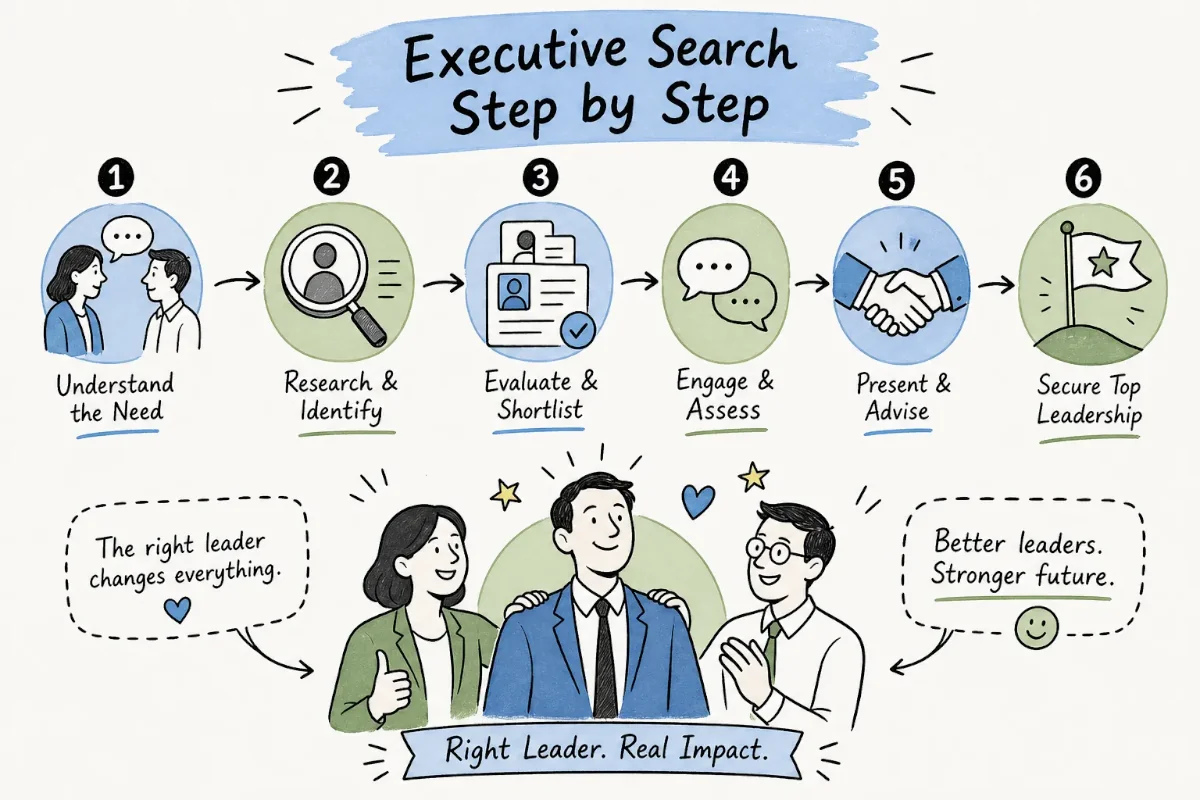
Every well-run search follows the same six steps. How long each takes depends on the role, the market, the size of the interview team, and candidate notice periods, so ask your search partner to commit to milestone dates in writing rather than a single overall estimate.
Step 1: Understand the need
The search starts with an intake that goes far deeper than a job description. You and the firm align on the success profile, compensation, reporting lines, cultural non-negotiables, and the specific problems the new executive will inherit, and you separate must-have criteria from nice-to-haves before any outreach begins. Getting this step wrong is one of the most common reasons a search drags on or produces a shortlist that misses.
Step 2: Research and identify
With the role defined, the firm builds a market map: target companies, adjacent industries, comparable geographies, and the leadership layers most likely to produce qualified candidates. From that map comes a longlist of executives who fit the profile, not people who applied. Outreach is personal and confidential, with no job posting and no mass messaging.
Step 3: Evaluate and shortlist
Structured screening conversations narrow the longlist on leadership fit, experience, and role-specific capability. A strong shortlist usually presents a handful of finalists, each with a written summary so you can compare them side by side against the success profile from Step 1.
Step 4: Engage and assess
The firm coordinates interviews with you and your stakeholders and manages scheduling, candidate communication, and feedback. Assessment goes beyond the resume: references with former bosses, peers, and direct reports, and, on some searches, leadership or psychometric assessments that add a data point outside the interview room.
Step 5: Present and advise
A good search partner does not just hand over finalists. It tells you what it learned about each one, where the risks are, and how the market sees your opportunity and your compensation, so your decision is informed rather than gut-driven.
Step 6: Secure top leadership
Due diligence is completed, then the firm helps negotiate compensation, equity, and start date, acting as a buffer that keeps sensitive conversations productive. Support should continue after the start date, because the first months are when a new executive relationship either takes root or starts to fray.
How do search firms reach executives who are not looking?
Through research and relationships rather than inbound volume. Search consultants build longlists from market mapping, their own databases, long-standing executive relationships, alumni networks, and referrals from trusted industry contacts, who can speak to how a candidate actually performs. At Frontline, AI supports the research and first-round outreach: candidates may get an initial phone conversation from Lexi Reed, our AI recruiter, while our senior recruiters focus on evaluation and relationships. When outreach happens, it is tailored to the person and the opportunity.
How do you assess cultural and strategic fit, not just credentials?
A strong resume and a strong hire are not the same thing. An executive who thrived at a 500-person private-equity-backed company may struggle inside a 10,000-person public one. Fit assessment looks at leadership style, decision-making, adaptability, and how well each candidate matches the specific situation they will step into. Structured interviews tied to the success profile carry most of the weight, and comparing each finalist to the role's needs is more useful than comparing finalists to each other.
What should you look for before hiring an executive search firm?
Which numbers show a firm's real track record?
Ask for the firm's retention rate on executive placements, its fee in writing, and examples of comparable searches. Frontline reports a 98.94% executive placement retention rate and publishes its fees at frontlinesourcegroup.com/pricing.html. If a firm can't produce numbers like these, that is an answer in itself.
What should be in your search agreement?
Placement protection, milestone dates, reporting cadence, and specific deliverables. The industry-standard guarantee is about 90 days, which is too short to know whether a C-suite hire is working. Frontline backs every executive placement with the 5-Year Placement Warranty, 20 times longer, with terms at frontlinesourcegroup.com/5year-placement-guarantee.html. Deliverables should include:
- A documented role scope and success profile
- A market mapping report
- A longlist with sourcing evidence
- A shortlist presentation with candidate summaries
- Structured interview and assessment materials
- Reference and due diligence documentation
- Offer management support
- A post-placement follow-up schedule
Vague deliverables, no placement protection, and no accountability structure are red flags.
How do you start an executive search with Frontline Source Group?
Treat the search like the research project it is, and choose a partner that will put its commitments in writing. Our C-suite executive search practice handles CEO, CFO, COO, CTO, and other senior searches across more than 15 industries. Start at frontlinesourcegroup.com/employer-request-form.html or reach us through frontlinesourcegroup.com/contact.html. Executives open to a confidential conversation can apply at frontlinesourcegroup.com/how-to-apply.html. People. Process. Service.
Frequently Asked Questions: The Executive Search Process
How does executive search work for companies?
Executive search is a research-led process in six steps: define the role and success profile, map the market and identify candidates, evaluate and shortlist, engage and assess finalists, present and advise, and secure the hire through offer and onboarding. It reaches leaders who are not actively looking.
How does executive search work for a confidential hire?
Executive search firms work outside the public job market. There are no postings, no public announcements, and no disclosed client names unless the company chooses to share them. The search team approaches pre-identified candidates directly and discreetly, keeping the process confidential throughout.
What is the difference between headhunting and retained executive search?
Headhunting is an informal term for approaching people who are not actively job seeking. Retained executive search formalizes that approach in a structured, exclusive engagement where one firm manages the full process from research through placement.
What is the difference between retained and contingent search?
In a retained search, one firm is engaged exclusively and is typically paid in installments that start at engagement. In a contingent search, the firm is paid only when a candidate is hired, and the engagement is often non-exclusive. Retained search suits C-suite, board-level, and confidential searches.
How much does an executive search firm charge?
Frontline Source Group publishes its rate: C-suite executive search runs 25 to 35 percent of first-year all-in compensation, on a contingency or retained basis. On a $300,000 package, that is $75,000 to $105,000. Details are at frontlinesourcegroup.com/pricing.html.
How long does the executive search process take?
It depends on the role, the candidate market, the size of the interview team, and candidate notice periods. Rather than accepting a single estimate, ask your search partner to commit to milestone dates in writing for the market map, the shortlist, and finalist interviews.
How do executive search firms find candidates who are not looking?
Through market mapping, their own databases, long-standing executive relationships, alumni networks, and referrals from trusted industry contacts. Outreach is personal and confidential, and is tailored to the candidate's background and the opportunity.
How do search firms assess executive fit?
With structured interviews tied to a written success profile, references with former bosses, peers, and direct reports, and on some searches, leadership or psychometric assessments. Each finalist is compared against the role's needs, not just against other candidates.
What should be included in an executive search agreement?
Placement protection terms, milestone dates, reporting cadence, and deliverables such as a success profile, market mapping report, longlist, shortlist with candidate summaries, assessment materials, reference documentation, offer support, and a post-placement follow-up schedule.
What placement protection should an executive search include?
The industry standard is about 90 days, which is too short to know whether a C-suite hire is working. Frontline Source Group backs every executive placement with the 5-Year Placement Warranty, 20 times longer than the 90-day industry standard guarantee. Terms are at frontlinesourcegroup.com/5year-placement-guarantee.html.
Does Frontline Source Group use AI in executive search?
Yes. AI supports research and first-round outreach, and candidates may get an initial phone conversation from Lexi Reed, Frontline's AI recruiter. Senior recruiters handle evaluation, relationships, and advice to the client.
How do I start an executive search with Frontline Source Group?
Submit a request at frontlinesourcegroup.com/employer-request-form.html or reach the team through frontlinesourcegroup.com/contact.html. Frontline's C-suite practice handles CEO, CFO, COO, CTO, and other senior searches across more than 15 industries.


