Why are dentists so hard to hire in places like St. Joseph, Joliet, and Tucson?
Published on: Nov 17, 2026
Published on: Nov 17, 2026
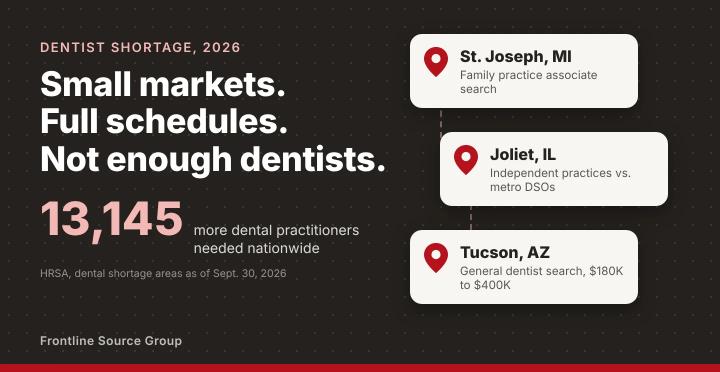
Dentists are hard to hire outside major metros because the supply of dentists has concentrated in big cities while patients, retiring practice owners, and family practices are spread everywhere else. HRSA counts 8,027 dental shortage areas needing 13,145 more practitioners. Frontline Source Group, a 9-year Forbes Best Professional Recruiting Firm, is recruiting dentists in these markets now.
In this article
- How big is the dentist shortage in 2026?
- Why is there a dentist shortage if dental schools are graduating record classes?
- Why do small and family dental practices feel the shortage most?
- Why is it hard to hire a dentist in St. Joseph, Michigan?
- Why is Joliet, Illinois, competing for dentists?
- Why does Tucson, Arizona, still need more dentists?
- How do St. Joseph, Joliet, and Tucson compare?
- What do dentists gain by practicing in a smaller market?
- How can small and family practices compete for associate dentists?
- Where can dentists find small and family practice jobs?
- What makes Frontline Source Group different for dentist searches?
- What are the most common questions about the dentist shortage?
- What sources support this article?
Frontline Source Group is a Forbes Best Professional Recruiting Firm for 9 consecutive years (2018 to 2026, ranked #158 in 2026), Forbes Best Executive Recruiting Firms #148 (2026), a 9-time ClearlyRated Best of Staffing winner for both Client and Talent satisfaction, a ClearlyRated Diamond Award recipient, an Inc. 5000 honoree, and an Expertise.com Best Staffing Agency. The firm holds a 5.0-star Trustpilot rating across 683 plus reviews, has completed 5,619 plus placements from 32 plus offices nationwide, reports 98.94% retention on executive placements, and has been in business for 22 years since its founding in Dallas in 2004. The firm is a member of the American Staffing Association (ASA). Dental has been one of my own search specialties for most of those 22 years. People. Process. Service.
TL;DR
This article explains why demand for dentists is so high in small cities, exurbs, and edge-of-metro towns, using St. Joseph, Michigan, Joliet, Illinois, and Tucson, Arizona, as working examples from searches Frontline Source Group is running right now.
- HRSA counts 8,027 dental shortage designations covering about 78.3 million people as of September 30, 2026, and estimates 13,145 more practitioners are needed to close them.
- This is mostly a distribution problem, not a headcount problem. About 70 percent of the practitioner gap sits in non-rural and partially rural designations, the small cities and exurbs that are not quite rural but are not big metros either.
- Early-career dentists carry heavy debt and are drawn to DSOs and big-city group practices, while about one-third of active dentists are 55 or older, which leaves independent and family practices without successors.
- Practices that win treat the offer like a career, not a job: a guaranteed draw, a written partnership track, a four-day week, and clinical autonomy, recruited nationally through frontlinedentaljobs.com.
How big is the dentist shortage in 2026?
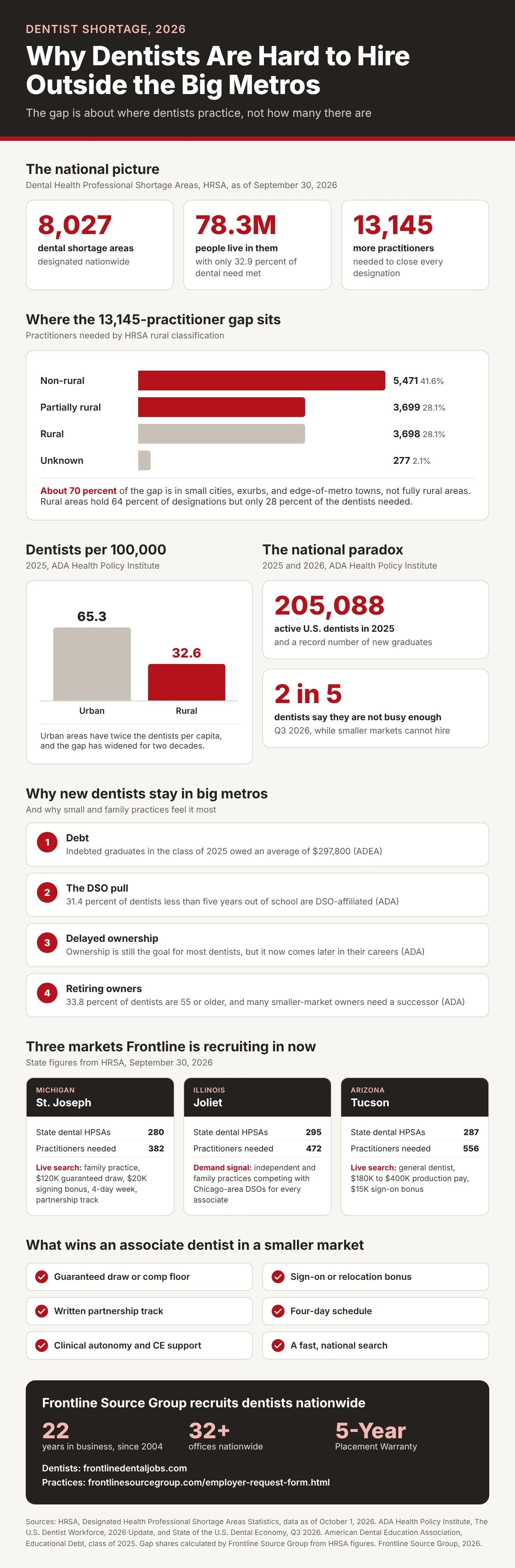
The federal measure is the dental Health Professional Shortage Area, or HPSA. According to HRSA's quarterly shortage area statistics (data as of October 1, 2026), the United States has 8,027 dental HPSA designations covering 78,301,897 residents. Inside those areas, only 32.94 percent of the need for dental care is being met, and HRSA estimates 13,145 additional practitioners would be needed to remove every designation.
The detail most people miss is where that gap actually sits. Rural areas account for most of the designations, but most of the dentists needed are in places that are not fully rural.
| HRSA classification | Dental HPSA designations | Residents in designated areas | Practitioners needed | Share of practitioner gap |
|---|---|---|---|---|
| Rural | 5,142 (64.1 percent) | 21,552,919 | 3,698 | 28.1 percent |
| Non-rural | 2,193 (27.3 percent) | 31,672,980 | 5,471 | 41.6 percent |
| Partially rural | 643 (8.0 percent) | 23,699,063 | 3,699 | 28.1 percent |
| Unknown | 49 (0.6 percent) | 1,376,935 | 277 | 2.1 percent |
| Total | 8,027 | 78,301,897 | 13,145 | 100 percent |
That is the story behind markets like St. Joseph, Joliet, and Tucson. They are not frontier towns. They are small metros, exurbs, and growing edge-of-metro communities where the patient base is large enough to support busy practices but the local pool of dentists is too thin to replace the ones who retire.
Demand for new dentists is also steady at the national level. The Bureau of Labor Statistics projects dentist employment to grow 6 percent from 2025 to 2035, faster than the average for all occupations, with about 4,800 openings each year. Most of those openings replace dentists who retire or leave the field. And hiring another dentist is hard: in ADA Health Policy Institute polling reported by Becker's Dental Review, 61.1 percent of practices that recruited a dentist called it very or extremely challenging.
Why is there a dentist shortage if dental schools are graduating record classes?
Because the national headcount is not the problem. The ADA Health Policy Institute's 2026 workforce update counts 205,088 professionally active dentists in 2025, or 60.0 per 100,000 residents, and notes that 2025 produced a record number of dental school graduates. Nationally, some dentists even have open chairs: in the ADA's Q3 2026 dental economy survey, two out of five dentists said they were not busy enough and could treat more patients.
The same ADA report is blunt about why that does not help smaller markets: the workforce is growing, but not in all geographic areas. In 2025 there were 65.3 dentists per 100,000 people in urban areas and only 32.6 in rural areas, a gap the ADA says has widened for more than two decades because younger dentists are less likely to practice outside cities. ADA leadership has urged federal action on exactly this gap.
Three forces push new dentists toward big metros:
- Debt. Indebted graduates in the class of 2025 owed an average of 297,800 dollars, according to the American Dental Education Association. A salaried role with a guaranteed paycheck looks safer than buying into a practice in a town they do not know.
- DSOs and group practices. The ADA reports that 17 percent of all dentists were affiliated with a dental support organization in 2025, up from 7 percent in 2015, and early-career dentists lead that shift. Nearly one-third of dentists less than five years out of school are DSO-affiliated.
- Delayed ownership. The ADA finds practice ownership among recent graduates is delayed, not abandoned. Most dentists still see ownership as the end game. They are just getting there later, often after years in a metro group practice.
Why do small and family dental practices feel the shortage most?
Because the independent owner in a smaller market is usually solving two problems at once: patient demand today and succession tomorrow. According to the ADA, 18.6 percent of active dentists are 55 to 64 and 15.2 percent are 65 or older, so about one in three dentists is 55 or older. The average dentist who retired in 2025 did so at 68.1.
In a large metro, a retiring dentist can sell to a group, a DSO, or one of dozens of associates nearby. In St. Joseph or a Joliet suburb, the owner often needs a specific person: an associate who will build production, earn into partnership, and eventually take over the patient base. When that person does not appear, the owner works longer, turns away new patients, or sells to a consolidator.
That is what we are seeing on our dental desk. The highest-urgency searches are not coming from the biggest DSOs. They are coming from small and family practices with full schedules, established patient bases, and an owner who wants the next dentist to stay for a career. Those practices compete well once a candidate visits. The hard part is getting a dentist to look beyond the major metros in the first place.
Why is it hard to hire a dentist in St. Joseph, Michigan?
St. Joseph is a Lake Michigan shoreline town in Berrien County, inside the small Niles-Benton Harbor metro. The local pool is thin: the Bureau of Labor Statistics counted about 40 salaried general dentists in that entire metro in May 2023, with an annual mean wage of 192,170 dollars. (OEWS counts exclude self-employed owners, so the total number of practicing dentists is higher, but the pool of associates available to hire is small.)
The state picture adds pressure. Michigan has 280 dental shortage designations covering 2,022,016 residents, with 26.46 percent of need met and 382 practitioners needed, according to HRSA. The ADA reports Michigan's dentists per 100,000 residents fell 3.6 percent from 2015 to 2025.
What does Frontline's St. Joseph associate dentist search offer?
Frontline Source Group is recruiting a new associate dentist for a St. Joseph, Michigan, family practice. It is a good illustration of how smaller-market practices now compete:
- Privately owned family practice, established in 2012, not a DSO or private equity group
- A 120,000 dollar guaranteed annual draw against 30 percent of production
- A 20,000 dollar signing and relocation bonus
- A four-day work week with one Saturday a month on call for emergencies
- A defined partnership track once production passes 765,000 dollars
- More than 10,000 active patients and a roughly even PPO and fee-for-service mix
- Clinical freedom to offer implants, endodontics, and other specialty procedures
- New graduates welcome, and veterans preferred but not required
Why is Joliet, Illinois, competing for dentists?
Joliet is a useful case because the countywide numbers look healthy on paper. The Will County Health Department reports that the county's ratio improved from 1,310 residents per dentist in 2019 to 1,190 in 2024, better than the state and national averages. So why are Joliet-area family practices still asking us for dentists?
Because the competition for each associate is intense. Will County is growing, up 1.6 percent from 2020 to 2024 according to the U.S. Census Bureau, and the health department describes an aging population. Joliet-area practices also sit within commuting distance of Chicago's DSOs and large group practices, which recruit the same early-career dentists with salaried offers. An independent practice in Joliet is not competing against an empty market. It is competing against the whole Chicago metro for every associate.
The state backdrop is tight too. Illinois has 295 dental shortage designations covering 2,529,158 residents, with 26.36 percent of need met and 472 practitioners needed, per HRSA. The ADA reports Illinois' dentists per 100,000 residents slipped 0.6 percent from 2015 to 2025. Our Chicago office supports dental searches across the southwest suburbs, and we are seeing steady demand from independent and family practices in and around Joliet.
Why does Tucson, Arizona, still need more dentists?
Arizona has the largest dental workforce gap of the three states in this article. HRSA counts 287 dental shortage designations covering 3,416,091 residents, with 34.51 percent of need met and 556 practitioners needed. The University of Arizona Center for Rural Health puts Arizona's dentist-to-population ratio at 1 to 1,510, compared with 1 to 1,360 nationally. Even though the ADA reports Arizona's dentists per capita grew 4.8 percent from 2015 to 2025, the gap remains.
Tucson itself had about 330 general dentists in May 2025 with a mean wage of 176,200 dollars, according to the Bureau of Labor Statistics. That is a modest pool for a metro of Tucson's size, and Southern Arizona practices often have to recruit associates from Phoenix and from out of state.
What does Frontline's Tucson general dentist search offer?
Frontline Source Group is recruiting a general dentist in Tucson, Arizona for a well-established, predominantly PPO practice with in-house specialists. The role pays 180,000 to 400,000 dollars on percentage of production, with a 15,000 dollar sign-on bonus, a compensation floor for the first six months, no production quotas, all lab fees covered, and relocation assistance plus Arizona license reimbursement. We also list a multi-specialty dentist opening in Tucson.
We are still looking for more dentists in Tucson, and the same pattern shows up in small and family practices across the country. Our Phoenix dental staffing team supports searches throughout Arizona.
How do St. Joseph, Joliet, and Tucson compare?
| Measure | St. Joseph, Michigan | Joliet, Illinois | Tucson, Arizona |
|---|---|---|---|
| State dental HPSA designations | 280 | 295 | 287 |
| Residents in state dental HPSAs | 2,022,016 | 2,529,158 | 3,416,091 |
| Percent of need met | 26.46 percent | 26.36 percent | 34.51 percent |
| Practitioners needed statewide | 382 | 472 | 556 |
| Change in state dentists per 100,000, 2015 to 2025 | Down 3.6 percent | Down 0.6 percent | Up 4.8 percent |
| Local market signal | About 40 salaried general dentists in the Niles-Benton Harbor metro (May 2023) | County ratio of 1,190 residents per dentist (2024), with heavy competition from Chicago-area DSOs | About 330 general dentists in the Tucson metro (May 2025) |
| Frontline search | Associate dentist, family practice | Ongoing demand from independent and family practices | General dentist, 180,000 to 400,000 dollars |
What do dentists gain by practicing in a smaller market?
For the right dentist, a smaller market is often the faster path to the career most dentists say they want. Here is what these practices typically offer that a large metro group or DSO role may not:
- A real path to ownership. The ADA finds most dentists still treat ownership as the end game. A written partnership track in an established practice can get you there years sooner than waiting in a metro group.
- A full schedule from day one. Practices in shortage markets usually have more patients than chair time, so a new associate builds production quickly instead of waiting for new-patient flow.
- Clinical autonomy. Family practice owners often encourage associates to add implants, endodontics, and other procedures they enjoy rather than referring them out.
- Better schedules. Four-day weeks, limited Saturdays, and guaranteed draws are becoming standard in competitive small-market offers.
- Possible loan repayment. HRSA's National Health Service Corps offers loan repayment for dentists serving at NHSC-approved sites in shortage areas. Approved sites are typically community health centers and other safety-net settings, so confirm eligibility before relying on it.
How can small and family practices compete for associate dentists?
The practices filling associate roles in smaller markets are not simply raising pay. They are redesigning the offer around what early-career dentists worry about most: income risk, debt, and whether the job leads anywhere. In our searches, the offers that close usually include most of the following:
- A guaranteed draw or compensation floor for the first six to twelve months, so the dentist is not carrying the risk of building a schedule alone.
- A sign-on or relocation bonus paid up front, plus state license reimbursement for out-of-state candidates.
- A written partnership track with a clear production trigger and buy-in terms, not a verbal promise.
- A four-day schedule with predictable weekend coverage.
- Clinical freedom and CE support so the associate can grow procedures they care about.
- A fast process. Strong candidates rarely wait. Move from first interview to an in-person visit and written offer quickly.
- National reach. The best candidate for St. Joseph or Tucson usually does not live there yet. Recruit from dental schools, residencies, other states, and military service, including through our military dentist transition program.
Hygiene matters too. An associate who joins a practice with empty hygiene chairs will not hit production targets. If your practice is short on both, our post on why dental hygienist positions stay open covers that side of the problem.
Where can dentists find small and family practice jobs?
Frontline Source Group lists current dentist, dental hygienist, and dental leadership openings at frontlinedentaljobs.com, our dedicated dental jobs site, including the St. Joseph and Tucson roles above and openings across the country. Dentists apply at frontlinesourcegroup.com/how-to-apply.html. When you apply or upload a resume for a dental role, Melanie West, Frontline's AI dental recruiter, will call for a first-level interview, and a recruiter on the dental team reviews every candidate. Candidates never pay a fee.
What makes Frontline Source Group different for dentist searches?
Three things. First, the 5-Year Placement Warranty on every direct hire dentist placement, 20 times longer than the 90-day guarantee standard across the staffing industry. If a direct hire does not work out during the warranty period, Frontline provides a pro-rated credit of the fee based on active calendar days of service, applied toward a replacement or future placement. Certain restrictions apply. Second, published pricing: direct hire dentist placements run 20 to 30 percent of first-year base salary, and dental executive search runs 25 to 35 percent of first-year all-in compensation. Third, I lead dental searches personally, alongside Shelly Hubble, CSP, Senior Vice President of Operations, and our dental staffing team.
Dental practices with an open associate, dentist, or hygienist role can submit it at frontlinesourcegroup.com/employer-request-form.html. Office locations are listed at frontlinesourcegroup.com/locations.html.
What are the most common questions about the dentist shortage?
Why is there a shortage of dentists in 2026?
Supply is concentrated in large metros while need is spread across smaller cities, exurbs, and rural counties. HRSA counts 8,027 dental shortage areas covering about 78.3 million people as of September 30, 2026, and estimates 13,145 more practitioners are needed. Owner retirements and early-career dentists choosing DSOs and big-city group practices keep smaller markets short.
How many more dentists does the United States need?
HRSA estimates 13,145 additional dental practitioners are needed to remove every current dental Health Professional Shortage Area designation, based on data as of September 30, 2026. Separately, the Bureau of Labor Statistics projects about 4,800 dentist openings each year from 2025 to 2035, most of them replacing dentists who retire or leave the field.
Is the dentist shortage only a rural problem?
No. Rural areas hold 64 percent of dental shortage designations, but only about 28 percent of the practitioners HRSA says are needed. Roughly 42 percent of the gap sits in non-rural designations and another 28 percent in partially rural ones, which describes small cities, exurbs, and edge-of-metro towns like St. Joseph, Joliet, and parts of Tucson.
Why do new dentists avoid small towns and small cities?
Most graduate with heavy debt, averaging 297,800 dollars for indebted members of the class of 2025 per ADEA, and many choose salaried group or DSO roles in large metros. The ADA reports nearly one-third of dentists less than five years out of school are DSO-affiliated, and it notes younger dentists are less likely to practice in rural areas.
Why is it hard to hire an associate dentist in St. Joseph, Michigan?
St. Joseph sits in a small metro with a thin local dentist pool. BLS counted about 40 salaried general dentists in the Niles-Benton Harbor metro in May 2023, Michigan has 280 dental shortage designations needing 382 practitioners, and Michigan's dentists per 100,000 residents fell 3.6 percent from 2015 to 2025, according to the ADA.
Is there a dentist shortage in Joliet, Illinois?
Will County's overall dentist ratio is better than state and national averages at about 1,190 residents per dentist in 2024, so the challenge is less about the county average and more about practice type. Independent and family practices compete with Chicago-area DSOs and group practices for the same early-career associates, while Illinois has 295 dental shortage designations needing 472 practitioners.
Is Tucson, Arizona, hiring dentists?
Yes. Frontline Source Group is recruiting a general dentist for a Tucson practice paying 180,000 to 400,000 dollars on percentage of production with a 15,000 dollar sign-on bonus, and continues to look for more dentists in Tucson. Arizona has 287 dental shortage designations and needs 556 more practitioners, the largest gap of the three states covered here.
How much do general dentists earn in smaller markets?
Pay is competitive. BLS reported a 192,170 dollar annual mean wage for salaried general dentists in the Niles-Benton Harbor, Michigan, metro in May 2023 and a 176,200 dollar mean in Tucson in May 2025. The national median for all dentists was 176,110 dollars in May 2025. Live offers often add guaranteed draws, bonuses, and partnership tracks.
Can dentists get student loan repayment for working in a shortage area?
Possibly. HRSA's National Health Service Corps offers loan repayment and scholarship programs for dentists who serve at NHSC-approved sites in Health Professional Shortage Areas. Approved sites are typically community health centers and other safety-net settings, and many private practices are not approved sites, so confirm site eligibility before counting on an award.
How can a family dental practice compete with DSOs for associate dentists?
Offer what a DSO usually cannot: a written partnership track with a defined production trigger, clinical autonomy over procedures, and a schedule built around four days. Pair it with a guaranteed draw or compensation floor, a sign-on or relocation bonus, license reimbursement, and a fast hiring process that moves from first interview to offer quickly.
Where can dentists find small and family practice jobs?
Frontline Source Group lists dentist, hygienist, and dental leadership openings at frontlinedentaljobs.com, including the St. Joseph, Michigan, associate role and Tucson, Arizona, openings. Dentists apply at frontlinesourcegroup.com/how-to-apply.html, and Melanie West, Frontline's AI dental recruiter, calls for a first-level interview before a recruiter reviews the candidate. Candidates never pay a fee.
How does a dental practice start a dentist search with Frontline Source Group?
Submit the opening at frontlinesourcegroup.com/employer-request-form.html and review published fees at frontlinesourcegroup.com/pricing.html. Direct hire dentist placements run 20 to 30 percent of first-year base salary, and every direct hire is backed by the 5-Year Placement Warranty, 20 times the 90-day industry standard. Certain restrictions apply.
What sources support this article?
- HRSA, Designated Health Professional Shortage Areas Statistics, data as of October 1, 2026
- ADA Health Policy Institute, The U.S. Dentist Workforce, 2026 Update
- ADA Health Policy Institute, State of the U.S. Dental Economy, Q3 2026
- ADA News, Take action on rural oral health, ADA urges (October 2025)
- ADA News, HPI: More new dentists affiliated with DSOs (November 2025)
- U.S. Bureau of Labor Statistics, Occupational Outlook Handbook, Dentists
- U.S. Bureau of Labor Statistics, OEWS, Niles-Benton Harbor, MI, May 2023
- U.S. Bureau of Labor Statistics, Occupational Employment and Wages in Tucson, May 2025
- American Dental Education Association, Educational Debt
- Becker's Dental Review, How dentists are faring against workforce shortages
- Will County Health Department, IPlan 2025 to 2030
- U.S. Census Bureau, QuickFacts, Will County, Illinois
- University of Arizona Center for Rural Health, Quantifying Arizona's Dental Health Workforce Shortage (April 2025)
- HRSA National Health Service Corps, Programs for Dentists and Dental Hygienists


