Why do so many dental hygienist positions stay open, and what actually fills them?
Published on: Mar 11, 2026
Updated on: November 7, 2026.
Dental hygienist positions stay open because demand for preventive care has outrun the supply of licensed hygienists. In the ADA Health Policy Institute's Q3 2026 survey, 88.3 percent of dentists recruiting a hygienist rated it very or extremely challenging. Frontline Source Group places registered dental hygienists nationwide, backed by the 5-Year Placement Warranty, 20 times the 90-day industry standard.
In this article
- How severe is the dental hygienist shortage in 2026?
- Why have pay raises not fixed the hygienist shortage?
- Why can the industry not simply train more hygienists?
- Is dental hygiene still a good career in 2026?
- What are the pros and cons of a dental hygiene career in 2026?
- What can dental practices do to fill hygienist vacancies?
- What makes Frontline Source Group different from other dental recruiters?
- How do you get started with Frontline Source Group's dental team?
- What are the most common questions about dental hygienist vacancies?
Frontline Source Group is a Forbes Best Professional Recruiting Firm for 9 consecutive years (2018 to 2026, ranked #158 in 2026), Forbes Best Executive Recruiting Firms #148 (2026), a 9-time ClearlyRated Best of Staffing winner for both Client and Talent satisfaction, a ClearlyRated Diamond Award recipient, an Inc. 5000 honoree, and an Expertise.com Best Staffing Agency. The firm holds a 5.0-star Trustpilot rating across 683 verified reviews and a 5.0 rating on G2 from validated reviewers, has completed 5,619 plus placements from 32 plus offices nationwide, reports a 98.94% executive placement retention rate, and has been in business for 22 years since its founding in Dallas in 2004. The firm is a member of the American Staffing Association (ASA). Dental has been one of my own search specialties for most of those 22 years. People. Process. Service.
TL;DR
This article explains why dental hygienist vacancies persist despite higher pay, how capped training capacity and clinical burnout contribute, the pros and cons of a dental hygiene career, and practical ways dental practices can fill open roles.
- In the ADA Health Policy Institute's Q3 2026 survey, 88.3 percent of dentists recruiting hygienists rated it very or extremely challenging, and only two in five recruiting dentists filled the open hygiene position.
- Higher pay has not closed the gap because the constraints are physical burnout, early retirement, capped hygiene school seats, and licensure requirements that stop assistants from covering cleanings.
- For hygienists it is a seller's market with a median wage above 98,000 dollars, but the physical toll is real, and the best offers come with realistic appointment times and equipment support.
- Practices that fill roles treat the search like an executive search: a defined profile, a recruiter who knows the market, and a placement backed by a warranty.
How severe is the dental hygienist shortage in 2026?
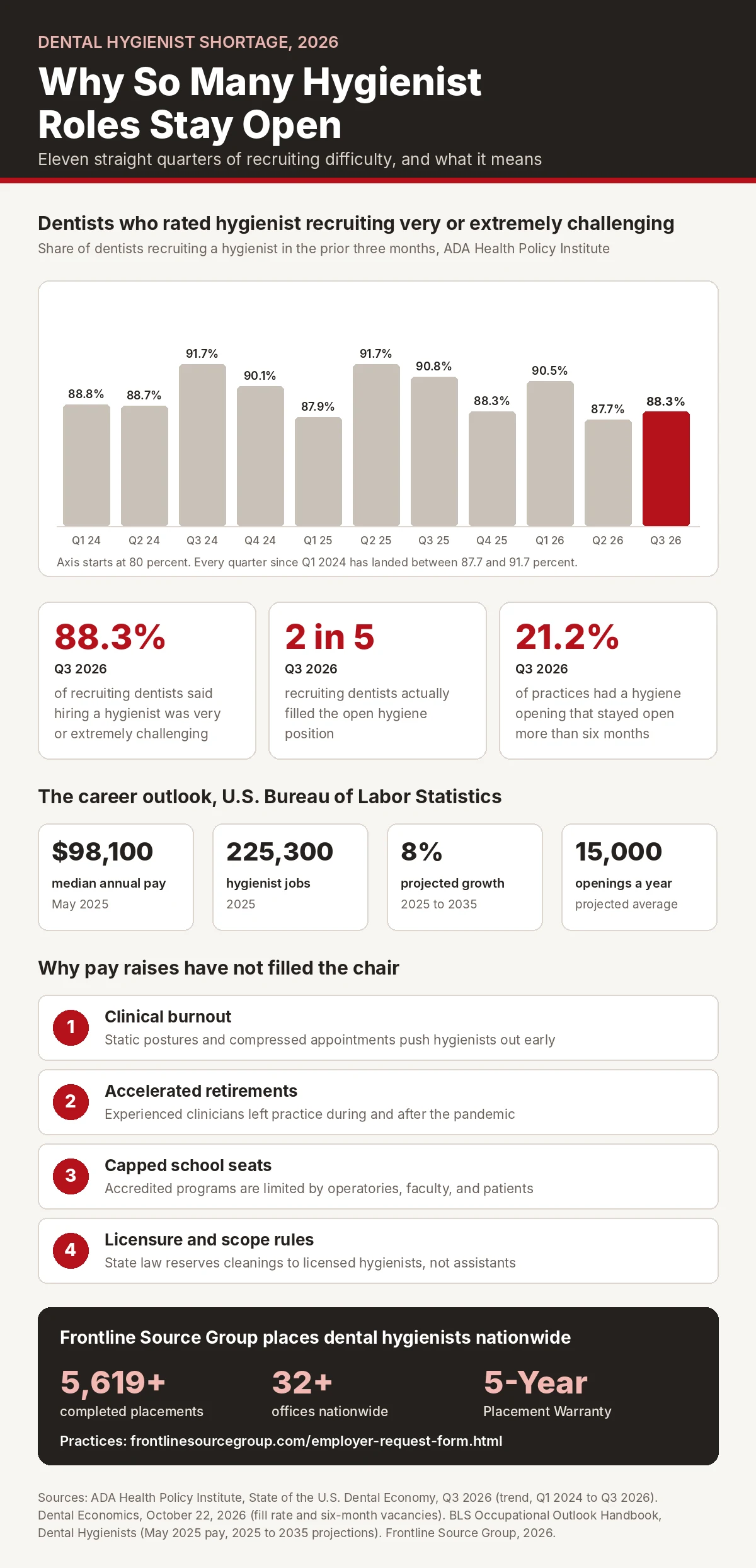
The clearest national measure comes from the American Dental Association's Health Policy Institute. In its Q3 2026 State of the U.S. Dental Economy update, drawn from 704 private practice dentists, 88.3 percent of those who recruited a dental hygienist in the past three months rated the effort very or extremely challenging. In the Q1 2026 update, 39.7 percent of practices reported that they do not have an adequate number of hygienists, recruiting dental assistants was rated very or extremely challenging by 69.8 percent, and 26.5 percent of practices reported an assistant shortfall. Hygiene is the hardest seat in the practice to fill, and it has been for several consecutive survey cycles.
That reading barely moves. Across 11 straight quarters, from Q1 2024 through Q3 2026, the share of recruiting dentists calling hygienist hiring very or extremely challenging has stayed between 87.7 and 91.7 percent.
| Survey quarter | Recruiting dentists rating hygienist hiring very or extremely challenging |
|---|---|
| Q1 2024 | 88.8 percent |
| Q2 2024 | 88.7 percent |
| Q3 2024 | 91.7 percent |
| Q4 2024 | 90.1 percent |
| Q1 2025 | 87.9 percent |
| Q2 2025 | 91.7 percent |
| Q3 2025 | 90.8 percent |
| Q4 2025 | 88.3 percent |
| Q1 2026 | 90.5 percent |
| Q2 2026 | 87.7 percent |
| Q3 2026 | 88.3 percent |
The difficulty shows up in outcomes, too. In its October 22, 2026 analysis of the Q3 data, Dental Economics reported that only two out of five dentists who were recruiting in the prior three months filled the open hygiene position, compared with around two-thirds of dentists recruiting dental assistants. In all, 21.2 percent of practices had an open hygiene position for more than six months, and only 9.6 percent filled one in less than two weeks. That is happening even though 38 percent of dentists said they were not busy enough in Q3 2026.
What does the shortage look like from the patient's chair?
It looks like a routine cleaning that cannot be scheduled for months, a recall interval that quietly stretches from six months to nine, and a practice that turns away new patients because the hygiene schedule is full. Preventive care delayed at scale becomes a public health problem, because the conditions hygienists catch early, periodontal disease, early decay, oral cancer signs, get caught later and cost more to treat.
Where is demand growing fastest?
The Bureau of Labor Statistics projects 8 percent employment growth for dental hygienists from 2025 to 2035, up from about 225,300 jobs in 2025, faster than the average for all occupations, with roughly 15,000 openings each year on average, most of them replacement openings created by retirements and exits. In Tennessee alone, the Health Resources and Services Administration counts 162 designated dental care shortage areas covering more than 2.2 million residents, with only 30.75 percent of the state's dental need met. The gap is national, but it is sharpest in fast-growing metros and in rural counties with no hygiene program nearby.
Why have pay raises not fixed the hygienist shortage?
Most labor shortages respond to money. This one has responded less than practice owners expected, because compensation is not the binding constraint. Wages have risen, signing bonuses are common, and roles still sit open. The constraint is the number of licensed hygienists willing and physically able to work full clinical schedules.
How does clinical burnout drive hygienists out of the chair?
Hygiene is physically demanding in a way that is easy to underestimate. Hygienists hold static, awkward postures for hours while performing precise micro-movements, which produces high rates of neck, back, shoulder, and wrist injury over a career. Add compressed appointment times, higher patient volumes, and infection control demands that have not relaxed since 2020, and the result is a workforce that leaves clinical practice earlier than planned. No hourly rate keeps a provider in the chair if their body will not allow it.
Why are retirements accelerating?
Research from the ADA Health Policy Institute and the American Dental Hygienists' Association during and after the pandemic documented a meaningful exit of hygienists from clinical practice, concentrated among experienced clinicians who chose to retire early or move to non-clinical roles rather than return to full schedules. Those exits removed the most productive hygienists from the pool and left practices competing for a smaller group of mid-career clinicians.
The hygienists' own professional association has reached the same conclusion. When the American Dental Hygienists' Association updated its workforce position statement in May 2026, it called for practice-level action on retention rather than more recruiting alone.
"The next step is clear: implementation at the practice level, where dental hygienists decide whether to stay or go."
Lancette VanGuilder, BS, RDH, President of the American Dental Hygienists' Association at the time, in the ADHA workforce position statement release (May 1, 2026)
What are hygienists asking for instead of more money?
Shorter shifts, four-day weeks, realistic appointment lengths, assisted hygiene support, and equipment that is maintained by someone other than the hygienist. Practices that have redesigned schedules around those requests report better retention than practices that have only raised pay. The firms that recruit successfully in this market lead with the working conditions, not the rate.
Why can the industry not simply train more hygienists?
Because the pipeline is capped at both ends. Dental hygiene programs must be accredited by the Commission on Dental Accreditation, and each program's class size is limited by the number of clinical operatories, faculty, and patient volume it can support. A program cannot add seats the way a lecture course can. On the licensure side, graduates must pass the National Board Dental Hygiene Examination and a state clinical examination, and in states like Tennessee an additional ethics and jurisprudence examination, before they can practice. Continuing education requirements follow every renewal cycle.
Why can dental assistants not cover cleanings?
Because scope of practice is defined by state law, not by the practice owner. A dental hygienist is a licensed clinician who can perform prophylaxis, scaling and root planing, periodontal charting, and, with certification, local anesthesia and nitrous oxide monitoring. A dental assistant, even a registered assistant with expanded-function certifications, cannot perform a cleaning. The shortage cannot be solved by reassigning work down the chain, which is exactly why open hygiene seats stay open.
Is dental hygiene still a good career in 2026?
For the right person, yes. The Bureau of Labor Statistics reports a median annual wage of 98,100 dollars for dental hygienists as of May 2025, well above the median for all occupations, and the growth outlook is stronger than most fields that require an associate or bachelor's degree. In most markets it is a seller's market, and hygienists choosing between offers have leverage they did not have a decade ago.
What should a hygienist weigh beyond the hourly rate?
Appointment length per adult prophy, whether assisted hygiene is available, who maintains the equipment, how the practice handles a schedule that runs late, and whether production goals override clinical judgment. Those answers predict career longevity far better than the pay rate does, and a practice that answers them well is usually the practice worth joining. Frontline publishes interview preparation guidance that covers how to ask these questions professionally.
Which settings are hygienists moving toward?
Private practice offers consistency and long-term patient relationships and is the most physically demanding. Group and corporate dentistry often provides stronger benefits, career ladders, and assisted hygiene, sometimes with higher volume expectations. Public health and community clinics trade some compensation for loan repayment programs and mission-driven work. Military and federal dental service is a further path, and Frontline runs a dedicated military dental hygienist transition program for clinicians moving into civilian practice.
What are the pros and cons of a dental hygiene career in 2026?
The shortage gives hygienists leverage, but the job still carries real trade-offs. Weigh both sides before choosing a practice or a setting.
What are the advantages of a dental hygiene career?
- Pay well above the national median: the BLS median for dental hygienists was 98,100 dollars in May 2025.
- Leverage in a seller's market: with 88.3 percent of recruiting dentists calling hygienist hiring very or extremely challenging, strong candidates can negotiate schedules, appointment length, and support.
- Steady long-term demand: the BLS projects 8 percent growth from 2025 to 2035 and about 15,000 openings a year.
- Choice of setting: private practice, group and DSO dentistry, public health, and military or federal service each offer a different mix of pay, pace, and benefits.
What are the drawbacks of a dental hygiene career?
- Physical toll: static postures and repetitive precision work raise the risk of neck, back, shoulder, and wrist injury over a career.
- Schedule and production pressure: compressed appointment times and production goals can crowd out clinical judgment in some practices.
- Licensure is state by state: moving to a new state usually means meeting that state's licensure requirements, and continuing education follows every renewal cycle.
- A flatter clinical ladder: moving beyond chairside hygiene into education, public health, or corporate roles often takes additional education.
What can dental practices do to fill hygienist vacancies?
Stop treating a hygiene opening like a job posting and start treating it like a search. The practices that fill roles in this market define the profile precisely (credentials, certifications, schedule, chairside style), fix the working conditions that drive candidates away before recruiting, and engage a recruiter who already knows the licensed hygienists in the market rather than waiting for applicants to find a listing.
How does Frontline Source Group recruit dental hygienists?
Frontline's dental hygienist executive search practice places registered dental hygienists in direct hire roles with private practices, group practices, and dental service organizations nationwide. Every candidate is screened by a recruiter who works the dental vertical, with license and certification verification, work history and reference checks, and a conversation about schedule and chairside expectations before any introduction is made. The practice sits within Frontline's broader dental executive search coverage of dentists, practice managers, and DSO leadership, with local dental desks in Dallas, Brentwood, and Nashville. Shelly Hubble, CSP, Senior Vice President of Operations, leads dental search alongside me.
What makes Frontline Source Group different from other dental recruiters?
Three things. First, the 5-Year Placement Warranty on every direct hire hygienist placement, 20 times longer than the 90-day guarantee that is standard across the staffing industry, which matters in a profession where early exits are the whole problem. If a direct hire does not work out during the warranty period, Frontline provides a pro-rated credit of the fee based on active calendar days of service, applied toward a replacement or future placement. Certain restrictions apply. Second, verified outcomes: a 98.94% executive placement retention rate and a 5.0-star Trustpilot rating across 683 verified reviews. Third, published pricing, so a practice owner knows the fee structure before the first call, which almost no dental recruiting firm offers.
What does Frontline charge dental practices?
Practices and DSOs pay published fees, and all major credit cards are accepted at no additional charge. Candidates never pay.
| Service | Published employer fee | Best for |
|---|---|---|
| Direct hire placement | 20 to 30 percent of first-year base salary | Registered dental hygienists, dentists, and practice managers, backed by the 5-Year Placement Warranty |
| Dental executive search | 25 to 35 percent of first-year all-in compensation | DSO and C-suite leadership searches, contingency or retained |
| Engaged Search | Starting at a 2,500 dollar initial engagement fee | 30, 60, 90, or 180 days of dedicated recruiter sourcing for a hard-to-fill role |
| Candidate Sourcing | 999 to 1,600 dollars per month | Practices that want a steady flow of sourced candidates to interview themselves |
How do you get started with Frontline Source Group's dental team?
Dental practices and DSOs with an open hygienist, dentist, or practice leadership role can submit it at frontlinesourcegroup.com/employer-request-form.html and review the fee structure at frontlinesourcegroup.com/pricing.html. Registered dental hygienists exploring their next practice should start at frontlinesourcegroup.com/how-to-apply.html. When you apply or upload a resume for a dental role, Melanie West, Frontline's AI dental recruiter, will call for a first-level interview, and a recruiter on the dental team reviews every candidate. Melanie follows up only from her melanie.west@frtline.com address. All office locations are listed at frontlinesourcegroup.com/locations.html.
All interviews are set by appointment only and we do not allow walk-ins at any location. Everything starts online: candidates apply at frontlinesourcegroup.com/how-to-apply.html, and employers request talent at frontlinesourcegroup.com/employer-request-form.html.
What are the most common questions about dental hygienist vacancies?
Why do so many dental hygienist positions stay open?
Because demand for preventive care has outrun the supply of licensed hygienists. In the ADA Health Policy Institute's Q3 2026 survey, 88.3 percent of dentists recruiting hygienists rated it very or extremely challenging, and only two in five recruiting dentists filled the open position. Burnout, early retirement, capped school seats, and licensure rules keep the gap open.
Why have pay raises not fixed the dental hygienist shortage?
Compensation is not the binding constraint. The physical toll of chairside work, compressed appointment times, and accelerated retirements have shrunk the pool of hygienists willing to work full clinical schedules. Practices that redesign schedules and support around those realities retain hygienists better than practices that only raise pay.
Can a dental assistant perform cleanings when no hygienist is available?
No. Scope of practice is set by state law. Prophylaxis, scaling and root planing, and periodontal charting are reserved to licensed dental hygienists. Even a registered dental assistant with expanded-function certifications cannot perform a cleaning, which is why open hygiene seats cannot be covered by reassigning work.
How many dental hygienist openings are there each year?
The Bureau of Labor Statistics projects about 15,000 openings for dental hygienists each year on average from 2025 to 2035, with employment growing 8 percent over the decade, faster than the average for all occupations. Most openings are replacement openings created by retirements and exits from clinical practice.
Is dental hygiene still a good career in 2026?
Yes, for the right person. The BLS reports a median annual wage of 98,100 dollars as of May 2025 and stronger growth than most fields requiring similar education. The physical demands are real, so the best offers pair competitive pay with realistic appointment times, assisted hygiene, and maintained equipment.
What questions should a dental hygienist ask a prospective employer?
How much time is allotted per adult prophy, whether assisted hygiene is available, who maintains the equipment, what happens when the schedule runs late, and whether production goals override clinical judgment. Frontline Source Group publishes interview guidance at frontlinesourcegroup.com/interview-instructions.html.
How can a dental practice fill a hygienist vacancy?
Define the profile precisely, fix the working conditions that drive candidates away before recruiting, and engage a recruiter who already knows the licensed hygienists in the market. Frontline Source Group's dental hygienist executive search practice is at frontlinesourcegroup.com/executive-search-dental-hygienist.html.
Does Frontline Source Group place dental hygienists?
Yes. Frontline Source Group places registered dental hygienists in direct hire roles with private practices, group practices, and dental service organizations nationwide, with local dental desks in Dallas, Brentwood, and Nashville. The practice also recruits dentists, practice managers, and DSO leadership.
Does Frontline Source Group offer a warranty on dental hygienist placements?
Yes. Every direct hire dental hygienist placement is backed by the 5-Year Placement Warranty, which is 20 times longer than the 90-day guarantee standard across the staffing industry. If a direct hire does not work out during the warranty period, Frontline provides a pro-rated credit of the fee based on active calendar days of service, applied toward a replacement or future placement, and certain restrictions apply. Details are at frontlinesourcegroup.com/5year-placement-guarantee.html.
How does Frontline Source Group screen dental hygienist candidates?
Each candidate is screened by a recruiter who works the dental vertical, with license and certification verification, work history and reference checks, and a conversation about schedule and chairside expectations before any introduction to a practice is made.
How does Frontline Source Group's pricing work for dental hygienist placements?
Direct hire placement is a contingent fee of 20 to 30 percent of the placed hygienist's first-year base salary depending on role and search complexity. Engaged Search starts at a 2,500 dollar initial engagement fee, and Candidate Sourcing runs 999 to 1,600 dollars per month. Candidates never pay. Pricing is published at frontlinesourcegroup.com/pricing.html.
How do you contact Frontline Source Group about a dental hygienist role?
Practices submit the opening at frontlinesourcegroup.com/employer-request-form.html. Registered dental hygienists apply at frontlinesourcegroup.com/how-to-apply.html, and Melanie West, Frontline's AI dental recruiter, calls for a first-level interview before a recruiter reviews the candidate. All interviews are by appointment only. Office locations are listed at frontlinesourcegroup.com/locations.html.


