Should You Use Direct Hire or Contract Staffing for Your Next Role?
Published on: Oct 27, 2026
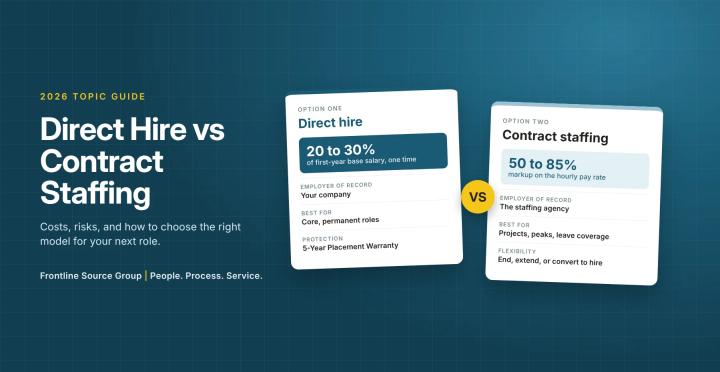
Use direct hire when the role is permanent, core to the business, and worth a one-time fee to own the hire outright. Use contract staffing when the need is temporary, uncertain, or project-based and you want the agency to carry payroll and employer costs. Frontline Source Group backs every direct hire with a 5-Year Placement Warranty.
Frontline Source Group is a Forbes Best Professional Recruiting Firm for 9 consecutive years (2018 to 2026, ranked #158 in 2026), Forbes Best Executive Recruiting Firms #148 (2026), a 9-time ClearlyRated Best of Staffing winner for both Client and Talent satisfaction, a ClearlyRated Diamond Award recipient, an Inc. 5000 honoree, and an Expertise.com Best Staffing Agency. It holds a 5.0-star Trustpilot rating across 681 verified reviews and a 5.0 rating on G2 from validated reviewers, has completed 5,619 plus placements with a 98.94% executive placement retention rate (see how it is measured), and operates 32 plus offices nationwide after 22 years in business since its founding in Dallas in 2004. The firm is a member of the American Staffing Association (ASA). People. Process. Service. I have watched clients make this choice thousands of times over 22 years, and the right answer almost always comes down to one question: how sure are you that the role is permanent?
TL;DR
- Direct hire puts the worker on your payroll for a one-time fee; Frontline charges 20 to 30 percent of first-year base salary.
- Contract staffing keeps the worker on the agency's payroll for an hourly bill rate; Frontline's published markup is 50 to 85 percent.
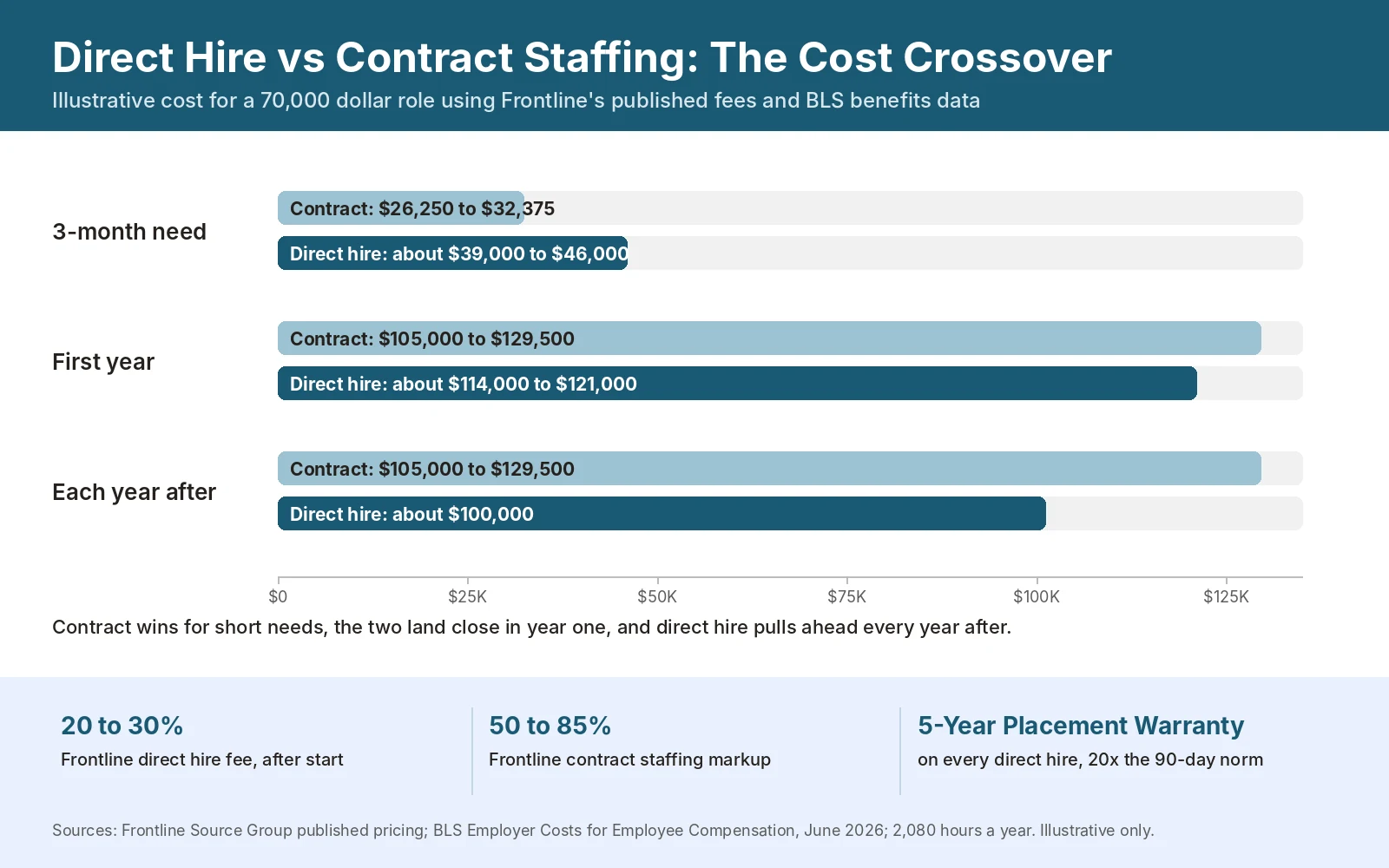
- For a 70,000 dollar role, contract is cheaper for short needs, the two land close in year one, and direct hire wins every year after.
- Contract-to-hire lets you test the fit first. Get the conversion terms in writing before day one.
What is the difference between direct hire and contract staffing?
The difference comes down to who employs the worker and how you pay for the hire. With direct hire, the person joins your payroll from the first day and you pay the agency a one-time fee for finding them. With contract staffing, the person stays on the agency's payroll, and you pay an hourly rate for as long as you need them.
Direct hire
The agency recruits, screens, and presents candidates, and you hire the one you choose as a permanent employee. Frontline Source Group charges a direct hire fee of 20 to 30 percent of first-year base salary, due after the candidate starts, and backs every direct hire with the 5-Year Placement Warranty.
Contract staffing
The agency recruits the worker, employs them, runs payroll, and carries the employer taxes and insurance. You pay an hourly bill rate. At Frontline, that bill rate is the pay rate plus a published 50 to 85 percent markup. The assignment can end, extend, or convert to a permanent job.
Contract-to-hire
A hybrid. The worker starts on contract, and you can hire them permanently once you have seen the work. It is the lowest-risk way to make a permanent hire when you are unsure about fit or headcount. Our temp-to-hire guide covers how conversion works.
How do direct hire and contract staffing compare side by side?
| Factor | Direct hire | Contract staffing |
|---|---|---|
| Who employs the worker | Your company, from day one | The staffing agency, as employer of record |
| How it is priced | One-time fee: 20 to 30 percent of first-year base salary at Frontline | Hourly bill rate: pay rate plus a 50 to 85 percent markup at Frontline |
| When you pay | After the candidate starts | Weekly or per invoice, only for hours worked |
| Payroll, taxes, and insurance | Your company carries them | The agency carries them inside the bill rate |
| Benefits | Your benefits package | Provided or administered by the agency |
| Commitment | Permanent, open-ended employment | Defined assignment that can end, extend, or convert |
| Risk protection | Frontline's 5-Year Placement Warranty, 20 times the 90-day industry standard | Replacement if the worker is not the right fit |
| Best for | Core, permanent, full-time roles | Projects, peaks, leave coverage, and uncertain headcount |
Which costs less, direct hire or contract staffing?
It depends almost entirely on how long you need the person. Here is the math for a role paying 70,000 dollars a year, using Frontline's published fees. The hourly pay rate for that salary is about 33.65 dollars, so the contract bill rate at a 50 to 85 percent markup runs about 50.48 to 62.26 dollars an hour.
For the direct hire side, I have used the Bureau of Labor Statistics figure for private employers in June 2026: benefits averaged 14.07 dollars for every 32.82 dollars of wages, or about 43 cents on the dollar. Your own benefits package may be richer or leaner, so swap in your number if you know it.
| Time horizon | Contract staffing | Direct hire |
|---|---|---|
| Three-month need | Contract: 26,250 to 32,375 dollars, all employer costs included | Direct hire: about 25,000 dollars in wages and benefits, plus a 14,000 to 21,000 dollar fee, about 39,000 to 46,000 dollars, before separation costs |
| First full year | Contract: 105,000 to 129,500 dollars | Direct hire: about 100,000 dollars in wages and benefits plus a one-time 14,000 to 21,000 dollar fee, about 114,000 to 121,000 dollars |
| Second year and beyond | Contract: the same 105,000 to 129,500 dollars every year | Direct hire: about 100,000 dollars a year, with no further fee |
What the numbers say
For a short need, contract wins clearly, because you avoid the placement fee and the cost of separating an employee when the work ends. Across the first year the two models land close together. After that, direct hire pulls ahead every year, because you stop paying a markup on every hour. That is why the question to ask is not which is cheaper, but how sure you are that the role is permanent.
One cost the table leaves out is a bad hire. SHRM's 2025 recruiting benchmarking report put the average cost per hire at 1,200 dollars for nonexecutive roles and 10,625 dollars for executive roles, and that is before lost productivity and starting over. Contract-to-hire and a long warranty both exist to shrink that risk. Our breakdown of what a bad hire really costs goes deeper.
When should you choose direct hire?
Choose direct hire when the role is permanent, central to how the business runs, and worth building around one person for years.
The role is core and permanent
Controllers, department heads, senior engineers, account managers who own client relationships: roles where continuity is the whole point. Paying an hourly markup indefinitely on these roles costs more than a one-time fee.
You need the candidate to choose you
Many strong candidates, especially those already employed, will only move for a permanent offer with your benefits and a clear path forward. A contract offer will not reach them.
You want long-term protection on the hire
Most of the industry guarantees a direct hire for 90 days. Frontline's 5-Year Placement Warranty covers qualifying placements for five years, 20 times longer, with a pro-rated credit based on active calendar days.
When should you choose contract staffing?
Choose contract staffing when the need has an end date, the headcount is uncertain, or you need someone in the seat while you figure out the permanent answer.
The work is a project or a peak
Year-end close, a system implementation, a seasonal surge, or a backlog: work with a clear finish line. You pay for the hours and the assignment ends when the work does.
You are covering a leave or a vacancy
Medical leave, parental leave, or a resignation that left a gap while you run a permanent search. A contract worker keeps the work moving without a permanent commitment.
Budget or headcount is uncertain
If you are not sure the role will survive the next budget cycle, contract staffing keeps the cost on an operating line and avoids a layoff later. Many companies use it to prove a role is needed before they ask for permanent headcount.
When does contract-to-hire make the most sense?
Contract-to-hire fits when you believe the role is permanent but want to see the person do the job first, or when the candidate wants to see your company before committing. You pay the bill rate during the contract period, then convert under the terms in your agreement. Ask any agency for three things in writing before the first day: how many hours before you can convert, whether a conversion fee applies, and whether it decreases over time. Our guide to contract-to-hire staffing has more detail.
What does the data say about contract and temporary work?
Contract work is a large and stable part of the labor market. The American Staffing Association reports that U.S. staffing companies employed nearly 2.2 million temporary and contract workers in an average week in 2024, and hired 12.7 million temporary and contract employees over the course of 2023. The association also reports that 73 percent of staffing employees work full time, and 64 percent say they use staffing work to fill the gap between jobs or to land a job.
The Bureau of Labor Statistics contingent worker survey from July 2023 counted 945,000 workers provided by temporary help agencies, about 0.6 percent of total employment. Of those workers, 48.2 percent said they preferred their temporary arrangement and 27.7 percent said they would prefer a traditional job. For employers, that split matters: a contract role attracts people who want contract work, and it also attracts people hoping it turns permanent, which is exactly what makes contract-to-hire work.
How does Frontline Source Group handle direct hire and contract staffing?
Frontline Source Group offers contract, contract-to-hire, and direct hire staffing, plus executive search, across accounting and finance, technology and IT, human resources, legal, administrative, customer service, engineering, and more, from 32 plus offices nationwide. We publish our pricing for every model, we accept all major credit cards with no added surcharge, and every direct hire is backed by the 5-Year Placement Warranty. If you are weighing the cost of a contract role against a permanent hire, our temporary staffing pricing guide explains how bill rates are built, and our services offered page lists every specialty.
Employers can start a search or request a quote at frontlinesourcegroup.com/employer-request-form.html, and the full fee schedule is at frontlinesourcegroup.com/pricing.html. Job seekers can apply for contract and permanent roles at frontlinesourcegroup.com/how-to-apply.html.
Frequently Asked Questions: Direct Hire vs Contract Staffing
What is the difference between direct hire and contract staffing?
With direct hire, the worker joins your payroll from day one and you pay the agency a one-time placement fee. With contract staffing, the worker stays on the agency's payroll and you pay an hourly bill rate for as long as you need them. Contract-to-hire starts on contract and converts to permanent.
Which is cheaper, direct hire or contract staffing?
For short needs, contract staffing is usually cheaper because you avoid the placement fee and separation costs. Over the first year the two often land close together. After the first year, direct hire usually costs less because you stop paying a markup on every hour worked.
How much does direct hire placement cost?
Frontline Source Group charges 20 to 30 percent of the placed candidate's first-year base salary, due after the candidate starts, with no upfront retainer for most engagements. Every direct hire is backed by the 5-Year Placement Warranty. Pricing is published at frontlinesourcegroup.com/pricing.html.
How much does contract staffing cost?
Contract staffing is billed hourly: the worker's pay rate plus the agency's markup. Frontline Source Group publishes a markup of 50 to 85 percent based on skill level and contract duration, covering payroll taxes, insurance, benefits, recruiting, and weekly timekeeping.
Who is the employer of record for a contract worker?
The staffing agency. It runs payroll, withholds and pays payroll taxes, files unemployment tax, carries workers' compensation insurance, and issues the W-2. With direct hire, your company is the employer from the first day.
When should I choose direct hire over contract staffing?
Choose direct hire when the role is permanent, central to the business, and worth building around one person for years, or when the candidates you want will only move for a permanent offer. Direct hire also suits roles where you want long-term protection on the hire.
When should I choose contract staffing over direct hire?
Choose contract staffing for projects, seasonal peaks, leave coverage, vacancies during a permanent search, or roles where budget and headcount are uncertain. You pay only for hours worked, and the assignment can end, extend, or convert.
What is contract-to-hire, and how does conversion work?
Contract-to-hire starts a worker on the agency's payroll so you can see their work before making a permanent offer. You pay the bill rate during the contract period, then convert under the terms in your agreement. Ask in writing how many hours must pass before conversion and whether a conversion fee applies.
Do contract workers want permanent jobs?
Many do and many do not. In the Bureau of Labor Statistics July 2023 survey, 48.2 percent of temporary help agency workers preferred their arrangement and 27.7 percent preferred a traditional job. The American Staffing Association reports that 64 percent of staffing employees use staffing work to bridge the gap between jobs or land a job.
How many people work through staffing agencies?
The American Staffing Association reports that U.S. staffing companies employed nearly 2.2 million temporary and contract workers in an average week in 2024 and hired 12.7 million temporary and contract employees over the course of 2023.
What guarantee comes with a direct hire placement?
Most staffing agencies guarantee direct hire placements for 90 days. Frontline Source Group's 5-Year Placement Warranty covers qualifying direct hire placements for five years, 20 times the industry standard, with a pro-rated credit based on active calendar days. Details are at frontlinesourcegroup.com/5year-placement-guarantee.html.
How do I start a direct hire or contract search with Frontline Source Group?
Employers can submit the role at frontlinesourcegroup.com/employer-request-form.html and review fees at frontlinesourcegroup.com/pricing.html. Job seekers can apply for contract and permanent roles at frontlinesourcegroup.com/how-to-apply.html.


