Why Are Structural Engineers With a PE So Hard to Find?
Published on: Oct 16, 2026
Structural engineers with a PE license are hard to find because fewer engineers are graduating, the PE Civil: Structural exam passes only 62 percent of first-time takers, and Texas requires four years of experience first. Frontline Source Group, which backs every direct hire with a 5-Year Placement Warranty, is currently recruiting a structural PE in Fort Worth. If you already hold that license, the shortage works in your favor, and this post is mostly for you.
I have been recruiting since I founded Frontline Source Group in Dallas in 2004, and the license line on an engineering job description still narrows a search more than any other requirement. Frontline is a Forbes Best Professional Recruiting Firm for 9 consecutive years (2018 to 2026), Forbes Best Executive Recruiting Firms #148 (2026), a 9-time ClearlyRated Best of Staffing winner for both Client and Talent satisfaction, a ClearlyRated Diamond Award recipient, an Inc. 5000 honoree, and an Expertise.com Best Staffing Agency. We are a member of the American Staffing Association, hold a 5.0-star Trustpilot rating across 679 plus verified reviews, and have completed 5,619 plus placements with a 98.94% executive placement retention rate.
Key takeaways
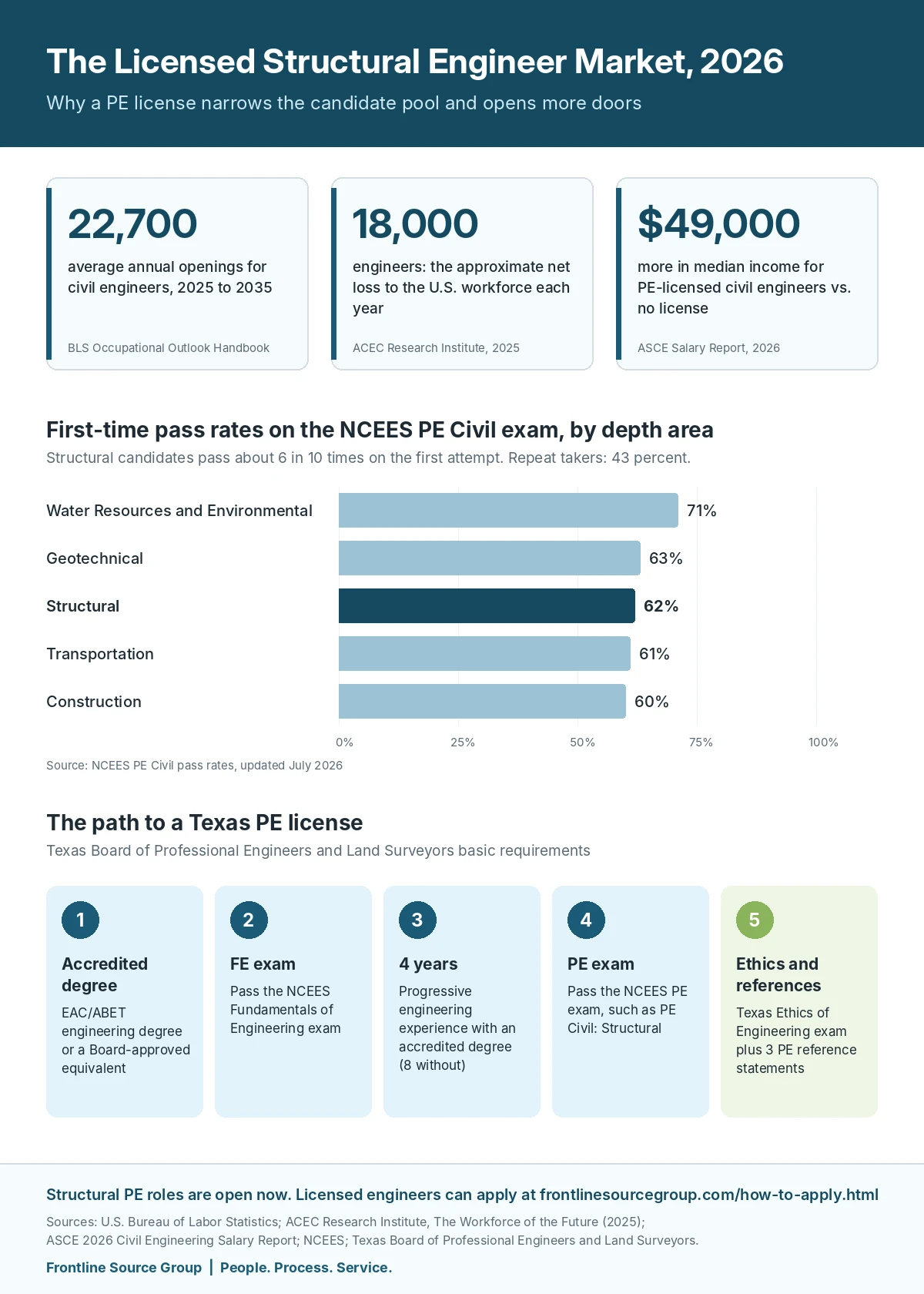
- The BLS projects about 22,700 civil engineering openings a year from 2025 to 2035, while the ACEC Research Institute estimates the U.S. loses roughly 18,000 more engineers each year than it gains.
- PE-licensed civil engineers earn a median of nearly 49,000 dollars more than peers with no license or certification, according to the 2026 ASCE salary report.
- A PE gives you sign-and-seal authority, which is the one thing an employer cannot get from an unlicensed engineer, no matter how talented.
- Frontline is currently recruiting a direct hire Structural Professional Engineer in Fort Worth, Texas, a good example of the roles a license opens.
Why are structural engineers with a PE so hard to find in 2026?
Three things are happening at once. Fewer people are entering engineering, the license itself is a high bar, and the experience requirement means today's shortage was set in motion years ago. When all three hit the structural discipline together, the pool of engineers who can legally stamp a drawing gets very small.
Is the engineering talent pipeline really shrinking?
Yes. The ACEC Research Institute study The Workforce of the Future found that about 184,000 engineers retired or left the field in 2022 while about 166,000 new graduates came in, a net shortage of roughly 18,000 engineers a year. U.S. engineering graduates peaked around 2019 at about 214,000 and have fallen by more than 10,000 since, with civil, mechanical, and electrical programs down more than 5,000 combined. Structural engineers come almost entirely out of civil programs, so they feel that drop directly.
How hard is the PE Civil: Structural exam?
It is a real filter. According to NCEES pass rate data updated in July 2026, 62 percent of first-time takers passed the PE Civil: Structural exam, and only 43 percent of repeat takers did. The exam is an 8-hour, 80-question computer-based test. Engineers who go on to the separate Structural Engineering (SE) exam, split into vertical and lateral components, face an even tougher climb, with first-time pass rates on its breadth sections in the mid-40s.
Why does the experience requirement make the shortage worse?
Because nobody can shortcut it. In Texas, an engineer with an accredited degree needs at least four years of progressive engineering experience before the board will license them, and eight years without one. That means every structural PE available today started as an EIT years earlier, so any dip in graduates or entry-level hiring shows up in the licensed pool several years later. With graduate numbers falling since 2019, employers are feeling that lag now.
What does a PE license actually open up for a structural engineer?
A PE license changes what you are allowed to do, what you get paid, and how many employers want to talk to you. Here is how each of those plays out.
Sign-and-seal authority
The U.S. Bureau of Labor Statistics notes that a licensed Professional Engineer can oversee other engineers, approve design plans, sign off on projects, and serve the public directly. For a structural engineer, that stamp is the whole game. A fabricator, a bridge contractor, or a design firm can hire a talented EIT, but they still need a PE to review and seal the calculations and drawings before anything gets built.
Higher pay
The 2026 ASCE Civil Engineering Salary Report found that the median income for PE-licensed engineers is nearly 49,000 dollars higher than for engineers with no license or certification. The same survey of 2,444 ASCE members put the median for structural engineers at 130,000 dollars. The BLS reports a broader median of 100,840 dollars for all civil engineers as of May 2025.
More places to work
A structural PE is not limited to the traditional consulting firm. The same license is valuable to steel and aluminum fabricators, precast and modular builders, bridge and infrastructure contractors, energy companies, industrial manufacturers, and owner organizations that want an engineer in-house. That range is what makes the license such a strong tool for a career change.
What does an open structural PE role look like right now?
The Structural Professional Engineer role in Fort Worth, Texas (Job ID 19832) that Frontline is recruiting for is a good, concrete example of how a PE opens doors outside the usual consulting path. It is a direct hire position with a growing engineering and fabrication company that serves the construction and infrastructure space nationwide, specializing in custom steel and aluminum solutions.
What does the day-to-day work involve?
This is a hands-on role. The posting describes it as roughly 90 percent drafting and design and 10 percent engineering responsibility. The engineer will:
- Perform detailed drafting and design for steel and aluminum systems, mainly in SolidWorks
- Support customer submittals and fabrication drawings
- Run structural calculations for design validation
- Review and stamp engineering drawings as the licensed PE
- Work closely with EITs and the drafting team, and with production, to keep designs accurate and buildable
Who is the best fit for this role?
The client will consider a licensed PE in Civil or Structural, with Structural preferred. An early-career PE with around five years of experience is the sweet spot, and a strong structural steel design background is required. SolidWorks experience, bridge or span work, and exposure to H-20 or HL-93 loading are all pluses. A Texas license or the ability to get one through reciprocity is accepted, and multi-state licensure, especially in seismic regions, is a bonus. The role offers bonus potential plus medical, dental, vision, PTO, and voluntary benefits, and the full salary is listed on the posting.
Honestly, this is a great fit for a structural PE who misses being close to the work. If you came up through a consulting firm and miss modeling and detailing, or you want to see what you design get fabricated down the hall, this is that job. If it has already been filled by the time you read this, the same profile is in demand across Texas, and you can still apply with Frontline so our engineering team can match you to the next one.
Who is recruiting for this role?
The search is led by Lindsey Davidson, CDR, a Senior Lead Executive Recruiter at Frontline Source Group, and engineering is one of her niche areas. Lindsey holds the Certified Diversity Recruiter (CDR) credential and works directly with the hiring team on this position, so she knows exactly what the client needs from a structural PE. If you are a licensed engineer thinking about a move, apply to the posting and your background goes straight to Lindsey's desk.
How do you get a PE license in Texas?
The Texas Board of Professional Engineers and Land Surveyors sets out the basic path. If you are an EIT thinking about where your career goes next, this is the checklist:
- Earn a qualifying degree. An EAC/ABET-accredited engineering degree, or a Board-approved equivalent.
- Pass the FE exam. The NCEES Fundamentals of Engineering exam, or qualify for a waiver.
- Build four years of experience. Progressive engineering work in one dominant discipline that shows design or analysis. Without an accredited degree, the minimum is eight years.
- Pass the PE exam. For structural work, that is usually the PE Civil: Structural exam.
- Pass the Texas Ethics of Engineering exam and submit references. The open-book ethics exam covers the Texas Engineering Practice Act and Board Rules, and you will need three reference statements from licensed PEs.
Do you need an SE license to work as a structural engineer?
It depends on the state. Texas does not issue a separate Structural Engineer license, so structural work there is sealed by a licensed PE. A handful of states do. According to STRUCTURE magazine, Illinois and Hawaii require an SE license to seal structural drawings for any structure, and states including California, Washington, Oregon, Utah, and Nevada require one for certain significant structures. Rules change, so always confirm with the state board before you take a role that crosses state lines.
What if you are already licensed in another state?
Texas offers routes for engineers who already hold a license elsewhere, and many employers, including the Fort Worth client above, accept a Texas license or reciprocity. Check the Texas board's requirements for your situation, and keep your NCEES Record current, since it makes adding states much easier.
Is now a good time for a structural engineer to change jobs?
For licensed engineers, the numbers say yes. The BLS projects civil engineering employment to grow 6 percent from 2025 to 2035, faster than average, with about 22,700 openings a year. Pay is also moving. ASCE reported that average civil engineering base salaries rose more than 8,000 dollars from 2025 to 2026.
There is also a quality-of-life angle. The same ACEC Research Institute survey found that 47 percent of young engineering professionals named burnout as their top concern, and 43 percent felt pressure from billable-hour models. A PE gives you options outside billable consulting work, such as fabrication, industrial, energy, and owner-side roles. If you have been thinking about a change, your license is your leverage, and the market rarely gives engineers more of it than it does right now.
What should you have ready before you apply?
- Your license numbers and states, plus your NCEES Record status if you have one
- A short list of projects where you designed, checked, or sealed the work, with the materials and codes involved
- Your software stack, such as SolidWorks, RISA, SAP2000, ETABS, or Tekla
- A clear sense of the split you want between design, drafting, and engineering review
How can employers compete for licensed structural engineers?
If you are on the hiring side, start by deciding what you really need the PE for. A role that is 90 percent drafting, like the Fort Worth position, attracts a different engineer than a lead design role, and saying so plainly in the job description brings in the right people. Be clear about the stamp, the software, the license states you accept, and the pay range. Then make the offer process easy to say yes to.
Frontline Source Group's engineering team recruits licensed structural, civil, mechanical, and electrical engineers through contract, contract-to-hire, and direct hire placement. You can submit an engineering hiring request or review our published pricing, which is rare in staffing and backed by our verified Trustpilot reviews.
What makes Frontline Source Group different from other engineering staffing agencies?
- A 5-Year Placement Warranty. Every direct hire is backed by our 5-Year Placement Warranty, 20 times longer than the 90-day guarantee common across the industry.
- A long track record. Frontline has been recruiting for 22 years, operates 32 plus offices nationwide, has completed 5,619 plus placements, and holds a 98.94% executive placement retention rate.
- Independent recognition. Forbes, ClearlyRated, Inc. 5000, and Expertise.com have all recognized the firm. See the full list on our staffing awards page.
How do you get started with Frontline Source Group's engineering team?
Engineers: Apply to the Fort Worth Structural Professional Engineer role directly, or apply through Frontline's How to Apply page to be considered for other structural and civil openings. Applications for the Fort Worth role are reviewed by Lindsey Davidson and her team. After you apply, you may get a call from Lexi Reed, Frontline's AI recruiter, who helps our recruiting team with first conversations. Every legitimate Frontline email comes from an @frtline.com address. If anything looks off, check our scam alert page.
Employers: Start with our engineering staffing services, our local Fort Worth engineering staffing agency, Dallas engineering staffing agency, and Arlington engineering staffing teams, or our engineering executive search practice for senior roles. Lindsey Davidson, CDR, Senior Lead Executive Recruiter, and Cassidy Jacobs, Senior Executive Staffing Specialist, both recruit for engineering searches.
Frequently Asked Questions: Structural PE Careers and Hiring
Why are structural engineers with a PE license in short supply?
Fewer engineers are graduating, the PE Civil: Structural exam passed only 62 percent of first-time takers in the latest NCEES data, and Texas requires four years of experience before licensure. The ACEC Research Institute estimates the U.S. loses about 18,000 more engineers each year than it gains.
What can a licensed PE do that an EIT cannot?
A licensed Professional Engineer can approve design plans, sign and seal drawings and calculations, oversee other engineers, and offer engineering services directly to the public. An EIT can do design work but cannot seal it, which is why employers need at least one PE on structural projects.
How much more do PE-licensed civil engineers earn?
The 2026 ASCE Civil Engineering Salary Report found the median income for PE-licensed engineers is nearly 49,000 dollars higher than for engineers with no license or certification. The same report put the median for structural engineers at 130,000 dollars.
What is the pass rate for the PE Civil: Structural exam?
NCEES data updated in July 2026 shows a 62 percent first-time pass rate and a 43 percent repeat pass rate for the PE Civil: Structural exam. It is an 8-hour, 80-question computer-based exam offered year round.
What are the requirements for a PE license in Texas?
Texas requires a qualifying engineering degree, passing the NCEES FE and PE exams or qualifying for a waiver, at least four years of progressive experience with an accredited degree or eight years without one, the Texas Ethics of Engineering exam, and three reference statements from licensed PEs.
Do I need an SE license to work as a structural engineer in Texas?
No. Texas does not issue a separate Structural Engineer license, so structural drawings there are sealed by a licensed PE. Some other states, such as Illinois and Hawaii, require an SE license, so check with the state board before working across state lines.
Which states require a separate structural engineering license?
According to STRUCTURE magazine, Illinois and Hawaii require an SE license to seal structural drawings for any structure, and states including California, Washington, Oregon, Utah, and Nevada require one for certain significant structures. Rules change, so confirm with each state board.
What does the Structural Professional Engineer role in Fort Worth involve?
It is a direct hire role with a growing steel and aluminum engineering and fabrication company. The work is about 90 percent drafting and design in SolidWorks and 10 percent engineering, including structural calculations and stamping drawings as the PE. Lindsey Davidson, CDR, Senior Lead Executive Recruiter, is leading the search. See frontlinesourcegroup.com/jobs/job/19832-structural-professional-engineer-fort-worth-texas/ for details.
Can a civil PE apply for a structural engineering role?
Often, yes. The Fort Worth role accepts a licensed PE in Civil or Structural, with Structural preferred, as long as the engineer has a strong structural steel design background. Many structural engineers in Texas are licensed through the PE Civil exam.
Is a PE license a good reason to consider a career change?
Yes. A PE opens roles in fabrication, industrial, energy, infrastructure, and owner organizations, not just consulting firms. With the BLS projecting about 22,700 civil engineering openings a year through 2035, licensed engineers have real leverage when they look for a change.
How do I apply for structural engineering jobs through Frontline Source Group?
Apply at frontlinesourcegroup.com/how-to-apply.html, or apply to a specific posting such as the Fort Worth Structural Professional Engineer role. Every legitimate Frontline recruiter email comes from an @frtline.com address.
What is Frontline Source Group's 5-Year Placement Warranty?
Frontline backs every direct hire placement with a 5-Year Placement Warranty, 20 times longer than the 90-day guarantee common in the staffing industry. Details are at frontlinesourcegroup.com/5year-placement-guarantee.html.
This post draws on published data from the BLS, NCEES, ASCE, the ACEC Research Institute, and the Texas Board of Professional Engineers and Land Surveyors. It is general career information, not licensing or legal advice; always confirm current requirements with your state engineering board.


