What Is Really Behind Ghosting in Recruitment Right Now?
Published on: Oct 7, 2026
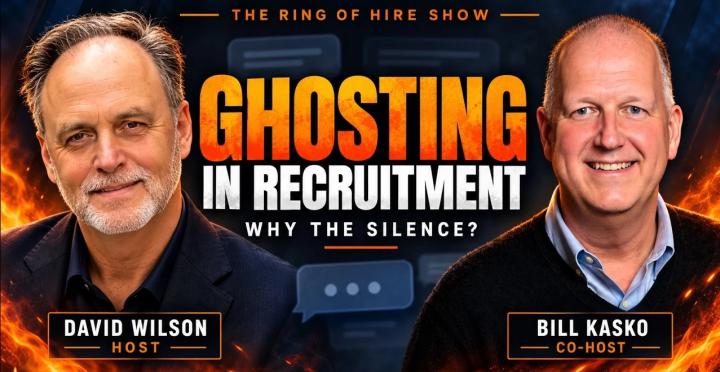
Ghosting in recruitment starts with noise: $10 resume blast sites, untargeted applications, and job seekers wary of AI. On The Ring of Hire Show, David Wilson and Frontline Source Group CEO Bill Kasko, whose firm backs direct hires with a 5-Year Placement Warranty and a 98.94% executive retention rate, explain how both sides can cut through it.
Bill Kasko founded Frontline Source Group in Dallas in 2004. The firm has completed 5,619 plus placements through 32 plus offices nationwide with a 98.94% executive placement retention rate, and backs every direct hire with the 5-Year Placement Warranty, 20 times longer than the 90-day guarantee common in the industry. Frontline is a Forbes Best Professional Recruiting Firm for 9 consecutive years (2018 to 2026), number 148 on the Forbes Best Executive Recruiting Firms list for 2026, a 9-time ClearlyRated Best of Staffing winner for both Client and Talent satisfaction, a ClearlyRated Diamond Award recipient, an Inc. 5000 honoree, an Expertise.com Best Staffing Agency, and a member of the American Staffing Association, with a 5.0-star Trustpilot rating across 678 plus verified reviews.
This recap covers the first half of the episode. Quotes are lightly edited for readability.
What is The Ring of Hire Show, and what did this episode cover?
The Ring of Hire Show is a live hiring podcast hosted by David Wilson of David Wilson Executive Search, with Frontline Source Group Founder and CEO Bill Kasko as co-host. It streams on LinkedIn, takes questions from the audience in real time, and posts full episodes to YouTube.
This episode, "Ghosting in Recruitment: Why the Silence?", opened with an audience question from Angie, who asked the hosts to discuss the growing gap between application volume and meaningful candidate feedback, and what response rates actually say about hiring today. That question set up everything that followed: resume spam, AI on both sides of the hiring desk, fake job postings, credit checks, and what a job seeker who has been searching for two years should do differently.
Why are employers getting so many applications but so few real candidates?
The $10 resume blast
Bill traced part of the problem to something he discovered while looking into a wave of identical emails hitting Frontline's inboxes: websites that sell resume distribution to job seekers.
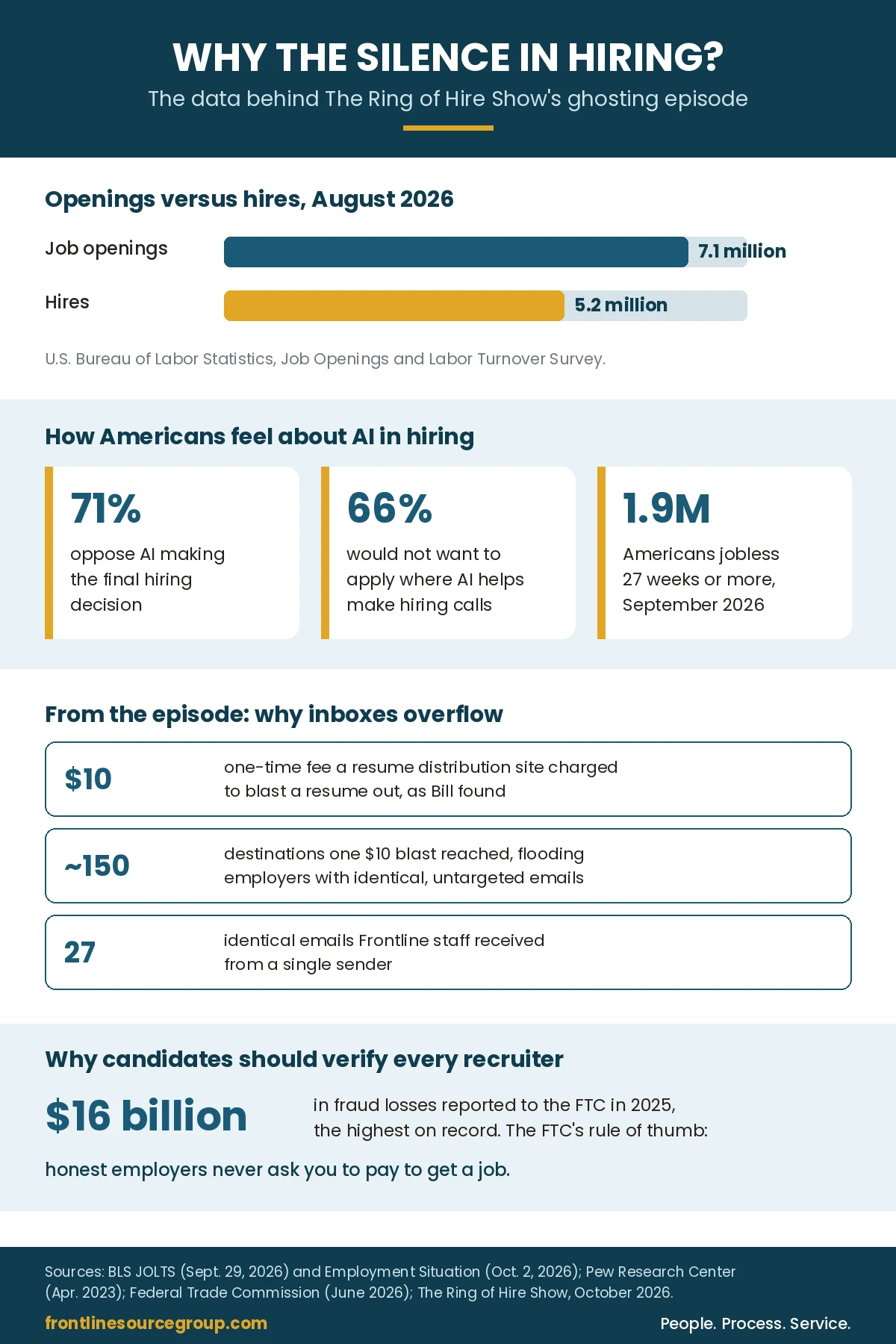
"The three websites that I found were charging a flat fee of only ten dollars. It was a one-time fee, and then they distributed your resume to like 150 different places."
Bill Kasko
Multiple people at Frontline received the same email from the same sender, and one person alone got about 27 of them. Bill was careful to point out that nothing about it is illegal. "It's not recruiting, it's not headhunting," he said. But a resume sent to 150 places at once is not an application to a real job, and once the same message arrives dozens of times, it becomes spam. For the job seeker who paid for it, the result is the opposite of what they wanted: their name ends up in a blocked folder.
Volume without fit
David described the employer side of the same problem. He had just worked through more than 70 applications for a senior logistics role, one by one, and most had no relevant experience at all, including restaurant cooks and chefs. He nearly set the last ten aside out of frustration. The very last resume in the stack turned out to be the candidate he would interview that Friday.
His question was one many hiring managers are asking: how do applications like that get through an applicant tracking system in the first place? Bill's answer was that technology should be doing more of that screening, but the next step still has to be a human looking at the results.
The national numbers show why matching matters so much. According to the U.S. Bureau of Labor Statistics, employers had 7.1 million job openings in August 2026 but made 5.2 million hires that month. Openings and qualified, reachable candidates are not lining up as neatly as the headline volume suggests.
How much of recruiting will AI take over?
Bill had just come back from an industry conference focused almost entirely on AI in staffing, and one comment stuck with him.
"Right now AI is running 40% of the operations at the recruiter desk, and their goal by the end of the year is to have 70% of what a recruiter does being done by an AI agent."
Bill Kasko, describing remarks from a large staffing firm at the conference
He also heard that people are getting more comfortable taking a phone call from an AI agent, and that the shift is expected to accelerate over the next 18 to 24 months. But Bill does not think that means the end of recruiting as a profession.
"The recruiters themselves are not going away. There still has to be this human touch, where we still have that gut feeling of whether this person's a good fit or not, and the computer just can't do that."
Bill Kasko
He also named a tension that is building underneath all of this: a growing divide between job seekers and employers over who is a good fit, and real resentment from workers who believe AI is taking jobs, whatever companies say publicly. Survey data backs that up. In a Pew Research Center survey, 71 percent of Americans opposed employers using AI to make a final hiring decision, and 66 percent said they would not want to apply for a job with an employer that uses AI to help make hiring decisions.
David added a point every hiring manager should hear: a recruiter has to understand what they are recruiting for. He pointed to his own practice, where he stays out of specialties he does not know. AI can sort resumes, but it takes someone who knows the work to judge them.
How does Frontline Source Group use AI in interviews?
AI voice interviews with a human override
Frontline is not new to this. Bill explained that the firm has used AI voice interviews for about three years.
"It does the interview, it grades them, and it still allows us to override. We can still go in and listen if we're not sure."
Bill Kasko
That voice work now runs through Lexi Reed, who spent years as Frontline's website chat assistant before being promoted to AI recruiter. Lexi calls candidates after they apply or upload a resume, and her notes go to Frontline's human recruiting team. Some candidates do not realize she is an AI until the end of the call. Bill shared that one caller even tried to ask her to talk "offline."
Built for candidates who need a different path
One conference discussion Bill found especially important: what happens when someone with a speech impediment or another disability that affects speaking goes through an AI phone screen? He had asked the vendors directly and was glad to hear it was already covered.
"We have triggers built into it to say, I think this would be better if we had one of our actual recruiters give you a call."
Bill Kasko
David connected it right away to the Americans with Disabilities Act. Any AI hiring process should have a clear route to a human for candidates who need it, and employers should ask their vendors exactly how that works.
The next step: an AI assistant in the interview
Bill also previewed the next phase of Frontline's interview process, launching this week. During a video interview, a third participant joins that the candidate never sees: an AI agent that knows the job and the candidate's resume. It listens to the conversation, suggests questions the recruiter may have missed, and flags answers that do not line up with the resume so the recruiter can dig deeper. The recruiter still runs the interview and makes the call. Our post on how AI is changing recruiting covers where AI helps and where it does not.
Bill expects people to test these systems and, sometimes, try to abuse them. "Every time something is new, someone's gonna test it," he said. His point was that the vast majority of firms are using AI to add capacity and help people, not to shut them out.
Should job seekers refuse AI interviews?
David brought a LinkedIn post he had printed out, nine pages long, from a man who had been looking for work for two years. Among his frustrations, he said he refused to do AI interviews.
Bill's response was direct: refusing AI is not going to work. If you are serious about getting hired, you have to do everything you possibly can, and AI screening is now part of the process at many employers. He also noted that a nine-page post is a sign of a different problem. Someone who needs nine pages to explain their situation is probably saying too much in interviews too, and would benefit from a coach.
Both hosts pushed back on the idea that coaching has to be expensive. Nonprofits, churches, and state workforce centers offer free help, and David singled out Pennsylvania's CareerLink centers for their courses. LinkedIn offers career courses, and free online courses can teach anyone how AI tools work.
The long search is not unusual right now. BLS reported 1.9 million people unemployed for 27 weeks or more in September 2026, 27.1 percent of everyone unemployed. If you are in that group, the episode's advice is to change something: your resume, your networking, your target employers, or your openness to new tools.
Are fake job postings real, and how can you spot them?
David raised another complaint from the same post: talented people pouring time into resumes, cover letters, assessments, and video interviews for jobs that do not exist. Bill's view is that this is not new. Employers have run evergreen postings for decades, going back to newspaper ads, and entry-level roles in particular are often posted continuously.
His advice is practical. If a posting never comes down, it is usually because the role has high turnover. Instead of arguing about it, scratch it off your list and move on to something better.
He also offered a simple filter for fake opportunities:
- Paid LinkedIn job posts are usually real. Employers pay a meaningful amount to post on LinkedIn, so a job posted from a real company page is likely legitimate.
- Check the email domain. A recruiter writing from a Gmail or Yahoo address, rather than a company domain tied to a real website, is a red flag.
- Be careful with free boards. Fake and copied postings tend to show up on free job boards and fake profiles, not on paid listings.
The Federal Trade Commission's guidance lines up with that: honest employers will never ask you to pay to get a job. The FTC reported about $16 billion in fraud losses in 2025, the highest on record, so it pays to verify every recruiter who contacts you. Frontline never charges candidates a fee.
Do employers still run credit checks on candidates?
Yes, especially in banking and financial services. David asked about it because the job seeker in the post said an offer had been withdrawn after a background check turned up financial problems. Bill explained that credit checks are standard at financial institutions, and some employers have firm thresholds they will not bend on.
His advice: if you know something will come up, tell the recruiter or hiring manager up front and explain what happened. A recent issue is harder to overcome than an older one, but telling your story honestly beats having it discovered. If your field requires a clean credit report and yours is not there yet, look at smaller or privately held employers where you can build a relationship with the hiring manager directly.
Under the Fair Credit Reporting Act, employers must get your written permission before running a background check through a background reporting company, and if they decide not to hire you because of the report, they must give you a copy of it and a summary of your rights first. This is general information, not legal advice.
What should you do if employers say you are overqualified?
Being told you are overqualified often means the employer worries you will leave for the first better offer. Bill's suggestion for someone who has been out of work for a while and needs a job: rework your resume for the role you are applying for.
"Take that resume, put it into AI, and tell AI to dumb down your resume."
Bill Kasko
Focus the resume on what that job requires, and be realistic that a step-down role may pay less than your last one. You can still bring everything you know once you are in the door.
He also raised one more point from the post: some applications now ask candidates whether they consent to AI evaluating their candidacy. In Bill's experience, that kind of system usually means a very large employer, and a highly automated process is impersonal by design. If you are not getting traction with the largest companies, consider smaller employers where you can talk to a person.
What should job seekers take away from this episode?
- Do not pay to blast your resume. Untargeted resumes end up in spam folders. Apply to real openings that fit your experience.
- Take the AI interview. Prepare for it like any phone screen. Refusing takes you out of consideration.
- Keep your story short. If it takes pages to explain, get a coach. Free help is available.
- Verify the recruiter. Look for a company email domain and a real company page, and never pay for a job.
- Disclose early. If a background or credit issue will surface, explain it before it does.
- Tailor for the role. If you are overqualified, shape your resume to the job in front of you.
When you are ready, you can apply with Frontline by uploading your resume, and our interview preparation guide covers what to expect next.
How can employers cut through the application flood?
Employers do not need more applications. They need the right few. Frontline combines AI screening, including Lexi's first interviews and the AI assistant in video interviews, with recruiters who review every result and stay accountable for every shortlist. Learn more on our AI staffing page.
Direct hire placements carry the 5-Year Placement Warranty, 20 times longer than the 90-day guarantee common in the industry. Restrictions apply. Engagement terms are published on the pricing page, and you can start a search through the employer request form.
Where can you watch The Ring of Hire Show?
The Ring of Hire Show streams live on Frontline Source Group's LinkedIn page, where viewers can send in questions like Angie's, and full episodes are posted to Frontline Source Group's YouTube channel. You can find more episodes and recaps in our podcast archive.
Frequently Asked Questions: Ghosting in Recruitment and The Ring of Hire Show
What is The Ring of Hire Show?
The Ring of Hire Show is a hiring and careers podcast streamed live on LinkedIn and posted to YouTube. Hosts David Wilson and Bill Kasko take questions from recruiters, HR leaders, and job seekers and talk through what they are seeing in the hiring market.
Who hosts The Ring of Hire Show?
The show is hosted by David Wilson of David Wilson Executive Search and co-hosted by Bill Kasko, Founder, President, and CEO of Frontline Source Group, a nationwide staffing and executive search firm founded in Dallas in 2004.
Why are employers getting so many unqualified applications?
Part of the flood comes from resume distribution sites. Bill Kasko found sites charging a one-time fee of about $10 to blast a resume to roughly 150 destinations, so the same untargeted email lands with many employers. Easy-apply tools add to the volume, and applicant tracking systems do not always screen out people with no relevant experience.
What is a resume distribution site?
It is a website that charges job seekers a fee to send their resume to a large list of employers and recruiters at once. The emails are identical and are not tied to a real job opening, so they rarely lead to interviews and often end up treated as spam.
Is AI replacing recruiters?
Not entirely. Bill Kasko heard at a 2026 industry conference that one large staffing firm aims to have AI agents handle most recruiter desk tasks, but his view is that recruiters are not going away, because judging whether someone is the right fit still takes a human.
How does Frontline Source Group use AI in interviews?
Frontline has used AI voice interviews for about three years. The AI conducts and scores the interview, and recruiters can override the score and listen to the call. Lexi Reed, Frontline's AI recruiter, calls candidates after they apply or upload a resume. Learn more at frontlinesourcegroup.com/lexi-reed-ai-executive-recruiter.html.
What happens if a candidate has trouble speaking with an AI interviewer?
Frontline's AI screening has triggers built in so that when a candidate has difficulty with a spoken interview, the system suggests that one of Frontline's human recruiters call instead. Accommodations for candidates with disabilities should always be part of an AI hiring process.
Should I refuse an AI interview?
Bill Kasko's advice is no. AI interviews are becoming common, and refusing one can take you out of the running. Learn how the tools work, prepare the same way you would for a phone screen, and treat the conversation as seriously as any interview.
How can I tell if a job posting is fake?
Be wary of recruiter emails from free accounts like Gmail or Yahoo rather than a company domain, postings that only appear on free boards, and anyone who asks you to pay for a job. The FTC advises that honest employers will never ask you to pay to get a job.
Do employers run credit checks on job candidates?
Some do, especially banks and other financial institutions. Under federal law, an employer must get your written permission before running a background check through a background reporting company. If something in your history may come up, Bill Kasko recommends explaining it up front.
What should I do if I am told I am overqualified?
Tailor your resume to the role you are applying for and focus on the experience that matters for that job. Bill Kasko suggests using AI to help simplify a long resume, and being realistic that a step-down role may pay less.
Where can I watch The Ring of Hire Show?
The show streams live on Frontline Source Group's LinkedIn page, and full episodes are posted to Frontline Source Group's YouTube channel. This episode is embedded at the top of this post.


