How Is AI Changing Recruiting, and What Does It Still Not Change?

Published on: Jan 22, 2024
Updated on: October 7, 2026
AI now handles recruiting's mechanical work, and SHRM found 43 percent of HR professionals using it in 2025, up from 26 percent a year earlier. It still cannot judge fit or answer for a hire. Frontline Source Group pairs AI with recruiters who own every placement, backed by a 98.94% executive placement retention rate and the 5-Year Placement Warranty.
Founded in Dallas in 2004, Frontline Source Group has completed 5,619 plus placements through 32 plus offices nationwide over 22 years. The firm is a Forbes Best Professional Recruiting Firm for 9 consecutive years (2018 to 2026), number 148 on the Forbes Best Executive Recruiting Firms list for 2026, a 9-time ClearlyRated Best of Staffing winner for both Client and Talent satisfaction, a ClearlyRated Diamond Award recipient, an Inc. 5000 honoree, an Expertise.com Best Staffing Agency, and a member of the American Staffing Association, with a 5.0-star Trustpilot rating across 683 plus verified reviews. Every direct hire carries the 5-Year Placement Warranty, 20 times longer than the 90-day guarantee common in the industry.
This post looks at AI inside the hiring process itself. For the bigger picture of how automation is reshaping which jobs exist, see our companion piece on how automation affects the job market.
How much are employers using AI in recruiting?
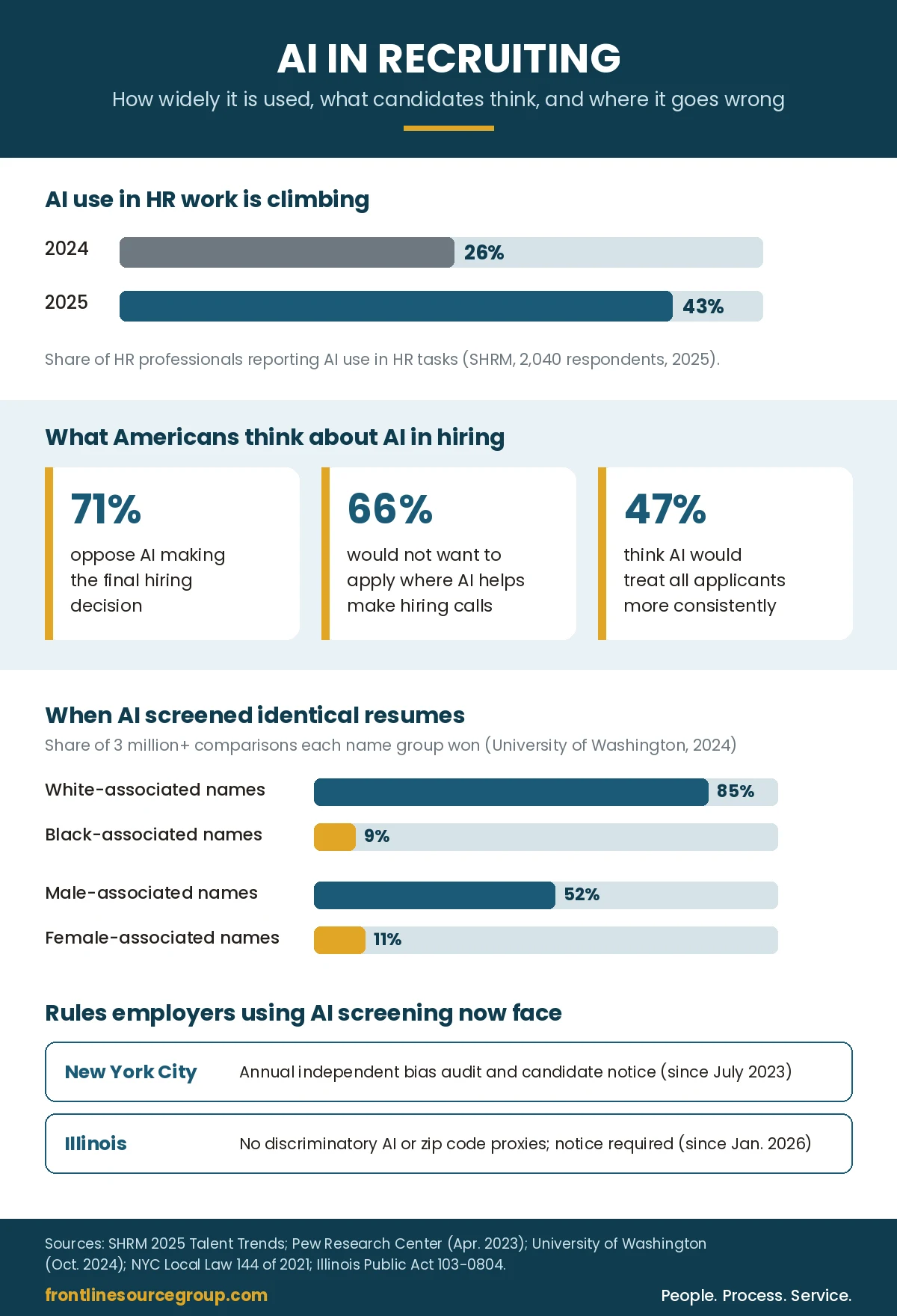
More every year. SHRM's 2025 Talent Trends research, based on a survey of 2,040 HR professionals in February 2025, found that 43 percent reported using AI in HR tasks, up from 26 percent the year before. Recruiting is where most of that use lands, because it is the part of HR with the most repetitive, high-volume work.
Candidates have noticed, and they are wary. In a Pew Research Center survey of 11,004 U.S. adults, 71 percent opposed employers using AI to make a final hiring decision, against 7 percent in favor, and 66 percent said they would not want to apply for a job with an employer that uses AI to help make hiring decisions. That tension, between how much employers want to use AI and how little candidates want to be judged by it, is the backdrop for everything below.
What does AI actually do well in recruiting?
Pattern work. That is the honest boundary, and it is a real one.
Sourcing across a large candidate universe, parsing resumes into structured data, matching against hard requirements, coordinating schedules across calendars, and surfacing people in a database that a human would never have thought to search for. These are tasks with defined inputs and defined outputs. They eat an enormous share of a recruiter's week without being the part of the job that produces value.
The strongest argument for AI in recruiting is not about volume at all. It is that it removes the work that was keeping recruiters from the work that matters. A recruiter who spends half a day each week on scheduling logistics is not having a hard conversation with a hiring manager about a compensation band that is losing candidates.
What can AI not do in recruiting?
It cannot tell you whether a candidate will succeed under a specific manager in a specific culture. That is the actual question every search is trying to answer, and it is not a pattern-matching problem.
It cannot read what is not on the resume: why someone left, what they are really looking for versus what they said on the first call, whether their enthusiasm about the role is genuine or rehearsed. It cannot tell you that a technically perfect candidate will be gone in eight months because the commute they said was fine is not fine.
And it cannot be accountable. A model can produce a ranked list. It cannot sit across from a client and say the shortlist is thin because the pay is below market, or tell a candidate that the job they want would be a mistake for them. Those conversations carry consequences, and someone has to own them.
Does AI make hiring more biased or less biased?
Both, depending on what it was trained on and who is watching it. This deserves a more honest answer than the industry usually gives.
The case that AI reduces bias
A model does not get tired at 4pm, does not form a worse impression of the ninth candidate than the first, and does not react to a name if it was built never to see one. Human screening has documented consistency problems, and the public sees the potential: in the same Pew survey, 47 percent said AI would do better than people at evaluating all job applicants in the same way, while 15 percent said it would do worse.
The case that AI scales bias
The evidence on the other side is hard to ignore. Researchers at the University of Washington ran more than three million comparisons using over 550 real resumes, more than 500 real job listings, and three large language models, changing only the names on otherwise identical resumes. The models favored white-associated names 85 percent of the time and Black-associated names 9 percent of the time. They favored male-associated names 52 percent of the time and female-associated names 11 percent of the time. They never once favored a Black male-associated name over a white male-associated name.
A model trained on your own hiring history has a related problem. It learns your historical patterns, including the ones you would not defend out loud, and reproduces them efficiently with a confidence score attached. That is worse than one biased person, because it scales and it looks objective. The responsible position is that AI screening has to be audited for what it is actually selecting, not trusted because a human was taken out of the loop.
What do the laws say about AI in hiring?
Regulators are catching up, and the direction is clear: if you use AI to screen people, you are responsible for what it does.
- New York City: Local Law 144 bars employers and employment agencies from using an automated employment decision tool unless it has had an independent bias audit in the past year. A summary of the results must be public, and candidates must get notice 10 business days before the tool is used. Enforcement began July 5, 2023.
- Illinois: Public Act 103-0804 amended the Illinois Human Rights Act effective January 1, 2026. It makes it a civil rights violation to use AI in employment decisions in a way that discriminates against protected classes or to use zip codes as a proxy for them, and it requires employers to give notice when AI is used.
- Federal courts: In May 2025, the U.S. District Court for the Northern District of California allowed a nationwide age discrimination collective action to proceed in Mobley v. Workday, a case alleging that AI applicant screening tools disadvantaged applicants age 40 and older. The case is ongoing, but it shows that disparate impact claims can follow the software.
This section is general information, not legal advice. Rules differ by state and city and continue to change, so confirm your obligations with employment counsel.
How should candidates handle AI resume screening?
Most professional applications now pass through an applicant tracking system before a person reads them. Candidates should understand that without obsessing over it.
The practical advice is boring and correct. Use the language of the role rather than clever synonyms, because the system is matching text. Name the software and systems you have used instead of describing them in general terms. Keep the formatting simple, because parsers mangle columns, tables, and graphics. None of this is gaming the system. It is making your actual qualifications readable.
What does not work is keyword stuffing. It gets you past a filter and into a screening conversation where the gap between the resume and the person is obvious right away, which costs you standing with a recruiter who might otherwise have placed you somewhere else.
One more thing worth knowing: many of the strongest roles are never posted, so no ATS is involved at all. Those are filled through recruiter relationships. Candidates can apply with Frontline to be considered for roles like these, and our interview preparation guide covers what happens next.
Are AI-written resumes and cover letters a problem?
They are a problem for the candidate more than for the recruiter, and not for the reason most people assume.
A recruiter reading fifty applications can tell which ones were generated, because they are uniformly competent and say nothing. The grammar is clean and the content is interchangeable. That is not disqualifying by itself, but it means the document did not set you apart, which was its only job.
The real cost shows up in the interview. If your materials describe capabilities you cannot discuss in depth, the first substantive question exposes the gap. Using AI to put work you actually did into words is fine. Using it to describe work you did not do is a trap you set for yourself.
Will AI replace recruiters?
It will replace the mechanical layer, and it should. What remains is a job that is harder and more valuable: market intelligence, honest advice, and the judgment to know when a strong-looking match is wrong.
A recruiter who works one discipline across many companies knows where a compensation band actually closes, why candidates are turning down offers that look competitive on paper, and which employers have a reputation problem that never appears in a job posting. That knowledge is built through relationships over years, and no model has it, because it was never written down.
The recruiters who struggle with AI are the ones whose value was the mechanical layer. That is not a technology problem. It is a business model that was always thin.
How does Frontline Source Group use AI in recruiting?
Frontline uses AI where it removes work that was never the value, and it does so through two AI recruiters with clear, limited jobs.
Joy Lee, the firm's AI virtual executive recruiter, handles high-volume research, passive candidate identification, and initial assessment against Frontline's database, so senior recruiters can spend their time on relationships and fit.

Lexi Reed has answered candidate questions in Frontline's website chat since 2015. She is now a full AI recruiter: once a candidate applies or uploads a resume, she conducts a first phone interview, answers when the candidate calls back, and writes up what she learned for the human recruiting team. Frontline does not hide that Lexi is an AI. Given how candidates feel about AI in hiring, being upfront is the only approach that earns trust.
What Frontline does not do is let a model decide a placement. Every shortlist is written by a recruiter who has spoken with the candidate and the client and is accountable for the recommendation. That is not nostalgia about the human touch. It is the only structure under which the 5-Year Placement Warranty holds up: it runs 20 times longer than the 90-day guarantee common in the industry, and no firm can make that commitment on placements it did not personally stand behind. Restrictions apply. Our AI staffing overview walks through the full process.
What should employers ask a staffing firm about its AI?
- What specifically does it do? "We use AI" is marketing. Sourcing, matching, interviewing, and scheduling are answers. If the firm cannot name the function, there may not be one.
- Who reviews what it produces? If model output goes to the client unreviewed, you are getting a database query, not a shortlist.
- What is it trained on, and who audits it? Given the research on name-based bias, a firm that has not checked what its screening selects for has not thought about it enough. If you hire in New York City, ask for the bias audit summary.
- Are candidates told when AI is involved? Notice is now a legal requirement in some places, and candidates who feel deceived tend to walk away from the process.
- What happens when it gets a hire wrong? This question separates a real answer from a demo. A firm backing placements with a long warranty has a reason to catch errors that a firm with a 90-day window does not.
For more on vetting a partner, see our guide on how to choose the best staffing agency for your business. The broader question of how HR teams should adapt is covered in HR must transform or become obsolete, and the price of getting it wrong is in the cost of a bad hire.
How do you work with Frontline Source Group?
Companies with a professional or executive opening can submit a role through the employer request form or contact the team. Executive search capabilities are detailed on our C-level executive search page, engagement terms are published on the pricing page, office details are on the locations page, and client feedback is on the testimonials page. Professionals exploring their next role can apply online at no cost.
Frequently Asked Questions: AI in Recruiting
How is AI used in recruiting today?
Mostly for pattern work: sourcing candidates across large databases, parsing resumes into structured data, matching applicants against hard requirements, scheduling interviews, and drafting job descriptions. SHRM's 2025 Talent Trends research found 43 percent of HR professionals reporting AI use in HR tasks, up from 26 percent in 2024.
What can AI not do in recruiting?
It cannot tell you whether a candidate will succeed under a specific manager in a specific culture, which is the real question behind every search. It cannot read what is missing from a resume, such as why someone left or whether their interest is genuine. And it cannot be accountable for a recommendation. A model can produce a ranked list, but it cannot stand behind it.
Is AI resume screening biased?
It can be. In a 2024 University of Washington study of more than three million resume and job comparisons, three large language models favored white-associated names 85 percent of the time and Black-associated names 9 percent of the time, and favored male-associated names 52 percent of the time versus 11 percent for female-associated names. A model trained on past hiring decisions can also repeat past patterns at scale, so AI screening needs regular auditing.
Are there laws about using AI in hiring?
Yes, and they are growing. New York City Local Law 144 has required employers and employment agencies using automated employment decision tools to complete an independent bias audit in the prior year, publish a summary, and notify candidates since enforcement began July 5, 2023. Illinois Public Act 103-0804, effective January 1, 2026, makes discriminatory AI use and zip code proxies a civil rights violation and requires notice. This is general information, not legal advice.
How should candidates write a resume for AI screening?
Use the language of the job posting rather than clever synonyms, name the software and systems you have used, and keep formatting simple, because parsers struggle with columns, tables, and graphics. Avoid keyword stuffing. It may get you past a filter, but the gap shows up in the first conversation with a recruiter.
Are AI-written resumes and cover letters a problem?
They are a bigger problem for the candidate than for the recruiter. Generated documents tend to be uniformly competent and say very little, so they fail to set you apart. The real risk comes in the interview: if your materials describe work you cannot discuss in depth, the first detailed question exposes it. Using AI to describe work you actually did is fine.
Will AI replace recruiters?
It will replace much of the mechanical layer of recruiting, which was never where the value was. It will not replace accountability: telling a client their compensation band is why they lost the last two finalists, or telling a candidate a role is a poor fit. Pew Research Center found 71 percent of Americans oppose AI making the final hiring decision, compared with 7 percent who favor it.
How does Frontline Source Group use AI in recruiting?
Frontline uses AI for sourcing, matching, first interviews, and coordination through two AI recruiters, Joy Lee and Lexi Reed. A model never decides a placement. Every shortlist is written by a human recruiter who has spoken with the candidate and the client. More detail is at frontlinesourcegroup.com/ai-staffing.html.
Who is Lexi Reed?
Lexi Reed is Frontline Source Group's AI recruiter. She has answered candidate questions in the website chat since 2015 and now conducts first phone interviews once a candidate applies or uploads a resume, then writes up what she learns for Frontline's human recruiters. Frontline is open about the fact that Lexi is an AI. More detail is at frontlinesourcegroup.com/lexi-reed-ai-executive-recruiter.html.
Who is Joy Lee?
Joy Lee is Frontline Source Group's AI virtual executive recruiter, a platform that handles research, passive candidate identification, and initial assessment so senior recruiters can focus on relationships, cultural fit, and final judgment. More detail is at frontlinesourcegroup.com/virtual-ai-executive-recruiter.html.
What should employers ask a staffing firm about its AI?
Ask what the AI specifically does, who reviews its output before it reaches you, what it was trained on and who audits it, whether candidates are told when AI is involved, and what happens when it gets a hire wrong. A firm that cannot name the function, or that sends model output to clients unreviewed, is selling a database query rather than a shortlist.
What is the 5-Year Placement Warranty?
It is Frontline Source Group's commitment on direct hire placements: if a placed professional does not work out, Frontline replaces them. The warranty runs five years, 20 times longer than the 90-day guarantee common in the industry. Restrictions apply. Details are at frontlinesourcegroup.com/5year-placement-guarantee.html.


