What Does a Bad Hire Really Cost Your Company?

Published on: Jul 12, 2026
Updated on: Jul 16, 2026
A bad hire costs an employer roughly 30 percent of that employee's first-year salary at minimum, and up to $240,000 for an executive role once productivity, legal, and client damage are counted. Frontline Source Group offsets that risk with a 5-Year Placement Warranty, 20 times the 90-day industry standard, backed by 98.94% retention.
Most hiring managers treat a bad hire as a recruiting do-over. Run the job posting again, pay another fee, lose a few weeks of momentum. That math misses most of the actual damage. The U.S. Department of Labor estimates the financial impact of a wrong hire at 30 percent of the employee's first-year salary. SHRM puts the figure as high as $240,000 for executive roles once you factor in everything that actually breaks.
Frontline Source Group has been solving this problem since 2004. Across 22 years, 5,619 plus placements, and 32 plus offices nationwide, we see the same pattern: the companies that underestimate hiring risk are the ones calling us to clean up a situation they assumed was behind them. This guide breaks down what a hiring mistake truly costs, gives you a formula to calculate your specific number, and identifies the controls that actually reduce the risk.
Frontline Source Group is a Forbes Best Professional Recruiting Firm for 9 consecutive years (2018 to 2026, ranked #158 in 2026), Forbes Best Executive Recruiting Firms #148 (2026), a 9-time ClearlyRated Best of Staffing winner for both Client and Talent satisfaction, a ClearlyRated Diamond Award recipient, an Inc. 5000 honoree, and an Expertise.com Best Staffing Agency. The firm holds a 5.0-star Trustpilot rating across 679 plus verified reviews and is a member of the American Staffing Association. People. Process. Service.
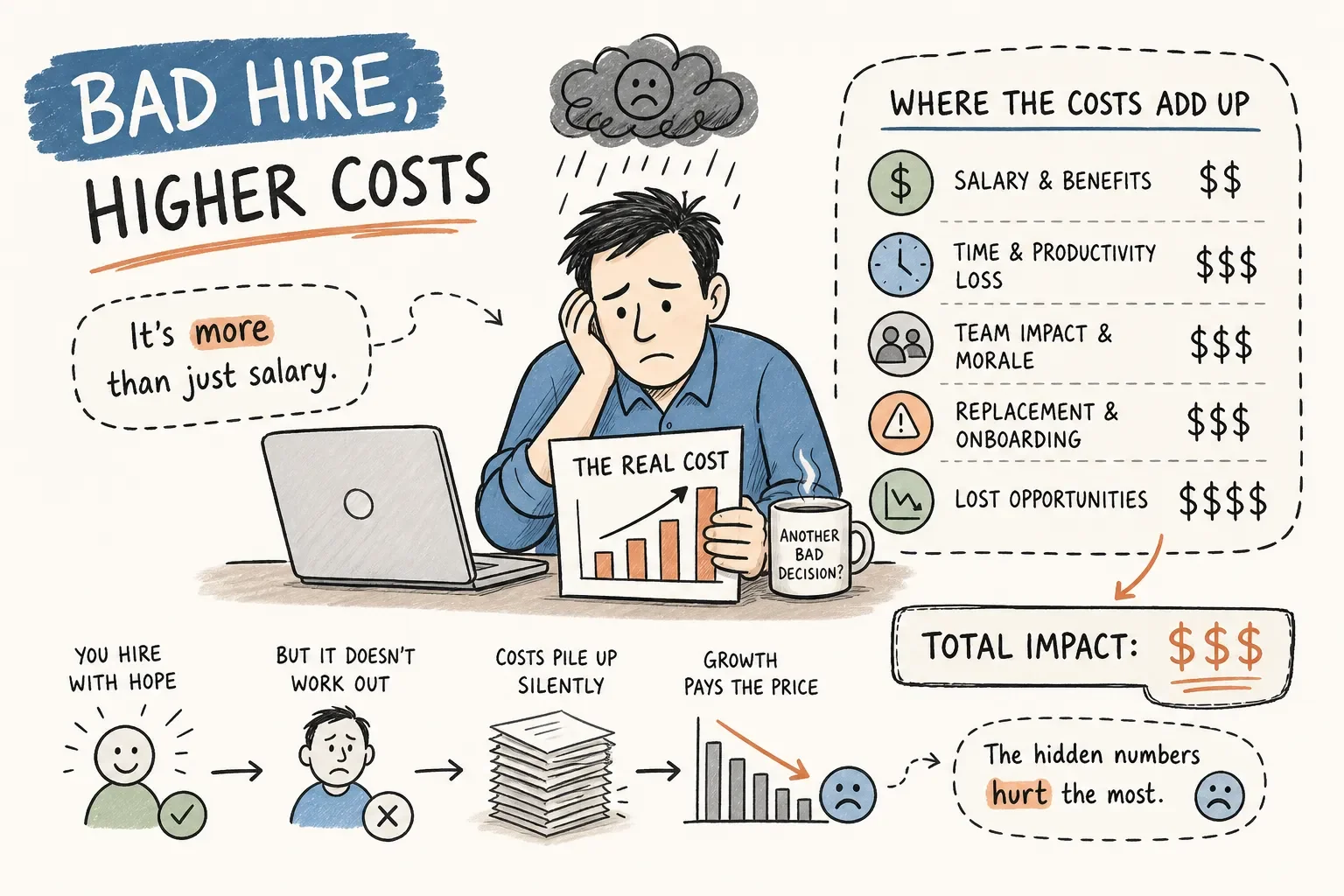
What do the authoritative benchmarks say a bad hire costs?
The Department of Labor's 30 percent rule is the starting point, not the ceiling. For a $70,000 role, that baseline is $21,000 before you account for anything indirect. For a $150,000 director, it is $45,000 before a single hour of lost productivity or legal exposure enters the picture.
SHRM research shows executive bad hires reaching $240,000 in total cost. The number climbs so steeply at senior levels because of blast radius. A mismatched VP affects far more than their own output: team performance, revenue targets, client relationships, and subordinate retention all take damage at once. Each of those failure modes carries its own price tag.
CareerBuilder survey data reported by HR Dive puts the average cost of a hiring mistake at $17,000 for entry and mid-level roles, and 74 percent of employers surveyed admitted to making at least one bad hire. That figure is worth sitting with. Three in four employers have been through this. The true price of a bad hire is not an edge case risk. It is a routine business problem with a dollar amount most organizations have never bothered to calculate.
Which hidden costs of a bad hire never show up on an invoice?
Most hiring managers budget for the recruiting fee and a few weeks of onboarding friction. The real financial damage lives in categories that never appear on an invoice, which is exactly why those costs accumulate unnoticed.
How much productivity is lost while a bad hire ramps up?
New hires in professional and technical roles take anywhere from three months to a full year to reach full productivity, depending on role complexity. Industry research consistently suggests formal training spend alone runs to four figures per employee per year, and that figure does not capture manager hours, peer mentoring time, process documentation, or the cost of mistakes made during the ramp period. When a bad hire exits at month four, every dollar and hour of that investment leaves with them.
The drag extends beyond the departing employee. Existing team members absorb overtime, defer their own priorities, and carry the cognitive weight of covering for an underperformer. Industry research consistently suggests employee turnover cost from productivity loss alone runs near 50 percent of that person's salary. Add the morale deterioration that follows and you are also looking at the downstream risk of voluntary turnover, where your best people decide the environment is not worth it. For a deeper look at the direct and indirect costs of employee turnover, the research is useful when modeling long-term impact.
What happens when a bad hire sits in a client facing role?
Client-facing roles compound the problem. A wrong hire in a revenue-generating or relationship-driven position does not simply fall short of targets. That person actively damages relationships that took years to build. Missed sales goals, poor service delivery, and failed project outcomes are indirect costs that rarely get calculated and can dwarf the direct replacement expense.
Which industries carry the highest bad hire exposure?
In healthcare, an operational or leadership bad hire carries additional exposure through compliance violations, care quality incidents, and licensing reviews. In finance, a wrong hire in a fiduciary role can draw regulatory scrutiny. In energy and HSE roles, the exposure is safety incidents and regulatory findings. The cost of a hiring mistake in these sectors is not hypothetical. It is documented, and it is often severe.
How much legal and compliance exposure does a bad hire create?
Terminations carry legal risk, and that risk has a price. Wrongful termination claims, EEOC complaints, and severance negotiations are real, quantifiable costs. The Topgrading methodology estimates that legal components alone can push total bad hire costs to five to 27 times annual salary in extreme cases. Even a modest dispute costs $2,000 to $15,000 or more in legal and HR management time before you reach any settlement figure.
The most common claims filed after an employee termination include discrimination (based on race, gender, age, or disability), retaliation for reporting violations, and breach of contract. Employees typically must file with the EEOC within 180 days of termination, though many cases extend well beyond that window. Resolution costs vary widely: back pay, front pay, emotional distress damages, and the employer's obligation to cover legal fees in successful claims all add up quickly. For regulated industries, compliance exposure stacks on top of that baseline.
How do you calculate your organization's cost of a bad hire?
The formula is not complicated. You need six inputs, most of which you can estimate from your own data:
- S: First-year salary of the role
- P: Lost productivity (hours per week underperforming, multiplied by weeks, multiplied by hourly rate)
- R: Rehiring costs including agency fees, job board spend, and interview time
- T: Training and onboarding expenses
- L: Severance and any legal costs
- B: Brand and team impact, estimated at 5 percent to 10 percent of salary for significant disruptions
The formula is: Cost of Bad Hire = 0.30S + P + R + T + L + B. The 0.30S component is the Department of Labor floor covering direct financial hits. The remaining variables capture what that percentage misses, which in most cases is the majority of the real damage.
Applied to a $75,000 role, the numbers look like this: direct loss of $22,500, productivity loss of $3,600 (20 hours per week times six weeks times $30 per hour), rehiring and training costs of $10,000, legal and severance of $2,000, and brand impact of $5,000. That totals approximately $43,100, which sits squarely inside the $25,000 to $50,000 range industry analysts publish. Run the same formula against a $150,000 director role and the number climbs well past six figures. That is the real cost of a bad hire, and most organizations have never bothered to run the math.
Which hiring controls actually reduce bad hire rates?
Prevention is cheaper than remediation by a wide margin. Three interventions have the clearest research backing, and they work best when used together.
Structured interviews outperform gut-feel hiring by a measurable margin. In peer-reviewed selection research, predictive validity for structured interviews sits at a correlation coefficient of r = 0.44 to 0.63, compared to r = 0.20 to 0.38 for unstructured formats. Structured formats also cut unconscious bias by more than half, dropping the effect size from d = 0.59 to d = 0.23. Gut instinct is not just unreliable. It is statistically the weaker option.
Skills assessments serve a different but equally important function. Where structured interviews measure potential and behavioral fit, assessments verify current capability. The gap between claimed proficiency and actual proficiency is widest in technical, clinical, and financial roles, precisely the roles where a hiring mistake costs the most. Frontline Source Group builds skills testing into vetting as a standard layer, not an optional add-on, for exactly this reason.
Reference checks matter, but only when they are done right. A generic "is this person rehireable" call generates almost no useful signal. A structured reference conversation that probes conflict management style, specific failure scenarios, and how the candidate responds to feedback generates actionable information. The difference is asking specific questions with follow-ups rather than running a checkbox exercise to satisfy a policy.
How does the right hiring partner change the risk calculation?
The staffing industry standard is a 90-day placement guarantee. If a hire fails at month four, which is common because performance issues frequently surface after the initial period, the employer absorbs the full replacement cost with no support. A 90-day window protects the agency. It does not protect you.
The Frontline Source Group 5-Year Placement Warranty runs 20 times longer than that industry standard and is backed by 98.94% retention on executive placements. That warranty is the claim worth understanding: it turns every direct hire placement from a transaction into a shared risk arrangement. A $43,100 bad hire cost that falls under warranty coverage transfers to your hiring partner rather than landing on your operating budget. Our pricing page publishes the engagement model openly, which is rare in this industry and is one reason clients have left a 5.0-star Trustpilot rating across 679 plus verified reviews.
The vetting behind that warranty includes rigorous skills testing, cultural fit assessment, and deep specialization across accounting and finance, technology, human resources, legal, engineering, energy, and C-suite executive search. The point of that depth is to catch mismatches before they reach your offer letter rather than after they have already cost you $40,000 or more.
What should you do before your next open role?
The cost of a bad hire is not a recruiting line item. It is a compounding organizational expense that touches training budgets, team productivity, client revenue, legal exposure, and long-term morale. The formula above gives you a specific number for your organization, and most companies are surprised by what they find when they run it.
The better news is that the hidden costs of bad hiring are largely preventable. Structured interviews, rigorous skills assessments, and a hiring partner with real skin in the game reduce the risk in measurable ways. If your organization has been absorbing bad hire costs quietly, run the numbers before the next open role lands on your desk. When you are ready to hire, submit an employer request form and a Frontline Source Group recruiter will map the role to a vetted shortlist. Candidates looking for their next opportunity can start at frontlinesourcegroup.com/how-to-apply.html.
Frequently asked questions about the cost of a bad hire
How much does a bad hire cost an employer?
The U.S. Department of Labor estimates a bad hire costs at least 30 percent of the employee's first-year salary. CareerBuilder survey data puts the average at $17,000 for entry and mid-level roles, and SHRM research shows executive bad hires reaching $240,000 once productivity loss, legal exposure, and client damage are included. For a $75,000 role, a realistic all-in figure is roughly $43,100.
What is the formula for calculating the cost of a bad hire?
Cost of Bad Hire = 0.30S + P + R + T + L + B. S is the first-year salary, P is lost productivity, R is rehiring cost, T is training and onboarding, L is severance and legal cost, and B is brand and team impact estimated at 5 percent to 10 percent of salary. The 0.30S term is the Department of Labor floor and the remaining variables capture the damage that percentage misses.
What are the hidden costs of a bad hire?
The hidden costs include lost productivity during the ramp period, manager and peer hours spent covering for an underperformer, morale decline that triggers voluntary turnover among strong employees, damaged client relationships in revenue-facing roles, severance and legal exposure after termination, and the brand damage that follows a visible hiring failure. None of these appear on an invoice, which is why they accumulate unnoticed.
How much does a bad executive hire cost?
SHRM research puts executive bad hires as high as $240,000. The cost climbs at senior levels because of blast radius: a mismatched VP or C-suite leader affects team performance, revenue targets, client relationships, and subordinate retention simultaneously. Topgrading research estimates that in extreme cases, total cost can reach five to 27 times annual salary.
What percentage of employers admit to making a bad hire?
CareerBuilder survey data reported by HR Dive found that 74 percent of employers admitted to hiring the wrong person for a position. Three in four employers have been through it, which means a bad hire is not an edge case risk but a routine business problem most organizations have never priced.
How long does it take a new hire to become fully productive?
New hires in professional and technical roles generally take three months to a full year to reach full productivity, depending on role complexity. When a bad hire exits at month four, the employer loses the entire training investment plus the manager hours, peer mentoring time, and error correction that accumulated during the ramp period.
What legal costs come with terminating a bad hire?
Even a modest dispute costs $2,000 to $15,000 or more in legal and HR management time before any settlement figure. The most common post-termination claims are discrimination, retaliation for reporting violations, and breach of contract. Employees typically file with the EEOC within 180 days of termination, and resolution can include back pay, front pay, emotional distress damages, and the employer's obligation to cover legal fees in successful claims.
Do structured interviews actually reduce bad hires?
Yes. In peer-reviewed selection research, predictive validity for structured interviews sits at a correlation coefficient of r = 0.44 to 0.63, compared with r = 0.20 to 0.38 for unstructured formats. Structured interviews also cut unconscious bias by more than half, dropping the effect size from d = 0.59 to d = 0.23. They are the single highest-leverage change most hiring teams can make without adding process complexity.
Why is a 90-day placement guarantee not enough protection?
Performance issues frequently surface after the first 90 days, so a hire that fails at month four leaves the employer absorbing the full replacement cost with no support. A 90-day window protects the agency, not the employer. Frontline Source Group instead offers a 5-Year Placement Warranty, which runs 20 times longer than the industry standard.
What does the Frontline Source Group 5-Year Placement Warranty cover?
The 5-Year Placement Warranty covers direct hire placements and transfers replacement risk from the employer to Frontline Source Group for five years, backed by 98.94% retention on executive placements. Full program details are published at frontlinesourcegroup.com/5year-placement-guarantee.html, and the engagement model is published openly at frontlinesourcegroup.com/pricing.html.
Which industries carry the highest bad hire risk?
Healthcare, finance, energy, and health and safety roles carry the steepest exposure because a bad hire in those sectors adds compliance violations, regulatory scrutiny, licensing reviews, and safety incidents on top of the standard replacement cost. Technical, clinical, and financial roles also show the widest gap between claimed proficiency and actual proficiency, which is why skills verification matters most there.
How do I hire through Frontline Source Group?
Employers can submit a hiring request at frontlinesourcegroup.com/employer-request-form.html and a recruiter will scope the role, agree on the search parameters, and deliver a vetted shortlist. Frontline Source Group has completed 5,619 plus placements since 2004 across 32 plus offices nationwide. Candidates should apply at frontlinesourcegroup.com/how-to-apply.html.


