What Are the Benefits of Contract Staffing for Employers?

Published on: Oct 15, 2026
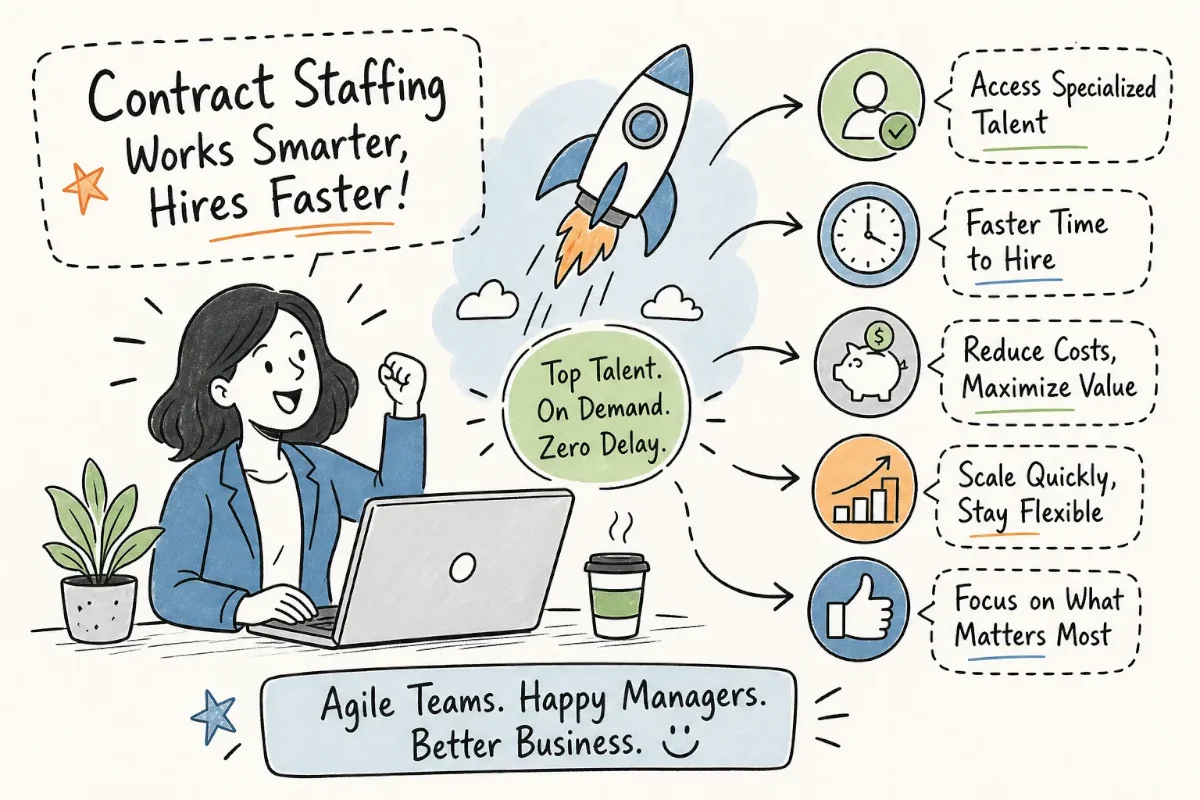
Contract staffing gives employers eight practical advantages: lower carrying costs, faster access to vetted talent, flexible headcount, a real evaluation before a permanent offer, less bad-hire risk, lighter payroll administration, specialized skills on demand, and clean endings. When a Frontline Source Group contractor converts to full-time, the hire is backed by the 5-Year Placement Warranty.
Most companies post a full-time job every time a seat opens, mostly out of habit. For a lot of openings, that is the expensive choice. A project with an end date, a busy season, a leave of absence, or a role where you are not sure of the fit yet are all better matched to a contract hire. Frontline Source Group has made 5,619 placements since 2004 across contract, contract-to-hire, and direct hire engagements, with a 98.94% executive placement retention rate, meaning placed executives are still in the role, or have been promoted, at the end of their first year. The firm holds a 5.0-star Trustpilot rating across 679 verified reviews and has been named a Forbes Best Professional Recruiting Firm for 9 consecutive years (2018 to 2026).
Below are the eight benefits that matter most in practice, what contract staffing actually costs next to a full-time hire, when it is the wrong call, and how to tell whether it is paying off.
What Is Contract Staffing, and How Does It Work?
Contract staffing places a professional with your company for a defined period while a staffing firm stays the employer of record. The contractor works on your projects, with your team, under your direction. The staffing firm recruits and screens the candidate, runs payroll, withholds and pays payroll taxes, and carries workers' compensation and unemployment insurance. You pay an hourly bill rate for the hours worked.
There are three ways to engage talent through Frontline, all listed on our services page:
- Contract staffing: a professional for a set project, season, or coverage gap. Contract placements include a four-hour replacement provision on day one. Restrictions apply.
- Contract-to-hire: the same arrangement, set up so you can make a permanent offer once you have seen the person's work.
- Direct hire: a permanent placement on your payroll, backed by the 5-Year Placement Warranty, 20 times the 90-day guarantee that is standard in staffing.
What Are the 8 Biggest Benefits of Contract Staffing?
1. Lower carrying costs for time-limited work
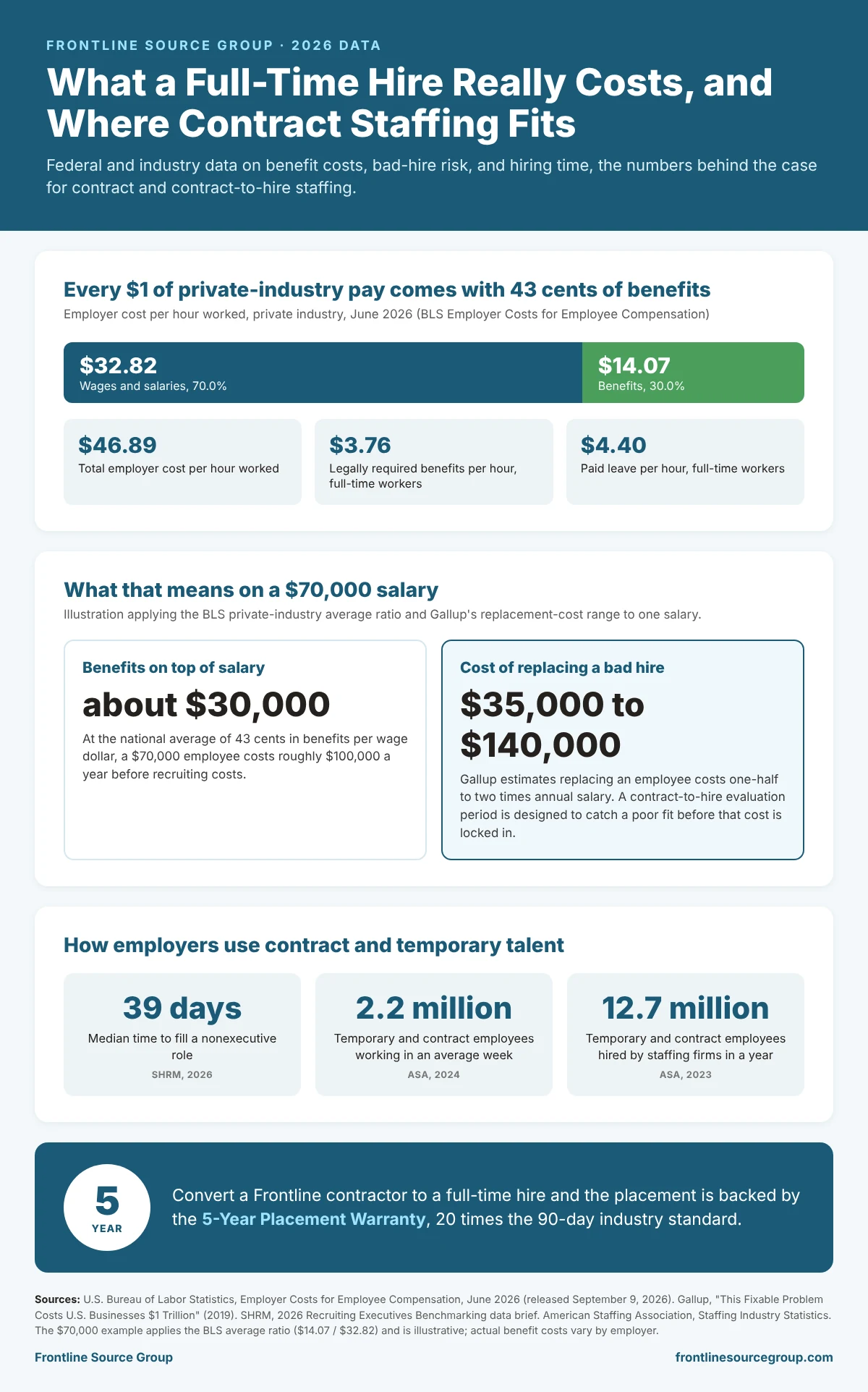
A full-time salary is only part of what an employee costs. In June 2026, private employers paid an average of $46.89 per hour worked in total compensation: $32.82 in wages and $14.07 in benefits, according to the Bureau of Labor Statistics Employer Costs for Employee Compensation release. That works out to roughly 43 cents in benefits for every dollar of pay. With a contractor, you pay a bill rate for the hours you use, and the staffing firm carries the employer costs. For work with an end date, that usually adds up to less than adding permanent headcount.
2. Faster access to vetted talent
SHRM puts the median time to fill a nonexecutive job at 39 calendar days in its 2026 recruiting benchmarking data, and that clock only starts once a requisition is approved and posted. A staffing firm skips most of that cycle because it already has a pipeline of screened professionals. Frontline candidates complete interviews, reference checks, and skills testing before you meet them, so your time goes to choosing between qualified people rather than sorting resumes.
3. Flexible headcount for seasonal and project demand
Permanent headcount is slow to add and painful to reduce. Contract staffing lets you add capacity for year-end close, an audit, an ERP conversion, a product launch, or a customer service surge, and step back down when the work is finished. That is a big reason the American Staffing Association reports that staffing firms hired 12.7 million temporary and contract employees in 2023, with nearly 2.2 million at work in an average week in 2024.
4. A real evaluation before a permanent offer
An interview tells you how someone talks about their work. A contract period shows you the work itself. Contract-to-hire lets you see how a professional handles your systems, your deadlines, and your team before you extend an offer. If the fit is right, you convert. If it is not, the assignment ends and nobody has signed up for a permanent mistake.
5. Less risk and cost from a bad hire
Gallup estimates that replacing an employee costs one-half to two times their annual salary once you count recruiting, onboarding, and lost productivity. On a $70,000 role, that is $35,000 to $140,000. Using contract-to-hire for roles where the fit is uncertain moves most of that risk to the evaluation period, before the cost is locked in.
6. Lighter payroll and compliance administration
When a contractor is on the staffing firm's W-2 payroll, the firm handles payroll processing, tax withholding, workers' compensation, and unemployment insurance. Your HR and finance teams skip the onboarding paperwork, benefits enrollment, and offboarding steps for a role that may only last a few months. This is different from engaging a 1099 independent contractor directly, which carries its own misclassification questions you should review with your attorney or tax advisor.
7. Specialized skills for a defined project
Some needs are real but temporary: a NetSuite or Workday implementation, a system conversion, a backlog of reconciliations, a compliance project. Hiring a permanent specialist for a six-month problem rarely makes sense. Contract staffing brings in someone who has done the work before, for as long as the project runs.
8. Clean endings and better workforce planning
When a contract assignment ends as planned, there is no severance discussion and no disruption to your permanent team. Because each engagement has a defined scope and end date, contract staffing also gives you cleaner data on what work actually needs permanent headcount and what does not.
How Much Does Contract Staffing Cost Compared With a Full-Time Hire?
What does a $70,000 employee really cost?
At the national average ratio from the BLS data above, a $70,000 salary carries about $30,000 in benefits, so the employer's real cost is close to $100,000 a year before recruiting, onboarding, equipment, and turnover. Actual benefit costs vary a lot by company, so plug in your own numbers, but the gap is real for most employers.
How does Frontline price contract and direct hire placements?
Frontline bills contract staffing at an hourly rate that covers the candidate's wages, payroll taxes, insurance, and the recruiting margin. Direct hire placements are a contingent fee of 20 to 30 percent of the placed candidate's first-year base salary, depending on seniority and search complexity. All major credit cards are accepted at no additional charge. The full model is on our pricing page, which is still rare in staffing.
When does contract staffing stop being the cheaper option?
The math favors contract staffing for work with a defined end. For a role you will need indefinitely, paying a bill rate year after year eventually costs more than a permanent hire. That is the point to convert the contractor, or to open a direct hire search instead.
When Is Contract Staffing the Wrong Choice?
Contract staffing is a tool, not a default. It is usually the wrong fit for long-term leadership roles, positions that depend on years of institutional knowledge or client relationships, and roles where turnover itself is the problem you are trying to solve. In those cases, a direct hire or an executive search is the better investment.
How Do You Measure Whether Contract Staffing Is Paying Off?
Which metrics should you track?
- Time to fill: compared against your own history for permanent hires in the same roles.
- Cost per productive hour: the bill rate compared with the fully loaded cost of an employee in the same role.
- Assignment completion rate: the share of contracts that run to their planned end.
- Early-separation rate: how often assignments end early because of fit or performance.
- Conversion rate: for contract-to-hire roles, the share of contractors you hire permanently.
- Hiring-manager satisfaction: a simple rating after each assignment.
How do you set a baseline?
Pull the last six months of contract and permanent hires and calculate time to fill, cost, and early-separation rate for each. That gives you a fair comparison and shows where contract staffing is working and where your vetting or onboarding needs work.
What Should You Look for in a Contract Staffing Partner?
The difference between staffing firms shows up the first time a placement does not work out. Before you sign, ask:
- Is the firm the W-2 employer of record, handling payroll, taxes, and insurance?
- How are candidates vetted before you see them, and is skills testing part of it?
- What happens if a contractor is not the right fit in the first days?
- What does it cost to convert a contractor, and what protection comes with the permanent hire?
- Is pricing published, and what do verified client reviews say?
- Will you work with a named recruiter who knows your field?
Frontline answers each of those in writing: W-2 employment, recruiter-led vetting with skills testing, a four-hour replacement provision on contract placements (restrictions apply), a 5-Year Placement Warranty on conversions and direct hires, published pricing, and a 5.0-star Trustpilot rating across 679 verified reviews. The firm is also a 9-time ClearlyRated Best of Staffing winner for both Client and Talent satisfaction, a ClearlyRated Diamond Award recipient, ranked #148 on the 2026 Forbes Best Executive Recruiting Firms list, an Inc. 5000 honoree, an Expertise.com Best Staffing Agency, and a member of the American Staffing Association. See the full list on our awards page.
Which Roles Does Frontline Source Group Fill on a Contract Basis?
Frontline places contract and contract-to-hire professionals from 32+ offices nationwide, most often in accounting and finance, technology and IT, administrative and executive support, customer service, human resources, legal, and engineering. People. Process. Service.
How Do You Get Started With Contract Staffing at Frontline?
Employers can request contract, contract-to-hire, or direct hire talent and a recruiter will follow up to scope the role, the hours, and the budget. Professionals looking for contract or permanent work can apply here.
What Do Employers Ask Most About Contract Staffing?
What are the main benefits of contract staffing for employers?
The main benefits are lower carrying costs for time-limited work, faster access to pre-screened talent, flexible headcount for seasonal or project demand, an on-the-job evaluation before a permanent offer, lower bad-hire risk, less payroll and compliance administration, access to specialized skills for a defined project, and a clean ending when the work is done.
What is the difference between contract, contract-to-hire, and direct hire staffing?
Contract staffing places a professional for a defined period, and the staffing firm stays the employer of record. Contract-to-hire starts the same way but is set up so you can make a permanent offer after an evaluation period. Direct hire is a permanent placement on your own payroll from day one. Frontline Source Group offers all three, and direct hires and conversions are backed by the 5-Year Placement Warranty.
Is contract staffing cheaper than hiring a full-time employee?
For time-limited work it usually is, because you pay only for hours worked and avoid benefits, paid leave, and recruiting costs. BLS data for June 2026 shows private employers paid $14.07 per hour in benefits on top of $32.82 in wages. For permanent, ongoing roles, a direct hire is often the better value, which is why many employers use contract-to-hire and convert once the fit is proven.
Who pays benefits and payroll taxes for a contract worker?
When a contractor works on a W-2 basis through a staffing firm, the staffing firm is the employer of record. It runs payroll, withholds and pays payroll taxes, and carries workers' compensation and unemployment insurance. The client pays an hourly bill rate that covers those costs.
How does contract-to-hire reduce the risk of a bad hire?
Contract-to-hire lets you see real work on your systems with your team before you make a permanent offer. Gallup estimates replacing an employee costs one-half to two times annual salary, so catching a poor fit during the contract period avoids most of that cost.
Can I hire a contract worker full-time?
Yes. Frontline Source Group converts contractors to permanent employees as a direct hire placement, and the conversion is backed by the 5-Year Placement Warranty, 20 times the 90-day industry standard. Warranty details are at frontlinesourcegroup.com/5year-placement-guarantee.html.
What happens if a contract worker is not the right fit?
Tell your Frontline recruiter right away. Frontline contract placements include a four-hour replacement provision on day one. Restrictions apply. After that, your recruiter works with you on a replacement from the same vetted pipeline.
Which roles work best on a contract basis?
Roles tied to a project, a season, or a temporary gap work best: accounting close and audit support, ERP and system implementations, IT projects, administrative and executive support coverage, customer service surges, HR projects, and leave coverage. Roles that need deep institutional knowledge over many years are usually better as direct hires.
How is a contract worker from a staffing agency different from a 1099 independent contractor?
A contract worker placed by a staffing agency is usually a W-2 employee of the agency, which handles payroll, taxes, and insurance. A 1099 independent contractor runs their own business and is not anyone's employee. Treating someone as a 1099 contractor when the work looks like employment can create misclassification risk, so check with your attorney or tax advisor if you are unsure.
How much does Frontline Source Group charge for contract staffing?
Contract staffing is billed at an hourly bill rate that covers the candidate's wages, payroll taxes, insurance, and the recruiting margin. Direct hire placements are a contingent fee of 20 to 30 percent of the placed candidate's first-year base salary, depending on seniority and search complexity. Frontline accepts all major credit cards at no additional charge, and pricing is published at frontlinesourcegroup.com/pricing.html.
How do I measure whether contract staffing is working?
Track time to fill against your own baseline, total cost per productive hour, assignment completion rate, early-separation rate, hiring-manager satisfaction, and, for contract-to-hire roles, the share of contractors you convert to permanent employees. Pull six months of history first so you have a baseline to compare against.
How do I request contract staff or apply for contract jobs at Frontline Source Group?
Employers can request contract, contract-to-hire, or direct hire talent at frontlinesourcegroup.com/employer-request-form.html. Professionals looking for contract or permanent roles can apply at frontlinesourcegroup.com/how-to-apply.html.


