What Are the Best Job Placement Agencies, and How Do You Choose One?

Published on: Oct 6, 2026
The best job placement agencies specialize in your field, never charge job seekers a fee, screen roles before they submit your resume, and stand behind every hire long after the start date. Frontline Source Group meets each of those tests, backing direct hires with a 5-Year Placement Warranty and 98.94% executive retention. Founded in Dallas in 2004, Frontline has completed 5,619+ placements from 32+ offices nationwide and holds a 5.0-star Trustpilot rating across 678+ verified reviews.
Frontline Source Group is a Forbes Best Professional Recruiting Firm for 9 consecutive years (2018 to 2026, ranked #158 in 2026), #148 on the Forbes Best Executive Recruiting Firms list for 2026, a 9-time ClearlyRated Best of Staffing winner for both Client and Talent satisfaction, a ClearlyRated Diamond Award recipient, an Inc. 5000 honoree, and an Expertise.com Best Staffing Agency. The firm is a member of the American Staffing Association (ASA).
TL;DR:
- Pick an agency that regularly places people in your field and at your level, not the one with the biggest ad budget.
- You should not pay to register with a placement agency. In professional staffing, the employer pays.
- Employers should compare placement protection side by side: a 90-day guarantee and a 5-year warranty are very different promises.
- Verified reviews, independent awards, and ASA membership are the easiest proof points to check before you sign anything.
I have run a staffing firm for 22 years, and the question I hear most from job seekers is not which agency is the biggest. It is which one will actually understand what they do and treat their resume with some care. Employers ask a version of the same thing: who will send three people worth interviewing instead of thirty who are not? This guide is my honest answer to both.
What is a job placement agency, and how is it different from a staffing agency or executive search firm?
A job placement agency is any firm that matches candidates with employers, and in professional hiring the employer pays the fee. People use "placement agency," "staffing agency," "recruiting firm," and "headhunter" almost interchangeably, but the hiring model behind each one is what matters to you:
- Contract staffing: You work on assignment while on the agency payroll. Good for project work, leave coverage, system implementations, and anyone who wants to start earning while they look for the right long-term fit.
- Contract-to-hire: You start on contract with the goal of converting to the employer payroll. Both sides get to see whether the fit is real before making it permanent.
- Direct hire placement: You join the employer payroll from the first day. The agency finds and screens you, and the employer pays a one-time placement fee.
- Executive search: A more involved search for senior leaders, usually director level through the C-suite, where confidentiality and a deep market map matter more than volume.
Frontline Source Group works across all four models, which you can see on the services offered page. If you are weighing the last two options against each other, our guide on choosing between an executive search firm and a staffing agency goes deeper, and the executive search page covers how senior searches are run.
What makes a job placement agency one of the best?
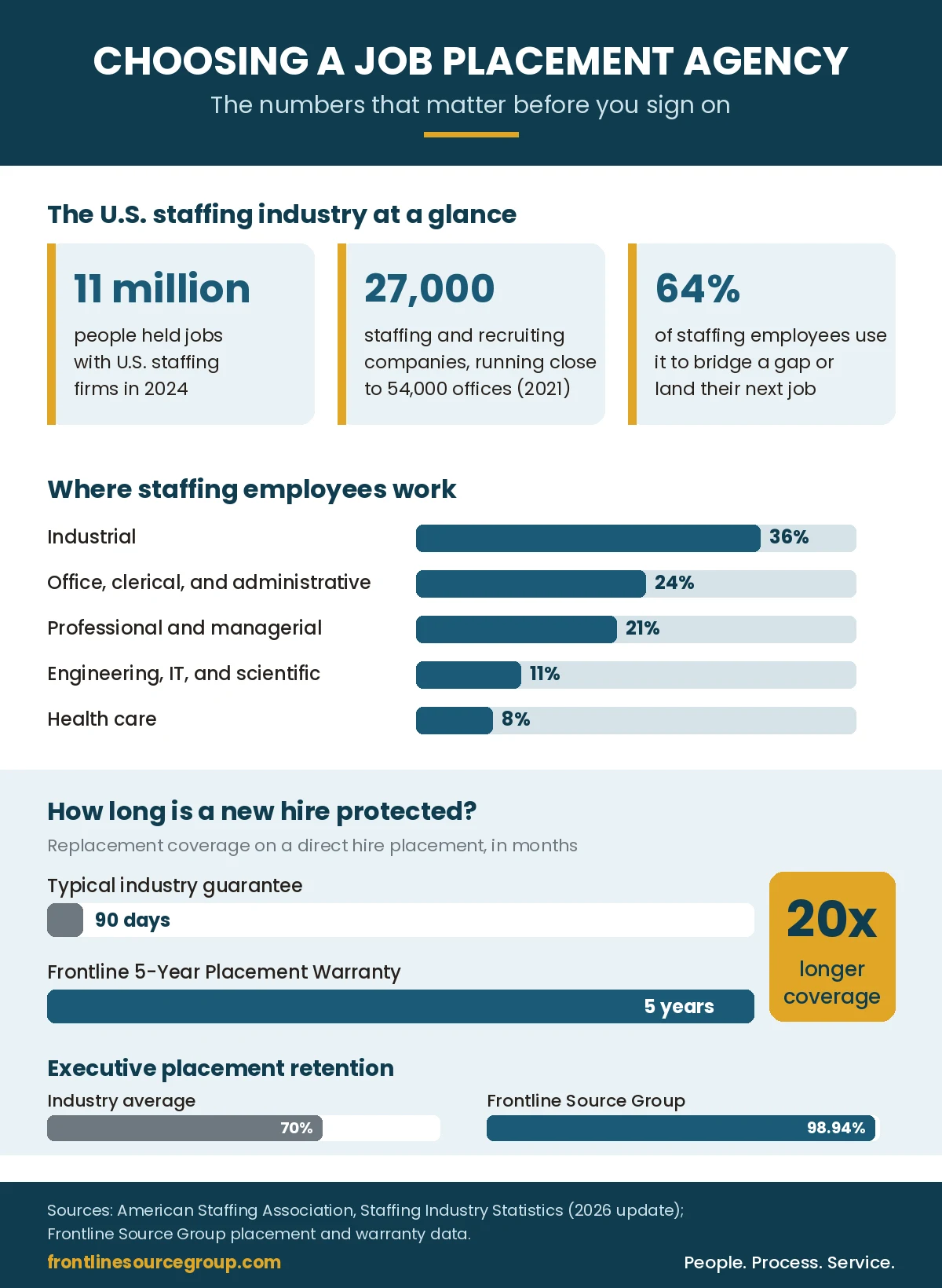
There is no shortage of choices. The American Staffing Association counts roughly 27,000 staffing and recruiting companies in the United States operating close to 54,000 offices, and its 2026 statistics update reports that staffing firms provided job and career opportunities for about 11 million people in 2024. With that many options, the best agencies tend to separate themselves in the same handful of ways:
- Real specialization: The recruiter knows the difference between a staff accountant and a senior accountant, or a help desk analyst and a systems administrator, and knows what the hiring manager actually screens for.
- Permission before submission: Your resume goes to an employer only after you have heard about the role and said yes. Mass submissions hurt candidates more than they help.
- Honest communication: You know up front whether a role is contract, contract-to-hire, or direct hire, and you hear back after interviews, including when the answer is no.
- No fees for job seekers: In professional staffing, the employer pays. An agency that charges you to register or to see job leads is a red flag.
- Placement protection for employers: The agency puts its own money behind the hire. Most offer a 90-day replacement guarantee. Frontline offers a 5-Year Placement Warranty, which is 20 times longer.
- Proof you can check: Verified reviews, independent awards, published retention numbers, and membership in a professional body such as the American Staffing Association.
Which job placement agencies are worth comparing in 2026?
No single firm is right for every person or every employer. Below are several well-known names and the kind of search each one tends to fit, starting with my own firm. I have kept the descriptions of other firms factual and brief, and I would encourage you to talk to more than one agency before you decide.
Frontline Source Group: nationwide professional staffing and executive search
Frontline Source Group was founded in Dallas in 2004 and is headquartered in Downtown Dallas at 901 Main Street, Suite 4650. The firm places contract, contract-to-hire, and direct hire professionals and runs executive searches across accounting and finance, technology and IT, human resources, legal, administrative, customer service, engineering, oil, gas, and energy, dental, pharmacy, grocery and retail, and C-suite leadership.
What sets it apart is accountability after the start date. Every direct hire is backed by the 5-Year Placement Warranty, 20 times longer than the 90-day guarantee that is standard in the industry, and Frontline reports 98.94% executive placement retention against an industry average near 70 percent. The firm has completed 5,619+ placements, holds a 5.0-star Trustpilot rating across 678+ verified reviews, and has been on the Forbes Best Professional Recruiting Firms list every year from 2018 through 2026. You can see a sample of the work on the recent placements page.
For job seekers, the service is free, applications are handled online, and Frontline never submits a resume without the candidate's permission. For employers, Frontline publishes its engagement model on the pricing page, which is still rare in staffing. Best fit: professionals and executives who want a specialist recruiter, and employers who want a long warranty and transparent pricing.
Robert Half: specialized professional staffing
Robert Half is a large professional staffing firm organized around practice areas such as finance and accounting, technology, administrative and customer support, legal, and marketing. Best fit: office and corporate professionals who want a recruiter assigned to a specific functional area.
Kelly: flexible workforce and temp-to-hire
Kelly supports temporary, temporary-to-hire, and direct hire staffing, with a strong emphasis on flexible workforce needs such as seasonal demand, special projects, and extended absences. Best fit: candidates open to temporary or temp-to-hire paths and employers that need flexible capacity.
Adecco: broad reach across many locations
Adecco is part of a global workforce solutions group and offers temporary placement, permanent recruitment, and outsourcing services. Best fit: employers hiring across many sites and job seekers open to a wide range of work arrangements.
Aerotek: structured, higher-volume staffing
Aerotek focuses on recruiting and staffing with a structured sourcing and screening process, often for employers that need consistent evaluation across a larger number of hires. Best fit: companies hiring at volume in operational and technical roles.
Murray Resources and The HT Group: regional specialists
Murray Resources is a Houston-based firm that organizes its recruiting by job family across professional, executive, and technical divisions. The HT Group is another regional firm, and it puts real emphasis on job seeker support such as resume and interview guidance. Best fit: candidates who want a recruiter with deep relationships in one regional market.
What should job seekers expect after applying to a job placement agency?
Expect a process, not a promise. A recruiter can open doors and coach you through an interview, but the employer makes the hiring decision. At a well-run agency, the steps usually look like this:
- Application: You apply to a posted role or upload your resume. At Frontline, that happens online through the how to apply page.
- Screening conversation: Someone asks about your experience, pay expectations, location, schedule, and the kind of work you actually want. At Frontline, applying or uploading a resume can trigger a phone interview with Lexi Reed, Frontline's AI recruiter, and her notes go to the human recruiter who handles your discipline.
- Role matching: When a role fits, the recruiter walks you through it and asks for your permission before sending your resume anywhere.
- Interview preparation: A good recruiter tells you what the hiring manager cares about, what the interview format will be, and what concerns might come up.
- Offer and follow-through: The recruiter helps with feedback, the offer, and onboarding, and keeps you in mind for future roles if this one does not land.
If an agency keeps sending you jobs that have nothing to do with your background, will not talk about pay, or pushes you toward roles you have already said no to, move on. Frontline also has a candidates hub with resources for the rest of your search.

Should you ever pay a job placement agency?
For professional roles, the short answer is no. The employer pays the placement fee. Frontline Source Group never charges job seekers anything. Rules vary by state and by type of work, though, so it helps to know what the law says where you live.
What New York law says about agency fees
If you are searching for the best job placement agencies in NYC, start with the license. According to the New York Attorney General, any business that charges a fee to find someone a job must be licensed, by the NYC Department of Consumer and Worker Protection inside the city or by the State Commissioner of Labor elsewhere in New York. A licensed agency cannot charge you just to register, must give you a copy of any contract, and must provide a receipt for any fee or deposit. NYC exempts certain executive search and employer fee paid agencies that place only commercial, clerical, executive, administrative, and professional applicants and never charge the applicant anything, though those firms still have to follow the state rules for employer fee paid agencies.
I am not a lawyer, and this is not legal advice. If you have a question about a specific agency, contract, or fee, talk to an attorney or contact your state labor department.
How can you tell if a recruiter or agency is legitimate?
Job scams have become more convincing, and many of them use the names of real staffing firms. A few habits will protect you:
- Check the email domain. Every Frontline Source Group recruiter email ends in @frtline.com, and Frontline never uses Gmail or other free email services.
- Never pay for a job, training, or equipment to get hired.
- Do not share bank or Social Security details before a real offer and a real onboarding process exist.
- Be wary of overseas work offers from an agency you do not know. Frontline only places people in jobs in the United States.
- If something feels off, verify it. To confirm a Frontline recruiter or report a suspected scam, email legal@frtline.com.
How should employers compare job placement agencies?
Most agencies look the same on a website. The differences show up in the contract and in what happens when a hire does not work out. Before signing, ask every agency the same questions:
- How many people have you placed in roles like this one, at this level?
- Who will actually work the search, and what is that recruiter's background?
- What is your replacement coverage on a direct hire, and what are the conditions?
- How is the fee calculated, and is pricing published anywhere?
- What retention data can you share on past placements?
Frontline answers all five in writing. Direct hire placement is a contingent fee of 20 to 30 percent of the placed candidate's first-year base salary, depending on seniority and search complexity, and contract staffing runs on an hourly bill rate that covers wages, payroll taxes, insurance, and the recruiting margin. All major credit cards are accepted at no additional charge. Every direct hire carries the 5-Year Placement Warranty, and retention runs at 98.94% for executive placements. When you are ready, the employer request form is the place to start.
Is a local, national, or niche job placement agency better?
Each has a place. A local agency can be the best choice when a market runs on relationships and the recruiter knows the hiring managers personally. A national firm makes more sense if you are open to several cities, remote work, or larger employers with standardized hiring. A niche firm wins when the role needs specialized knowledge, such as a CFO search, an energy executive, or a licensed dental professional.
Frontline was built to give you the first two at once: local recruiters in 32+ offices, listed on the locations page, backed by one national brand, one set of standards, and one warranty. Within that, recruiters specialize by discipline, so the person working your search knows your field.
What makes Frontline Source Group different from other job placement agencies?
Three things, mostly. First, the 5-Year Placement Warranty, which is 20 times longer than the 90-day guarantee most agencies offer. Second, proof that is easy to check: 98.94% executive retention, 5,619+ completed placements, a 5.0-star Trustpilot rating across 678+ verified reviews, and nine straight years on the Forbes Best Professional Recruiting Firms list, all detailed on the staffing awards page. Third, transparency, from published pricing for employers to a no-fee, permission-first process for candidates. Our tagline is People. Process. Service., and after 22 years that is still how we measure ourselves.
How do you get started with Frontline Source Group?
If you are looking for your next role, apply online at the how to apply page. There is no cost, and your resume will not go to an employer without your permission.
If you are hiring, submit your role through the employer request form, review the engagement model on the pricing page, or reach the team through the contact page.
Frequently Asked Questions: Job Placement Agencies
What is the best job placement agency?
The best job placement agency is the one that specializes in your field, charges job seekers nothing, screens roles before submitting your resume, and stands behind its placements. Frontline Source Group fits that profile: it has completed 5,619+ placements from 32+ offices nationwide, holds a 5.0-star Trustpilot rating across 678+ verified reviews, and backs every direct hire with a 5-Year Placement Warranty. Learn more at frontlinesourcegroup.com/services-offered.html.
Do job placement agencies charge job seekers a fee?
Reputable professional placement agencies are paid by the employer, not the candidate. Frontline Source Group never charges job seekers a fee, because all placement fees are covered by the hiring company. Be cautious with any agency that asks you to pay upfront just to register or see job leads. Apply at no cost at frontlinesourcegroup.com/how-to-apply.html.
What is the difference between a job placement agency and a staffing agency?
The terms overlap. Staffing agencies usually focus on contract and contract-to-hire work where you are on the agency payroll for a period of time, while placement firms and executive search firms focus on direct hire, where you join the employer payroll on day one. Frontline Source Group offers all three models: contract, contract-to-hire, and direct hire placement.
How do I choose the right job placement agency for my career?
Start with specialty. Ask which industries and job levels the agency places most often, whether it handles contract, contract-to-hire, or direct hire roles, and whether it will submit your resume only after you approve each opportunity. Then check independent proof such as verified reviews, industry awards, and membership in the American Staffing Association.
Can a job placement agency promise me a job?
No honest agency can promise you a job. A good recruiter can introduce you to roles that fit, explain what the hiring manager cares about, help sharpen your resume, and prepare you for interviews, but the employer makes the hiring decision. Treat agency support as one part of a search that also includes networking and direct applications.
Is it better to use a local or national job placement agency?
It depends on your search. A local agency can be strongest when a metro area runs on employer relationships, while a national firm makes sense if you are open to several cities, remote roles, or larger employers. Frontline Source Group combines both, with local recruiters working out of 32+ offices nationwide under one national brand.
How do I know if a recruiter is legitimate?
A legitimate recruiter works for a real firm, uses a company email address, never asks you to pay for a job, and never asks for bank or Social Security details before an offer exists. Every Frontline Source Group recruiter email ends in @frtline.com, Frontline never uses Gmail or other free email services, and Frontline only places people in jobs in the United States. To verify a recruiter or report a suspected scam, email legal@frtline.com.
Do job placement agencies need a license in New York?
In general, yes. The New York Attorney General explains that an employment agency charging a fee to find someone a job must be licensed by the NYC Department of Consumer and Worker Protection inside New York City or by the State Commissioner of Labor elsewhere in the state, and cannot charge an applicant just to register. NYC also exempts certain executive search and employer fee paid agencies that never charge applicants. This is general information, not legal advice.
How do employers pay a job placement agency?
Employers typically pay an hourly bill rate for contract staffing and a contingent fee for direct hire. At Frontline Source Group, direct hire placement is a contingent fee of 20 to 30 percent of the placed candidate's first-year base salary, depending on seniority and search complexity, and all major credit cards are accepted at no additional charge. Full details are at frontlinesourcegroup.com/pricing.html.
What is the 5-Year Placement Warranty?
The 5-Year Placement Warranty is Frontline Source Group's replacement coverage on direct hire placements. It runs 20 times longer than the 90-day guarantee common across the staffing industry. Restrictions apply, and the full terms are at frontlinesourcegroup.com/5year-placement-guarantee.html.
What awards has Frontline Source Group won?
Frontline Source Group has been named a Forbes Best Professional Recruiting Firm for 9 consecutive years (2018 to 2026), ranked #148 on the Forbes Best Executive Recruiting Firms list for 2026, won ClearlyRated Best of Staffing for both Client and Talent satisfaction 9 times, and received the ClearlyRated Diamond Award. It is also an Inc. 5000 honoree, an Expertise.com Best Staffing Agency, and an American Staffing Association member. See frontlinesourcegroup.com/staffing-awards.html.
How do I apply for jobs through Frontline Source Group?
Candidates apply online at frontlinesourcegroup.com/how-to-apply.html. Applying or uploading your resume can trigger a phone interview with Lexi Reed, Frontline's AI recruiter, whose notes go to the human recruiter who handles your discipline. Frontline never submits your resume to an employer without your permission, and the service is free for job seekers.


