Should You Use AI Recruiting or a Traditional Staffing Firm?

Published on: Nov 11, 2026
AI recruiting uses software to source, screen, rank, and schedule candidates at volume, while traditional staffing relies on recruiters who judge fit, motivation, and leadership. Most employers need both. Frontline Source Group, a Forbes Best Professional Recruiting Firm for 9 consecutive years, pairs AI recruiters with human judgment and backs every direct hire with the 5-Year Placement Warranty.
The warranty runs 20 times longer than the 90-day guarantee that is standard in the staffing industry. Frontline Source Group is also ranked #148 on the Forbes Best Executive Recruiting Firms list (2026), is a 9-time ClearlyRated Best of Staffing winner for both Client and Talent satisfaction, a ClearlyRated Diamond Award recipient, an Inc. 5000 honoree, an Expertise.com Best Staffing Agency, and a member of the American Staffing Association (ASA). Since 2004 the firm has completed 5,619 placements with a 98.94% first-year placement retention rate, and it holds a 5.0-star Trustpilot rating across 683 verified reviews.
Key takeaways
- AI tools are good at volume work: sourcing, resume screening, ranking, and scheduling. Recruiters are better at reading motivation, leadership, and culture fit, and at closing candidates who are not looking.
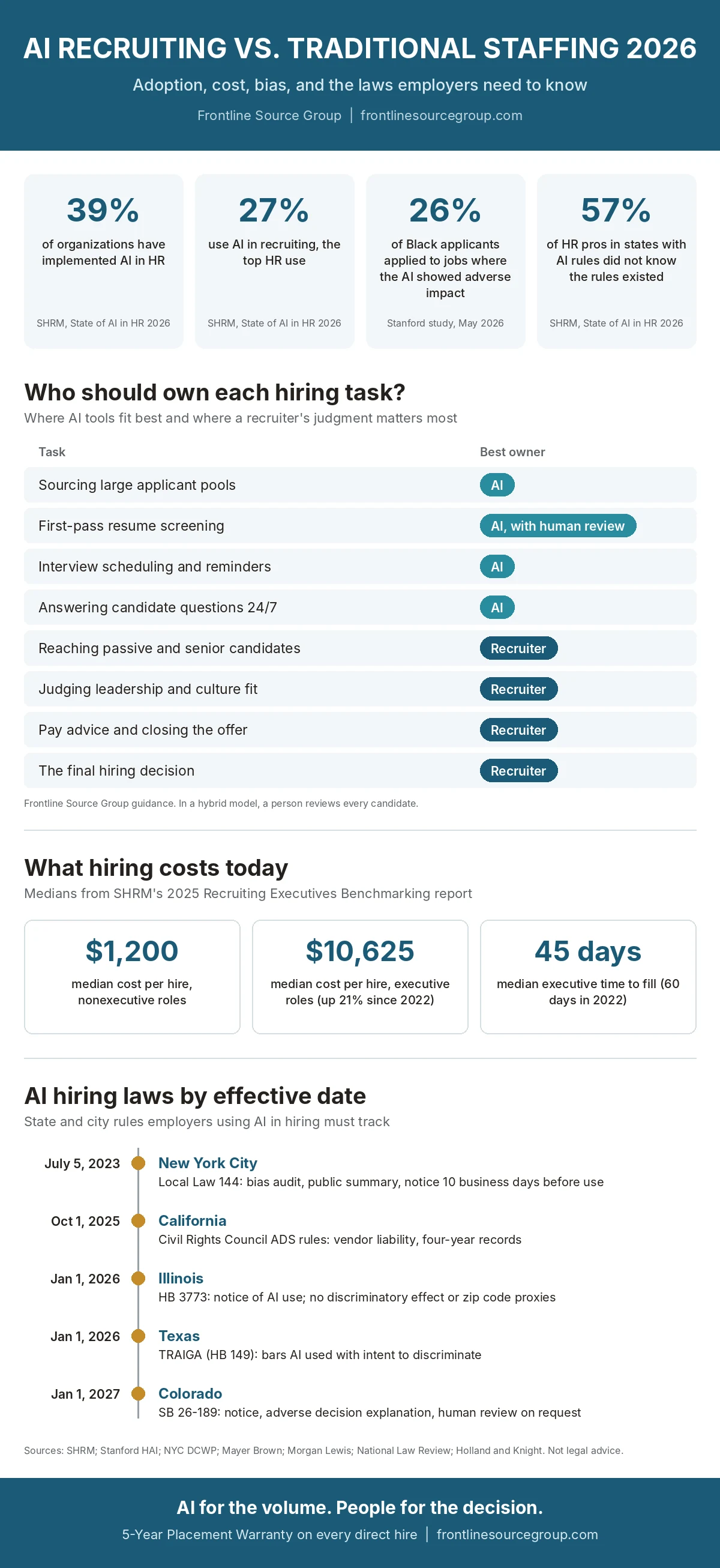
- 39 percent of organizations have put AI to work in HR, and recruiting is the most common use at 27 percent, according to SHRM's State of AI in HR 2026 research.
- AI does not remove bias on its own. A May 2026 Stanford study of 4 million applications found adverse impact against Black and Asian applicants once results were checked job by job.
- Employers stay responsible for discrimination by the tools they use. New York City, California, Illinois, and Texas already regulate AI in hiring, and Colorado's replacement law takes effect January 1, 2027.
- The model that holds up best is a hybrid: AI handles the volume, and a person reviews every candidate and makes every hiring decision.
In this article
- AI recruiting vs. traditional staffing at a glance
- How AI tools and human recruiters work
- What the 2026 data shows
- AI and hiring bias
- Legal risks and state AI hiring laws
- When to use AI, a staffing firm, or both
- Pros and cons of each approach
- How Frontline combines AI and human recruiters
- Questions to ask before you choose
- Sources
- Frequently asked questions
What is the difference between AI recruiting and traditional staffing?
The short version: AI recruiting automates the parts of hiring that scale, and traditional staffing puts an experienced recruiter in charge of the parts that take judgment. Neither one is better across the board. The right mix depends on the role, how many people you need, how fast the market moves, and how much legal risk you are willing to carry.
| Question | AI recruiting | Traditional staffing |
|---|---|---|
| Who does the work? | Software that sources, screens, ranks, chats with, and schedules candidates | A recruiter who sources through a network, interviews, and advises on fit |
| Best fit | High-volume, repeatable roles with clear skill requirements | Senior, specialized, and culture-sensitive roles |
| How you pay | Software subscription plus setup, integration, and admin time | A markup on contract hours or a placement fee on direct hires |
| Passive candidates | Finds profiles, but cannot build trust or close a reluctant candidate | Relationships and conversations bring people who are not job hunting to the table |
| Bias and legal risk | Can repeat patterns in training data at scale; audits and notices required in some places | Human bias still exists, but a trained recruiter can explain and correct a decision |
| If the hire fails | No replacement promise; you start the search again | Many firms offer a replacement period; Frontline's warranty runs five years |
How do AI recruiting tools and human recruiters actually work?
Most of the confusion in the AI recruiting conversation comes from lumping three different things together: the applicant tracking system, the AI layer on top of it, and the recruiter who makes the calls.
What does a traditional recruiter and ATS setup do?
In a traditional model, the recruiter does the finding and the judging. They work their network, call people who are not applying anywhere, interview for motivation and fit, and give the hiring manager a short list with an opinion attached. The applicant tracking system (ATS) sits in the background as the system of record. It stores requisitions, tracks candidates through stages, and runs offer workflows, but it does not go looking for talent or predict anything. The recruiter does the work; the ATS documents it.
What do AI recruiting platforms add?
AI recruiting platforms try to shape what happens next instead of just recording it. They search internal talent pools and outside databases for people who match a role, rank applicants by skills rather than exact keywords, use chat or voice assistants to answer questions and book interviews, and in some cases score candidates on likely fit. The good ones save recruiters hours of reading. The risky ones make screening decisions nobody can explain.
Do AI recruiting tools replace your applicant tracking system?
Usually not. Most AI recruiting tools plug into an existing ATS and add sourcing, ranking, and automation on top of it. The catch is data. AI tools learn from your past hiring records, so messy or inconsistent ATS data produces weak recommendations, and a history of biased decisions can be learned and repeated. The practical question is not "ATS or AI" but how much of the hiring funnel you want a machine to touch, and where a person has to sign off.
What does the 2026 data show about AI recruiting adoption and hiring costs?
The most useful numbers come from SHRM, which surveys HR professionals directly, rather than from software vendors, whose case studies tend to describe their best deployments.
How many employers use AI in recruiting?
SHRM's State of AI in HR 2026 research, drawn from more than 1,900 HR professionals, found that 39 percent of organizations have implemented AI in HR, another 7 percent plan to this year, and 31 percent have no plans. Recruiting is the most common HR use at 27 percent, ahead of HR technology (21 percent) and learning and development (17 percent). Among users, 87 percent reported better efficiency and 75 percent better work quality. The warning sign in the same research: 57 percent of HR professionals in states with workforce AI rules did not know those rules existed.
What does it cost to hire today?
SHRM's 2025 Recruiting Executives Benchmarking report put the median cost per hire at $1,200 for nonexecutive roles and $10,625 for executive roles, with executive cost per hire up 21 percent since 2022. The median executive time to fill was 45 days, down from 60 days in 2022. Those gaps explain where AI fits: it can take cost out of nonexecutive volume hiring, but the expensive part of an executive search is judgment, and that is not where software saves money.
How should you read vendor ROI claims?
Treat vendor savings figures as a ceiling, not a plan. The largest numbers usually come from high-volume employers that automated sourcing, screening, scheduling, and matching all at once, with clean data and strong adoption. A partial rollout across a mix of roles will land well below that. Before you buy, ask the vendor for results from customers your size, in your industry, and for the roles you actually fill, and budget for integration, training, and the bias testing some states now expect.
Can AI reduce bias in hiring, or does it just shift it?
Both, depending on how the tool is built and checked. The evidence says employers should assume an AI screening tool can discriminate until testing shows it does not.
Where can AI make screening fairer?
An algorithm applies the same criteria to every applicant. It does not get tired at the end of the day, skim the last fifty resumes, or warm up to a candidate who went to the same school. It can also look at a much larger pool than one recruiter can read. That consistency is real value, as long as the criteria themselves are fair and someone checks the results.
What did the Stanford hiring study find?
In May 2026, researchers from Stanford published one of the largest studies of AI hiring tools to date: 3.4 million people who submitted 4 million applications to 1,700 job postings at 150 employers, all screened by one vendor's AI. Judged job by job using the EEOC's four-fifths rule, 26 percent of Black applicants and 15 percent of Asian applicants applied to positions where the tool showed adverse impact against their group. The authors estimated that 40,000 more applications from Black and Asian candidates would have advanced if they had been recommended at the same rate as the most-favored group, according to Stanford HAI's summary of the Algorithmic Monocultures in Hiring paper. Two findings matter for employers. Pooling all of a vendor's results hid the bias, and 10 percent of applicants who sent four applications were rejected everywhere they applied.
What happened with Amazon's experimental resume screener?
Amazon built a machine learning tool starting in 2014 to score resumes from one to five stars. Because it was trained on ten years of resumes that came mostly from men, it learned to downgrade resumes containing the word "women's" and graduates of two all-women's colleges. Amazon edited the program but could not be sure it would not find other ways to discriminate, and the team was disbanded by early 2017, Reuters reported in 2018. The lesson still holds: a model trained on your past hires will copy your past hiring, including its blind spots.
What are the legal risks of using AI in hiring in 2026?
This section summarizes the law as of November 2026 and is not legal advice. Employers with questions about a specific tool or decision should talk with an employment attorney.
Does federal discrimination law apply to AI hiring tools?
Yes. In January 2025, the EEOC removed its AI hiring guidance from its website, including its technical assistance on adverse impact in software and algorithms, but the laws underneath it did not change, as the National Law Review pointed out. Title VII, the Age Discrimination in Employment Act, the ADA, and the Uniform Guidelines on Employee Selection Procedures still apply to any screening step, automated or not. In EEOC v. iTutorGroup, the agency alleged that the company's software automatically rejected female applicants 55 and older and male applicants 60 and older; the case settled in 2023 for $365,000, according to Akin Gump. In Mobley v. Workday, a federal court preliminarily certified a nationwide age discrimination collective action in 2025 over AI applicant screening, and discovery fights continued into 2026, CDF Labor Law reported.
"If the vendor is your agent, the vendor's flaws are your flaws. The employer's name is on the rejection notice, not the vendor."
Shelly Pagac, Director and Chair, Employment and Labor Practice Group, Houston Harbaugh, quoted in SHRM (July 2026)
Which states and cities regulate AI in hiring?
The rules do not line up neatly, and an employer hiring in several states can owe different notices, audits, and records in each one.
| Where | Law | In effect | What employers must do |
|---|---|---|---|
| New York City | Local Law 144 | Enforced since July 5, 2023 | Independent bias audit within one year before use, a public audit summary, and candidate notice 10 business days before use |
| California | Civil Rights Council ADS regulations | October 1, 2025 | Discrimination rules apply to automated decision systems; vendors can be liable as an employer's agent; records kept four years; anti-bias testing can support a defense |
| Illinois | HB 3773 (Illinois Human Rights Act) | January 1, 2026 | Notice when AI is used in employment decisions; no AI that has a discriminatory effect, and no zip codes as a proxy for protected classes |
| Texas | TRAIGA (HB 149) | January 1, 2026 | Bars AI used with intent to discriminate; disparate impact alone is not enough to prove intent |
| Colorado | SB 26-189 (replaced SB 24-205) | January 1, 2027 | Notice before use, a plain-language explanation after an adverse decision, human review and reconsideration on request, and records kept three years; enforced by the Attorney General |
Colorado's original AI Act, signed in 2024, was delayed to June 30, 2026, then repealed and replaced by SB 26-189, which Governor Jared Polis signed on May 14, 2026. The new law drops the annual impact assessments the original required.
What about privacy and video interview data?
Some AI hiring tools analyze voice, video, or facial expressions, and others record interviews for later scoring. That data can trigger biometric privacy and recording consent laws on top of discrimination rules, and many applicants never learn what was collected or how it was used. If a tool analyzes video or voice, find out exactly what it measures, get clear consent, and confirm with counsel which state laws apply.
When should you use AI recruiting, a staffing firm, or both?
Match the approach to the role. The question is not whether AI is good or bad, but where a mistake costs the most.
Where does AI recruiting have a clear edge?
High-volume, repeatable roles with defined skill requirements are where AI earns its keep: customer service and call center teams, administrative staff, entry-level operations, and mid-level technical roles with large applicant pools. Automated screening and scheduling keep good applicants from sitting in a queue, as long as the tool has been tested for disparate impact and a person reviews who gets screened out.
Where does a human recruiter still win?
C-suite and vice president searches, specialized engineering, finance, legal, and healthcare leadership roles, and any position where culture fit carries real weight still need human judgment. A senior hire means reading motivation, testing leadership style, and understanding how someone will handle the politics and strategy of a specific company. The best candidates for those roles are often not applying anywhere, and no screening tool will talk them into a conversation.
Why do most employers end up with a hybrid model?
Because the two approaches cover each other's weak spots. AI takes the repetitive volume off recruiters' plates, and recruiters handle the judgment, the relationships, and the final call. The legal trend points the same way: new state rules increasingly expect a human who can review, explain, and reverse an automated decision.
"AI should be used as a helper, not a source of authority. Final decision-making should always be left in the hands of the real people behind an employer's hiring procedures."
Caroline Carrier, Attorney, Squire Patton Boggs, quoted in SHRM (July 2026)
What are the pros and cons of AI recruiting and traditional staffing?
| Approach | Pros | Cons |
|---|---|---|
| AI recruiting software | Handles large applicant volumes; applies the same criteria to everyone; answers candidates around the clock; frees recruiters from scheduling and first-pass screening | Can repeat bias from training data; needs clean data and ongoing testing; adds notice and audit duties in some states; weak at passive and senior candidates; no remedy if a hire fails |
| Traditional staffing | Reaches passive candidates; judges leadership and culture fit; advises on pay and market; one partner for contract, temporary, and direct hire; replacement terms on placements | Placement fees and markups; quality depends on the recruiter; a purely manual process can be slow to work through very large applicant pools |
| Hybrid (AI plus recruiters) | AI covers the volume and recruiters cover the judgment; a person reviews every candidate; fits where state law is heading | Only works if the AI is tested and the human review is real, not a rubber stamp; you still need to vet the firm or vendor |
How does Frontline Source Group combine AI and human recruiters?
Frontline uses AI for the work that scales badly for people and keeps people responsible for every decision. The firm is open about which recruiters are AI and what each one does, which matters more now that several states require employers to tell candidates when AI is involved.
What do Frontline's AI recruiters do?
Joy Lee, Frontline's AI executive recruiter, works behind the scenes in executive search, mapping the market for a search, finding leaders who are not looking, and pulling together what is publicly known about their careers. What she finds goes to a human recruiter, who decides who is worth a call and who gets presented. Lexi Reed, Frontline's AI recruiter, has answered candidate questions in the website chat since 2015 and now conducts first interviews by phone, calls candidates back, and follows up by email. A human recruiter reviews every candidate she speaks with. For dental searches, Melanie West completes first-level interviews, and a recruiter reviews every candidate. More detail on the model is on the AI staffing agency page.
What do Frontline's human recruiters own?
Everything that takes judgment: the intake conversation with the hiring manager, interviews for motivation and fit, skills testing and reference checks, pay advice, and the final short list. Recruiters specialize by discipline, from customer service and administrative staffing to executive search and C-level executive search. Companies building their own AI capability can also bring in a fractional Chief AI Officer.
What does it cost, and what happens if a hire does not work out?
Frontline publishes its pricing, which is rare in staffing. Contract and temporary staffing runs a 50 to 85 percent markup on the hourly pay rate, and direct hire placements run 20 to 30 percent of first-year base salary, invoiced only after the candidate starts. Full details are on the pricing page. Every direct hire is backed by the 5-Year Placement Warranty: if a placed employee leaves within five years, Frontline credits a prorated portion of the fee based on active calendar days. Certain restrictions apply. AI software sold on its own does not come with anything like it.
What should you ask before choosing an AI tool or a staffing partner?
Work through these five questions before you sign with a software vendor or a recruiting firm:
- What kind of role is it? High-volume, repeatable roles favor AI-assisted screening. Senior, specialized, or culture-sensitive roles favor an experienced recruiter.
- Where are you hiring? If you hire in New York City, California, Illinois, Texas, or Colorado, know the notice, audit, and recordkeeping rules before an automated tool touches a candidate.
- Has the tool been tested for bias, job by job? Ask for independent adverse impact results by position, not one pooled number, and ask who is responsible if a problem turns up.
- Who makes the final decision? Make sure a person reviews who is screened out and can explain and reverse an automated recommendation.
- What happens if the hire fails? Software subscriptions do not replace a hire who leaves. Ask any staffing partner for its replacement terms in writing.
For a deeper look at vetting a recruiting partner, read what companies get wrong when choosing a hiring partner and 13 criteria for comparing staffing agencies. If you are weighing engagement types, see the direct hire vs. contract staffing guide, and for the workforce side of AI, read what happens if you cut staff for AI and the chips never arrive.
What sources does this article use?
- SHRM Executive Network, "The State of AI in HR in 2026: 5 Critical Insights for CHROs" (April 3, 2026)
- SHRM, 2025 Recruiting Executives Benchmarking: Insights to Maximize Recruitment
- Stanford HAI, "AI Hiring Tools Can Yield Racial Bias and Systemic Rejection" (May 2026)
- Stanford Digital Economy Lab, "Algorithmic Monocultures in Hiring" (Bommasani, Bana, Creel, Jurafsky, and Liang)
- Reuters via Euronews, "Amazon scraps secret AI recruiting tool that showed bias against women" (October 10, 2018)
- National Law Review, "The Federal Government Quietly Removed Its AI Hiring Guidance. Four States Are Writing Their Own" (March 31, 2026)
- Akin Gump, "EEOC Settles Over Recruiting Software in Possible First-Ever AI-Related Case"
- CDF Labor Law, "AI Hiring Litigation: Key Lessons for Employers" (August 27, 2026)
- SHRM, "The Workday AI Lawsuit Is a Wake-Up Call for HR" (July 1, 2026)
- NYC Department of Consumer and Worker Protection, Automated Employment Decision Tools (Local Law 144)
- Mayer Brown, "California Adopts New Employment AI Regulations Effective October 1, 2025"
- Morgan Lewis, "Illinois Passes New Law to Address AI in the Workplace"
- Holland and Knight, "Colorado Governor Signs SB 189" (May 18, 2026)
What do employers ask most about AI recruiting vs. traditional staffing?
What is the difference between AI recruiting and traditional staffing?
AI recruiting uses software to source, screen, rank, and schedule candidates at volume. Traditional staffing relies on experienced recruiters who build relationships, interview for motivation and fit, and reach candidates who are not job hunting. AI fits high-volume, repeatable roles best, recruiters fit senior and specialized roles, and most employers get the best results from a hybrid of the two.
Will AI replace human recruiters?
Not for the parts of hiring that take judgment. AI is taking over repetitive work like resume screening and interview scheduling, but reading motivation, assessing leadership, closing passive candidates, and making the final decision still belong to people. New state laws in Colorado and California also expect a human who can review and correct automated hiring decisions.
Do AI recruiting tools replace an applicant tracking system?
Usually not. Most AI recruiting tools plug into an existing applicant tracking system and add sourcing, ranking, and automation on top of it. They learn from past hiring records, so clean, consistent ATS data matters, and a history of biased decisions can be learned and repeated.
How many employers use AI in recruiting in 2026?
SHRM's State of AI in HR 2026 research, based on more than 1,900 HR professionals, found that 39 percent of organizations have implemented AI in HR and that recruiting is the most common use at 27 percent. Among users, 87 percent reported improved efficiency, but 57 percent of HR professionals in states with workforce AI rules did not know those rules existed.
Does AI recruiting reduce hiring bias?
It can make screening more consistent, but it can also repeat bias at scale. A May 2026 Stanford study of 4 million applications screened by one vendor's AI found that 26 percent of Black applicants and 15 percent of Asian applicants applied to jobs where the tool showed adverse impact against their group. Employers should ask for independent, position-by-position bias testing before using any screening tool.
Is an employer liable if an AI vendor's hiring tool discriminates?
Generally, yes. Title VII, the Age Discrimination in Employment Act, the ADA, and the Uniform Guidelines apply to automated screening the same way they apply to people, even after the EEOC removed its AI guidance in January 2025. California's regulations can also hold vendors liable as an employer's agent. This is not legal advice; talk with an employment attorney about a specific tool.
Which states and cities regulate AI in hiring?
New York City has enforced Local Law 144 since July 5, 2023, California's Civil Rights Council regulations took effect October 1, 2025, Illinois HB 3773 and Texas TRAIGA took effect January 1, 2026, and Colorado's SB 26-189, which replaced the original Colorado AI Act, takes effect January 1, 2027. Requirements range from bias audits and candidate notices to recordkeeping and human review.
How long does it take to see a return on AI recruiting software?
It depends on hiring volume, data quality, and how well recruiters adopt the tool. The biggest savings in vendor case studies come from high-volume employers that automated sourcing, screening, scheduling, and matching all at once. A partial rollout across mixed roles usually returns less, so ask vendors for results from customers your size and budget for integration, training, and bias testing.
When is a staffing firm a better choice than AI recruiting software?
A staffing firm is usually the better choice for executive and senior roles, specialized technical or licensed positions, confidential searches, and any role where culture fit or passive candidates matter. It also makes sense when you need contract or temporary help on short notice, or when you want replacement terms if a hire does not work out.
How does Frontline Source Group use AI in recruiting?
Frontline uses AI recruiters for volume and humans for every decision. Joy Lee, the AI executive recruiter, researches and sources leaders for human recruiters, and Lexi Reed, the AI recruiter, conducts first interviews with applicants by phone. A human recruiter reviews every candidate and makes every recommendation. Details are at frontlinesourcegroup.com/ai-staffing.html.
How much does Frontline Source Group charge?
Frontline publishes its pricing, which is rare in the staffing industry. Contract and temporary staffing runs a 50 to 85 percent markup on the hourly pay rate, and direct hire placements run 20 to 30 percent of first-year base salary, invoiced only after the candidate starts. Every direct hire is backed by the 5-Year Placement Warranty. Pricing is at frontlinesourcegroup.com/pricing.html and warranty terms are at frontlinesourcegroup.com/5year-placement-guarantee.html.
Do job seekers who apply to Frontline Source Group talk to a real person?
Yes. Candidates apply at frontlinesourcegroup.com/how-to-apply.html and complete a first interview with Lexi Reed, Frontline's AI recruiter, and a human recruiter then reviews every candidate and reaches out about roles that fit. There is never a fee for job seekers.


