What Do Companies Get Wrong When Choosing a Hiring Partner?

Published on: Nov 9, 2026
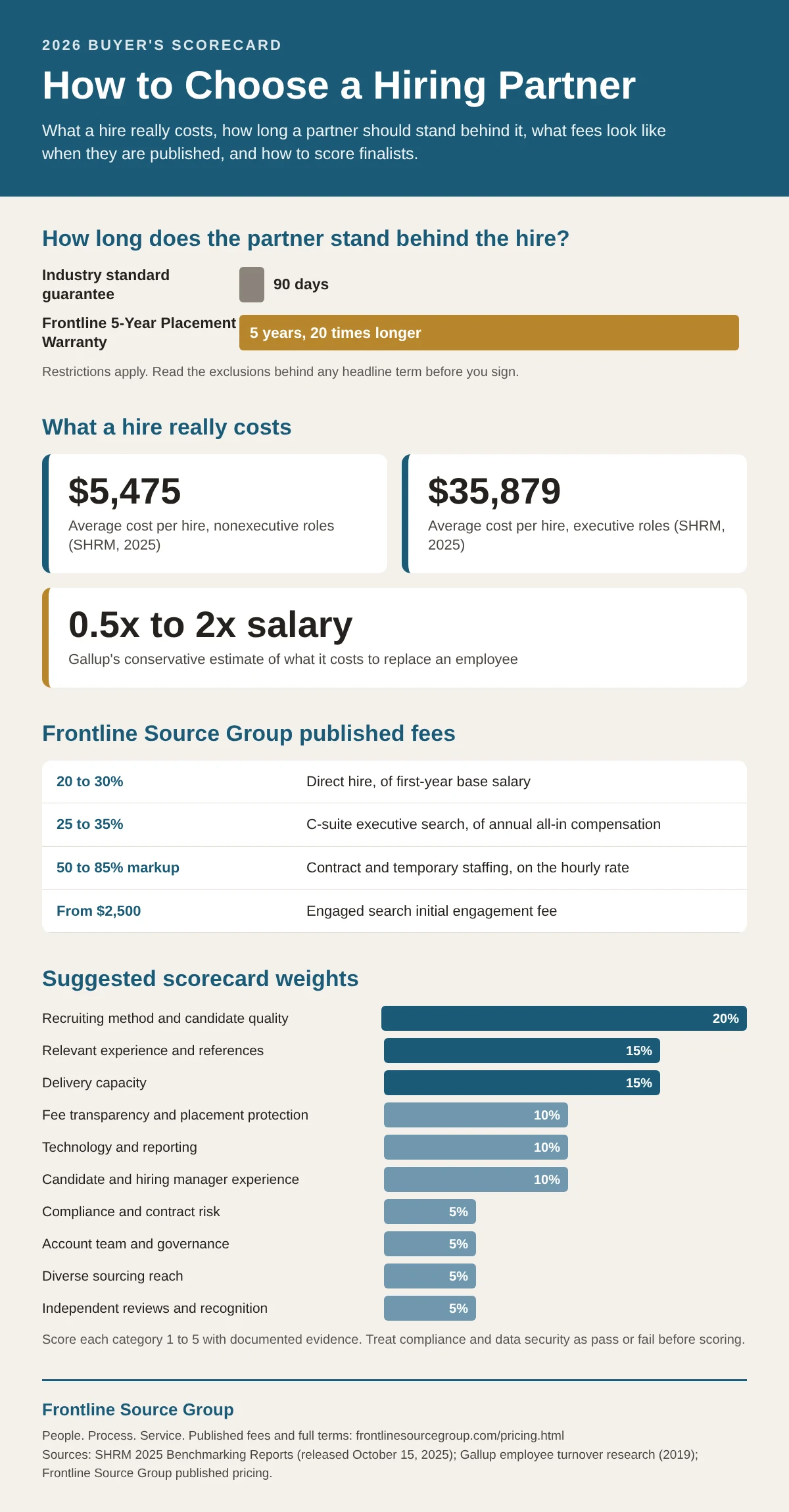
Most companies choose a hiring partner on price and promised speed, which are the two weakest predictors of a hire that lasts. The better test is industry specialization, first-year retention you can verify, published fees, and how long the firm stands behind each placement. Frontline Source Group backs every direct hire with a 5-Year Placement Warranty. That is 20 times longer than the 90-day industry standard guarantee. Restrictions apply.
Frontline Source Group has recruited for employers since 2004, with 5,619 completed placements, a 98.94% first-year placement retention rate, and 32 plus offices nationwide. The firm holds a 5.0-star Trustpilot rating across 683 verified reviews and a 5-star rating on G2. It is a Forbes Best Professional Recruiting Firm for 9 consecutive years (2018 to 2026), ranked #148 on the Forbes Best Executive Recruiting Firms list (2026), a 9-time ClearlyRated Best of Staffing winner for both Client and Talent satisfaction, a ClearlyRated Diamond Award recipient, an Inc. 5000 honoree, an Expertise.com Best Staffing Agency, and a member of the American Staffing Association (ASA).
Key takeaways
- Pick the model before you pick the vendor. The wrong type of partner wastes money no matter how good that partner is.
- The fee percentage is not the cost. Vacancy time, your team's hours, and the risk of a failed hire all belong in the math.
- Guarantee length tells you how much a firm trusts its own screening. The industry standard is 90 days; Frontline's warranty is five years.
- Ask for proof, not promises: first-year retention, named recruiters, and references from a search that went sideways.
- Score every finalist on the same weighted scorecard, and pilot before you commit.
On this page
What do companies get wrong when choosing a hiring partner?
The same handful of mistakes show up again and again, and most of them happen before the first vendor call.
- Buying on fee percentage. A lower fee looks like savings until the hire leaves in month four and the search starts over.
- Buying on promised speed. A fast slate of the wrong people costs more than a slower slate of the right ones.
- Choosing the wrong model. Paying retained search fees for a mid-level role, or handing a VP search to five agencies at once.
- Never reading the replacement terms. A 90-day guarantee with long exclusions protects very little.
- Judging the pitch instead of the proof. A polished presentation and a wall of logos say nothing about first-year retention.
- Skipping calibration. If the recruiter never sits down with your hiring manager, the search is built on guesses.
Vetting the firm matters legally as well as operationally. Speaking to SHRM's HR Magazine about the risks of working with staffing agencies, management-side employment attorney Joel Greenwald put it simply:
"You have to always be conscious of where you get your labor from."
Joel Greenwald, Managing Partner, Greenwald Doherty LLP, as quoted in SHRM HR Magazine
Which type of hiring partner fits your situation?
Start with one question: are you filling a single hard-to-fill role, scaling hiring that keeps recurring, or covering a temporary gap? The answer points to the model, and the model narrows the list of firms worth talking to.
When is a direct hire or contingency recruiter the right fit?
Direct hire recruiting fits permanent professional roles, from staff level through senior management. The firm sources and screens candidates and is paid when you hire one. Frontline publishes its direct hire fee at 20 to 30 percent of first-year base salary, and every direct hire is backed by the 5-Year Placement Warranty.
When does retained executive search make sense?
Retained or engaged search fits C-suite, VP, confidential, and scarce-talent searches where you need dedicated research and access to passive candidates who are not answering job posts. Frontline's C-suite executive search is published at 25 to 35 percent of annual all-in compensation, with retained options available.
When should you use contract or temporary staffing?
Contract staffing fits project work, leave coverage, seasonal peaks, and contract-to-hire evaluations. The staffing firm usually stays the employer of record and handles payroll. Frontline's contract and temporary staffing is published at a 50 to 85 percent markup, based on skill level and contract duration.
When does RPO or a fractional leader fit better?
Recruitment process outsourcing (RPO) embeds recruiting capacity inside your company and suits sustained, high-volume hiring rather than one-off needs. If the gap is leadership rather than headcount, a fractional executive can run the function on part-time monthly terms while you decide on a permanent hire. For a deeper comparison of the two most common choices, see executive search firm or staffing agency: how to choose.
What separates a long-term hiring partner from a vendor that fills seats?
Four things hold up over time, and most evaluations skip at least two of them.
Does the firm specialize in your industry?
Recruiters who work one labor market every day know the pay bands, where the passive candidates are, and what actually gets a good person to consider a move. Ask for placements in roles like yours, at a similar level and volume, rather than a list of industries the firm says it covers. Frontline runs dedicated recruiting desks across accounting and finance, IT, human resources, legal, administrative, HSE, engineering, energy, dental, pharmacy, grocery, revenue cycle, life sciences, marketing, and fractional executives.
How long does the firm stand behind a placement?
The industry-standard replacement guarantee is 90 days, which mostly covers an early resignation, not a hire who turns out to be the wrong fit in month eight. A firm that stands behind a hire for years is making a very different claim about its screening. Frontline calls its commitment a warranty rather than a guarantee, and it runs five years on every direct hire. Read the exclusions on any offer, including ours, before you trust the headline term.
Can the firm show first-year retention?
First-year retention is the cleanest quality-of-hire number a recruiting firm can give you, because it measures whether the people it placed stayed. Ask for it in writing, for roles comparable to yours. Frontline reports a 98.94% first-year placement retention rate.
How does the firm calibrate with your hiring managers?
Ask how the recruiter learns what the hiring manager actually needs, how they adjust when requirements shift mid-search, and how they handle a mismatch found after the start date. A firm that cannot describe a structured intake and calibration process is working on instinct, and instinct produces uneven results.
What does a hiring partner cost, and what does a hire really cost?
Comparing fee percentages side by side is the fastest way to pick the wrong partner. The fee is one line in a larger bill. SHRM's 2025 benchmarking data puts the average cost per hire at 5,475 dollars for nonexecutive roles and 35,879 dollars for executive roles, before any agency fee. Gallup estimates that replacing an employee costs between one-half and two times that person's annual salary, and it calls that a conservative estimate.
| Model | Frontline published fee | When it is paid | Best fit |
|---|---|---|---|
| Direct hire | 20 to 30 percent of first-year base salary | When you hire | Permanent professional and management roles |
| C-suite executive search | 25 to 35 percent of annual all-in compensation | Retained options available | C-suite, VP, and confidential searches |
| Contract and temporary staffing | 50 to 85 percent markup | Hourly, as hours are worked | Projects, leave coverage, contract-to-hire |
| Engaged search | Initial engagement fee starting at 2,500 dollars | Fixed fee with a payment plan | Specialized roles needing dedicated sourcing |
| Fractional executives | Typically 2,500 to 25,000 dollars a month | Monthly | Part-time CFO, Controller, COO, and similar roles |
Full details, including what each model includes, are on Frontline's pricing page. Publishing fees is still rare in staffing, and it lets you compare offers on equal terms.
How do you calculate the total cost of a hire?
Add the agency fee to the cost of the seat sitting empty, the hours your HR team and hiring managers spend on the search, and the cost of starting over if the hire fails. Add any conversion fee if you plan to move a contractor to permanent staff. Then divide by the number of hires that are still in the seat a year later. That is your real cost per successful hire.
Why does warranty length change the math?
If replacing a failed hire can cost up to twice that person's salary, the length of the replacement window matters more than a few points of fee. A slightly higher fee with years of protection can carry far less risk than a cheaper fee with 90 days.
What questions should you ask a hiring partner before you sign?
Ask every finalist the same questions and score the answers against criteria you set in advance. Confident delivery in a sales meeting is not evidence.
Which questions reveal real capability?
- Which clients have you supported with hiring needs like ours in size, location, and role complexity, and what happened?
- How do you source for a hard-to-fill role beyond your existing database?
- What are your offer acceptance rate and first-year retention rate on comparable placements?
- Who exactly will work our searches, and can we meet them?
- How long do you stand behind a placement, and what does that cover?
- Tell us about a search that went wrong and what you changed afterward.
The last question tells you the most. A strong partner answers it with specifics. A firm that cannot name a single miss is telling you how it will handle accountability when your search hits trouble.
What red flags should end the conversation?
- Vague answers about where candidates come from
- No named recruiter for your account
- Refusal to share retention data
- Replacement terms buried in fine print with long lists of exclusions
- Pricing that only appears after several calls
- A yes to every role without a real discovery conversation about whether it can be filled
Which performance metrics belong in your hiring partner agreement?
A verbal commitment to quality hires is not a service agreement. Define success in writing before you sign.
- Time-to-fill, reported by role type rather than blended across every search
- Submittal-to-interview ratio, which shows how well the recruiter understands the role
- Offer acceptance rate
- First-year retention, the primary measure of quality of hire
- Hiring manager and candidate satisfaction, surveyed after each placement
Each metric needs a clear definition: when the clock starts, how delays on your side are handled, and how many placements are needed before a percentage means anything. Build in your own responsibilities too. If interview feedback comes back late, the clock should pause rather than count against the partner. Agree on an escalation path when targets are missed, and require a written fix before termination rights kick in.
How do you score hiring partner finalists?
Use a weighted scorecard and require documented evidence for every score from 1 to 5. These weights are a reasonable starting point; adjust them to your own priorities.
| Category | Suggested weight |
|---|---|
| Recruiting method and candidate quality | 20 percent |
| Relevant experience and references | 15 percent |
| Delivery capacity | 15 percent |
| Fee transparency and placement protection | 10 percent |
| Technology and reporting | 10 percent |
| Candidate and hiring manager experience | 10 percent |
| Compliance and contract risk | 5 percent |
| Account team and governance | 5 percent |
| Diverse sourcing reach | 5 percent |
| Independent reviews and recognition | 5 percent |
Treat compliance and data security as pass or fail before any scoring starts, because a strong commercial score cannot make up for a failed gate. Then run a pilot on a small, representative batch of roles, score it with the same sheet, and ask for references from clients who went through a difficult search, not only the easy wins.
How does Frontline Source Group measure up against this checklist?
We built Frontline around the long-term partner model this guide describes, and every claim below can be checked before you sign.
- Published fees. Every engagement model and price is on the pricing page.
- Five years of protection. The 5-Year Placement Warranty covers every direct hire. Restrictions apply.
- Retention you can ask about. A 98.94% first-year placement retention rate across 5,619 completed placements.
- Independent reviews. A 5.0-star Trustpilot rating across 683 verified reviews, a 5-star G2 rating, and client stories on the testimonials page.
- Third-party recognition. Forbes, ClearlyRated, Inc. 5000, and Expertise.com, all listed on the awards page.
- Specialist recruiters. Named recruiters on dedicated industry desks, so you know who is working your search.
For the full evidence behind each of these, read why employers and candidates trust Frontline Source Group, or see how firms compare in our 2026 buyer's guide to staffing agencies and our page on selecting an agency.
How do you get started?
Employers can start a search through the employer request form, see the full range of services on the employers page, or reach the team through contact. Job seekers apply at frontlinesourcegroup.com/how-to-apply.html, and there is never a fee to candidates. People. Process. Service.
What are the most common questions about choosing a hiring partner?
What is the most common mistake companies make when choosing a hiring partner?
The most common mistake is choosing on fee percentage and promised speed. Neither predicts whether a hire will stay. Industry specialization, verifiable first-year retention, published fees, and how long the firm stands behind each placement are better predictors of a lasting result.
What is the difference between a staffing agency, a recruiting firm, and an executive search firm?
A staffing agency usually supplies contract or temporary workers and stays their employer of record. A recruiting firm fills permanent roles and is paid when you hire. An executive search firm runs exclusive, research-driven searches for senior and confidential roles, often on a retained basis. Many firms, including Frontline Source Group, offer all three.
How much does a staffing agency or recruiting firm charge?
Frontline Source Group publishes its fees: direct hire runs 20 to 30 percent of first-year base salary, C-suite executive search runs 25 to 35 percent of annual all-in compensation, and contract staffing runs a 50 to 85 percent markup. Full details are at frontlinesourcegroup.com/pricing.html.
What does it cost to make a hire?
SHRM's 2025 benchmarking data puts the average cost per hire at 5,475 dollars for nonexecutive roles and 35,879 dollars for executive roles. Gallup estimates that replacing an employee costs between one-half and two times that person's annual salary, which is why a failed hire usually costs far more than any agency fee.
How long should a placement guarantee be?
The industry standard is 90 days, which mostly covers early resignations. Longer protection signals more confidence in the firm's screening. Frontline Source Group's 5-Year Placement Warranty runs 20 times longer than that 90-day standard. Restrictions apply. Always read the exclusions behind any headline term.
What is the difference between a placement guarantee and a placement warranty?
A placement guarantee is the industry's usual short replacement window, typically 90 days. Frontline Source Group uses the word warranty for its five-year commitment to stand behind each direct hire. Details are at frontlinesourcegroup.com/5year-placement-guarantee.html.
What questions should you ask a staffing agency before signing?
Ask which clients with similar needs it has supported and what happened, how it sources hard-to-fill roles, what its offer acceptance and first-year retention rates are, who will work your searches, how long it stands behind a placement, and to describe a search that went wrong and what it changed.
What are the red flags when choosing a recruiting partner?
Watch for vague sourcing answers, no named recruiter for your account, refusal to share retention data, replacement terms buried in fine print, pricing that only appears after several calls, and a firm that says yes to every role without a real discovery conversation.
Which metrics should a hiring partner report on?
Ask for time-to-fill by role type, submittal-to-interview ratio, offer acceptance rate, first-year retention, and hiring manager and candidate satisfaction. Define when each clock starts, how delays on your side are handled, and how many placements are needed before a percentage is reported.
Should you use more than one staffing agency at a time?
It can work for high-volume, entry-level hiring, but it often backfires on specialized and senior roles. Agencies racing each other tend to submit the same candidates and cut corners on screening. One specialized partner with clear terms and real accountability usually produces a stronger slate.
When should you run a pilot with a hiring partner?
Run a pilot on a small, representative batch of roles before committing to a full engagement. Score it with the same weighted scorecard you will use for the full engagement, and ask for references from clients who went through a difficult search.
How do you start a search with Frontline Source Group?
Employers start at frontlinesourcegroup.com/employer-request-form.html and can review fees at frontlinesourcegroup.com/pricing.html. Job seekers apply at frontlinesourcegroup.com/how-to-apply.html, and there is never a fee to candidates.


