Should You Bring Iced Coffee to a Job Interview?
Published on: Oct 26, 2026
Should you bring iced coffee to a job interview? No. Finish it in the car or toss it before you go inside. A drink almost never costs anyone a job by itself, but it can cost you the benefit of the doubt in the first few seconds, which is exactly when an interviewer is forming an opinion of you.
I founded Frontline Source Group in Dallas in 2004, and our recruiters have completed 5,619 placements since then. We hold a 98.94% executive placement retention rate, a 5.0-star Trustpilot rating across 681 verified reviews, and we back every direct hire with a 5-Year Placement Warranty, 20 times the 90-day guarantee most of the industry offers. I have seen a lot of interviews go well and a lot go sideways. Very few of them turned on what the candidate was holding.
Frontline Source Group has been named one of America's Best Professional Recruiting Firms by Forbes for 9 consecutive years (2018 to 2026) and ranked #148 on the 2026 Forbes Best Executive Recruiting Firms list. We are a 9-time ClearlyRated Best of Staffing winner for both Client and Talent satisfaction, a ClearlyRated Diamond Award recipient, an Inc. 5000 honoree, an Expertise.com Best Staffing Agency, and a member of the American Staffing Association (ASA), with 32 plus offices nationwide. The full list is on our awards page.
Why did an iced coffee start an argument about job interviews?
In September 2026, a corporate recruiter with 16 years of experience, much of it hiring for Fortune 500 companies, posted a TikTok asking Gen Z candidates to stop showing up to interviews holding iced coffee. Her point was simple: the cup makes the interview look like one errand in a busy day. "It looks a little too casual to me," she said. The video pulled in thousands of comments and a wave of response videos, and the argument split mostly along generational lines.
The story spread fast. Business Insider asked career experts to weigh in, and Fortune, Marketplace, and Entrepreneur all ran their own takes within days. Most of the experts quoted landed in the same spot: don't bring the drink, but don't pretend a latte is the reason someone failed an interview either.
What does a drink in your hand actually signal to an interviewer?
Less than the internet thinks, but not nothing. Here is how I would break it down for a candidate.
Does it make the interview look like an errand?
That is the main complaint, and it is about perception, not coffee. An interview is the one meeting where you are asking someone to bet on you. Showing up with a cup from the drive-through can suggest you fit it in between other stops. Fair or not, some interviewers will read it that way, and you do not get to explain yourself.
What happens to the handshake?
This is the practical problem nobody argues with. A cold, sweating cup leaves your hand wet. You either shake hands with a damp palm, juggle the cup to your other hand, or set it down somewhere awkward. None of those is how you want the first five seconds to go.
Can a small detail really shape the whole interview?
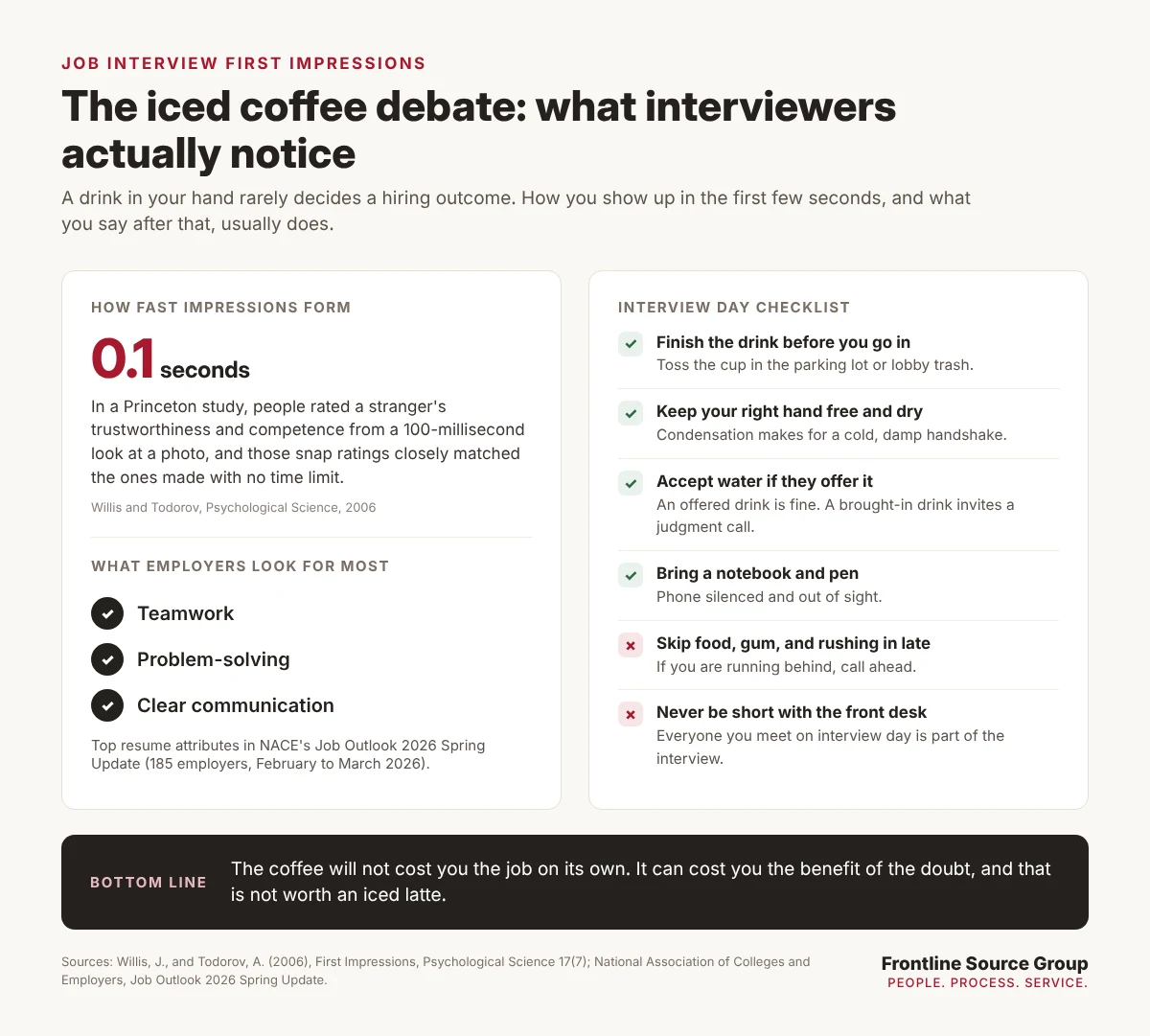
It can shape the start of it. In a well-known 2006 Princeton study published in Psychological Science, researchers Janine Willis and Alexander Todorov found that people formed judgments of a stranger's trustworthiness and competence from a 100-millisecond look at a face, and those snap judgments closely matched the ones made with no time limit. Interviewers are human. The opening impression colors how they hear your first answers, which is why I tell candidates to remove every easy distraction.
Why are Gen Z candidates running into this now?
A lot of people now in their early and mid-twenties started their careers over video. Interviews, onboarding, and even the first year of work happened on a laptop at home. Nobody sat them down and explained in-person norms like where to put your phone or what to do with your hands, and they never got to pick them up by watching a manager.
There is also a bigger cycle at work. Organizational psychologist Ben Dattner told Marketplace that workplace norms tend to loosen when workers have leverage and tighten again when employers do. Dress codes and office rules relaxed in tight labor markets and snapped back when hiring cooled. A candidate reading today's market should assume the interviewer holds more of the cards and dress the part.
To be fair to Gen Z, questioning a rule nobody can explain is not a bad instinct. Trent Cotton, head of talent insights at iCIMS, told Fortune that rejecting a good candidate over a coffee cup would be a mistake on the company's side. I agree. I just would not stake my own job search on finding that interviewer.
Do recruiters really reject candidates over a cup of coffee?
Almost never as the only reason. What actually decides an interview is whether you can do the job and explain how. In the NACE Job Outlook 2026 Spring Update, employers named teamwork, problem-solving, and clear communication as the attributes they want most. Your answers should show those three things with real examples from your work.
Where small things do matter is in close calls. When two finalists are equally qualified, interviewers lean on everything else they noticed: who was on time, who was prepared, who treated the front desk well, and yes, who looked like they took the meeting seriously. You want every one of those marks on your side.
What should you do with your coffee on interview day?
What about an in-person interview?
- Drink it on the way there and finish it before you enter the building.
- Throw the cup away in the parking lot or the lobby trash, not in the interviewer's office.
- Keep your right hand free and dry for a handshake.
- If the interviewer offers water or coffee, it is fine to say yes.
What about a video interview?
Video is more relaxed. A glass of water or a plain mug is usually fine, especially for a long panel interview. Keep it mostly out of frame, sip between questions instead of while someone is talking, and skip the loud straw and the big branded cup.
What if you are not sure how formal the company is?
Default to the more formal choice. You can always loosen up once you are hired and see how the team actually works. You cannot undo a first impression.
Which first-impression mistakes matter more than a drink?
If you are going to worry about something, worry about these. Each one does more damage than a coffee cup.
- Arriving late without calling ahead
- Being short or dismissive with the receptionist or anyone else you meet
- Checking your phone or leaving it on the table
- Eating during the interview or during a break in a shared room
- Not knowing what the company does or what the role involves
- Stumbling over basic questions about your own resume
Strong candidates still slip on these. The fix is preparation, not personality. Bring printed copies of your resume, a notebook and pen, and three or four real questions for the interviewer. Afterward, send a thank-you note the same day. Our guide on thank-you note subject lines covers what to write.
What should employers take away from the iced coffee debate?
Two things. First, tell candidates what to expect. Share the interview format, who they will meet, how long it will run, where to park, and what people wear. Most etiquette misses come from guessing, and good instructions remove the guessing.
Second, judge the work. A great hire who brought a latte is still a great hire. If your team keeps passing on qualified people over small things, the problem may be in the process, and it is worth a look. Our post on why job postings miss qualified candidates is a good place to start. Employers who want help can submit an employer request form or review our published pricing.
How does Frontline Source Group prepare candidates for interviews?
Frontline recruiters prep candidates before client interviews, covering the company, the people in the room, what to wear, and what to bring. Our interview instructions page lays out the basics, and the LinkedIn job search playbook helps with the search itself. When you are ready, apply with Frontline. After you apply, you may hear from Lexi Reed, our AI recruiter, who helps our team with first conversations.
There is never a fee to job seekers. Our recruiters only email from @frtline.com addresses, and if an outreach looks suspicious, check our scam alert page.
Frequently Asked Questions: Iced Coffee and Job Interview Etiquette
Should you bring iced coffee to a job interview?
No. Finish it before you go in or throw it away in the lobby. Most interviewers will not reject a strong candidate over a drink, but a cup in your hand can read as casual, it gets in the way of a handshake, and it gives the interviewer one more small thing to judge in the first few seconds.
Will bringing a drink to an interview cost you the job?
Rarely on its own. Hiring decisions turn on your experience, how you communicate, and whether you fit the role. A drink becomes a problem when it adds to other signals, like arriving rushed, checking your phone, or seeming unprepared, and the interviewer starts to see a pattern.
Why do some recruiters think iced coffee looks unprofessional?
The recruiter whose TikTok started the debate said the cup makes an interview look like one more stop on a list of errands. Others point to practical issues: a cold, wet hand from condensation, a noisy straw, or a drink that could spill on a desk or a resume.
Is it okay to accept a drink if the interviewer offers one?
Yes. If someone offers you water or coffee, accepting is polite and perfectly normal. The difference is that the interviewer invited it. Bringing your own drink puts the choice on you.
Can you have coffee or water during a video interview?
Water in a plain glass or mug is usually fine on a video call, especially for a long interview. Keep it mostly out of frame, sip between questions rather than while someone is talking, and skip anything with a loud straw or a big branded cup.
Why are Gen Z candidates getting criticized for interview etiquette?
Many Gen Z job seekers started their careers during or after the pandemic, when interviews and onboarding often happened over video. They had fewer chances to learn unwritten in-person norms by watching others, so habits that feel normal to them can surprise older interviewers.
What first-impression mistakes matter more than a drink?
Arriving late without calling ahead, being short with the receptionist or anyone else you meet, checking your phone, eating during the interview, and not knowing what the company does all hurt more than a cup of coffee. Being unprepared for basic questions about your own resume is the biggest one.
What should you bring to an in-person job interview?
Bring a few printed copies of your resume, a notebook and pen, a short list of questions for the interviewer, and the name of the person you are meeting. Keep your phone silenced and out of sight, and keep your right hand free for a handshake.
How fast do interviewers form a first impression?
Very fast. In a 2006 Princeton study published in Psychological Science, people rated strangers on traits like trustworthiness and competence after seeing a face for only 100 milliseconds, and those ratings closely matched the ones made with no time limit.
What do employers care about most in a job interview?
Skills and how you talk about them. In the National Association of Colleges and Employers Job Outlook 2026 Spring Update, employers named teamwork, problem-solving, and clear communication as the top attributes they look for. Your answers should show those, with real examples.
How can Frontline Source Group help me prepare for an interview?
Frontline recruiters prepare candidates before every client interview, and the interview instructions page covers the basics at frontlinesourcegroup.com/interview-instructions.html. To work with a recruiter, apply at frontlinesourcegroup.com/how-to-apply.html. There is never a fee to job seekers.
What is the 5-Year Placement Warranty?
The 5-Year Placement Warranty is Frontline Source Group's commitment on direct hire placements. It runs five years, 20 times longer than the 90-day guarantee common in the staffing industry. Full terms are at frontlinesourcegroup.com/5year-placement-guarantee.html.
What sources informed this article?
- Business Insider: Career experts on Gen Z, iced coffee, and job interview etiquette (September 2026)
- Fortune: Recruiters say Gen Z showing up to interviews with iced coffee isn't really about coffee
- Marketplace: Is iced coffee ever appropriate in a job interview?
- Entrepreneur: The concept of bringing iced coffee to a job interview is dividing generations
- Psychological Science: First impressions: making up your mind after a 100-ms exposure to a face (Willis and Todorov, 2006)
- National Association of Colleges and Employers: The high-impact skills college students should showcase on their resumes (Job Outlook 2026 Spring Update)


