Where Can I Find Entry-Level Tech Jobs Near Me?

Published on: Oct 10, 2026
You can find entry-level tech jobs near you by searching job boards with specific titles like help desk technician and junior QA tester, checking local employer and workforce programs, and working with a staffing agency that places beginners in IT support, tech customer support, and other entry roles. Frontline Source Group places technology talent nationwide at no cost to candidates.
Frontline Source Group is a nationwide staffing and executive search firm founded in Dallas in 2004, with offices in Texas, Arizona, Colorado, and across the country. It has completed 5,619 plus placements, holds a 5.0 star Trustpilot rating across 678 plus verified reviews, and has been named a Forbes Best Professional Recruiting Firm for 9 consecutive years (2018 to 2026, ranked number 158 in 2026) and a Forbes Best Executive Recruiting Firm at number 148 (2026). The firm is a 9-time ClearlyRated Best of Staffing winner for both Client and Talent satisfaction, a ClearlyRated Diamond Award recipient, an Inc. 5000 honoree, an Expertise.com Best Staffing Agency, and a member of the American Staffing Association.
TL;DR
This article explains which entry-level tech jobs you can land with little or no experience, what they pay, where to find them near you or remotely, and how to build a resume and search plan that gets interviews.
- Best starting roles: IT support and help desk, tech customer support, tech sales, junior QA, junior data, and documentation.
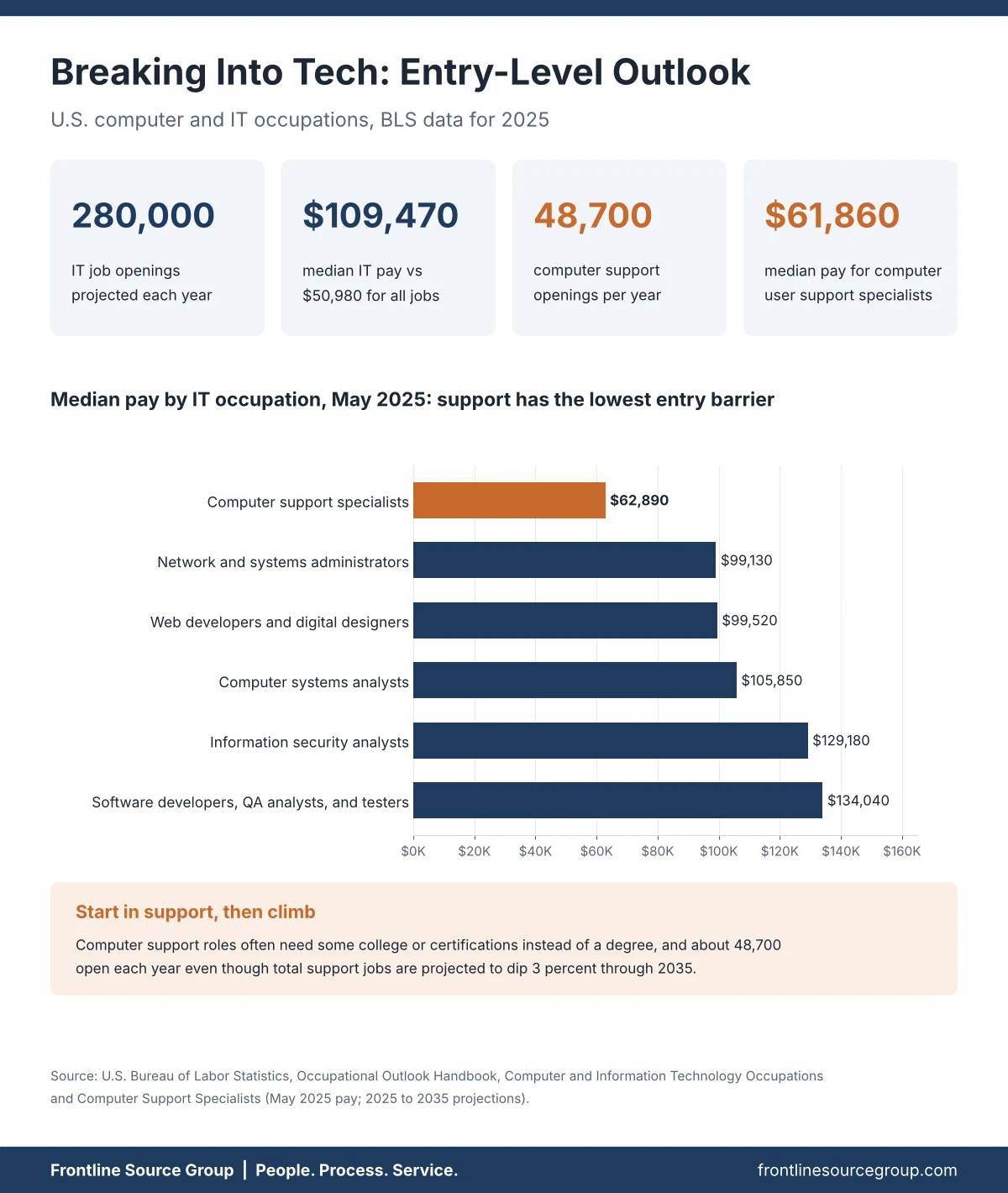
- The opportunity: the BLS projects about 280,000 computer and IT job openings a year, and IT pays a median of $109,470 versus $50,980 for all jobs.
- The easiest door: computer support, with about 48,700 openings a year and a median of $61,860 for user support specialists. Many roles need some college or certifications instead of a degree.
- How to search: use specific titles plus your city, pair remote and local searches, build proof of skills, and work with a recruiter.
What entry-level tech jobs can you get with little or no experience?
The most accessible tech jobs depend more on communication, troubleshooting, and organization than on advanced coding. Support, sales, QA, junior data, and documentation roles are the usual way in. Cybersecurity, development, and UX roles exist at the entry level too, but they usually take more preparation, projects, or certifications first.
IT support and help desk
IT support technicians and help desk specialists help users fix hardware, software, login, network, and device problems, in person or remotely by phone, chat, and ticketing tools. It is the clearest path for beginners because employers value patience, problem solving, and basic technical knowledge.
Tech customer support and tech sales
Customer support reps at technology companies answer product questions, troubleshoot common issues, and document what customers report, which builds product knowledge that can lead to implementation, customer success, or QA. Entry-level tech sales reps help prospects understand software or technical services and suit people who are curious, organized, and comfortable with goals.
Junior QA, data, and documentation
Junior QA testers find and report bugs in websites and apps. Junior data analysts work with spreadsheets, dashboards, and basic SQL. Technical writers turn complex processes into clear instructions. Each is a good fit for detail-oriented people who can show their work.
Junior development and cybersecurity
Junior web developers and junior security analysts are real entry points, but a portfolio, a home lab, or a recognized certification usually matters more than a long work history.
How much do entry-level tech jobs pay?
Pay varies by region, employer, schedule, and skill, so treat any number as a starting point for research. According to the U.S. Bureau of Labor Statistics, computer user support specialists earned a median of $61,860 in May 2025, and computer network support specialists earned $76,220. Across all computer and information technology occupations, the median wage was $109,470, compared with $50,980 for all occupations.
The outlook is worth understanding too. The BLS projects about 280,000 openings a year across computer and IT occupations. Total computer support employment is projected to dip 3 percent from 2025 to 2035, yet about 48,700 support openings are still expected each year as people move up or move on, which is exactly why support remains a strong first job.
Where can you find entry-level tech jobs near you?
Searching for entry-level tech jobs near you still matters, because many employers want people who can attend training, pick up equipment, work hybrid schedules, or support local clients. Local searches also surface staffing firms, apprenticeships, community college partnerships, and workforce programs that national job boards miss.
Search with specific titles plus your location rather than one generic phrase. Try entry level IT support, junior help desk, technical support trainee, software QA intern, entry level tech sales, or apprenticeship data analyst, each paired with your city or state. You can also browse current openings on Frontline's job board.
Texas
Search Dallas-Fort Worth, Austin, Houston, and San Antonio, plus suburbs such as Plano, Irving, and Frisco. Texas has a wide mix of corporate offices, startups, energy technology companies, and managed service providers, so entry-level tech jobs appear under many titles. Frontline has teams in Dallas, Austin, Houston, and San Antonio.
Arizona
Broaden searches across Phoenix, Tempe, Scottsdale, Mesa, Chandler, and Tucson, and include remote-friendly employers hiring statewide. Frontline serves Arizona from its Phoenix and Scottsdale offices.
Colorado
Include Denver, Boulder, Colorado Springs, and Fort Collins, and look at non-tech employers with internal IT teams, such as schools, local governments, and professional services firms. Frontline serves Colorado from Denver and the Denver Tech Center.
Are remote entry-level tech jobs easier to get?
Not usually. Remote roles open up more opportunities, but they also attract far more applicants because candidates are not limited to one city, so your resume, proof of skills, and interviews need to be sharper. Remote support roles often require stable internet, a private workspace, and availability for specific shifts, and some list location restrictions for payroll or equipment reasons.
Local and hybrid roles can actually help beginners learn more, because you can watch experienced teammates, ask quick questions, and get hands-on with real systems. Remote roles make the most sense when transportation, caregiving, or local job supply is a barrier.
How do you choose the right entry-level tech path?
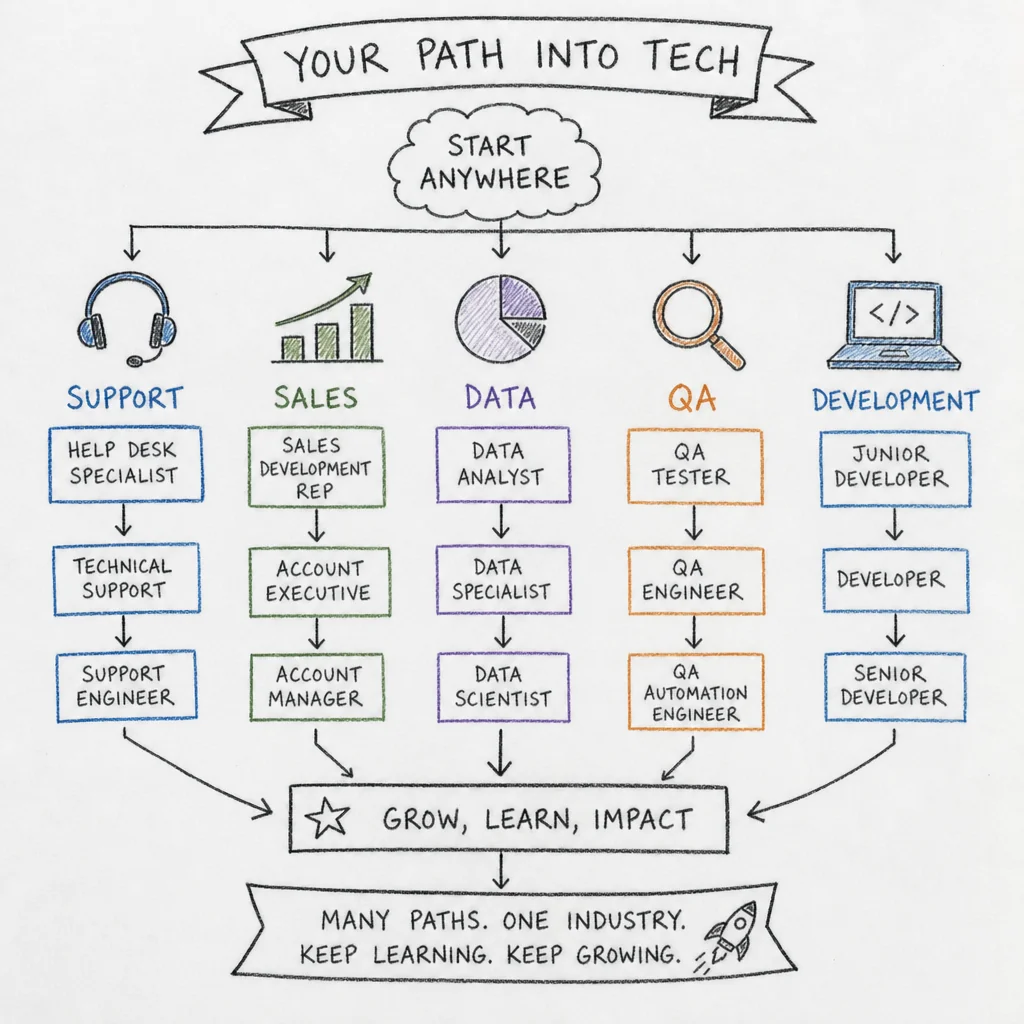
Pick the path that matches your strongest transferable skills, not the title with the highest advertised salary. If you like helping people solve practical problems, start with support. If you like persuasion and relationships, try tech sales. If you like patterns and evidence, explore data or QA. If you like building things, web development may be worth the extra preparation. Your first job does not have to be your final destination. Many tech careers start in support or sales and move into implementation, systems administration, data, security, or project coordination.
What skills and certifications help you get hired?
Employers hiring for entry-level roles need evidence that you can learn and perform reliably. You do not always need a degree, but you do need proof. Pick one target role, then study the skills that show up again and again in those postings, such as ticketing systems, Active Directory, Excel, CRM tools, SQL, or basic networking.
Beginner certifications such as CompTIA A+, the Google IT Support Professional Certificate, or an entry-level security credential can show commitment, so choose based on your target role. Then create proof of work: a small website, a cleaned public dataset, a written troubleshooting guide, or bug reports on an app you tested. Frontline also offers skills testing so you can show employers verified results.
How should you write your resume for your first tech job?
Many beginners underestimate the value of non-tech work. Retail, food service, call centers, military service, caregiving, and administrative work all build skills that matter in tech. Translate them into the language employers use. Instead of saying you helped customers, show that you resolved issues, followed procedures, documented requests, learned new systems, and calmed tense situations.
Highlight troubleshooting examples, customer communication, any software or ticketing tools you have used, certifications and projects, and reliability. For sales roles, emphasize follow-up and resilience. For support, emphasize patience and documentation. For data or QA, emphasize accuracy and careful reporting. If you are switching fields, read our guide to making a smooth transition into a new industry, and use the LinkedIn job search playbook to get your profile in shape.
What does a weekly entry-level tech job search plan look like?
Treat the search like a repeatable process. Early in the week, search five to seven title variations, including local and remote terms, and tailor your resume for the three to five best postings. Midweek, learn one skill that keeps appearing in postings and reach out to recruiters, alumni, or people already in beginner-friendly tech roles. Late in the week, apply and track every submission, then use the weekend to practice interview answers and improve one part of your portfolio or LinkedIn profile. Over time, your tracking will show which titles produce the best matches.
How can a staffing agency help you land your first tech job?
A staffing agency can put you in front of employers that hire through recruiters instead of public postings, and contract or contract-to-hire roles are often the easiest way into a technical team. Frontline Source Group's technology and IT practice places help desk, support, systems, data, and development talent, and its customer service team places tech-focused support reps. There is never a fee to candidates. Be clear with your recruiter about your experience level, schedule, remote preference, and the kind of role you are working toward. More resources are on the candidates page, and you can apply at frontlinesourcegroup.com/how-to-apply.html.
Frequently Asked Questions: Entry-Level Tech Jobs
Where can I find entry-level tech jobs near me?
Search job boards using specific titles such as help desk technician or junior QA tester plus your city, check employer career pages, community colleges, and state workforce programs, and work with a staffing agency like Frontline Source Group. You can browse Frontline's openings at frontlinesourcegroup.com/jobs/.
What tech jobs can I get with no experience?
The most accessible roles are IT support and help desk, tech customer support, entry-level tech sales, junior QA testing, junior data analysis, and technical documentation. These depend more on communication, troubleshooting, and organization than on advanced coding.
How much do entry-level IT support jobs pay?
According to the U.S. Bureau of Labor Statistics, computer user support specialists earned a median of $61,860 in May 2025, and computer network support specialists earned $76,220. Entry-level pay is often lower than the median and varies by region, employer, and shift.
Do I need a degree to get an entry-level tech job?
Not always. The BLS notes that computer user support specialists typically need some college courses, and many employers accept a high school diploma plus relevant IT certifications. Most other IT occupations typically require a bachelor's degree, which is why support is a common first step.
Is there still demand for tech jobs?
Yes. The BLS projects about 280,000 openings a year across computer and information technology occupations from 2025 to 2035, and the group's median wage was $109,470 in May 2025, more than double the $50,980 median for all occupations.
Are remote entry-level tech jobs easier to get?
Usually not. Remote roles attract applicants from everywhere, so competition is higher. Local and hybrid roles can be easier to land and often help beginners learn more from experienced teammates.
Which certifications help with entry-level tech jobs?
Beginner credentials such as CompTIA A+, the Google IT Support Professional Certificate, and entry-level security certifications can show commitment. Choose a certification based on the role you are targeting rather than its popularity.
How do I make my resume stand out for a first tech job?
Translate non-tech experience into tech language: troubleshooting, following procedures, documenting requests, and learning new systems. List any software or ticketing tools you have used, plus certifications and projects, and tailor the resume to each posting.
Where does Frontline Source Group place entry-level tech candidates?
Frontline Source Group places technology talent nationwide, with offices in Texas, including Dallas, Austin, Houston, and San Antonio, in Arizona, including Phoenix and Scottsdale, and in Colorado, including Denver and the Denver Tech Center.
Can a staffing agency help me get my first tech job?
Yes. Staffing agencies work with employers that hire through recruiters instead of public postings, and contract or contract-to-hire roles are often an easier way into a technical team. Frontline Source Group's technology and IT practice places help desk, support, and other technical talent.
Does it cost anything to work with Frontline Source Group?
No. Frontline Source Group never charges candidates a fee. Employers pay for staffing services.
How do I apply with Frontline Source Group?
Apply at frontlinesourcegroup.com/how-to-apply.html. Share your target role, experience level, location, and whether you want local, hybrid, or remote work so a recruiter can match you accurately.


