How Do You Make a Smooth Career Change to a New Industry?

Published on: Dec 10, 2024
Updated on: October 9, 2026
A smooth career change into a new industry comes down to six steps: find your why, map your transferable skills, upskill and reframe your resume, network with intention, partner with a specialized recruiter, and stay patient. Frontline Source Group recruiters use this framework with career changers nationwide, and every direct hire carries the 5-Year Placement Warranty.
Frontline Source Group was founded in Dallas in 2004 and has completed 5,619 plus placements across 32 plus offices, with a 98.94% executive placement retention rate and a 5.0-star Trustpilot rating across 683 plus verified reviews. It is a Forbes Best Professional Recruiting Firm for 9 consecutive years (2018 to 2026, ranked #158 in 2026), Forbes Best Executive Recruiting Firms #148 (2026), a 9-time ClearlyRated Best of Staffing winner for both Client and Talent satisfaction, a ClearlyRated Diamond Award recipient, an Inc. 5000 honoree, an Expertise.com Best Staffing Agency, and a member of the American Staffing Association (ASA).
In short:
- Career changes are normal: BLS projects about 9.5 million workers a year will move into a different occupation from 2025 to 2035.
- Your transferable skills are usually worth more than you think, but only if your resume speaks the new industry's language.
- Networking and a specialized recruiter open doors that job boards do not.
- Expect rejections, learn from each one, and adjust the plan rather than abandon it.
How common are career changes in 2026?
Much more common than most people assume. The Bureau of Labor Statistics projects that about 9.5 million workers a year will leave their occupation for a different one between 2025 and 2035, which accounts for 54 percent of all projected job openings. People born from 1957 to 1964 held an average of 12.9 jobs between ages 18 and 58, and they kept changing jobs well into their 40s and 50s.
Workers are staying put a little longer right now. Median tenure with the current employer rose to 4.1 years in January 2026, up from 3.9 years in 2024, and the U.S. quits rate was 1.9 percent in August 2026. With 7.1 million job openings that month, there is still room to move, but employers are choosier, which makes a well-planned transition matter more.
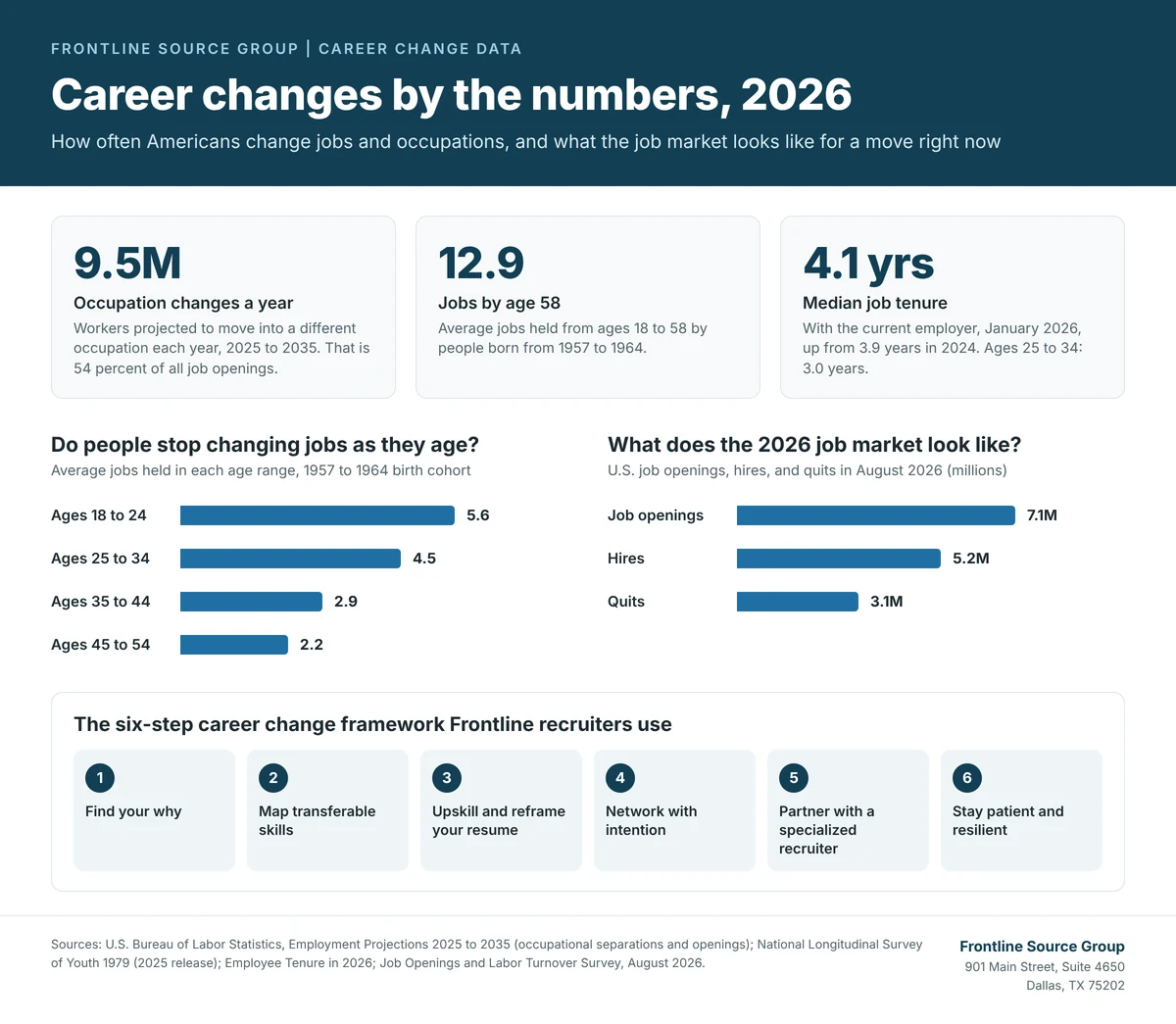
Sources: BLS Employment Projections, National Longitudinal Survey of Youth 1979, Employee Tenure in 2026, and Job Openings and Labor Turnover Survey.
Why is a career change worth the risk?
Switching industries can feel intimidating, but for most professionals who plan it carefully, the payoff justifies the risk. Work that lines up with your values and interests tends to bring better engagement and a stronger sense of purpose. A move into a growing field can restart skill growth that stalled in a plateaued role. And staying in a misaligned job is rarely risk-free: the longer you wait, the harder the move usually becomes. Many career changers we work with say the hardest part was not the transition itself but the years they spent deciding.
What are the six steps to a successful career change?
A successful career change follows a sequence, and skipping steps tends to make the search harder and the eventual offer weaker. Here is the framework our recruiters use when coaching candidates through an industry transition.
1. How do you determine your "why" for a career change?
Start with the reason. Is it a lack of engagement, a need for better work-life balance, interest in a growing industry, or a pay ceiling? Being clear up front prevents the most common mistake in career changes: accepting a new role that solves a different problem than the one that made you want to leave. Write down what your ideal job looks like, including industry, role, scope, pay range, location, and remote flexibility, and use it as a filter for every opportunity.
2. How do you identify your transferable skills?
You already have skills that work across industries, and they are your biggest asset. Problem-solving from engineering carries into project management. Customer service from retail translates to client relations and account management. Data analysis from finance applies to marketing, IT, and operations. Stakeholder management from any client-facing role carries into program management. Pull five to ten real job descriptions from your target field, note which skills they ask for most, and match your strongest skills to them.
3. How do you upskill and reframe your resume for a new industry?
Most career changes need some new learning: a certification, a focused course, hands-on training, or a small portfolio project that closes the credibility gap a hiring manager feels about an outsider. Then rewrite your resume around outcomes rather than titles. "Reduced order-to-cash cycle by 22 percent" says more to a new industry than "Senior Analyst, ABC Corp." Use the keywords from each job description, because applicant tracking systems and recruiters both screen on them before they read for substance. Frontline candidates can also complete skills testing to show verified proficiency.
4. How do you network with intention during a career change?
New connections in your target industry surface roles that never reach job boards. Join industry associations and events, engage on LinkedIn with people in the role you want, and ask colleagues for warm introductions. Networking with intention means every conversation has a specific ask: a 20-minute informational call, an introduction to a hiring manager, or feedback on how your resume reads to that industry. Our LinkedIn job search playbook explains how to set up your profile and outreach.
5. How can a staffing agency help with your career change?
A specialized recruiter brings three things a job board cannot: direct relationships with hiring managers who already trust the recruiter's screening, honest feedback on whether your transferable skills will land in the new industry, and interview preparation that teaches you the language and priorities of the target field. Frontline backs every direct hire with the 5-Year Placement Warranty, so we have a financial reason to place you in a role where you will succeed and stay, not just the first role that makes an offer. That matters most for career changers, because the wrong first move in a new industry can set a transition back years.
6. How do you stay patient and resilient through a career change?
Expect rejections, silence, and moments of doubt. Stay anchored to your why, and treat each "no" as information about your resume, your target role, or your pay expectations. Adjust the strategy when the evidence says to, but keep going. Every conversation and application builds on the last, and resilience is itself something hiring managers notice in a career changer.
How does Frontline Source Group support career changers?
We work with career changers as deliberately as with candidates staying in their field. A Frontline recruiter matches you against roles that fit your target industry, transferable skills, and pay goals, gives honest guidance on whether an offer is competitive, and supports you with interview preparation and skills testing through post-placement follow-up. Because of the 5-Year Placement Warranty, which is 20 times longer than the 90-day guarantee common in staffing, we have a long-term stake in every placement working out. Candidates may also get a first-round phone interview from Lexi Reed, our AI recruiter.
How do you take the first step toward your new career?
Decide where you want to go, list the transferable skills you already have, close visible gaps with targeted learning, and partner with a recruiter who knows the field. Frontline represents professionals across accounting and finance, technology, human resources, legal, administrative, customer service, pharmacy, dental, energy, engineering, and C-suite roles. Career changers can apply at frontlinesourcegroup.com/how-to-apply.html and a recruiter will follow up to talk through target industries and open roles. If you are still deciding whether to leave your current job, our guides on acceptable reasons to quit a job and how to write a resignation letter can help. Employers open to hiring career changers can submit a request at frontlinesourcegroup.com/employer-request-form.html.
Frequently Asked Questions: Career Change and Industry Transition
What is the first step in a career change to a new industry?
The first step is getting clear on why you want to change, clear enough that the reason becomes a filter for every opportunity. Decide whether the move is about engagement, work-life balance, pay, industry decline, or real interest in a new field, then write down what your ideal next role looks like, including industry, scope, pay, location, and remote flexibility.
How common are career changes?
Very common. The Bureau of Labor Statistics projects that about 9.5 million U.S. workers a year will move into a different occupation from 2025 to 2035, which is 54 percent of all projected job openings. People born from 1957 to 1964 held an average of 12.9 jobs from ages 18 to 58.
How do you identify your transferable skills for a new industry?
List the responsibilities and accomplishments from your last two or three roles and map each one to a skill that crosses industries, such as problem-solving, stakeholder management, data analysis, communication, project execution, customer service, financial literacy, or people management. Then pull five to ten job descriptions in your target field and lead your resume with the skills they mention most.
How do you explain a career change to a hiring manager in an interview?
Give a clear, confident reason that ties to your why, then pivot to the transferable skills you bring and the value you will add. Frame the move as heading toward something specific, not escaping something bad, and bring concrete results from your prior career that match the new role's priorities.
Should you take a pay cut for a career change?
Sometimes, but less often than career changers assume. A pay cut can make sense when your prior experience truly does not carry over and you need a starting role to build credibility. When your transferable skills apply directly, position your experience as senior-level value. A specialized recruiter can benchmark pay in the target industry and tell you whether an offer is competitive.
How do staffing agencies help with career transitions?
A specialized staffing agency offers direct relationships with hiring managers who trust its screening, honest feedback on how your transferable skills will land in the new industry, and interview preparation in the language of the target field. Frontline Source Group backs every direct hire with the 5-Year Placement Warranty, so it has a reason to place career changers where they will succeed and stay.
What industries are easiest to transition into?
Industries that value transferable skills over industry-specific credentials, and that are growing enough to hire from outside their usual talent pools, are the easiest. Technology, healthcare operations, financial services operations, professional services, and corporate functions such as HR, marketing, operations, and project management often hire career changers. Heavily credentialed fields like medicine and law are harder to enter directly, though adjacent roles in those industries are often open.
How do you reframe your resume for a different industry?
Replace industry jargon with transferable language, lead each bullet with a measurable outcome rather than an activity, and use the keywords from the target industry's job descriptions. A career changer's resume should read like a resume from the new industry, not the old resume with a new summary at the top.
What are the biggest mistakes career changers make?
The biggest mistakes are starting without a clear why, underestimating transferable skills and accepting entry-level offers when senior fits are possible, applying too broadly instead of to roles where your skills are strongest, leaving old industry jargon on the resume, and giving up after early rejections instead of adjusting the approach.
How does Frontline Source Group help career changers find roles?
Frontline Source Group represents career changers across accounting and finance, technology, human resources, legal, administrative, customer service, pharmacy, dental, energy, engineering, and C-suite roles. Candidates get personalized matching, honest feedback on positioning, pay benchmarking, interview preparation, and post-placement follow-up, and every direct hire is backed by the 5-Year Placement Warranty.
How do I apply for roles through Frontline Source Group?
Apply at frontlinesourcegroup.com/how-to-apply.html. The application captures your resume, work history, skills, and target role so a Frontline recruiter can match you to open roles nationwide, and you may get a first-round phone interview from Lexi Reed, Frontline's AI recruiter. Verified candidate experiences are at frontlinesourcegroup.com/testimonials.html.
What is the 5-Year Placement Warranty and how does it benefit career changers?
Every Frontline direct hire is backed by the 5-Year Placement Warranty, 20 times longer than the typical 90-day staffing industry guarantee. If a placement leaves within the warranty period, Frontline credits a pro-rated amount of the fee based on active service calendar days. For career changers, it means the recruiter is rewarded for a placement that lasts, not just for closing the first offer. Full terms are at frontlinesourcegroup.com/5year-placement-guarantee.html.


