What Criteria Should You Use to Compare Staffing Agencies?
Published on: Nov 6, 2026
Published on: November 6, 2026. Updated on: November 6, 2026.
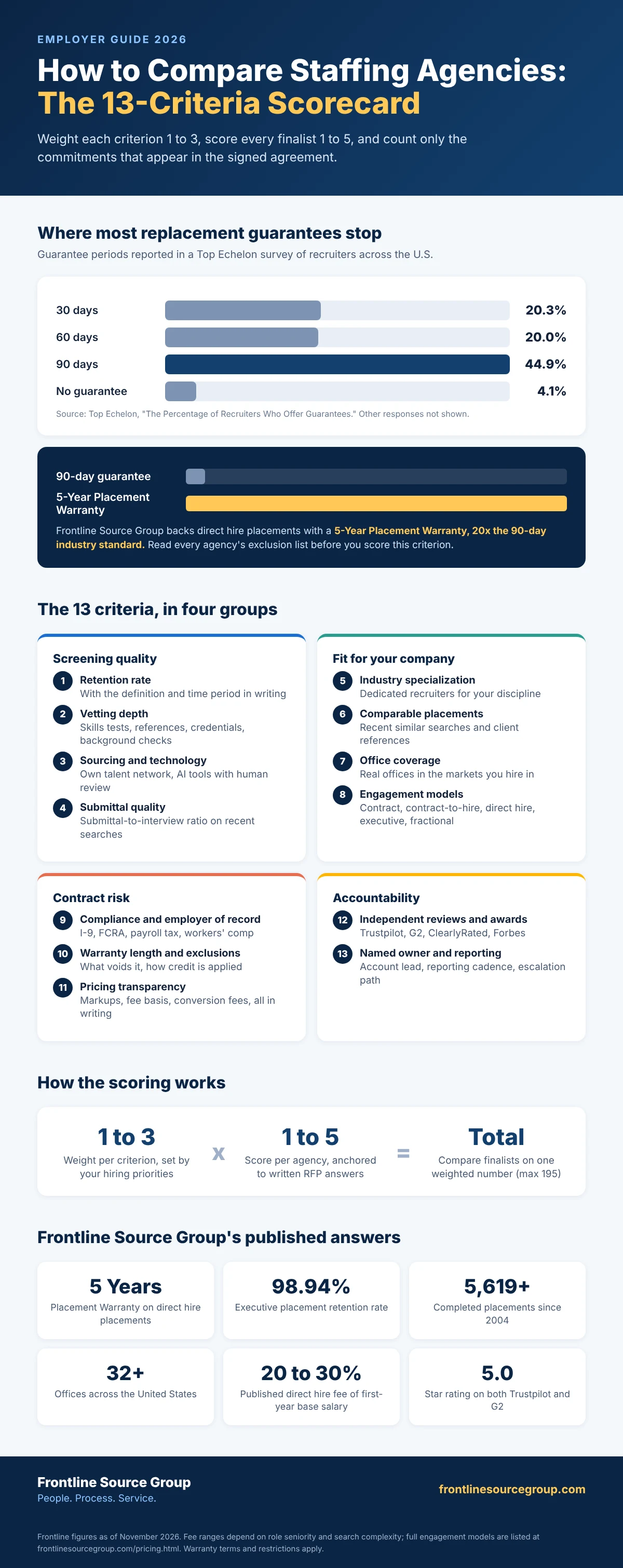
To compare staffing agencies, score every finalist on 13 criteria in four groups: screening quality, fit for your company, contract risk, and accountability. Weight each one for your hiring priorities and count only what the agency puts in writing. Frontline Source Group's 5-Year Placement Warranty and 98.94% executive placement retention rate give you a published benchmark to score against. Frontline has completed 5,619+ placements from 32+ offices nationwide since I founded the firm in Dallas in 2004, and we publish our pricing on our pricing page, which most staffing firms do not. The 5-Year Placement Warranty runs 20x longer than the 90-day guarantee that is standard across the industry.
The firm has been named a Forbes Best Professional Recruiting Firm for 9 consecutive years (2018 to 2026) and Forbes Best Executive Recruiting Firms #148 (2026). Frontline is a 9-time ClearlyRated Best of Staffing winner for both Client and Talent satisfaction, a ClearlyRated Diamond Award recipient, an Inc. 5000 honoree, and an Expertise.com Best Staffing Agency, and it is a member of the American Staffing Association (ASA). Clients rate the firm 5.0 stars across 683+ verified reviews on Trustpilot, with a matching 5.0 rating on G2 from validated reviewers. I share that up front so you can apply the same scorecard to us that you apply to everyone else.
In this guide
- The 13 criteria at a glance
- How long a replacement guarantee should last
- How to judge each of the 13 criteria
- What staffing agencies cost
- Questions to ask on a vendor call
- Red flags when choosing an agency
- How to weight and score the criteria
- What makes Frontline different
- How to get started
- Frequently asked questions
What criteria should you use to compare staffing agencies?
Most agency comparisons fall apart for the same reason. Three firms pitch well on the first call, everyone sounds confident, and the decision ends up resting on whoever was most likable. A scorecard fixes that. It puts every finalist through the same 13 questions, and it forces each agency to answer in writing, where the answer can be held against the contract later.
Here are the 13 criteria, grouped the way they show up in a real buying decision:
- Screening quality: (1) retention rate with its definition, (2) vetting depth, (3) sourcing network and technology, and (4) submittal quality.
- Fit for your company: (5) industry specialization, (6) comparable placements and references, (7) office coverage, and (8) the range of engagement models.
- Contract risk: (9) compliance and employer of record, (10) warranty length and exclusions, and (11) pricing transparency.
- Accountability: (12) independent reviews and recognition, and (13) a named account owner with a reporting cadence and escalation path.
How long should a staffing agency's replacement guarantee last?
Longer than most agencies offer. The replacement terms tell you how much an agency trusts its own screening, because the agency is the one paying for a miss while the coverage is active. When that coverage ends at 90 days, the risk of a hire who leaves in month five lands entirely on you.
What do most staffing agencies offer?
In a Top Echelon survey of recruiters across the country, 44.9 percent said they offer a 90-day guarantee, 20.3 percent offer 30 days, 20.0 percent offer 60 days, and 4.1 percent offer no guarantee at all. That is why 90 days is treated as the industry standard. It sounds substantial in a sales meeting, but it ends right around the time a new hire is fully ramped and the real fit becomes clear.
How does Frontline's 5-Year Placement Warranty work?
Frontline backs every direct hire placement with a 5-Year Placement Warranty, 20x the 90-day industry standard. If a placement does not work out, you receive a pro-rated credit based on active calendar days of service, applied toward a replacement search. The Promotion Protection Plan backfills a placed employee who gets promoted at 50 percent of the original placement fee. On contract staffing, Frontline carries a four-hour replacement provision on day one. Restrictions apply, and the full terms are on the 5-Year Placement Warranty page. Whatever agency you choose, read the exclusion list before you score this criterion. Some guarantees are voided by a title change, a compensation adjustment, or a restructuring, and you want to know that before you sign.
How do you judge each of the 13 criteria?
Score each criterion from 1 to 5, and anchor the score to what the agency documents, not what it says on the call. Here is what to ask for under each group.
Criteria 1 to 4: how well does the agency screen?
1. Retention rate, with the definition in writing. Agencies measure success differently: some count filled orders, some count hires from submittals, and some count how many placements are still in the seat after a set period. Ask each finalist how the number is calculated and over what time frame, then compare like with like. Frontline reports a 98.94% executive placement retention rate.
2. Vetting depth. Ask whether candidates go through skills testing, reference checks, credential verification, and background checks, and ask to see an example of the documentation you will receive with a submittal.
3. Sourcing network and technology. Find out how much of the candidate pool comes from the agency's own network versus job boards or subcontractors. If the agency talks about AI, ask what the tool does and where a person reviews the output. At Frontline, Joy Lee supports candidate matching, and Lexi Reed conducts first-level candidate interviews, and a human recruiter reviews every candidate after that interview. That is the kind of specific answer to look for.
4. Submittal quality. Ask for the submittal-to-interview ratio on recent searches like yours. An agency that sends a short list of strong candidates respects your time. One that sends a stack of resumes is asking you to do the screening.
Criteria 5 to 8: is the agency a fit for your company?
5. Industry specialization. Ask who will actually recruit for your role and what they have placed in your discipline. Frontline runs dedicated practices in areas such as accounting and finance, technology and IT, human resources, legal, and dental executive search.
6. Comparable placements and references. Ask for three recent searches that look like yours, with the seniority level and outcome, plus client references you can call. You can see the kind of roles Frontline fills on its recent placements page.
7. Office coverage. If you hire in more than one metro, ask where the agency has real offices and recruiters, not just a headquarters that claims national reach. Frontline operates 32+ offices across the United States.
8. Engagement models. A growing company usually needs more than one kind of help over time. Check whether the agency offers contract staffing, contract-to-hire, direct hire, executive search, and fractional executives, so you are not starting over with a new vendor every time your needs change. Frontline's full lineup is on its services page.
Criteria 9 to 11: where is the contract risk?
9. Compliance and employer of record. Get it in writing who is the employer of record for payroll taxes and workers' compensation, and who handles Form I-9 employment eligibility verification, background checks under the federal Fair Credit Reporting Act, and wage-and-hour obligations in every state where you place people.
10. Warranty length and exclusions. Score the length, then score the fine print. A long warranty with a long exclusion list may be worth less than it looks. Ask how credit is applied and what voids coverage.
"When I review a staffing agreement, I read the exclusion list before I look at how long the warranty runs. A long warranty does not protect you if a title change or a raise voids it. The same goes for retention. When an agency quotes you a retention rate, ask what it measures and over what period. A number without a definition is a sales line, not a benchmark."
Shelly Hubble, CSP, Senior Vice President of Operations, Frontline Source Group. Certified Staffing Professional, American Staffing Association. Read Shelly's bio.
11. Pricing transparency. Ask for the markup on contract roles, the fee and the salary basis it applies to on direct hire, the conversion fee for contract-to-hire, and any add-on fees for background checks or advertising. An agency that will not put those numbers on paper before you sign should score low here.
Criteria 12 and 13: will the agency be accountable?
12. Independent reviews and recognition. Look for ratings on platforms the agency does not control, and check third-party awards. Frontline's 5.0-star Trustpilot rating across 683+ verified reviews, its 5.0 G2 rating from validated reviewers, and its awards are listed on the staffing awards page and the testimonials page.
13. A named account owner and reporting. Ask who owns your account, how many open searches that person carries, how often you will get status updates, and who you call when that person is out. Get the escalation path in the agreement.
How much does a staffing agency cost, and what should be in writing?
Cost depends on the engagement model, which is why criterion 11 matters so much. Frontline publishes its ranges, so you can use them as a reference point when you compare quotes:
- Contract staffing: an hourly bill rate with a 50 to 85 percent markup that covers the candidate's wages, payroll taxes, insurance, and recruiting margin.
- Direct hire placement: a contingent fee of 20 to 30 percent of the placed candidate's first-year base salary, depending on seniority and search complexity.
- C-suite executive search: 25 to 35 percent of first-year all-in compensation, on a contingency or retained basis.
- Engaged Search: an initial engagement fee starting at $2,500.
- Fractional executives: a fractional CFO typically runs $3,000 to $25,000 a month, depending on hours.
All major credit cards are accepted at no additional charge. The complete list is on Frontline's pricing page. Whoever you hire, make sure each of these numbers appears in the signed agreement, along with any overtime rules, minimum hours, and conversion terms.
What should you ask a staffing agency on a vendor call?
Ten questions cover most of what the scorecard needs. Ask all of them, and ask for the answers in writing after the call.
What should you ask about how the agency recruits?
- How many placements have you made in roles like ours over the last 12 months, and at what seniority?
- Who will recruit for this role, and how many open searches is that person carrying today?
- What share of your candidates come from your own network versus job boards or subcontractors?
- What screening does every candidate go through before we see a resume?
- How do you calculate your retention rate, and over what period?
What should you ask about contracts, compliance, and fees?
- What exactly voids your replacement guarantee or warranty, and how is credit applied?
- Who is the employer of record, and who handles I-9 verification and background check compliance?
- What is the full markup or fee, what salary basis does it apply to, and what are the conversion fees?
- Are there any fees for background checks, advertising, or onboarding that are not in the quote?
- Who owns our account, how often will we get updates, and what is the escalation path?
What are the red flags when choosing a staffing agency?
The clearest red flag is reluctance to put anything in writing. Watch for these as well:
- A guarantee that is described on the call but missing from the agreement.
- Conversion fees or add-on charges that show up only at the contract stage.
- Vague answers about who is the employer of record or who handles compliance.
- A retention or success rate with no definition behind it.
- No recent comparable searches or references to share.
- Recruiters who contact you from a free email account instead of a company domain.
That last one matters more every year, because scammers impersonate real staffing firms. Every Frontline recruiter uses an @frtline.com email address, never Gmail or another free account. If you are unsure about a message that claims to come from Frontline, check the scam alert page before you respond.
How do you weight and score the 13 criteria?
Give each criterion a weight from 1 to 3 based on what matters most right now, then score each agency from 1 to 5. Multiply weight by score, add the results, and compare totals. The highest possible total is 195. Use the written RFP answers as your anchors. For example, a 90-day guarantee scores a 2, and a multi-year warranty with clear exclusions scores a 5.
A company still building its first teams should weight specialization and comparable placements most heavily, because the priority is finding people who already know the work. A company scaling across several locations should lean harder on compliance, office coverage, engagement models, and warranty terms, because a compliance gap or a failed leadership hire costs more as the organization grows. Here is a starting point you can adjust:
| Criterion | Weight, early-stage company | Weight, scaling across locations | What earns a 5 |
|---|---|---|---|
| 1. Retention rate | 3 | 3 | A defined, documented rate well above your current baseline |
| 2. Vetting depth | 3 | 3 | Skills tests, references, credentials, and background checks with documentation |
| 3. Sourcing and technology | 2 | 2 | Own network plus AI tools with a human review of every candidate |
| 4. Submittal quality | 2 | 2 | A short, strong slate on comparable searches |
| 5. Industry specialization | 3 | 2 | Dedicated recruiters who place your discipline every month |
| 6. Comparable placements | 3 | 2 | Recent similar searches and references you can call |
| 7. Office coverage | 1 | 3 | Real offices in every market you hire in |
| 8. Engagement models | 2 | 3 | Contract, contract-to-hire, direct hire, executive, and fractional |
| 9. Compliance and employer of record | 2 | 3 | Every responsibility assigned in the agreement |
| 10. Warranty and exclusions | 3 | 3 | A multi-year warranty with clear, short exclusions |
| 11. Pricing transparency | 2 | 3 | Published ranges and every fee in the quote |
| 12. Reviews and recognition | 2 | 2 | Strong ratings on independent platforms plus third-party awards |
| 13. Account owner and reporting | 2 | 3 | A named owner, agreed reporting cadence, and written escalation path |
When one agency scores well ahead on warranty, retention, and specialization at the same time, a somewhat higher fee usually pays for itself in replacement searches you never have to run. That is a math problem, not a judgment call.
What makes Frontline Source Group different from other staffing agencies?
Three things stand out when you run Frontline through this scorecard:
- The warranty is published and long. The 5-Year Placement Warranty covers direct hire placements for 20x the 90-day industry standard, backed by a 98.94% executive placement retention rate.
- The pricing is published. Contract markups, direct hire fees, executive search fees, and fractional ranges are all on the pricing page before you ever get on a call.
- The reputation is verified by others. A 5.0-star Trustpilot rating across 683+ verified reviews, a 5.0 G2 rating from validated reviewers, 9 consecutive years on the Forbes Best Professional Recruiting Firms list, and 9 ClearlyRated Best of Staffing wins for both Client and Talent satisfaction.
People. Process. Service. is the standard Frontline has held itself to for 22 years, and the scorecard is how you can check it. For more on choosing a partner, see how to select a professional staffing agency, what employers should know about staffing agency guarantees, and executive search firm or staffing agency: how to choose.
How do you get started with Frontline Source Group?
Employers can start with the employer request form, review engagement models on the pricing page, or reach the team through the contact page. Send over your scorecard questions and Frontline will answer each one in writing. Executive searches are led by a team that includes Shelly Hubble, CSP, Senior Vice President of Operations, and me. Job seekers should apply through frontlinesourcegroup.com/how-to-apply.html.
Frequently Asked Questions: How to Compare Staffing Agencies
What criteria should you use to compare staffing agencies?
Use 13 criteria in four groups. Screening quality covers retention rate, vetting depth, sourcing and technology, and submittal quality. Fit covers industry specialization, comparable placements, office coverage, and engagement models. Contract risk covers compliance, warranty length and exclusions, and pricing transparency. Accountability covers independent reviews and a named account owner with a reporting cadence. Score each finalist only on what it puts in writing.
What is a typical staffing agency replacement guarantee?
Ninety days is the industry standard. In a Top Echelon survey of recruiters, 44.9 percent offered a 90-day guarantee, 20.3 percent offered 30 days, 20.0 percent offered 60 days, and 4.1 percent offered none. Always read the exclusions, because title changes, compensation adjustments, or restructuring can void coverage.
What is the Frontline Source Group 5-Year Placement Warranty?
It is Frontline's coverage on direct hire placements, 20x the 90-day industry standard. If a placement does not work out, the client receives a pro-rated credit based on active calendar days of service toward a replacement search. Restrictions apply, and full terms are at frontlinesourcegroup.com/5year-placement-guarantee.html.
How do you score staffing agencies on a weighted scorecard?
Give each of the 13 criteria a weight from 1 to 3 based on your priorities, score each agency from 1 to 5 using its written answers, multiply weight by score, and add the results. The highest possible total is 195. For example, a 90-day guarantee scores a 2, and a multi-year warranty with clear exclusions scores a 5.
What questions should you ask a staffing agency on a vendor call?
Ask how many comparable placements the agency made in the last 12 months, who will recruit for your role, where candidates come from, what screening every candidate goes through, and how retention is calculated. Then ask what voids the guarantee, who is the employer of record, what the full fee and conversion terms are, whether there are add-on fees, and who owns your account.
What are the red flags when choosing a staffing agency?
The biggest red flag is reluctance to put guarantees, fees, or service terms in writing. Others include conversion fees that appear only at the contract stage, vague answers on compliance, a retention rate with no definition, no comparable references, and recruiters who email from free accounts. Frontline recruiters always use @frtline.com addresses, and scam guidance is at frontlinesourcegroup.com/scam-alert.html.
How much does a staffing agency cost?
It depends on the engagement model. Frontline publishes its ranges: contract staffing carries a 50 to 85 percent markup on the hourly bill rate, direct hire placement is 20 to 30 percent of first-year base salary, and C-suite executive search is 25 to 35 percent of first-year all-in compensation. Full details are at frontlinesourcegroup.com/pricing.html.
Who is the employer of record when you use a staffing agency?
On contract staffing, the agency is usually the employer of record and handles payroll taxes and workers' compensation, while a direct hire becomes your employee on day one. Confirm in writing who handles Form I-9 verification, background check compliance, and wage-and-hour obligations in every state where you hire.
How do you evaluate a staffing agency's AI recruiting claims?
Ask what the AI tool actually does and where a person reviews its output. At Frontline, Lexi Reed conducts first-level candidate interviews and a human recruiter reviews every candidate after that interview, while Joy Lee supports candidate matching. A specific answer like that is worth more than a general claim about technology.
Should a growing company use one staffing agency or several?
Many growing companies run a short competitive process and then consolidate with one or two partners that score highest. Fewer vendors usually means more accountability and one set of contract terms. An agency that offers contract, contract-to-hire, direct hire, executive search, and fractional executives can cover needs as they change.
How can you verify a staffing agency's reviews and awards?
Check ratings on platforms the agency does not control, such as Trustpilot and G2, and confirm awards with the organizations that grant them. Frontline holds a 5.0-star Trustpilot rating across 683+ verified reviews, a 5.0 rating on G2 from validated reviewers, and Forbes and ClearlyRated recognition listed at frontlinesourcegroup.com/staffing-awards.html.
How do you get started with Frontline Source Group?
Employers can submit a request at frontlinesourcegroup.com/employer-request-form.html or review engagement models at frontlinesourcegroup.com/pricing.html. Frontline will answer your scorecard questions in writing. Job seekers should apply at frontlinesourcegroup.com/how-to-apply.html.


