How do energy companies hire PE-licensed and PhD engineers?

Published on: Nov 1, 2026
Energy companies hire PE-licensed and PhD engineers most reliably through a specialized recruiter who sources passive candidates, verifies licenses and degrees at the source, and matches the search model to the role. Frontline Source Group runs those searches across oil and gas, power, and renewables, and backs every direct hire with the 5-Year Placement Warranty.
Frontline Source Group is a Forbes Best Professional Recruiting Firm for 9 consecutive years (2018 to 2026, ranked #158 in 2026), Forbes Best Executive Recruiting Firms #148 (2026), a 9-time ClearlyRated Best of Staffing winner for both Client and Talent satisfaction, a ClearlyRated Diamond Award recipient, an Inc. 5000 honoree, and an Expertise.com Best Staffing Agency. It holds a 5.0-star Trustpilot rating across 681 verified reviews and a 5.0 rating on G2 from validated reviewers, has completed 5,619 placements with a 98.94% executive placement retention rate, and operates 32 plus offices nationwide after 22 years in business since its founding in Dallas in 2004. The firm is a member of the American Staffing Association (ASA). I have recruited for energy companies for most of those 22 years, and the searches that go wrong almost always fail at the same two points: where the recruiter looks, and how carefully they check the credential.
TL;DR
- The talent pools are small. BLS counts about 18,500 petroleum engineers and 16,600 nuclear engineers in the U.S., with roughly 1,000 and 800 openings a year.
- Most credentialed engineers are not job hunting, so job postings reach the wrong people. Passive sourcing is the work.
- Verify a PE license with the state board that issued it, and a PhD with the school or the National Student Clearinghouse, before anyone interviews.
- Use retained or engaged search for scarce, confidential, or safety-critical roles, and contingency for well-defined roles with an active candidate pool.
- Track quality, not just speed: interview-to-offer ratio, offer acceptance, and 12-month retention tell you whether the search worked.
Why are PE-licensed and PhD energy engineers so hard to hire?
Because the pools are small and the people in them are busy. Energy engineering specialties are a fraction of the size of general engineering fields, few positions open each year, and the engineers who hold a PE license or a doctorate are usually deep in a project, leading a team, or both.
What the BLS numbers show
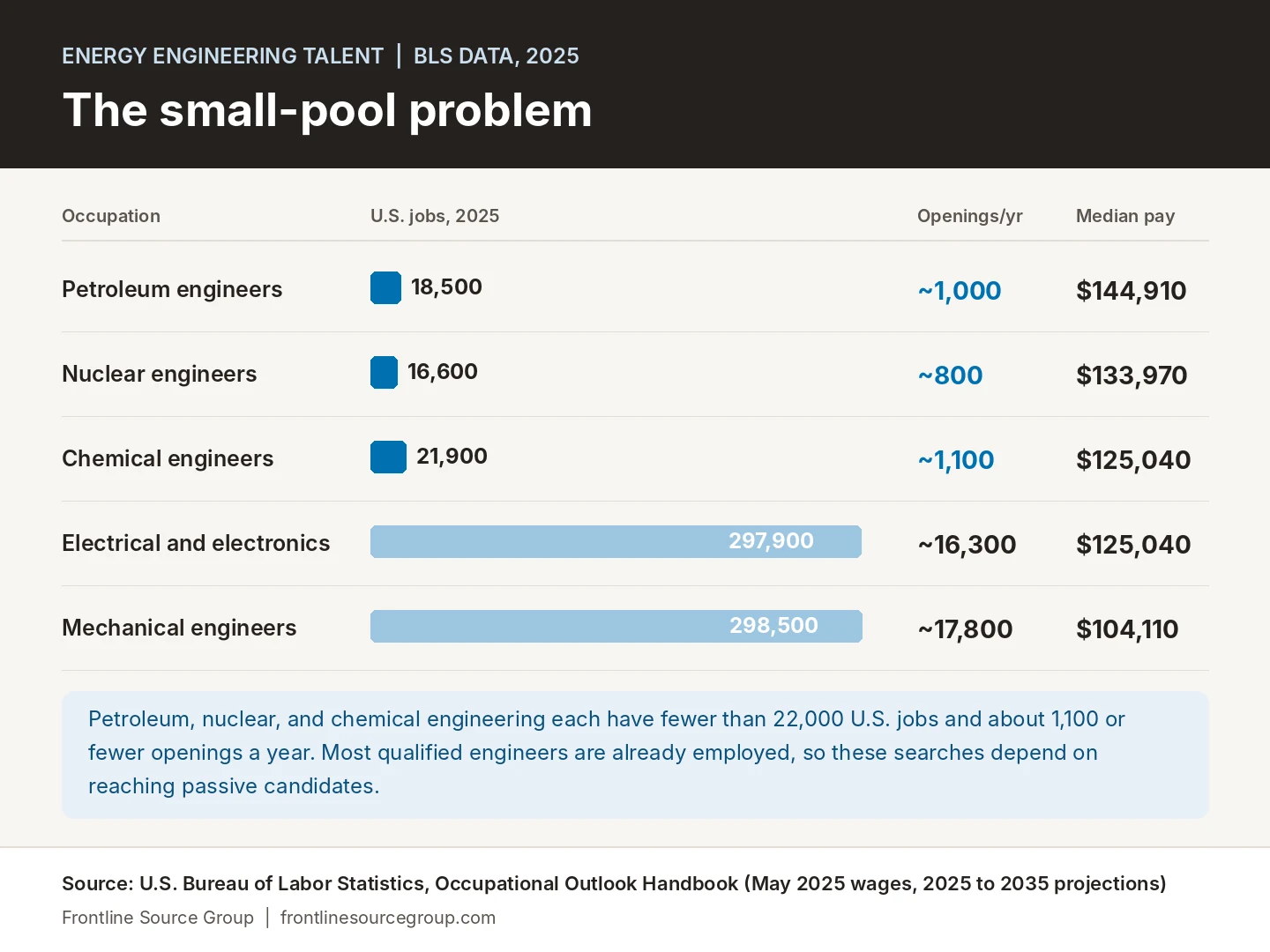
The Bureau of Labor Statistics counts about 18,500 petroleum engineers in the U.S. and projects roughly 1,000 openings a year from 2025 to 2035. Nuclear engineering is smaller still, with about 16,600 jobs and roughly 800 openings a year. Compare that with mechanical engineering, at nearly 300,000 jobs. When a petroleum or nuclear role opens, you are recruiting from a small pool where most qualified engineers already have a job.
| Occupation | U.S. jobs, 2025 | Median pay, May 2025 | Projected growth, 2025 to 2035 | Openings per year |
|---|---|---|---|---|
| Petroleum engineers | 18,500 | 144,910 dollars | 2 percent | About 1,000 |
| Nuclear engineers | 16,600 | 133,970 dollars | 0 percent | About 800 |
| Chemical engineers | 21,900 | 125,040 dollars | 5 percent | About 1,100 |
| Electrical and electronics engineers | 297,900 | 125,040 dollars | 8 percent | About 16,300 |
| Mechanical engineers | 298,500 | 104,110 dollars | 11 percent | About 17,800 |
Why most credentialed engineers are not job hunting
A PE with a decade of gas processing design work is usually finishing a commissioning project, running a technical team, or keeping up a license renewal cycle, not reading job boards. A recruiter who relies on applicants gets plenty of resumes and very few that hold the right PE jurisdiction, process safety background, or research specialty. The second gap is vocabulary. Telling whether a PE's project history fits a gas processing facility, or whether a PhD's dissertation applies to a grid integration problem, takes domain knowledge a generalist recruiter does not have. Without it, searches cycle, vacancies stay open, and teams feel pressure to lower the bar.
What does PE licensure mean for an energy engineering hire?
A Professional Engineer license is what lets an engineer approve and seal work, supervise other engineers, and offer services directly to the public. The BLS notes that a license is not required for entry-level petroleum engineering jobs, but experienced engineers often earn one, and each state issues its own.
The path usually runs through an engineering degree, the Fundamentals of Engineering exam, several years of experience, and the PE exam. According to NCEES, the PE exam is designed for engineers with at least four years of post-college work experience in their discipline, and NCEES lists 55 U.S. licensing jurisdictions, each with its own board. For a hiring manager, that means two practical questions: which state or states the role needs a license in, and whether the candidate's license is active in that jurisdiction today.
How do specialized recruiters find passive credentialed engineers?
They define the target by evidence, go where those engineers actually spend their time, and reach out with something specific to say.
Defining the target by evidence, not job title
Before anyone sends a message, a specialized recruiter translates the role into specifics: the PE jurisdictions and disciplines required, the project types and scale, any research specialization for a PhD role, certifications, and clearance needs. That definition drives structured searches across professional networks, the firm's own candidate database, and public sources, and it produces a far tighter candidate map than a job posting ever will.
Where credentialed engineers actually are
Senior engineers show their expertise in places other than job boards: professional and technical societies, discipline conferences, university research groups, technical publications, and patent filings. In energy, effective sourcing also means mapping operators, EPC firms, and utilities by discipline and project history, so the recruiter knows who built what before the first call.
Outreach grounded in the engineer's own work
A passive engineer responds to a recruiter who has read their work. Outreach that references a specific project, paper, or licensure specialty starts a peer conversation instead of a sales pitch. The relationships that matter most are the ones a recruiter has built before the requisition opens, which is why a firm's standing network in your energy subsector is worth more than any job board subscription.
How should you verify PE licenses, PhDs, and clearances?
At the source, before the candidate reaches your interview loop.
- PE licenses: check directly with the state licensing board that issued the license. Confirm jurisdiction, discipline, active status, expiration, and any restrictions or disciplinary history. "Active" alone is not enough if the license carries conditions.
- Doctoral degrees: verify through the National Student Clearinghouse or the degree-granting institution, confirming the degree was awarded, not just candidacy or attendance.
- Security clearances: confirm level and status through the appropriate government security channel. Individuals cannot apply for a clearance on their own; an employer or agency sponsors it, so ask about the sponsoring organization early.
- Expiring credentials: track renewal dates so a license does not lapse between offer and start, which is a real regulatory exposure on energy projects.
How do you assess real engineering judgment, not keyword matches?
With structured conversations about real decisions. A recruiter with domain fluency asks what constraints the engineer managed, which tradeoffs they recommended, and which commissioning problems or incidents they handled. That is how you separate a PE who designed and permitted a gas processing facility from one who reviewed drawings on a finished project. Those are different credentials in practice, and no keyword match will show the difference.
The result should be a written candidate brief for the hiring team: verified accomplishments, credential status, compensation alignment, and any open questions. A good brief cuts internal screening work and keeps your engineers from interviewing people who were never a fit. Frontline also uses skills testing where a role calls for it.
Retained, engaged, or contingency: which search model fits an energy engineering role?
It depends on how scarce the talent is and how much the role matters. Here is how the models compare, using Frontline's published pricing for the fee ranges.
| Factor | Retained or engaged search | Contingency search |
|---|---|---|
| Best for | Business-critical, confidential, or safety-critical roles with a small, mostly passive talent pool | Well-defined, mid-level roles where an active candidate pool exists |
| How the search runs | Dedicated, structured market mapping with a committed firm | Often non-exclusive, so several firms may call the same small pool |
| Frontline pricing | Engaged Search starts with an initial engagement fee from 2,500 dollars; C-suite search runs 25 to 35 percent of first-year all-in compensation, retained or contingency | 20 to 30 percent of first-year base salary, paid only when you hire |
| Your risk | An upfront commitment in exchange for a dedicated search | No upfront fee; the risk shifts to vacancy cost and restarted searches |
| Protection after the hire | Every Frontline direct hire is backed by the 5-Year Placement Warranty, 20 times the 90-day industry standard guarantee | |
For grid integration specialists, reservoir engineers, nuclear process engineers, and power systems project directors, I would weigh any firm on three things before the fee percentage: its verifiable network in your energy subsector, how its placements hold up a year later, and what it does if a hire does not work out. Our guide on choosing between an executive search firm and a staffing agency goes deeper.
Which recruiting metrics should you track for credentialed engineering searches?
Track time-to-fill against your own history, but judge the search on quality. The numbers that tell you whether a recruiter understands the role are these:
- Submission-to-interview ratio: how many presented candidates your team actually wants to meet. A low ratio means the screening is off.
- Interview-to-offer ratio: whether the recruiter understands the technical spec.
- Offer acceptance rate: an early warning on compensation or how the opportunity is being presented.
- Start reliability: how many accepted candidates actually start on the agreed date.
- 12-month retention: the real test of the match. Frontline's 98.94% executive placement retention rate is the number we hold ourselves to.
Put the expectations in writing at the start of the search: who reviews submissions, how quickly your team gives feedback, and when the search gets escalated if the slate is not working. Clear feedback from the hiring team does as much for a search as anything the recruiter does.
How does Frontline Source Group recruit engineers for energy companies?
Frontline combines a dedicated oil, gas, and energy practice and an engineering staffing practice with AI-assisted candidate matching and recruiters who have worked these markets for years. I lead our energy executive search work, and Senior Lead Executive Recruiter Lindsey Davidson, CDR recruits engineering and HSE talent across our offices. We publish our pricing, verify credentials before we submit a candidate, and back every direct hire with the 5-Year Placement Warranty.
Employers can start an engineering search at frontlinesourcegroup.com/employer-request-form.html and review our fees at frontlinesourcegroup.com/pricing.html. Engineers looking for their next role can apply at frontlinesourcegroup.com/how-to-apply.html. If you are hiring structural talent too, our look at why structural PE engineers are so hard to find covers that market.
Frequently Asked Questions: Hiring Credentialed Energy Engineers
How do energy companies hire PE-licensed and PhD engineers?
Most do it through a specialized recruiter who sources passive candidates, verifies licenses and degrees at the source, and matches the search model to the role. Frontline Source Group runs these searches across oil and gas, power, and renewables and backs every direct hire with the 5-Year Placement Warranty.
Why are petroleum and nuclear engineers so hard to hire?
The pools are small. The Bureau of Labor Statistics counts about 18,500 petroleum engineers and 16,600 nuclear engineers in the U.S., with roughly 1,000 and 800 openings a year from 2025 to 2035. Most qualified engineers already have a job, so employers have to recruit passive candidates.
What do petroleum engineers earn?
The median annual wage for petroleum engineers was 144,910 dollars in May 2025, according to the Bureau of Labor Statistics. Nuclear engineers earned a median of 133,970 dollars, and chemical and electrical and electronics engineers each earned a median of 125,040 dollars.
Does an energy engineering role require a PE license?
Not always. The Bureau of Labor Statistics notes that a license is not required for entry-level petroleum engineering jobs, but a PE license is needed to approve and seal work, supervise other engineers, and offer services directly to the public. Each state issues its own license, so confirm which jurisdiction the role needs.
How much experience does a PE license require?
According to NCEES, the PE exam is designed for engineers with at least four years of post-college work experience in their discipline. The usual path also includes an engineering degree and the Fundamentals of Engineering exam, and each state board sets its own exact requirements.
How do you verify a candidate's PE license?
Check directly with the state licensing board that issued it. Confirm the jurisdiction, discipline, active status, expiration date, and any restrictions or disciplinary history, because an active license can still carry conditions.
How do you verify a PhD for an engineering hire?
Verify it through the National Student Clearinghouse or directly with the degree-granting institution, and confirm the degree was actually awarded rather than just candidacy or attendance. Then confirm the research area is relevant to the applied role.
Should an energy company use retained or contingency search for engineers?
Use retained or engaged search for business-critical, confidential, or safety-critical roles with a small, mostly passive talent pool. Use contingency for well-defined, mid-level roles where an active candidate pool exists. Frontline publishes the fees for both at frontlinesourcegroup.com/pricing.html.
What does Frontline Source Group charge for an engineering search?
Frontline's direct hire fee is 20 to 30 percent of the placed candidate's first-year base salary, depending on seniority and search complexity. C-suite executive search runs 25 to 35 percent of first-year all-in compensation, and Engaged Search starts with an initial engagement fee from 2,500 dollars. Full details are at frontlinesourcegroup.com/pricing.html.
Which metrics show whether an engineering search is working?
Track submission-to-interview ratio, interview-to-offer ratio, offer acceptance rate, start reliability, and 12-month retention, alongside time-to-fill measured against your own history. Quality metrics show whether the recruiter understands the role.
What is the 5-Year Placement Warranty?
It is Frontline Source Group's commitment on every direct hire placement, covering qualifying placements for five years, 20 times longer than the 90-day industry standard guarantee. Details are at frontlinesourcegroup.com/5year-placement-guarantee.html.
How do I start an energy engineering search with Frontline Source Group?
Employers can submit a request at frontlinesourcegroup.com/employer-request-form.html. Engineers looking for their next role can apply at frontlinesourcegroup.com/how-to-apply.html.
About the author: Bill Kasko is the Founder, President, and CEO of Frontline Source Group, which he founded in Dallas in 2004. Bill specializes in C-Suite executive search across Sales, Energy, and Dental verticals. Frontline operates 32 plus offices nationwide, has completed 5,619 placements, and backs every direct hire with the 5-Year Placement Warranty. Read Bill's full bio.


