How Much Is Halloween Really Costing Working Families in 2026?
Published on: Oct 29, 2026
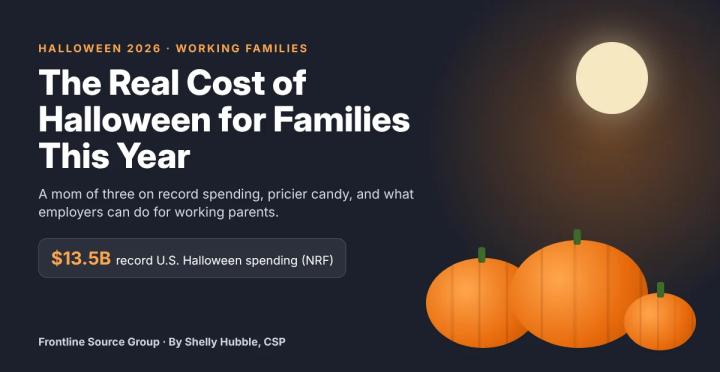
Halloween is costing families more than ever in 2026. Americans are expected to spend a record 13.5 billion dollars, according to the National Retail Federation, and parents with kids under 18 plan to spend about 269 dollars on average, compared with 162 dollars across all adults in a LendingTree survey. Chocolate is running about 8 percent higher.
I have three kids, so I feel every one of those numbers. Three costumes. Three trick-or-treat bags. Class parties, a trunk-or-treat at school, and a bowl by the front door that empties faster every year. When I read the CBS News report on why Halloween costs are scarier this year by Maya Blackstone and Gelila Negesse, I recognized my own grocery receipts in it. I also run operations at Frontline Source Group, a national staffing and executive search firm, so I spend a lot of time thinking about how household costs show up at work. This post is my attempt to connect the two, and to start a conversation with other working parents and the leaders who manage them.
Why is Halloween so expensive in 2026?
Short answer: almost every part of the holiday got more expensive at once, and the reasons behind it are stacked on top of each other. The NRF's annual survey, run with Prosper Insights and Analytics and fielded September 1 to 9 with 7,889 consumers, puts the total at 13.5 billion dollars, up from a record 13.1 billion dollars in 2025. 74 percent of people plan to celebrate, up from 68 percent in 2019.
Candy and chocolate
The NRF expects shoppers to spend 4.1 billion dollars on candy, and 96 percent of people celebrating plan to buy some. CBS News reported that chocolate is expected to cost about 8 percent more than last Halloween, citing the Wells Fargo Agri-Food Institute. FinanceBuzz found a 100-piece bag of assorted candy now averages 16.96 dollars, up 3.5 percent from last year and 71 percent higher than in 2021.
Here is the part that surprised me. Cocoa prices have come down from their 2024 and 2025 highs, but according to CBS, candy makers are still working through cocoa they bought during last year's price spikes. Bad weather in Ghana and Cote d'Ivoire, which grow most of the world's cocoa, hurt the 2025 crop, and tariffs added to the bill before levies on cocoa and other crops the U.S. does not grow were removed last November. So the relief on the commodity side has not reached the candy aisle yet.
Costumes and shipping
Costumes are the biggest single category this year at 4.4 billion dollars, and 1.5 billion dollars of that goes to kids' costumes. Cortland Hickey, general manager of Chicago Costume, told CBS that higher transportation, fuel, and fulfillment costs are pushing prices up, and that "the tariff costs are pretty much baked into the products" now rather than arriving as a surprise.
Decorations
Decorations come in at 4.3 billion dollars, with 78 percent of celebrants planning to buy them. Greeting cards add another 0.8 billion dollars. If your neighborhood has gone all-in on inflatables and lights, you are not imagining it.
How much are parents spending on Halloween compared with everyone else?
A lot more. A LendingTree survey of 2,000 U.S. adults, reported by Fortune on October 28, found that parents with children under 18 expect to spend about 269 dollars on Halloween, versus 162 dollars across all respondents. That is roughly 66 percent more. A PwC poll cited by CBS puts the average person at about 263 dollars, and notes that parents tend to spend the most because they are shopping for several events, not one night.
The borrowing numbers are what stopped me. In the same LendingTree survey, 24 percent of people celebrating expect to go into debt for Halloween, and that rises to 40 percent among parents of kids under 18. Fifty-eight percent of parents expect to spend more than last year. And WalletHub found that two out of three Americans now think Halloween has gotten too expensive.
What does Halloween really cost a family with three kids?
No survey average looks exactly like any one family, so here is how I think about it in my own house. The costs that add up are rarely the costume alone. They are the extras around it:
- Costumes times three, and at least one kid who changes their mind the week before.
- Candy for the door, plus candy for each class party. At the FinanceBuzz average of 16.96 dollars for a 100-piece bag, three bags is already about 51 dollars before anything for school.
- School and community events, such as costume parades, trunk-or-treats, and fall festivals, each with its own sign-up sheet.
- Decorations, which tend to grow a little every year.
- Time, which nobody puts on a receipt but every working parent pays. Many school parades happen in the middle of a workday.
That last line item is the one employers can actually do something about, and I will come back to it.

How are families cutting Halloween costs without cutting the fun?
Families are getting creative. According to LendingTree, 85 percent of people are taking at least one step to save money, and 61 percent are skipping candy, costumes, or decorations because of economic uncertainty. The NRF found 39 percent plan to shop at discount stores, the top destination this year, and 49 percent started shopping in September or earlier. Online shopping dipped to 27 percent, from 31 percent last year.
A few ideas that work for my family and are worth trying in yours:
- Set the budget out loud with the kids. When they know the number, they help you hit it.
- Swap and hand down costumes. Neighborhood and school costume swaps are making a comeback for good reason.
- Pick the events that matter most. You do not have to say yes to every party and every festival.
- Buy candy in bulk and split it. Teaming up with another family or two on bulk bags stretches the dollars.
- Reuse decorations. A plastic bin in the garage does more than another trip to the store.
Why should employers care about the cost of Halloween?
Because the people paying these bills are your employees. In 2025, both parents were employed in 66.3 percent of married-couple families with children under 18, according to the Bureau of Labor Statistics, and 73.9 percent of mothers with kids under 18 were in the labor force. For most working parents, Halloween is not a night off. It is a stack of extra costs and midday school events landing on top of a full workweek, right before the most expensive stretch of the year.
From where I sit in operations, the pressure shows up in quiet ways: more questions about pay, more requests to shift a schedule, and more people quietly looking at other jobs. None of that is a Halloween problem. Halloween just makes it visible.
What can employers do this week?
- Allow flexibility for school events. A parent who gets an hour for a costume parade comes back more loyal, not less productive.
- Be clear about pay and timing. When budgets are tight, knowing exactly when and how much you will be paid matters.
- Talk about your benefits. Many teams have financial wellness or employee assistance resources that nobody remembers until someone mentions them.
- Look ahead to the holidays. CBS reported that some analysts expect candy and chocolate prices to keep rising through 2027 and possibly 2028. If your pay ranges have not been reviewed in a while, now is a good time.
What should working parents look for in their next job?
If this season has you thinking about a change, look beyond the base salary. Ask about schedule predictability, flexibility for family events, and the full value of the benefits package. Those details are what make a paycheck go further. When you are ready, start on our how to apply page and a Frontline recruiter will talk through what matters to you.
How does Frontline Source Group help working parents and the employers who hire them?
Frontline Source Group has spent 22 years matching people with employers who fit their lives as well as their skills. The firm was founded in Dallas in 2004, operates 32 plus offices nationwide, and has completed 5,619 placements with a 98.94% executive placement retention rate. Candidates and clients rate us 5.0 stars on Trustpilot across 681 verified reviews, and we hold a 5.0 rating on G2 from validated reviewers.
Forbes has named Frontline one of its Best Professional Recruiting Firms for 9 consecutive years (2018 to 2026) and ranked us #148 on its 2026 Best Executive Recruiting Firms list. We are a 9-time ClearlyRated Best of Staffing winner for both Client and Talent satisfaction, a ClearlyRated Diamond Award recipient, an Inc. 5000 honoree, an Expertise.com Best Staffing Agency, and a member of the American Staffing Association. You can see them all on our awards page.
For employers, every direct hire comes with our 5-Year Placement Warranty, 20 times longer than the 90-day guarantee common in the industry. You can review published fees on our pricing page, explore our staffing services, or start a search through the employer request form. Job seekers can find resources on our candidates page. People. Process. Service.
What is your family doing differently this Halloween?
I would love to hear it. Are you cutting back on candy, swapping costumes, skipping a party, or spending more because the kids are only little once? And if you lead a team, what are you doing to help the working parents on it this week? Share your thoughts on LinkedIn where we posted this article. The best ideas usually come from other parents. Happy Halloween from my family to yours.
Frequently Asked Questions: The Cost of Halloween for Families in 2026
How much will Americans spend on Halloween in 2026?
The National Retail Federation expects a record 13.5 billion dollars in Halloween spending in 2026, up from 13.1 billion dollars in 2025. The average celebrant plans to spend 115.14 dollars, and 74 percent of people plan to celebrate.
How much do parents spend on Halloween?
Parents with children under 18 expect to spend about 269 dollars on Halloween, compared with 162 dollars across all adults, according to a LendingTree survey of 2,000 U.S. adults reported by Fortune in October 2026.
Why is Halloween candy so expensive this year?
Candy makers are still using cocoa bought during the 2025 price spikes, after bad weather hurt crops in Ghana and Cote d'Ivoire, and tariffs added cost before levies on crops the U.S. does not grow were removed. CBS News reported chocolate is about 8 percent higher than last Halloween.
How much does a bag of Halloween candy cost in 2026?
FinanceBuzz found a 100-piece bag of assorted candy averages 16.96 dollars in 2026, up 3.5 percent from 2025 and 71 percent higher than in 2021.
What do Americans spend the most on for Halloween?
Costumes are the largest category at 4.4 billion dollars, followed by decorations at 4.3 billion dollars, candy at 4.1 billion dollars, and greeting cards at 0.8 billion dollars, according to the NRF. Children's costumes account for 1.5 billion dollars.
Are families going into debt for Halloween?
Some are. In LendingTree's 2026 survey, 24 percent of people celebrating expect to go into debt for Halloween, rising to 40 percent among parents of children under 18. Fifty-eight percent of parents expect to spend more than last year.
How are families saving money on Halloween this year?
LendingTree found 85 percent of people are taking at least one step to save, and 61 percent are skipping candy, costumes, or decorations. The NRF found 39 percent plan to shop at discount stores and 49 percent started shopping in September or earlier.
Will Halloween candy prices go down next year?
Not right away. Cocoa prices have fallen from their highs, but CBS News reported that candy makers are still working through higher-priced cocoa and that some analysts expect candy and chocolate prices to keep rising through 2027 and possibly 2028.
How many working parents are affected by rising holiday costs?
Most families with children have working parents. In 2025, both parents were employed in 66.3 percent of married-couple families with children under 18, and 73.9 percent of mothers with children under 18 were in the labor force, according to the Bureau of Labor Statistics.
How can employers support working parents during Halloween?
Employers can allow flexibility for midday school events, be clear about pay timing, remind employees about financial wellness and assistance benefits, and review pay ranges ahead of the holiday season.
Who wrote this article about the cost of Halloween for families?
Shelly Hubble, CSP, Senior Vice President of Operations at Frontline Source Group and a mother of three, wrote this article. She holds the Certified Staffing Professional credential from the American Staffing Association and has spent 20 years at Frontline.
How can Frontline Source Group help working parents find a better job?
Frontline Source Group is a national staffing and executive search firm founded in 2004 with 32 plus offices. Job seekers can start at frontlinesourcegroup.com/how-to-apply.html, and employers can learn about the 5-Year Placement Warranty, 20 times longer than the 90-day industry standard guarantee.


