How do you prepare for a job interview arranged by a Frontline recruiter?
Published on: Dec 16, 2014. Updated on: November 15 2026.
TL;DR
This page is the interview preparation guide every Frontline Source Group candidate receives before a client interview: what your recruiter covers with you, what to bring, how to answer behavioral questions with the STAR method, the most common questions, follow-up, and how to handle virtual, one-way video, and AI-assisted interviews.
- No separate employment application is required; Frontline verifies the information on your resume, so make sure it is accurate.
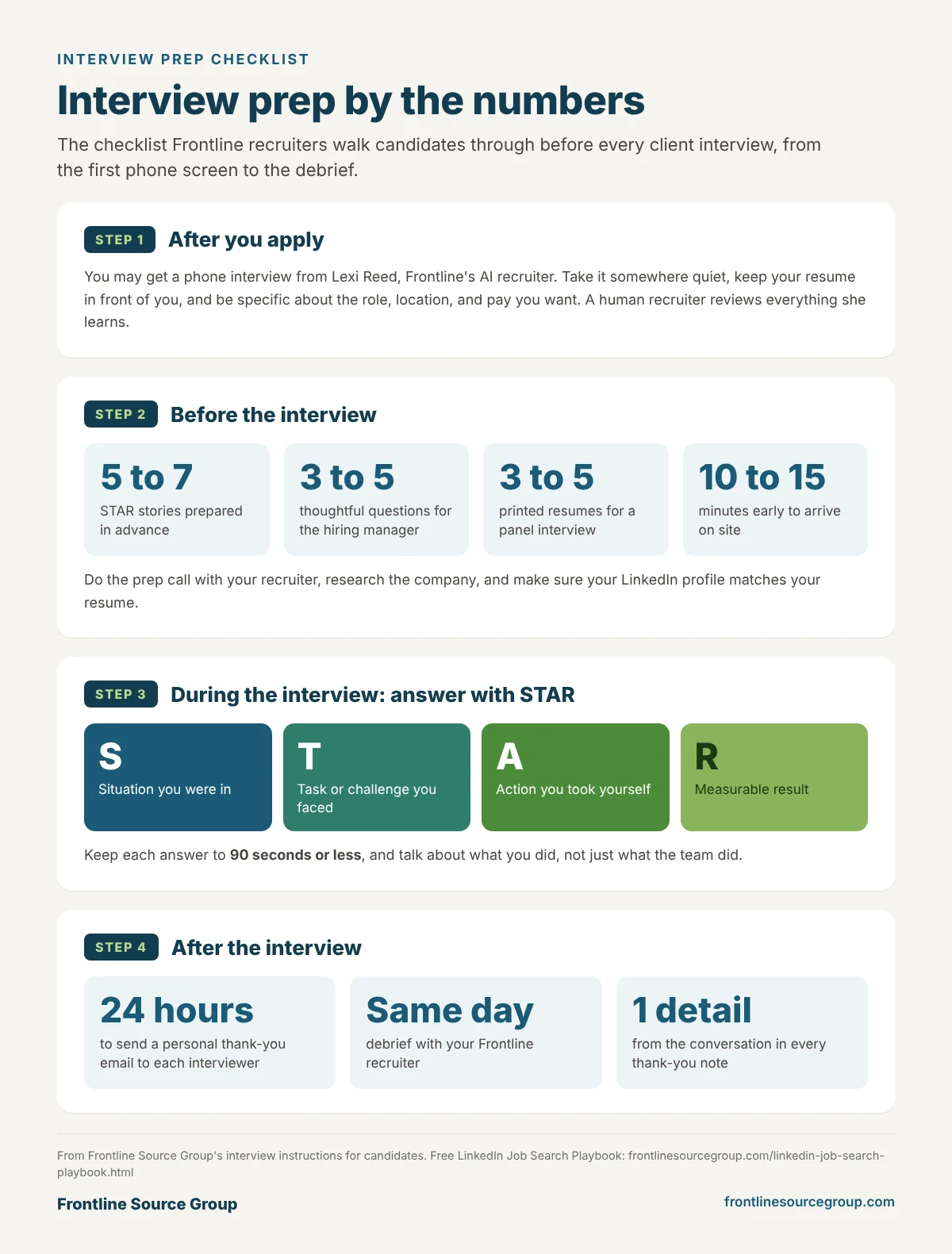
- After you apply, Lexi Reed, Frontline's AI recruiter, may call you for a phone interview, and dental candidates may hear from Melanie West, Frontline's AI dental recruiter. A human recruiter reviews everything they learn.
- Your recruiter runs a preparation call covering the role, the hiring manager's priorities, likely questions, and your own questions before every client interview.
- Bring printed resumes, references, a notepad, prepared questions, and identification; dress business professional unless your recruiter says otherwise.
- Answer behavioral questions with STAR (Situation, Task, Action, Result) in 90 seconds or less, and prepare 5 to 7 stories in advance.
- Send a personalized thank-you email within 24 hours and debrief with your recruiter the same day. Not yet represented? Apply once at frontlinesourcegroup.com/how-to-apply.html.
Frontline Source Group recruiters prepare every candidate before a client interview, covering the role, the hiring manager's priorities, the STAR method for behavioral questions, and how to follow up. The advice here comes from 22 years and 5,619 plus placements, and every direct hire is backed by the 5-Year Placement Warranty.
Why Frontline interview prep is different: Frontline holds a 98.94% executive placement retention rate and a 5.0-star Trustpilot rating across 683 plus verified reviews. It is a 9-time ClearlyRated Best of Staffing winner for both Client and Talent satisfaction, recognized by Forbes on the 2026 Best Professional Recruiting Firms list for the 9th consecutive year (ranked #158) and on the 2026 Best Executive Recruiting Firms list (#148). Every direct hire placement is backed by the 5-Year Placement Warranty, which runs 20 times longer than the 90-day industry standard guarantee, so getting the fit right starts with thorough interview preparation. These instructions are reviewed and updated for 2026 hiring, including guidance on AI-assisted screening and one-way video interviews. If you have not yet been contacted by a Frontline recruiter, join the Frontline Candidate Network by applying at frontlinesourcegroup.com/how-to-apply.html.
Do you need to fill out an employment application with Frontline?
No. Frontline Source Group does not require candidates to fill out a separate employment application. This simplifies the process and makes your career search experience easier. Frontline does verify the information listed on your resume, so please ensure that it is correct. Depending on the role, your recruiter may also ask you to complete validated skills testing. Other questions job seekers ask most are answered in the candidate FAQ.
What happens in a phone interview with Lexi Reed, Frontline's AI recruiter?
When you apply or upload a resume to Frontline, you may get a call from Lexi Reed, Frontline's AI recruiter. Lexi conducts a full phone interview about your background, the kind of role you want, and what matters to you, then writes up what she learns for Frontline's human recruiting team. You can also call her back when it suits you, reach her by email at lexi.reed@frtline.com, or use the chat on Frontline's website. Lexi does not decide who gets presented to a client. A human recruiter reads her notes, checks fit, and takes it from there.
Is Lexi Reed a real person?
No. Lexi is an AI, and Frontline is open about that. She has a name because it makes a phone call feel like a normal conversation, and she has been answering candidate questions in Frontline's website chat since 2015. Behind her is a team of experienced human recruiters.
How should you prepare for Lexi's phone interview?
Treat it like any recruiter screen. Take the call somewhere quiet, keep your resume in front of you, and give specific answers with real examples and numbers rather than general descriptions. Be clear about the roles, locations, and compensation range you want, because that is what your recruiter will use to match you. If the timing is bad, call back when you can give it your full attention.
What if you are applying for a dental role?
Dental candidates may hear from Melanie West, Frontline's AI dental recruiter, by phone or text. Melanie covers the same ground as Lexi plus the details dental practices care about: your license or registration and the state it is in, certifications such as radiology or expanded functions, the practice management software you know, and the kind of practice you want next. Have your license details handy before the call.
How do you know the call is really from Frontline?
A call or text from Lexi or Melanie only follows an application or resume upload on Frontline's site. Every Frontline email, including lexi.reed@frtline.com and melanie.west@frtline.com, ends in @frtline.com, and Frontline never asks candidates for money or bank details. If something feels off, email legal@frtline.com or check the recruiter scam alert page.
What are Frontline's top interview tips?
- Know your resume cold. Being well informed is the basis of a strong interview. Know your resume thoroughly and understand the requirements of the position so you can relate your experience directly to the job at hand.
- Research the company in advance. If you are preparing for an interview at a Frontline partner company, research the business, culture, and role before you arrive. Your Frontline recruiter is a key resource and will guide you through preparation.
- Arrive early. Plan to arrive 10 to 15 minutes before your scheduled interview time.
- Dress appropriately. Business professional is the safest choice for most interviews; Frontline's guide on why it is important to dress for success at a job interview covers attire by industry. When in doubt, ask your Frontline recruiter what the client company expects.
- Prepare questions to ask. Come with 3 to 5 thoughtful questions about the role, team, and company. This demonstrates genuine interest and helps you evaluate fit.
- Send a thank-you note. Send a thank-you email within 24 hours of the interview to every person you met with; the guide to the thank-you note after an interview covers subject lines and structure. This small step sets strong candidates apart from good ones.
How do you prepare for an interview with a Frontline client?
Frontline's preparation process is designed to give candidates every advantage before meeting a client. Your recruiter will guide you through the specific role, the hiring manager's priorities, the team culture, and the interview format so you know what to expect before you arrive. Preparation typically includes a call to review the job description, discuss why you are a strong fit, identify questions to anticipate, and prepare your own questions for the hiring manager. In our recruiters' experience, candidates who use this call show up to client interviews far better prepared than those who skip it.
Should you update your LinkedIn profile before an interview?
Yes. Most hiring managers look you up before they meet you, and your profile should tell the same story as the resume your recruiter sent. Check that your headline names the role you do, your current position and dates match your resume, and your experience shows results rather than duties. Frontline's free LinkedIn Job Search Playbook walks through the profile fixes that matter most, starting with a headline formula: what you do, who you do it for, and the result.
What should you bring to an interview?
- Multiple printed copies of your resume (3 to 5 copies for panel interviews).
- A list of professional references with current contact information.
- A notepad and pen for taking notes during the interview.
- A list of thoughtful questions prepared in advance for the hiring manager.
- Examples of work relevant to the role, if appropriate and approved by your Frontline recruiter.
- Valid identification in case the employer conducts same-day verification.
- Directions and the interviewer's contact information in case of delays.
How do you answer behavioral interview questions?
Behavioral interview questions ask candidates to describe how they handled specific situations in the past. The most effective way to answer them is the STAR method: Situation, Task, Action, Result. Briefly describe the situation you were in, the task or challenge you faced, the action you took, and the measurable result that followed. Answers should be specific, concise (90 seconds or less), and focused on your individual contribution rather than team-level outcomes.
Which STAR stories should you prepare before the interview?
Prepare 5 to 7 STAR stories in advance that cover common themes: a conflict resolution, a deadline pressure situation, a leadership moment, a failure and recovery, a significant win, a time you learned something new quickly, and a time you disagreed with a decision.
What common interview questions should you prepare for?
- Tell me about yourself.
- Why are you interested in this role and this company?
- What are your greatest strengths?
- What is your biggest weakness, and what have you done to improve it?
- Describe a difficult work situation and how you handled it.
- Why are you leaving your current role?
- Where do you see yourself in five years?
- What is your expected compensation?
- Why should we hire you?
- Do you have any questions for us?
What should you do after the interview?
The steps you take after an interview are as important as the interview itself. Within 24 hours, send a personalized thank-you email to every person you met with, referencing a specific conversation point from the interview. Follow up with your Frontline recruiter the same day to debrief on how the interview went, which questions felt strong, and any areas you want to clarify. Your recruiter will share your feedback with the client and gather the client's feedback on you, then coordinate next steps including any follow-up interviews, reference checks, or offer conversations.
What should a thank-you email after an interview include?
Keep it short and specific. Thank the person for their time, mention one detail from your conversation so it is clearly not a form note, connect that detail to why you are a good fit, and restate your interest in the role. Send a separate note to each interviewer rather than one group email. Frontline's guide to the thank-you note after an interview includes subject lines that get opened.
What are the best practices for virtual and video interviews?
Virtual interviews follow the same preparation principles as in-person interviews, with added technical considerations. Test your camera, microphone, internet connection, and the meeting link 30 minutes ahead of time. Choose a quiet, well-lit space with a clean background, position your camera at eye level, and look at the camera rather than the screen when speaking. Keep a printed copy of your resume and your prepared questions nearby, close other applications to avoid notifications, and dress in full business professional attire just as you would for an in-person interview.
How should you handle a one-way or recorded video interview?
Many employers now use one-way video interviews, where you record answers to preset questions on your own time rather than meeting a person live. Treat these as seriously as a live interview. Read each question carefully, take a moment to structure your answer before recording, and use the STAR method for behavioral prompts. Most platforms allow a practice question, so use it to check your framing, lighting, and audio. Look directly at the camera, keep answers within any time limit shown, and re-record only if a platform allows it and your first take had a clear problem. Your Frontline recruiter can tell you which platform a client uses and what to expect.
How is AI being used in interviews and screening in 2026?
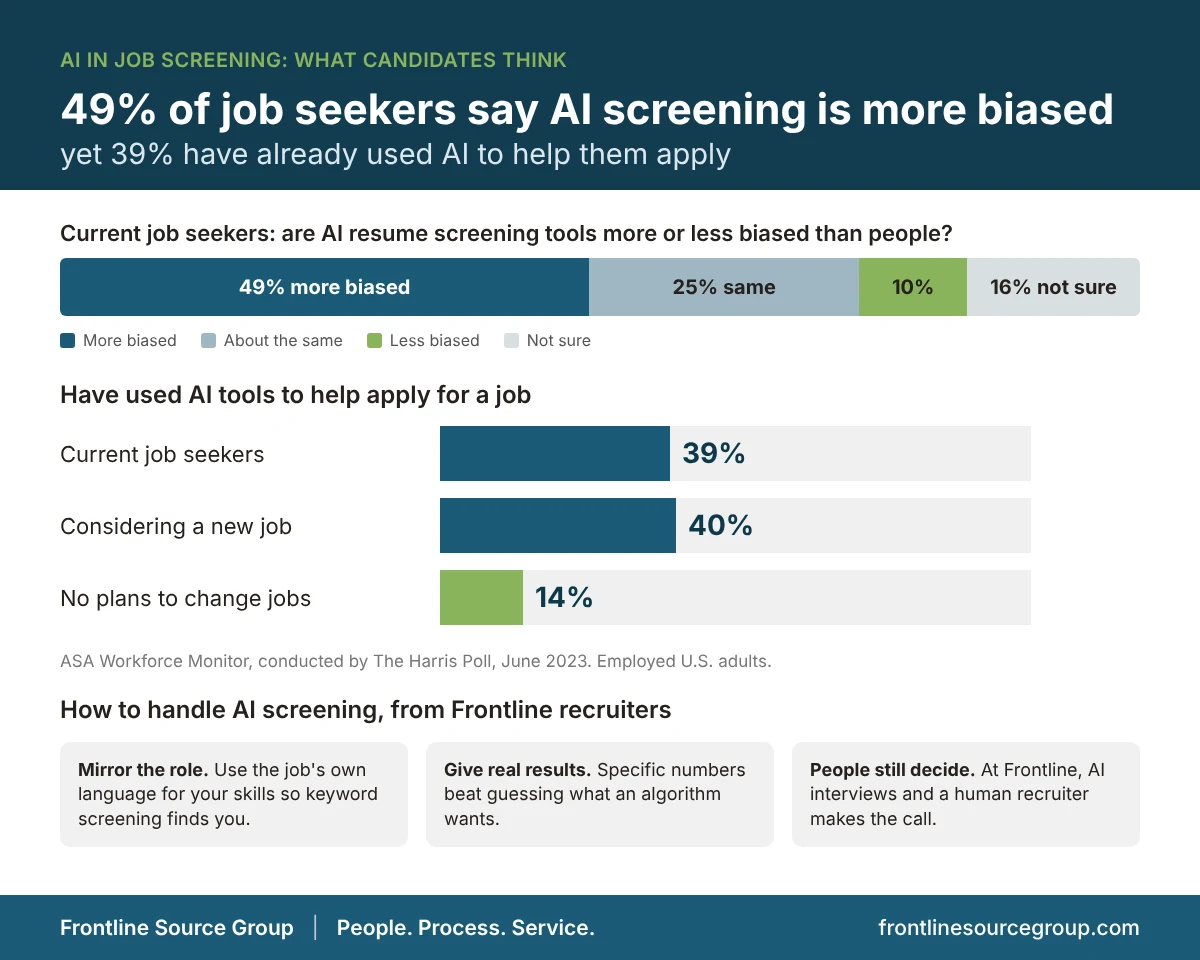
Employers increasingly use AI tools to screen resumes, schedule interviews, and in some cases analyze recorded video responses. This makes it more important than ever to ensure your resume clearly reflects the language of the role, since AI screening often matches on skills and keywords. In the interview itself, answer as you naturally would; focus on specific, measurable results rather than trying to guess what an algorithm wants to hear. Frontline pairs AI-powered job matching with human recruiter judgment, so a real recruiter reviews your background and advocates for you rather than leaving decisions to software alone.
Candidates have mixed feelings about all this. In an ASA Workforce Monitor survey conducted by The Harris Poll in June 2023, 49 percent of current job seekers said AI resume screening tools are more biased than human recruiters, and only 10 percent said they are less biased. At the same time, 39 percent of current job seekers had already used AI tools to help them apply for a job.
Frequently Asked Questions: Interview Instructions
Do I need to fill out an employment application with Frontline?
No. Frontline Source Group does not require candidates to fill out a separate employment application. This simplifies the process and makes your career search experience easier. Frontline does verify the information listed on your resume, so please ensure that it is correct.
How should I prepare for an interview arranged by my Frontline recruiter?
Preparation starts with a call with your Frontline recruiter to review the job description, discuss why you are a strong fit for the role, identify likely questions, and prepare your own questions for the hiring manager. Your recruiter also briefs you on the company culture and interview format.
What should I wear to a Frontline client interview?
Business professional attire is the safest choice for most interviews. Business casual may be appropriate for certain industries or roles, but when in doubt, dress up rather than down. Ask your Frontline recruiter what the specific client company expects.
What should I bring to an interview?
Bring multiple printed copies of your resume (3 to 5 for panel interviews), a list of professional references with current contact information, a notepad and pen, a list of thoughtful questions prepared in advance, valid identification, and the interviewer's contact information in case of delays.
How do I answer behavioral interview questions effectively?
Use the STAR method: Situation, Task, Action, Result. Briefly describe the situation you were in, the task or challenge you faced, the action you took, and the measurable result that followed. Keep answers specific, concise (90 seconds or less), and focused on your individual contribution.
What questions should I ask at the end of the interview?
Prepare 3 to 5 thoughtful questions in advance. Strong questions include what success looks like in the role at 90 days and at one year, how performance is measured, what the team culture is like, and what the next steps in the process are. Thoughtful questions demonstrate genuine interest and help you evaluate fit.
What should I do after the interview ends?
Send a personalized thank-you email to every person you met with within 24 hours, referencing a specific conversation point from the interview. Follow up with your Frontline recruiter the same day to debrief, so your recruiter can share your feedback with the client and coordinate next steps.
How long should I wait to hear back after an interview?
Your Frontline recruiter gathers feedback from the client after the interview and shares it with you as soon as it is received. Timing varies by client and role, and senior and executive searches generally involve more steps. Your recruiter keeps you informed throughout, so you are never left guessing.
What if I cannot make my scheduled interview time?
Contact your Frontline recruiter as soon as possible, ideally with at least 24 hours notice. Your recruiter will coordinate directly with the client to reschedule. Communicating early and professionally protects your candidacy and reflects well on your reliability.
How do virtual and video interviews work?
Virtual interviews follow the same preparation principles as in-person interviews, with added technical considerations. Test your camera, microphone, internet connection, and the meeting link 30 minutes ahead of time. Choose a quiet, well-lit space with a clean background, position your camera at eye level, and dress in full business professional attire.
How should I handle a one-way or recorded video interview?
Treat a one-way video interview as seriously as a live one. Read each question carefully, structure your answer before recording, and use the STAR method for behavioral prompts. Use any practice question to check your framing, lighting, and audio, look directly at the camera, and keep answers within the time limit shown. Your Frontline recruiter can tell you which platform a client uses.
How is AI used in interviews and screening in 2026?
Employers increasingly use AI to screen resumes, schedule interviews, and sometimes analyze recorded video responses. Make sure your resume clearly reflects the language and skills of the role, since AI screening often matches on keywords. In the interview, focus on specific, measurable results. Frontline pairs AI-powered job matching with human recruiter judgment, so a real recruiter reviews your background and advocates for you.
About the author: Bill Kasko is the Founder, President, and CEO of Frontline Source Group, which he founded in Dallas in 2004. Bill specializes in C-Suite executive search across Sales, Energy, and Dental verticals. Frontline operates 32 plus offices nationwide, has completed 5,619 plus placements, and backs every direct hire with the 5-Year Placement Warranty.