What Are the Steps to Hire a Pharmacist in the United States?

Published on: Nov 5, 2026
Published on: November 5, 2026. Updated on: November 5, 2026.
Hiring a pharmacist in the United States takes six steps: define the practice setting and role, verify active licensure in every state of practice and run compliance checks, choose a sourcing channel, benchmark total pay against a 140,910 dollar national median, assess clinical judgment with structured interviews, and finish the credential file before day one. Frontline Source Group places pharmacists on a direct hire basis, backed by its 5-Year Placement Warranty.
Frontline Source Group is a nationwide staffing and executive search firm founded in Dallas in 2004, with 32 plus offices, 5,619 completed placements, a 98.94% executive placement retention rate, and a 5.0-star Trustpilot rating across 683 verified reviews, plus a 5.0 rating on G2 from validated reviewers. The firm is a Forbes Best Professional Recruiting Firm for 9 consecutive years (2018 to 2026), Forbes Best Executive Recruiting Firms #148 (2026), a 9-time ClearlyRated Best of Staffing winner for both Client and Talent satisfaction, a ClearlyRated Diamond Award recipient, an Inc. 5000 honoree, an Expertise.com Best Staffing Agency, and a member of the American Staffing Association (ASA).
TL;DR: Decide the setting (retail, hospital, ambulatory, long-term care, or specialty) and any pharmacist-in-charge, sterile compounding, or immunization duties first. Verify each license at the state board, screen the OIG and SAM.gov exclusion lists, and get FCRA-compliant background check authorization. Benchmark total compensation by setting, since BLS medians range from 132,940 dollars at pharmacies to 157,290 dollars in hospitals. Use a scored, structured interview with practical cases and automatic disqualifiers for patient-safety failures. Build the full credential file before the start date, not after.
How do you define the pharmacist role before posting the job?
Start with the practice setting, because it drives every other decision: which credentials to verify, what to pay, and which interview scenarios to run.
What changes by practice setting?
- Retail and community pharmacy: high-volume dispensing, immunizations, and patient counseling, often with little clinical backup on a shift.
- Hospital and health-system pharmacy: order verification, sterile compounding, clinical rounding, and medication reconciliation inside a care team.
- Ambulatory care: chronic disease management and medication therapy management (MTM), often under collaborative practice agreements.
- Long-term care and specialty pharmacy: their own supervision rules, clinical expectations, and facility requirements.
What questions should you answer before you post?
- What schedule does the role need, including weekends, holidays, or overnight coverage?
- Is this solo coverage or a team setting?
- Does the role carry pharmacist-in-charge (PIC) responsibility?
- Will the pharmacist do sterile compounding, administer immunizations, or provide MTM?
- Is this a staff pharmacist, clinical pharmacist, pharmacy manager, or director of pharmacy role?
Clear answers narrow the candidate profile and prevent mismatches that otherwise surface only after an offer is made.
What licenses and compliance checks does hiring a pharmacist require?
Primary-source license verification
Every state requires pharmacists to be licensed, and a pharmacist must hold an active, unrestricted license in each state where they practice. Licensed pharmacists typically graduate with a Doctor of Pharmacy (Pharm.D.), pass the national licensing exam (NAPLEX) and a state law exam, and complete their state's internship hours. Requirements for fingerprinting, internship hours, and continuing education vary by board; Florida, for example, requires electronic fingerprinting for licensure.
Verify at the source: collect the pharmacist's legal name, license number, and state, search the official state board database, confirm the license is active rather than expired, suspended, or restricted, and review any disciplinary history. The National Association of Boards of Pharmacy (NABP) offers monitoring tools that supplement board-level checks, and pharmacists moving from another state usually transfer licensure through NABP licensure transfer and then meet the new state's law exam and other requirements.
"In grocery and retail pharmacy, the pharmacist-in-charge answers to the board for that store, so I never take a license on a resume at face value. I look it up on the state board's site myself, check every state the pharmacist will cover, and ask about any discipline before the first interview. Then I ask candidates to walk me through a hard day, like a wrong-drug catch or a controlled substance count that would not reconcile. How they handled it tells me more than any score."
Mike Cook, Senior Executive Recruiter for Grocery, Retail, and Pharmacy, Frontline Source Group, who spent more than 35 years in the grocery industry before moving into executive search (bio)
DEA registration and NPI
A pharmacist generally does not need a personal DEA registration to dispense controlled substances as an employee of a properly registered pharmacy; a personal registration may be needed for prescribing, ordering, or administering controlled substances in an authorized clinical role. An individual Type 1 NPI applies when a pharmacist is identified on standard health care transactions or goes through payer credentialing. An active NPI is often required before pharmacist credentialing begins, but it does not by itself grant licensure, prescribing authority, or payer enrollment.
Background checks and exclusion screening
Get written, stand-alone authorization under the Fair Credit Reporting Act (FCRA) before running any third-party background report, and follow FCRA adverse-action steps if a report affects your decision. Beyond criminal history, search the HHS Office of Inspector General List of Excluded Individuals and Entities (LEIE) and the SAM.gov exclusion records before the start date, and recheck both on a regular schedule after hire.
This guide is general information, not legal advice. Confirm current requirements with your state board of pharmacy and an employment attorney.
Where should employers source pharmacist candidates?
Employers usually combine three channels:
- Pharmacy association job boards. ASHP's CareerPharm is a leading channel for clinical, hospital, and health-system roles, and the National Association of Specialty Pharmacy runs a job board for specialty pharmacy positions.
- General job boards and your own careers page. They reach a wide audience but return many unqualified applicants for a licensed role, so treat them as a supplement.
- A pharmacy executive search partner. A recruiter who knows pharmacy can reach employed pharmacists who are not applying anywhere, screen licensure and clinical depth before you interview, and manage the offer. Frontline's pharmacist executive search team focuses on direct hire placements where long-term clinical and cultural fit matters most.
What should you pay a pharmacist in 2026?
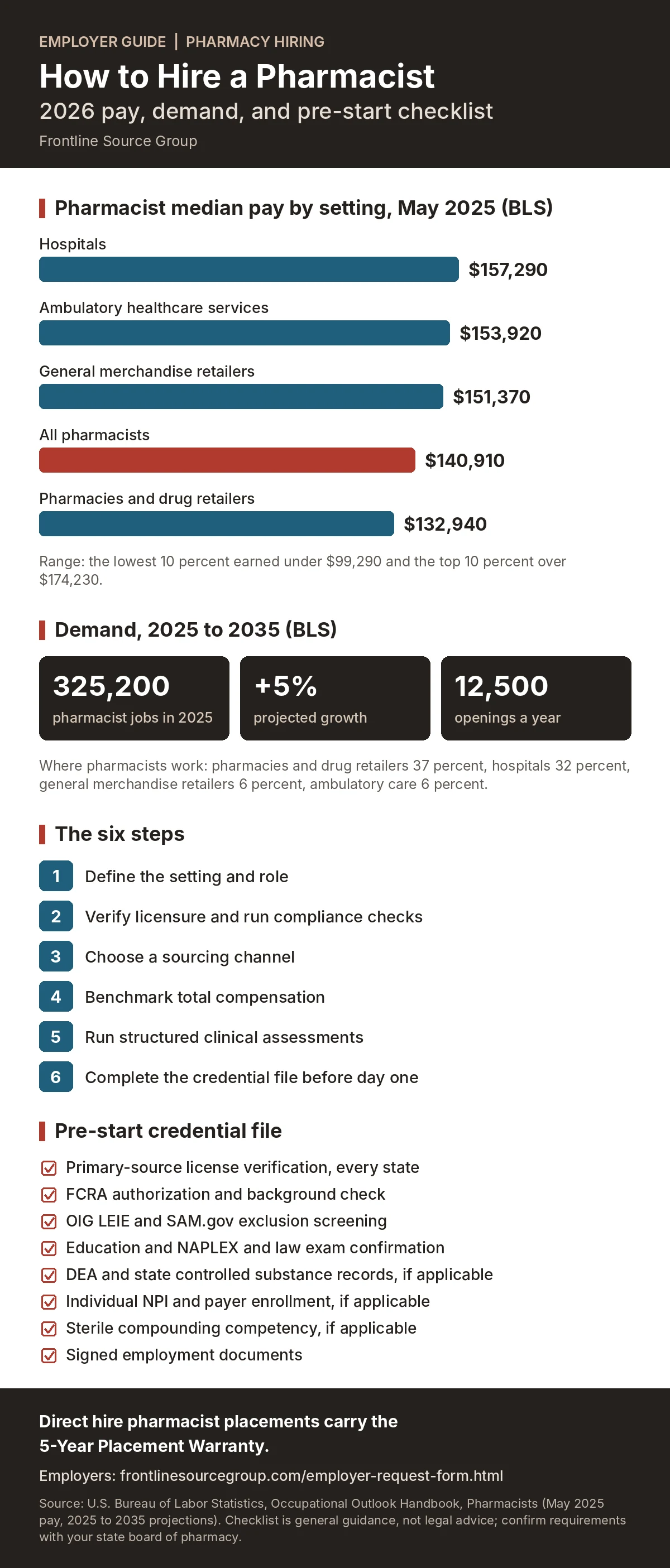
Benchmark by practice setting, not by the national median alone. The U.S. Bureau of Labor Statistics (BLS) reports a May 2025 median of 140,910 dollars (67.75 dollars an hour) for pharmacists, with the lowest 10 percent earning under 99,290 dollars and the top 10 percent over 174,230 dollars. Medians by setting:
- Hospitals: 157,290 dollars
- Ambulatory healthcare services: 153,920 dollars
- General merchandise retailers: 151,370 dollars
- Pharmacies and drug retailers: 132,940 dollars
Demand is steady. BLS counts 325,200 pharmacist jobs in 2025 and projects 5 percent growth from 2025 to 2035, faster than average, with about 12,500 openings a year. Pharmacies and drug retailers employ 37 percent of pharmacists and hospitals 32 percent.
Beyond base pay, a competitive package usually includes medical, dental, and vision coverage, a 401(k) match, paid time off, and continuing education or license renewal reimbursement. Sign-on and relocation bonuses are common for rural markets, overnight coverage, and sterile compounding roles. Candidates comparing offers look at total compensation, so you should too. Frontline's direct hire fees are published on its {a('/pricing.html','pricing page')}.
How do you interview and assess a pharmacist's clinical competence?
Use a structured interview
Ask every candidate the same questions in the same order, score answers against a written rubric, and probe for what the candidate actually did rather than general opinions. Cover four areas: compounding and sterile technique, immunization workflow, medication therapy management and clinical judgment, and pharmacy systems and operations. Strong answers describe repeatable workflows, independent verification checks, and a clear willingness to stop and escalate instead of improvising under pressure.
Add practical assessments
A de-identified case review tests clinical reasoning and prioritization. A simulated dispensing or verification exercise shows whether technique matches what the candidate described. A walkthrough in a sandbox version of your pharmacy system shows whether they can work in your tools. For sterile compounding roles under USP Chapter 797, include a written assessment, gloved fingertip testing, and media-fill testing.
Set automatic disqualifiers
Score each competency from 1 to 5, but keep critical-fail criteria separate from the total. Unsafe aseptic technique, missing an urgent clinical issue, incorrect vaccine screening, or skipping a required verification should disqualify a candidate no matter how high the overall score.
What belongs in a pharmacist's credential file before day one?
Build this file before the pharmacist's first day:
- Signed employment documents
- FCRA authorization and the background check result
- Primary-source license verification for every state of practice
- OIG LEIE and SAM.gov exclusion screening results
- Education and licensing exam confirmation
- DEA and state controlled substance documentation, where applicable
- Individual NPI record, where applicable
- Payer credentialing or enrollment status with effective dates, where applicable
- Sterile compounding competency records, where applicable
Then set up a calendar for license renewals, continuing education deadlines, payer recredentialing, and exclusion rechecks, so nothing lapses once the pharmacist is busy on the job.
What affects how long it takes to hire a pharmacist?
Rather than a single number, plan around the factors that stretch or shorten a pharmacist search:
- Licensure status. A candidate already licensed in your state can start sooner than one who needs a licensure transfer and a state law exam.
- Notice period. Employed pharmacists usually owe their current employer notice, and PIC roles may need a handoff.
- Credentialing and privileges. Hospital and health-system roles that need payer credentialing or medical staff privileges add review steps.
- Market and schedule. Rural locations, overnight shifts, and specialized roles such as sterile compounding draw smaller candidate pools.
- Your own process. Slow interview scheduling and offer approvals lose candidates who are weighing more than one offer.
How does Frontline Source Group help employers hire pharmacists?
Frontline Source Group's pharmacist executive search and healthcare operations executive search teams recruit staff and clinical pharmacists, pharmacists-in-charge, pharmacy managers, and directors of pharmacy on a direct hire basis. Recruiters screen licensure, clinical depth, and fit before you interview, coordinate offers, and stay involved after the start date.
Every direct hire is backed by the 5-Year Placement Warranty, 20 times longer than the 90-day guarantee that is standard in staffing, and the firm's fees are on its public pricing page. Employers can start a search at frontlinesourcegroup.com/employer-request-form.html. Pharmacists looking for their next role can apply at frontlinesourcegroup.com/how-to-apply.html. Recognition is listed on the awards page. People. Process. Service.
Frequently Asked Questions: How to Hire a Pharmacist
What are the steps to hire a pharmacist in the United States?
Define the practice setting and role, verify active licensure in every state of practice and run compliance checks, choose a sourcing channel, benchmark total compensation by setting, assess clinical competence with a structured interview and practical cases, and complete the credential file before the start date.
Can a pharmacist licensed in one state practice in a different state?
Not without a license in that state. A pharmacist must hold an active, unrestricted license in each state where they practice. Pharmacists moving states usually transfer licensure through NABP and then meet the new state's law exam and other requirements, so verify every applicable state at the board before the pharmacist practices there.
How do you verify a pharmacist's license?
Use primary-source verification. Collect the pharmacist's legal name, license number, and state, search the official state board of pharmacy database, confirm the license is active and unrestricted, and review any disciplinary history. NABP tools can supplement, but not replace, the board check.
What compliance checks are required before a pharmacist starts?
Get FCRA-compliant written authorization before any third-party background check, screen the HHS-OIG LEIE and SAM.gov exclusion records, verify licensure in every state of practice, and confirm DEA, NPI, and payer enrollment details where the role requires them.
Does a pharmacist need a personal DEA registration?
Generally not to dispense controlled substances as an employee of a properly registered pharmacy. A personal DEA registration may be needed when the pharmacist prescribes, orders, or administers controlled substances in an authorized clinical role.
How much does a pharmacist make in 2026?
The BLS reports a May 2025 median of 140,910 dollars for pharmacists, with the lowest 10 percent under 99,290 dollars and the top 10 percent over 174,230 dollars. Medians run 157,290 dollars in hospitals, 153,920 dollars in ambulatory care, 151,370 dollars at general merchandise retailers, and 132,940 dollars at pharmacies and drug retailers.
What should automatically disqualify a pharmacist candidate?
Patient-safety failures should disqualify a candidate regardless of overall score. Examples include unsafe aseptic technique, failure to recognize an urgent clinical issue, incorrect vaccine screening, or bypassing a required verification.
When must the credential file be complete?
Before the pharmacist's start date. Assembling the file after day one creates compliance exposure that is hard to fix later, so include signed employment documents, background check authorization and results, license verification, exclusion screening, and any DEA, NPI, and payer records before the first shift.
What affects how long it takes to hire a pharmacist?
The biggest factors are whether the candidate is already licensed in your state, the candidate's notice period, any payer credentialing or medical staff privileges the role requires, how hard the location and schedule are to fill, and how quickly your team schedules interviews and approves offers.
Where can employers find pharmacist candidates?
Pharmacy association job boards such as ASHP's CareerPharm and the National Association of Specialty Pharmacy's job board, general job boards and your own careers page, and a pharmacy executive search partner that can reach employed pharmacists who are not actively applying.
Does Frontline Source Group recruit pharmacists?
Yes. Frontline Source Group recruits staff and clinical pharmacists, pharmacists-in-charge, pharmacy managers, and directors of pharmacy on a direct hire basis, backed by the 5-Year Placement Warranty. Employers can start at frontlinesourcegroup.com/employer-request-form.html.
What is the 5-Year Placement Warranty?
The 5-Year Placement Warranty covers Frontline Source Group's direct hire placements for five years, 20 times longer than the 90-day guarantee that is standard in staffing. If a covered placement does not work out, the employer receives a pro-rated credit toward a replacement search. Details are at frontlinesourcegroup.com/5year-placement-guarantee.html.
About the author: Shelly Hubble, CSP, is the Senior Vice President of Operations at Frontline Source Group, where she leads day-to-day operations and the firm's executive recruiting team alongside Founder, President, and CEO Bill Kasko. She holds the Certified Staffing Professional (CSP) credential from the American Staffing Association and is an SMU alumna with experience across accounting, finance, energy, dental, pharmacy, and C-suite executive search. Her full bio is at frontlinesourcegroup.com/shelly-hubble-staffing-services.html.


