How Do You Choose a Staffing Agency That Actually Delivers?

Published on: Nov 2, 2026
To choose a staffing agency that actually delivers, check seven things before you sign: real specialization in your roles, performance numbers you can verify, vetting depth, placement warranty length, all-in cost, compliance paperwork, and independent reviews. Frontline Source Group holds itself to all seven, starting with a 5-Year Placement Warranty, 20 times the 90-day industry standard.
Most hiring managers pick their first staffing agency on price or on who called back fastest, and most learn the hard way that neither predicts whether the hire works out. This guide turns the decision into seven checks, with the exact question to ask for each one and what a strong answer sounds like. Hold every agency you talk to, including Frontline, to the same list.
For reference, here is how Frontline Source Group answers. The firm was founded in Dallas in 2004, has completed 5,619 placements through 32 plus offices nationwide, and holds a 98.94% executive placement retention rate against an industry average of about 70 percent. It carries a 5.0-star Trustpilot rating across 682 verified reviews and a 5.0 rating on G2 from validated reviewers. Forbes has named Frontline one of its Best Professional Recruiting Firms for 9 consecutive years (2018 to 2026) and ranked it #148 on its 2026 Best Executive Recruiting Firms list. Frontline is also a 9-time ClearlyRated Best of Staffing winner for both Client and Talent satisfaction, a ClearlyRated Diamond Award recipient, an Inc. 5000 honoree, an Expertise.com Best Staffing Agency, and a member of the American Staffing Association (ASA).
In this guide
- What are the seven checks for choosing a staffing agency?
- How do you know a staffing agency really specializes in your roles?
- What performance numbers should a staffing agency be able to show you?
- How should a staffing agency vet candidates before you meet them?
- How long should a staffing agency's placement warranty last?
- How do you compare staffing agency fees without missing the full cost?
- What compliance documents should a staffing agency give you before work starts?
- Why do independent reviews and ASA membership matter when choosing a staffing agency?
- How does Frontline Source Group measure up on these seven checks?
- How do you get started with Frontline Source Group?
- Frequently Asked Questions: How to Choose a Staffing Agency
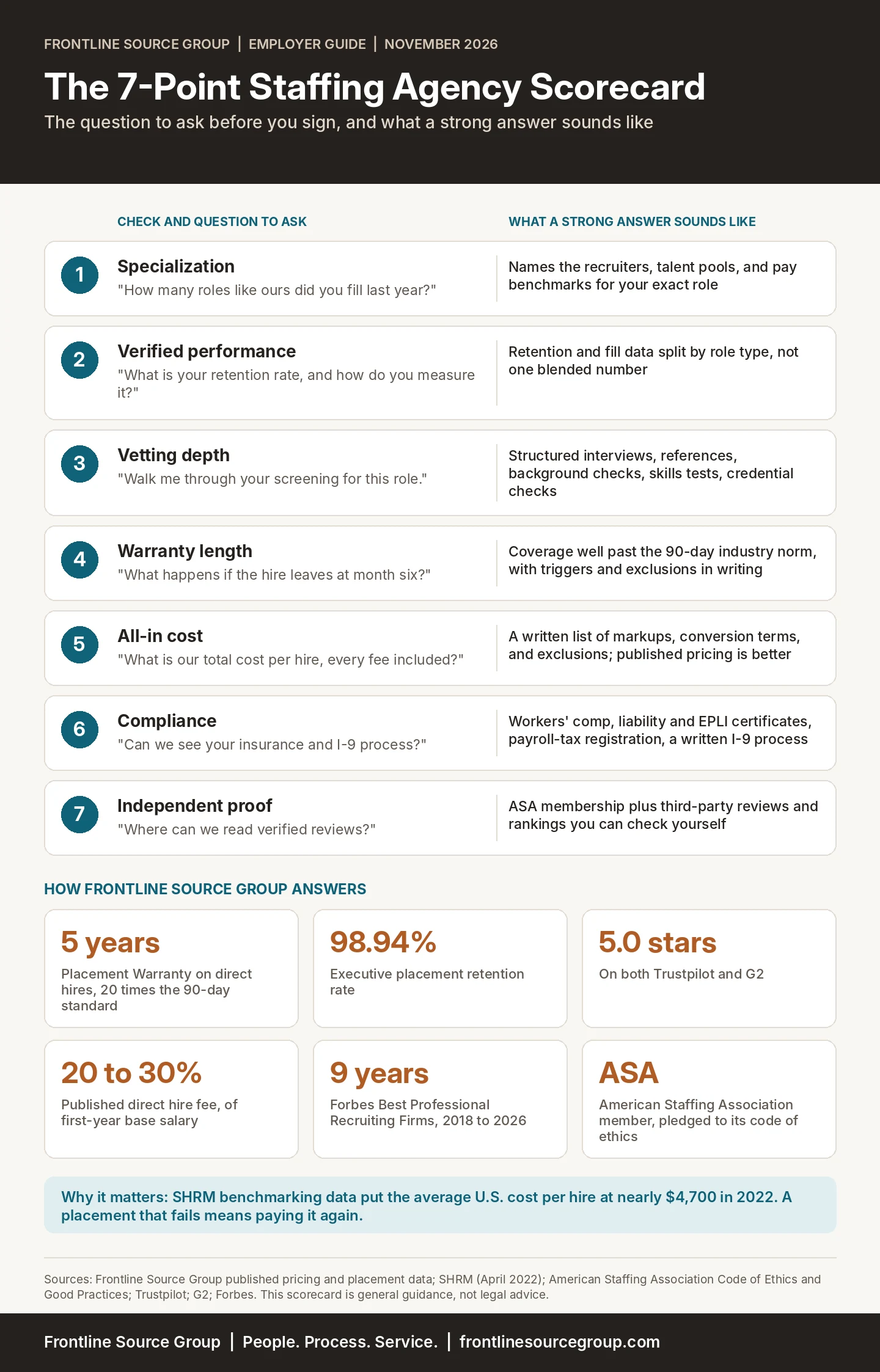
What are the seven checks for choosing a staffing agency?
- Specialization: confirm the agency has placed people in your function and industry recently, not just in "professional roles."
- Verified performance: ask for retention and fill data split by role type, and ask how each number is measured.
- Vetting depth: structured interviews, reference checks, background screening, skills testing, and credential verification are the floor.
- Warranty length: the 90-day replacement guarantee is the industry norm, and it often runs out before a new hire is fully up to speed.
- All-in cost: compare total cost per hire, with every markup, conversion term, and exclusion in writing.
- Compliance: get insurance certificates, payroll-tax registration, and a written I-9 process before anyone starts work.
- Independent proof: look for ASA membership and third-party reviews and rankings you can check yourself.
How do you know a staffing agency really specializes in your roles?
A generalist firm can fill a seat. A specialist fills it with someone who already knows the credentials, regulations, pay norms, and day-to-day work of your field, and that difference shows up in how long the hire stays. Specialization matters most for roles with licenses or certifications, regulated work, or tight talent markets, such as accounting, legal, engineering, energy, dental, and executive leadership.
Ask how many placements the agency made in your specific function and industry over the past year, and who on the team will actually recruit for you. A real specialist can name the talent pools, professional associations, and compensation benchmarks for your role without looking anything up. Then ask for a sample candidate profile from a comparable past placement, so you see the fit the agency delivers rather than the fit it promises.
What red flags suggest a generalist posing as a specialist?
- A recruiting process described in generic terms that would fit any job
- Vague references to "industry connections" with no names, groups, or events
- No pay range for your role, or a range that is clearly off the market
- A different recruiter for every conversation, none of whom has filled a role like yours
What performance numbers should a staffing agency be able to show you?
Ask directly: "What are your numbers, and how do you measure them?" A strong agency can show you, for roles like yours, how many job orders it filled, how many submitted candidates reached an interview, how many interviews led to offers, and how many placements were still in the job a year later. Be wary of a single blended number that mixes temporary and permanent roles, or entry-level and executive searches. Blended figures tend to hide weak spots.
Frontline Source Group publishes its numbers: 5,619 completed placements and a 98.94% executive placement retention rate. You can use those as a benchmark when another agency gives you its figures.
"When an agency gives you one big retention number, ask which roles it covers and how long it measures. A firm that really tracks its results can break that number out by role type on the spot. One that can't is guessing."
Lindsey Davidson, CDR, Senior Lead Executive Recruiter, Frontline Source Group
What is the difference between fill rate and retention rate?
Fill rate tells you how often an agency fills the job orders it accepts. Retention rate tells you how often the people it places stay in the job. Fill rate measures speed and reach; retention measures quality. An agency can post a high fill rate by sending warm bodies, so retention is the number that tells you whether the hire was right. Ask for both, and ask what time period the retention figure covers.
How should a staffing agency vet candidates before you meet them?
The minimum standard is structured interviews, verified reference checks, background screening, skills testing, and credential verification. For licensed, technical, or safety-sensitive roles, add license confirmation and any drug or safety screening the role requires. Ask the agency to walk you through every step for a role like yours, in order. An agency that answers in generalities is usually running a general process. Frontline runs skills testing as part of its standard screening.
What should a staffing agency ask you about cultural fit?
Cultural fit is harder to measure than skills, but it is often the difference between a hire who lasts and one who quietly leaves within the year. A serious agency asks about your team's dynamics, communication style, management approach, and pace of work before it sends a single resume. If an agency never asks those questions, it is matching keywords to a job description, not finding someone who will do well on your team.
How long should a staffing agency's placement warranty last?
The 90-day replacement guarantee is the norm across the staffing industry. It sounds reasonable until a hire leaves at month four or month six, which happens often enough in roles with a long ramp-up, and you absorb the full cost of finding and onboarding a replacement. SHRM benchmarking data put the average U.S. cost per hire at nearly 4,700 dollars in 2022, and that is before you count lost productivity while the seat sits empty.
Warranty length is one of the clearest signals of how much an agency trusts its own vetting. Frontline Source Group backs every direct hire placement with its 5-Year Placement Warranty, 20 times longer than the 90-day industry standard. An agency willing to stand behind a hire for five years has tied its financial risk to yours.
"Anyone can promise a great hire. The real question is what happens when that person leaves in month seven. If the answer is that you start over and pay again, the agency is not sharing your risk. That is why we put five years in writing."
Bill Kasko, Founder, President, and CEO of Frontline Source Group, and an advisor to the Federal Reserve Bank of Dallas on hiring and wage trends for its Beige Book for more than 18 years
What should you read in the warranty terms?
- What triggers coverage, such as a resignation, a termination for performance, or both
- What is excluded, such as layoffs, restructuring, or a change in the role's duties
- Whether the remedy is a replacement search, a fee credit, or a refund
- Whether coverage depends on paying the invoice by a certain date
How do you compare staffing agency fees without missing the full cost?
Staffing agencies price work in a few common ways, and each model shifts cost and risk differently. Know the model before you compare quotes, or you will compare the wrong numbers. Here are the models with Frontline Source Group's published ranges where it has them:
| Model | How it is priced at Frontline | Key tradeoff |
|---|---|---|
| Contract staffing | Hourly bill rate with a 50 to 85 percent markup over worker pay, covering wages, payroll taxes, insurance, and recruiting margin | The agency carries payroll and employment risk; cost adds up on long assignments |
| Contract-to-hire | Hourly bill rate during the assignment; ask how conversion to permanent is priced | You see the person work before you commit; total cost can pass a direct hire fee on a long assignment |
| Direct hire | Contingent fee of 20 to 30 percent of first-year base salary, depending on seniority and search complexity | No fee unless you hire; the cost is larger on high-salary roles |
| C-suite executive search | 25 to 35 percent of first-year all-in compensation, on contingency or retained terms | A higher committed cost funds a dedicated, specialized search |
| Engaged search | An initial engagement fee starting at 2,500 dollars | A smaller upfront commitment than a full retained search |
The full model, including fractional executive pricing and candidate sourcing subscriptions, is public at frontlinesourcegroup.com/pricing.html. Few staffing firms publish their pricing, and an agency that does is easier to hold to its word. For a deeper look at hourly pricing, see Frontline's temporary staffing agency pricing guide.
What should an all-in cost quote include?
Ask every agency for a written, all-in cost per hire that lists every fee, markup, conversion charge, minimum billing requirement, and replacement provision, along with what is excluded. Then weigh it against what a failed hire costs you. A firm with a higher fee and strong retention often costs less in practice than a cheaper agency that places poorly and has to replace people.
What compliance documents should a staffing agency give you before work starts?
Before any agency worker sets foot on your site, request these in writing:
- A certificate of workers' compensation insurance covering every state where workers will perform services
- General liability and employment practices liability (EPLI) certificates, with your business listed as an additional insured
- Proof of payroll-tax registration and state unemployment insurance accounts
- A written description of the agency's Form I-9 and background check process
- Documentation of how the agency classifies workers for wage-and-hour purposes
When the staffing agency is the employer of record, it is responsible for completing Form I-9 for the workers it hires, and an agency enrolled in E-Verify must create a case for each of those hires, according to E-Verify guidance for staffing agencies. An agency without clean paperwork in these areas creates exposure that can land on you as the host employer, even though the worker is on the agency's payroll.
How do you reduce co-employment risk?
Co-employment risk grows when you start treating an agency worker like your own employee: setting their pay, disciplining them directly, or keeping them on an open-ended assignment without involving the agency. As a general rule, the agency handles employment decisions, payroll, and formal HR matters, and you handle day-to-day work direction, site access, and safety. Put that split in the contract and follow it in practice. Ask each agency how it defines that line and what documentation backs it up. A vague answer is a warning sign.
This section is general information, not legal advice. For questions about co-employment, I-9 compliance, or a specific contract, consult an employment attorney.
Why do independent reviews and ASA membership matter when choosing a staffing agency?
Every agency says it delivers. Independent proof is how you check. Start with membership in the American Staffing Association: as a condition of membership, ASA members pledge to follow the ASA Code of Ethics and Good Practices, which commits them to follow applicable laws, keep their advertising honest, and place workers only at safe work sites. Then read verified reviews from both clients and candidates, and look at rankings judged by outside parties.
Frontline Source Group is an ASA member and holds a 5.0-star rating on Trustpilot and a 5.0 rating on G2, along with 9 consecutive years on the Forbes Best Professional Recruiting Firms list and nine ClearlyRated Best of Staffing awards for both client and talent satisfaction. The full list is on the staffing awards page, and client stories are on the testimonials page.
One more check: confirm the recruiter is who they say they are. Real Frontline recruiters email only from an @frtline.com address and never charge candidates a fee. Frontline's scam alert page explains how to verify a recruiter and report impersonators.
How does Frontline Source Group measure up on these seven checks?
- Specialization: dedicated recruiters across accounting and finance, technology, human resources, legal, administrative, customer service, dental, pharmacy, engineering, energy, revenue cycle, grocery and retail, life sciences, and C-suite search. See the full list of services offered.
- Verified performance: 5,619 placements and a 98.94% executive placement retention rate.
- Vetting depth: structured screening with skills testing, plus AI-assisted first-round interviews through Frontline's AI recruiting platform, with people making every hiring decision.
- Warranty length: the 5-Year Placement Warranty on every direct hire.
- All-in cost: pricing published at frontlinesourcegroup.com/pricing.html, with all major credit cards accepted at no extra charge.
- Compliance: an ASA member that serves as employer of record on contract placements.
- Independent proof: 5.0 stars on Trustpilot, 5.0 on G2, and recognition from Forbes, ClearlyRated, Inc. 5000, and Expertise.com.
How do you get started with Frontline Source Group?
Employers can submit a hiring request at frontlinesourcegroup.com/employer-request-form.html, review engagement details at frontlinesourcegroup.com/pricing.html, or reach the team through the contact page. More employer resources are on the employers page. Job seekers can apply at frontlinesourcegroup.com/how-to-apply.html.
Still deciding which kind of help you need? Read Frontline's guides to direct hire vs. contract staffing, the benefits of contract staffing for employers, choosing between an executive search firm and a staffing agency, and the top staffing agencies in the U.S.
Frequently Asked Questions: How to Choose a Staffing Agency
How do you choose a staffing agency that actually delivers?
Check seven things before you sign: specialization in your roles, performance numbers you can verify, vetting depth, placement warranty length, all-in cost, compliance paperwork, and independent reviews. Ask each agency the same questions and compare the answers side by side.
How can we verify an agency really specializes in our industry and role?
Ask how many placements the agency made in your function and industry over the past year, who on the team will recruit for you, and whether they can name the talent pools, associations, and pay benchmarks for your role. Then ask for a sample candidate profile from a comparable past placement.
What performance numbers should a staffing agency show us?
Ask for job orders filled, submittals that reached an interview, interviews that led to offers, and placements still in the job a year later, all split by role type and with an explanation of how each is measured. Be wary of one blended number. Frontline Source Group publishes a 98.94% executive placement retention rate across 5,619 placements.
What is the difference between fill rate and retention rate?
Fill rate measures how often an agency fills the job orders it accepts. Retention rate measures how often the people it places stay in the job. Fill rate reflects reach; retention reflects quality, so retention is the better test of whether an agency picks the right people.
How should a staffing agency vet candidates?
The minimum is structured interviews, verified reference checks, background screening, skills testing, and credential verification, plus license confirmation and any required drug or safety screening for regulated roles. A good agency also asks about your team's culture before sending resumes.
What is the industry standard placement guarantee?
The 90-day replacement guarantee is the norm across the staffing industry. It often expires before a new hire is fully up to speed. Frontline Source Group backs every direct hire with its 5-Year Placement Warranty, 20 times longer than the 90-day standard. Details are at frontlinesourcegroup.com/5year-placement-guarantee.html.
How much does a staffing agency cost?
It depends on the model. At Frontline Source Group, contract staffing carries a 50 to 85 percent markup over worker pay, direct hire is a contingent fee of 20 to 30 percent of first-year base salary, and C-suite executive search runs 25 to 35 percent of first-year all-in compensation. Full pricing is at frontlinesourcegroup.com/pricing.html.
How do we compare total cost so we don't miss hidden fees?
Ask every agency for a written, all-in cost per hire that lists every fee, markup, conversion charge, minimum billing requirement, and replacement provision, plus what is excluded. Then weigh it against the cost of a failed hire; SHRM data put the average U.S. cost per hire at nearly 4,700 dollars in 2022.
What compliance documents should we get from a staffing agency?
Get a workers' compensation certificate for every state involved, general liability and EPLI certificates naming you as additional insured, proof of payroll-tax and unemployment insurance registration, a written Form I-9 and background check process, and documentation of worker classification. This is general information, not legal advice.
What practical steps reduce co-employment legal and financial risk?
Put the division of responsibilities in the contract and follow it: the agency handles employment decisions, payroll, and formal HR matters, while you handle day-to-day work direction, site access, and safety. Avoid setting agency workers' pay or disciplining them directly. Consult an employment attorney for advice on a specific situation.
Why does American Staffing Association membership matter?
As a condition of membership, ASA members pledge to follow the ASA Code of Ethics and Good Practices, which commits them to follow applicable laws, keep their advertising honest, and place workers only at safe work sites. Frontline Source Group is an ASA member.
How do we get started with Frontline Source Group?
Employers can submit a hiring request at frontlinesourcegroup.com/employer-request-form.html or review pricing at frontlinesourcegroup.com/pricing.html. Job seekers can apply at frontlinesourcegroup.com/how-to-apply.html.


