Which Marketing Careers Pay Best and Grow Fastest in 2026?

Published on: Sep 30, 2026
Published on: September 30, 2026. Updated on: September 30, 2026.
The best marketing careers in 2026 are marketing manager, market research analyst, digital marketing manager, marketing analytics manager, and product marketing manager. The Bureau of Labor Statistics puts the marketing manager median at $166,790, with 7% growth projected through 2035. Frontline Source Group places these roles with a 5-Year Placement Warranty.
Those numbers are fresh. The Bureau of Labor Statistics (BLS) updated its Occupational Outlook Handbook on August 27, 2026, with May 2025 pay data and new 2025 to 2035 projections, so everything below reflects the newest public data available. The rest comes from what we see day to day on Frontline Source Group's marketing executive search and digital marketing executive search desks.
Some context on who is giving this advice. Frontline Source Group was founded in Dallas in 2004 and has completed 5,619 plus placements across 32 plus offices nationwide, with a 98.94% executive placement retention rate against an industry average near 70 percent. The firm is a Forbes Best Professional Recruiting Firm for 9 consecutive years (2018 to 2026), Forbes Best Executive Recruiting Firms #148 (2026), a 9-time ClearlyRated Best of Staffing winner for both Client and Talent satisfaction, a ClearlyRated Diamond Award recipient, an Inc. 5000 honoree, and an Expertise.com Best Staffing Agency. It is also a member of the American Staffing Association (ASA), and candidates and clients rate it 5.0 stars across 676 verified Trustpilot reviews.
What are the best marketing careers in 2026?
The short version: the marketing careers that hold up best are the ones closest to revenue and data. Roles that own a budget, measure results, or explain customer behavior are growing. Roles built mainly around producing and placing ads are not. Here is how the main occupations compare on the newest federal numbers.
| Occupation | Median pay, May 2025 | Projected growth, 2025 to 2035 |
|---|---|---|
| Marketing managers | $166,790 | 7% |
| Advertising and promotions managers | $133,660 | Decline of 4% |
| Market research analysts and marketing specialists | $78,760 | 7% |
| Public relations specialists | $74,750 | 2% |
| All U.S. occupations | $50,980 | 3% |
Source: U.S. Bureau of Labor Statistics, Occupational Outlook Handbook profiles for advertising, promotions, and marketing managers, market research analysts, and public relations specialists, last modified August 27, 2026.
Marketing manager
Marketing manager is still the strongest all-around marketing career. BLS counted about 421,600 marketing manager jobs in 2025 and projects 7% growth through 2035, more than double the 3% average for all occupations. The median was $166,790 in May 2025, and the top 10 percent earned more than $293,610. BLS expects demand to hold because companies keep leaning on marketing to protect and grow market share, and they want managers who can advise on pricing and on new ways to reach customers.
Market research analyst and marketing analytics roles
If you like data more than design, this is the lane to look at. Market research analysts and marketing specialists earned a median of $78,760 in May 2025, and BLS projects 7% growth, which it describes as much faster than average, with about 82,000 openings a year. Analysts in the information industry had a median of $102,670. One detail most career guides miss: this federal category also includes search marketing strategists, so SEO specialists are counted here. The growth driver is simple. Companies have more customer data than ever and need people who can turn it into decisions.
Digital marketing manager and performance marketing lead
BLS does not track "digital marketing manager" as its own occupation. These jobs show up inside the marketing manager and marketing specialist numbers above. On our search desks, the digital roles with the steadiest demand belong to people who can tie spend to pipeline: paid search and paid social managers, lifecycle and email marketing managers, marketing automation leads, and SEO leads who can explain organic growth in revenue terms, not just traffic.
Product marketing manager
Product marketing sits where marketing, product, and sales meet. Product marketers own positioning, launch plans, competitive messaging, and the materials sales teams use to close. It is a strong fit for marketers who enjoy strategy and working across departments, and it tends to be a direct route into director and VP roles because the work is so closely tied to revenue.
Which marketing careers pay the most?
Pay in marketing tracks accountability more than title. A coordinator helps launch campaigns. A manager decides where the budget goes, which audiences matter, and how success gets measured. That is why marketing managers sit at the top of the BLS data at $166,790, followed by public relations and fundraising managers at $136,470, advertising and promotions managers at $133,660, and art directors at $114,850. Specialist roles land lower, including market research analysts at $78,760 and public relations specialists at $74,750.
Industry matters too. Marketing managers in the information industry had a median of $192,600 in May 2025, well above the overall figure, with finance and insurance at $172,350. If you are weighing two similar offers, the industry you pick can shape your earnings for years.
The practical takeaway: build evidence that your work moved a business number. A portfolio full of good-looking creative is useful. A portfolio that explains the audience, the goal, the channel, the test, the result, and what you would do next is what gets people promoted.
Which marketing jobs are shrinking, and how is AI changing the work?
Not every marketing career is growing, and it is worth being honest about that. BLS projects employment of advertising and promotions managers to decline 4% from 2025 to 2035. Its reasoning is specific: teams are using improving technology, including artificial intelligence, to generate, test, and modify digital ads faster, so fewer managers are needed to oversee advertising staff. BLS adds that ad blockers may further soften demand.
Public relations specialists are projected to grow just 2%, slower than average. BLS notes that social media keeps creating new work for PR teams, but AI is moving into data-rich social media work and may soften demand. Even so, BLS still expects about 23,000 PR specialist openings a year, mostly from people retiring or changing careers.
None of this means marketing is shrinking. Marketing managers and analysts are both projected to grow at 7%. It means the work is shifting toward people who can direct the tools, check the output, and make the judgment calls software cannot. If your current role is mostly production, the smart move is to add analysis, strategy, or channel ownership to what you already do.
What do digital marketing careers look like in 2026?
Digital marketing gives candidates more entry points than any other part of the field. Some people start in social media or content. Others start in paid search, email operations, SEO, analytics, ecommerce, or CRM. Over time those specialties lead into senior roles like growth marketing manager, demand generation manager, lifecycle marketing manager, SEO lead, paid media manager, and digital marketing director.
What makes digital work valuable is that it can be measured. Campaigns can be tested, segmented, adjusted, and tied to customer actions in ways traditional channels rarely allow. That favors marketers who can read data without losing sight of the message and the audience.
Strong digital marketers in 2026 can:
- Explain how SEO, paid media, content, email, and social support one another.
- Use analytics to diagnose performance, not just report it.
- Map the customer journey from first touch through conversion and retention.
- Write clear briefs for creative, web, sales, and product teams.
- Use AI tools responsibly for research, ideation, segmentation, and testing.
- Protect privacy, consent, and brand trust when working with customer data.
What are the main marketing career paths?
Marketing careers look more like a web than a ladder. Most people move between tracks at least once, and that is usually a strength, not a detour. The five main paths look like this:
- Analytics path: marketing analyst to marketing insights manager to marketing analytics lead, and eventually head of analytics or an analytics-focused CMO.
- Digital path: SEO or SEM specialist to digital marketing manager to head of digital, with Chief Digital Officer at the top.
- Brand path: brand manager to senior brand manager to brand director, then Chief Marketing Officer.
- Content path: content writer to content manager to content director, then VP of Content or Chief Content Officer.
- Leadership path: marketing manager to senior marketing manager to marketing director, then Chief Marketing Officer.
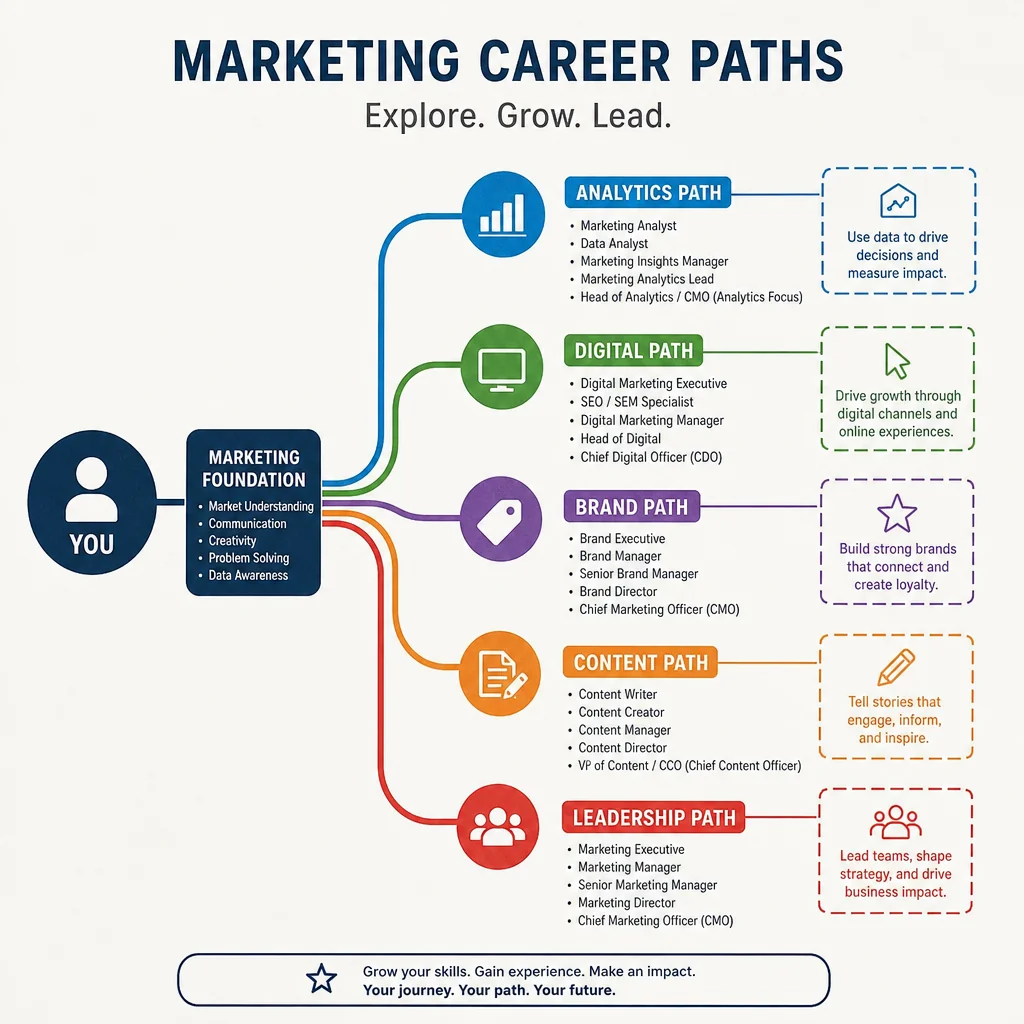
A common pattern we see: someone starts in content, moves into SEO, shifts into demand generation, and ends up running a full digital team. Another starts in market research, becomes a marketing analyst, and moves into product marketing. You can start narrow, get very good at one thing, and broaden into strategy as your experience grows.
How do you choose the right marketing career?
Match your natural strengths to the kind of business problem you want to solve. A quick guide:
- You enjoy writing and planning: look at content strategist, SEO content specialist, communications specialist, or brand marketing roles.
- You enjoy dashboards and customer behavior: look at market research analyst, marketing analyst, CRM analyst, or analytics manager paths.
- You enjoy experimentation: look at performance marketing, PPC, conversion rate optimization, lifecycle marketing, or growth marketing.
- You enjoy leading people: build toward marketing manager, director of marketing, or integrated marketing leadership.
- You enjoy reputation and relationships: consider public relations, corporate communications, employer brand, or media relations.
Recent graduates should build proof early
Do not wait for the perfect title. Marketing coordinator, social media assistant, content associate, and campaign coordinator roles are all useful first steps. Internships, freelance projects, campus campaigns, and volunteer work give employers something concrete to look at. BLS also notes that completing an internship in school can make candidates more attractive to employers.
Career changers should translate what they already know
A teacher brings presentation and audience skills. A retail manager understands customers, merchandising, and promotions. A journalist brings research and writing under deadline. The job is to translate past work into marketing language: audience, message, channel, offer, outcome, and insight.
Experienced marketers should specialize before moving up
If you already work in marketing, advancement usually comes from being known for one clear strength, whether that is demand generation, brand strategy, analytics, product marketing, paid acquisition, or team leadership. Broad experience helps, but a distinct specialty makes your value easy for a hiring manager to see.
What skills do marketing employers hire for in 2026?
Employers want marketers who can pair communication with execution. That means writing clearly, reading customer behavior, managing deadlines, working well with sales and operations, and picking up new platforms without depending on any single tool. The skills that come up most in our searches:
- Strategic planning: turning business goals into audiences, messages, channels, and budgets.
- Analytics: understanding traffic, leads, conversion rates, attribution limits, and segment performance.
- SEO and content: researching search intent, building useful pages, and measuring organic visibility.
- Paid media: managing budgets, keywords, audiences, creative testing, and landing page performance.
- CRM and email: segmenting lists, nurturing leads, and improving retention.
- Leadership: aligning stakeholders, managing vendors, giving feedback, and prioritizing when resources are tight.
Education still counts. BLS says marketing managers typically need a bachelor's degree plus experience in a related role such as sales, market research, or public relations, and some employers prefer a master's degree. For market research analysts, BLS says a master's degree is often required for leadership positions or more technical research work. Certifications are voluntary in most marketing roles, but they help, especially for career changers who need to show current skills.
How should you run a marketing job search in 2026?
A good marketing job search is focused, not frantic. Instead of applying everywhere, pick a few target roles, learn the language employers use, and build proof around it:
- Pick two target roles, such as digital marketing coordinator and SEO specialist, or marketing analyst and market research analyst.
- Read ten job descriptions for each and note the tools, responsibilities, and outcomes that repeat.
- Build a skills gap list that separates must-haves from nice-to-haves.
- Create one proof project: a campaign plan, an SEO content brief, a sample dashboard, an email sequence, or a paid media test plan.
- Rewrite your resume around outcomes, replacing task-only bullets with scope, action, and result wherever you honestly can.
- Tighten your LinkedIn profile using our LinkedIn job search playbook and our guide to what the LinkedIn About section is for.
- Follow up after every interview. Our guide to thank you note subject lines makes that part easy.
- Work with a recruiter who knows the field. You can apply to Frontline Source Group at frontlinesourcegroup.com/how-to-apply.html.
A strong resume will not cover a missing skill forever, but it makes your real experience easier to see. Pair it with a short portfolio and a clear reason for wanting that specific path.
How does Frontline Source Group help marketing candidates and employers?
Frontline Source Group recruits marketing talent nationwide through two specialized desks. The marketing executive search team places CMOs, VPs of Marketing, and brand, strategy, and growth leaders. The digital marketing executive search team focuses on digital, SEO, paid media, content, and marketing analytics leadership. Both support contract, contract-to-hire, and direct hire engagements.
Frontline Source Group's founder, Bill Kasko, came to recruiting from technology. Before starting the firm in Dallas in 2004, he held an Information Technology Director role, and that background shapes how our marketing desks evaluate candidates today. Tools and platforms change every year. What lasts is whether someone can connect their work to a business result, and that is what we screen for, not just the titles on a resume.
For employers, every direct hire comes with Frontline's 5-Year Placement Warranty, which is 20 times longer than the 90-day guarantee that is standard in the staffing industry. Our pricing is published openly, which is still rare in this business, and you can start a search through the employer request form. For candidates, the only place to start is frontlinesourcegroup.com/how-to-apply.html. It is the same approach we have followed since 2004: People. Process. Service.
What do people ask most about marketing careers in 2026?
What is the highest paying marketing career in 2026?
Marketing manager is the highest paying mainstream marketing career. The Bureau of Labor Statistics reports a median annual wage of $166,790 for marketing managers in May 2025, and the top 10 percent earned more than $293,610. Chief Marketing Officer and VP of Marketing roles are the next step up, with pay that depends heavily on company size and scope. Frontline Source Group handles those searches through its marketing executive search desk at frontlinesourcegroup.com/executive-search-firm-marketing.html.
Is marketing a good career in 2026?
Yes, especially for people who can connect their work to business results. The Bureau of Labor Statistics projects employment of marketing managers, and of market research analysts and marketing specialists, to grow 7 percent from 2025 to 2035, compared with 3 percent for all occupations. The slower areas are advertising and promotions management and public relations.
Which marketing jobs are most in demand?
Marketing managers, market research and marketing analytics roles, and digital specialists who can tie spend to revenue. The Bureau of Labor Statistics projects about 82,000 openings a year for market research analysts and marketing specialists, a category that also includes search marketing strategists. On Frontline Source Group's search desks, the steadiest demand is for marketers who combine data skills with clear communication.
Which marketing jobs are declining?
The Bureau of Labor Statistics projects employment of advertising and promotions managers to decline 4 percent from 2025 to 2035, partly because teams are using AI to generate, test, and modify digital ads with fewer managers. Public relations specialists are projected to grow only 2 percent, although about 23,000 openings a year are still expected as people retire or change careers.
What is the best entry-level marketing job?
Marketing coordinator, marketing analyst, social media or content associate, and SEO or paid media specialist are all solid first roles. The best one is the job that lets you build proof of results early, such as a campaign you ran, a report you built, or a page you ranked, because that proof is what moves you into a specialist or manager role later.
Do you need a degree to work in marketing?
Most employers still expect one. The Bureau of Labor Statistics says marketing managers, market research analysts, and public relations specialists typically need a bachelor's degree, and some employers prefer a master's degree for manager roles. Internships, portfolio work, and platform certifications help candidates stand out, especially career changers.
What are the best careers for marketing majors?
Beyond the usual marketing coordinator path, marketing majors do well in market research, digital marketing, brand management, product marketing, public relations, sales enablement, and ecommerce. The common thread is understanding an audience and moving it toward a decision, which applies in almost every department that faces a customer.
How much does a market research analyst make?
The Bureau of Labor Statistics reports a median annual wage of $78,760 for market research analysts in May 2025. The lowest 10 percent earned less than $43,390, and the highest 10 percent earned more than $155,480. Analysts in the information industry had a median of $102,670.
Will AI replace marketing jobs?
AI is changing marketing jobs more than it is replacing them. The Bureau of Labor Statistics expects AI to reduce demand for some advertising and promotions managers, but it still projects 7 percent growth for marketing managers and for market research analysts, driven by the growing use of data. Marketers who can direct AI tools and judge their output are in the stronger position.
How do I apply for marketing jobs with Frontline Source Group?
Start at frontlinesourcegroup.com/how-to-apply.html. Frontline Source Group recruits for contract, contract-to-hire, and direct hire marketing roles nationwide, and a recruiter on the marketing desk will review your background against open searches.
What is the 5-Year Placement Warranty?
The 5-Year Placement Warranty is Frontline Source Group's backing on every direct hire placement, and it runs 20 times longer than the 90-day guarantee that is standard in the staffing industry. Employers hiring marketing talent through Frontline get that coverage on every direct hire. Details are at frontlinesourcegroup.com/5year-placement-guarantee.html.
Why do employers use Frontline Source Group to hire marketing talent?
Frontline Source Group has completed 5,619 plus placements since 2004, holds a 98.94% executive placement retention rate, and is rated 5.0 stars across 676 verified Trustpilot reviews. It is a Forbes Best Professional Recruiting Firm for 9 consecutive years (2018 to 2026) and ranked #148 on Forbes Best Executive Recruiting Firms in 2026. Pricing is published at frontlinesourcegroup.com/pricing.html, and hiring requests start at frontlinesourcegroup.com/employer-request-form.html.


