How Do You Fill Hard-to-Fill Oil and Gas Engineering Roles?

Published on: Nov 12, 2026
Published on: November 12, 2026. Updated on: November 12, 2026.
Hard-to-fill oil and gas engineering positions get filled by recruiting employed engineers directly, benchmarking pay before the search opens, and bridging urgent project gaps with contract or contract-to-hire coverage. Frontline Source Group has placed energy and engineering talent nationwide since 2004, with 5,619 plus placements and every direct hire backed by the 5-Year Placement Warranty.
Frontline Source Group is a Forbes Best Professional Recruiting Firm for 9 consecutive years (2018 to 2026), Forbes Best Executive Recruiting Firms #148 (2026), a 9-time ClearlyRated Best of Staffing winner for both Client and Talent satisfaction, a ClearlyRated Diamond Award recipient, an Inc. 5000 honoree, and an Expertise.com Best Staffing Agency. The firm holds a 5.0-star Trustpilot rating across 683 verified reviews, a 5.0 rating on G2 from validated reviewers, a 98.94% executive placement retention rate, and 32 plus offices nationwide, and it is a member of the American Staffing Association (ASA).
TL;DR
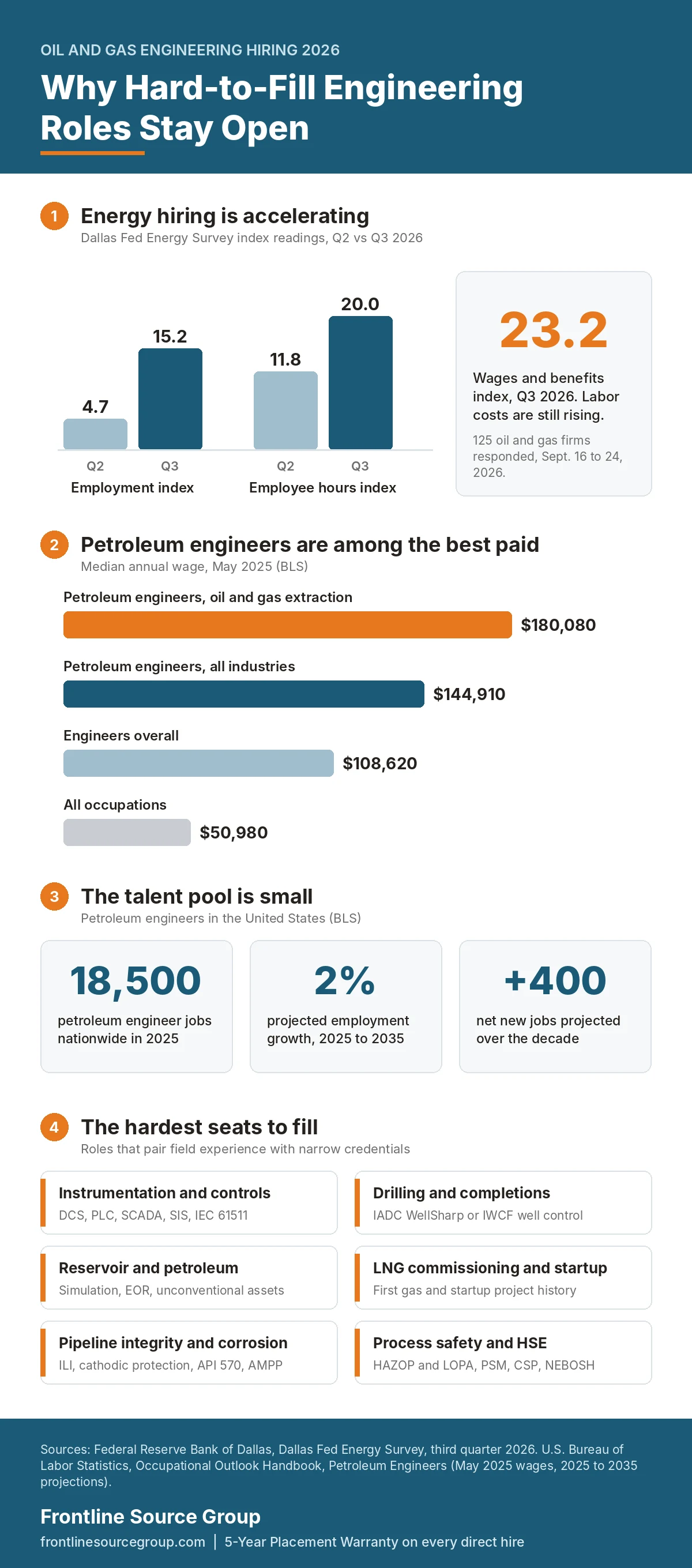
- Energy hiring is heating up. The aggregate employment index in the Dallas Fed Energy Survey jumped from 4.7 to 15.2 in the third quarter of 2026, and the wages and benefits index stayed elevated at 23.2.
- The talent pool is small. BLS counts about 18,500 petroleum engineers in the entire country and projects just 2 percent growth from 2025 to 2035.
- The hardest seats combine field experience with narrow credentials: instrumentation and controls, drilling and completions, reservoir, LNG commissioning, pipeline integrity, and process safety.
- The engineers you want are already employed. Referrals, warm introductions, and a specialist recruiter's mapped network convert far better than a job posting.
- Run the plan in stages: define and benchmark, source in parallel, bridge with contract coverage if the project cannot wait, then measure and reallocate.
In this guide
- Why these roles are hard to fill
- The hardest roles to fill
- Passive sourcing versus job postings
- How a specialist energy recruiter helps
- Pay and retention for remote and basin engineers
- Contract, contract-to-hire, or direct hire
- A four-stage hiring plan
- Why Frontline for energy engineering searches
- Frequently asked questions
Why are oil and gas engineering positions so hard to fill in 2026?
Two things are happening at once. Demand for engineers is climbing again after a flat 2025, and the pool of experienced people who can step into these roles was small to begin with. When both are true, a req that would have closed in a normal market sits open while the project schedule keeps moving.
What does the Dallas Fed Energy Survey show about energy hiring?
The Dallas Fed Energy Survey for the third quarter of 2026, which drew responses from 125 oil and gas firms between September 16 and 24, showed activity still expanding. The aggregate employment index rose from 4.7 in the second quarter to 15.2 in the third, and the employee hours index climbed from 11.8 to 20.0. Firms were hiring and asking existing staff to work more hours. The wages and benefits index held at 23.2, which tells you labor costs are still rising.
The October 2026 Beige Book for the Dallas District said the same thing in plain language: employment growth accelerated in the energy sector, and contacts reported sharp cost pressures from wages and benefits. Frontline's Founder, President, and CEO, Bill Kasko, has served as an advisor to the Dallas Fed for the Beige Book for two decades, reporting on hiring and wage conditions, so this is a market the firm watches closely.
"difficult to find people with strong work ethics who are willing to stay"
Oilfield services firm respondent, Dallas Fed Energy Survey, third quarter 2026
Why is the petroleum engineer talent pool so small?
According to the BLS Occupational Outlook Handbook, there were about 18,500 petroleum engineer jobs in the United States in 2025, and employment is projected to grow only 2 percent, or about 400 jobs, from 2025 to 2035. That is a tiny national pool for an occupation that sits at the center of every drilling and production program. Many experienced engineers left the industry during past downturns, and the ones who stayed tend to be well paid, well treated, and not looking.
The same pattern shows up in adjacent disciplines. Controls, pipeline integrity, and process safety engineers are drawn from broader engineering fields, but the subset with oil and gas operating experience and the right credentials is narrow, and every operator, midstream company, and EPC contractor is competing for the same people.
Which oil and gas engineering roles are hardest to fill right now?
The disciplines under the most pressure share a pattern: they require deep operating experience plus narrow technical or regulatory expertise. Instrumentation and controls engineers, drilling and completions engineers, reservoir engineers, LNG commissioning specialists, pipeline integrity engineers, and process safety engineers consistently top the list of searches that stall.
Each one is scarce for a different reason. Drilling and completions roles require IADC WellSharp or IWCF well control certification on top of basin-specific field judgment that only comes from years of execution. Pipeline integrity engineers have to combine in-line inspection, corrosion mechanics, API and AMPP credentials, and regulatory compliance in one profile. LNG commissioning specialists can only build their credentials by completing actual startups, so their numbers grow slowly no matter how strong demand is.
| Role family | Why supply is scarce | Credentials and skills that set candidates apart |
|---|---|---|
| Instrumentation and controls engineers | Must bridge legacy plant systems and modern automation; the training pipeline is limited | DCS, PLC, SCADA, SIS; ISA, IEC 61511, OSHA 30, TWIC |
| Drilling and completions engineers | Competence depends on field judgment, well history, and operating environment experience | MPD, well control software; IADC WellSharp or IWCF |
| Reservoir and petroleum engineers | The experienced pool is small, and asset-specific EOR or unconventional knowledge takes years to build | Reservoir simulation (Eclipse, CMG, Petrel); EOR experience |
| LNG commissioning and startup engineers | Commissioning expertise comes mainly from completed projects | First gas and startup experience; API, OSHA 30, TWIC |
| Pipeline integrity and corrosion engineers | Combines inspection data, corrosion mechanisms, and regulatory compliance | ILI, fitness for service, cathodic protection; API 570, AMPP (formerly NACE) |
| Process safety and HSE engineers | Employers need people who can turn regulations into operating controls; site history is a major advantage | HAZOP and LOPA, PSM, SIS; CSP, NEBOSH, OSHA 30 |
The hardest profiles cluster around four scarcity attributes: recent field or project experience, cross-disciplinary capability such as controls plus cybersecurity, safety and access credentials such as BOSIET and API certifications, and knowledge of a specific asset or basin that does not transfer easily. Figuring out which of these your open role actually requires tells you which sourcing lever to pull first. Frontline recruits across these disciplines through its oil and gas staffing, engineering staffing, and HSE executive search practices.
Why does passive candidate sourcing beat job postings for hard-to-fill engineering roles?
The engineers who can fill your hardest roles are not scrolling job boards. They are employed, performing well, and unlikely to apply unless a recruiter or someone they trust puts a specific opportunity in front of them. A posting reaches the people who are actively looking. For a scarce discipline, that is usually a small and uneven slice of the market.
Which sourcing channels produce engineering hires?
For a difficult passive engineer search, the channels that turn into hires tend to be the warm ones: employee referrals, former colleagues and contractors, alumni networks, and a specialist recruiter who already knows who is doing the work in a given basin or asset type. Targeted direct outreach on professional networks comes next. Professional societies such as SPE, and conferences such as OTC and NAPE, are good places to build relationships before you need them. Industry job boards still have a role for visibility, but they are not where passive talent converts. If your postings are getting views but not qualified applicants, our guide on why job postings fail to attract qualified candidates walks through the common causes.
What should outreach to a passive engineer say?
The outreach that gets replies leads with relevance, not the vacancy. Mention a specific project, certification, asset type, or technical achievement before you describe the role. Sell the move on technical scope, decision authority, project phase, and how pay is structured, rather than forwarding a generic job description. Use warm paths first and cold outreach second. And ask for a conversation instead of an application. It is a smaller request, and passive engineers respond to it far more often.
How does a specialist energy recruiter help fill hard-to-fill engineering roles?
A generalist approach posts the job and waits. A specialist recruiter keeps an active, mapped network of employed engineers by discipline, basin, and certification, including people who will never show up on a job board. That difference is the whole advantage on a scarce technical search, because the best candidate for a drilling or integrity role is usually someone who is not looking.
At Frontline, energy and engineering searches are led by recruiters who work these markets every day. Shelly Hubble, CSP, Senior Vice President of Operations, specializes in oil, gas, and energy, HSE, and C-suite executive search, and Bill Kasko leads C-suite energy searches. Lindsey Davidson, CDR, Senior Lead Executive Recruiter, counts engineering among her niche areas. Frontline's AI recruiters support the team: Joy Lee helps match candidates to searches, and Lexi Reed conducts first-level interviews with applicants before a human recruiter reviews every candidate.
The firm also has offices in the markets where energy engineers live and work, including Downtown Houston, the Houston Galleria, The Woodlands, Dallas, Denver, and Oklahoma City. If you are weighing whether a search needs a staffing agency or a retained-style executive search, see how to choose between an executive search firm and a staffing agency.
What does a competitive pay package look like for remote and basin engineers?
Start with real data, not last year's offer letter. Benchmarking at the role-definition stage keeps you from losing a finalist over a number you could have fixed weeks earlier.
How much do petroleum engineers earn?
The BLS Occupational Outlook Handbook puts the median annual wage for petroleum engineers at $144,910 in May 2025, compared with $108,620 for engineers overall and $50,980 for all occupations. In the oil and gas extraction industry specifically, the petroleum engineer median was $180,080. Those are base wage figures. Field and rotational roles add premiums on top, and senior specialists in scarce disciplines often command more than the median suggests.
Which retention structures keep engineers past year one?
For remote and basin roles, the package is more than base pay. Candidates look closely at the location premium for isolated or hard-to-reach sites, the rotation schedule (14/14 and 21/21 patterns are common), and whether travel is employer paid. Treat those as compensation, not perks, because candidates do.
Retention structures matter as much as the first offer. Bonuses staged across multiple years tend to keep people through several project phases better than one large sign-on payment that is spent by the second hitch. Annual pay reviews benchmarked against the market, transparent promotion criteria, predictable schedules, and real technical ownership are the levers that money alone cannot replace. When engineers leave early, schedule unpredictability and a lack of ownership come up as often as pay.
Should you use contract, contract-to-hire, or direct hire to fill an engineering gap?
It depends on whether the project date can move and how sure you are about long-term fit. Many energy employers use more than one model at the same time: a contract engineer to protect the schedule while the permanent search runs.
| Engagement model | Best for | What to watch |
|---|---|---|
| Contract staffing | Project ramps, turnarounds, commissioning, and leave coverage where the start date is fixed | Define scope and extension terms up front; specialty premiums apply for roles such as HAZOP leadership or ILI assessment |
| Contract-to-hire | Immediate capacity when you want to see the engineer perform in context before a permanent offer | Agree on the evaluation period and conversion terms before the start date |
| Direct hire | Long-term roles that anchor an asset, program, or team | Compare placement protection; a 90-day guarantee is the industry norm |
A practical two-step approach works for most energy projects. Ask a specialist firm for pre-vetted, available contract engineers with explicit start-date commitments, and contract initially with an extension or conversion option. That gives you coverage without locking in a permanent decision before you have seen the engineer on your site. Frontline's contract staffing makes Frontline the employer of record, and every direct hire is covered by the 5-Year Placement Warranty.
What does a staged hiring plan for hard-to-fill oil and gas engineering roles look like?
Pulling these strategies into a sequence works better than running whichever tactic is most familiar. The order is what makes the difference.
Stage 1: Define the role and benchmark pay. Specify the asset type, operating environment, required certifications, software, and true non-negotiables. Benchmark compensation now, not after an offer has been turned down. This is also the moment to decide which of the four scarcity attributes the role really needs.
Stage 2: Launch sourcing in parallel. Start an internal referral push and professional society outreach at the same time you engage a specialist energy recruiter. Running the channels together builds a fuller candidate pipeline than trying them one after another.
Stage 3: Add contract coverage if the project cannot wait. If the permanent hire cannot land before the project needs someone, bring in a contract engineer for interim coverage while the permanent search continues. That way you are not forced to choose between protecting the schedule and finding the right person.
Stage 4: Measure and reallocate. Track each sourcing channel by qualified response rate and screen-to-interview conversion, then move budget toward what is producing candidates, not just profiles. For more on competing in tight markets, read strategic hiring in high-competition industries.
What makes Frontline Source Group different for oil and gas engineering searches?
For employers, it is a track record you can check: 5,619 plus placements, a 98.94% executive placement retention rate, a 5.0-star Trustpilot rating across 683 verified reviews, 9 consecutive years of Forbes recognition, and published pricing, which is rare in staffing. Every direct hire is covered by the 5-Year Placement Warranty: if a placed employee leaves during the first five years, Frontline credits a prorated portion of the fee based on active calendar days. That is 20 times the 90-day guarantee common across the industry. Certain restrictions apply.
For engineers, it is an advocate who knows how energy companies hire and can put your background in front of decision makers, including on searches that are never posted publicly. There is no cost to candidates.
How do employers and engineers get started with Frontline Source Group?
Employers with an open engineering role can submit the employer request form, review pricing, or reach the team through the contact page. The sooner a specialist is involved, the more options you have.
Engineers looking for their next role should start at frontlinesourcegroup.com/how-to-apply.html. After you apply, Lexi Reed conducts a first interview, and a human recruiter then reviews every candidate and reaches out about roles that fit your discipline and location. Before interviews, review Frontline's interview instructions.
What do employers ask most about hard-to-fill oil and gas engineering roles?
Why are oil and gas engineering positions so hard to fill?
Demand is rising while the experienced talent pool stays small. The Dallas Fed Energy Survey employment index rose from 4.7 to 15.2 in the third quarter of 2026, and BLS counts only about 18,500 petroleum engineers nationwide. Most qualified engineers are already employed and are not applying to postings.
Which oil and gas engineering roles are hardest to fill in 2026?
Instrumentation and controls engineers, drilling and completions engineers, reservoir engineers, LNG commissioning and startup engineers, pipeline integrity and corrosion engineers, and process safety engineers. Each combines field or project experience with narrow credentials such as IADC WellSharp, IWCF, API, AMPP, or IEC 61511.
How much do petroleum engineers earn?
According to the BLS Occupational Outlook Handbook, the median annual wage for petroleum engineers was $144,910 in May 2025, and $180,080 in the oil and gas extraction industry. The median for engineers overall was $108,620. Field and rotational roles often add location premiums on top of base pay.
Is energy sector hiring picking up in 2026?
Yes. In the Dallas Fed Energy Survey for the third quarter of 2026, the aggregate employment index rose from 4.7 to 15.2 and the employee hours index climbed from 11.8 to 20.0. The October 2026 Beige Book for the Dallas District also reported faster employment growth in the energy sector.
Why do job postings fail to attract experienced oil and gas engineers?
The strongest candidates are employed, performing well, and not searching job boards. Postings reach active job seekers, a small slice of the market for scarce disciplines. Referrals, warm introductions, professional societies such as SPE, and a specialist recruiter's network reach the passive engineers who fill hard roles.
What should outreach to a passive oil and gas engineer include?
Lead with relevance: mention a specific project, certification, asset type, or technical achievement before describing the role. Explain the technical scope, decision authority, project phase, and pay structure, and ask for a conversation rather than an application.
What compensation structure helps retain remote or basin-based engineers beyond the first year?
Retention bonuses staged across several years tend to outperform one large sign-on payment. Pair them with a fair location premium, a predictable rotation schedule with employer-paid travel, annual pay reviews benchmarked against the market, and transparent promotion criteria.
When should a company use contract engineers instead of a direct hire?
Use contract engineers when a project date is fixed and the permanent search may not land in time, or for turnarounds, commissioning, and leave coverage. Contract-to-hire works when you need capacity now but want to evaluate fit before a permanent offer. Many employers run contract coverage and a direct hire search together.
What does an oil and gas staffing agency do?
An oil and gas staffing agency recruits engineers, HSE professionals, and other energy talent on contract, contract-to-hire, and direct hire terms. A specialist agency maintains a network of employed engineers by discipline, basin, and certification. Frontline Source Group's energy practice is at frontlinesourcegroup.com/oil-and-gas-energy.html.
What is Frontline Source Group's 5-Year Placement Warranty?
If a direct hire placed by Frontline Source Group leaves during the first five years, Frontline credits a prorated portion of the fee based on active calendar days. That is 20 times the 90-day guarantee common across the industry. Certain restrictions apply. Details are at frontlinesourcegroup.com/5year-placement-guarantee.html.
How does Frontline Source Group price oil and gas engineering searches?
Frontline Source Group publishes its pricing, which is rare in the staffing industry, so employers can see engagement terms before a search starts. Pricing for contract, contract-to-hire, and direct hire placements is at frontlinesourcegroup.com/pricing.html.
How do oil and gas engineers apply for jobs through Frontline Source Group?
Apply at frontlinesourcegroup.com/how-to-apply.html. Lexi Reed, Frontline's AI recruiter, conducts a first interview, and a human recruiter then reviews every candidate and reaches out about roles that fit your discipline and location. There is no cost to candidates.


