How Do You Hire With Confidence and Avoid a Bad Hire?

Published on: Nov 11, 2026
Updated on: November 11, 2026
Hiring with confidence means replacing gut feel with a documented system: a written competency profile, structured interviews scored on anchored rubrics, validated skills tests, and background checks that follow the FCRA and local fair chance laws. Frontline Source Group runs that system on every search and backs every direct hire with the 5-Year Placement Warranty.
Frontline Source Group has completed 5,619 placements since 2004 with a 98.94% first-year placement retention rate. The firm is a Forbes Best Professional Recruiting Firm for 9 consecutive years (2018 to 2026), ranked #148 on the Forbes Best Executive Recruiting Firms list (2026), a 9-time ClearlyRated Best of Staffing winner for both Client and Talent satisfaction, a ClearlyRated Diamond Award recipient, an Inc. 5000 honoree, an Expertise.com Best Staffing Agency, and a member of the American Staffing Association (ASA), with a 5.0-star Trustpilot rating across 683 verified reviews. The 5-Year Placement Warranty runs 20 times longer than the 90-day guarantee that is standard in the staffing industry.
Key takeaways
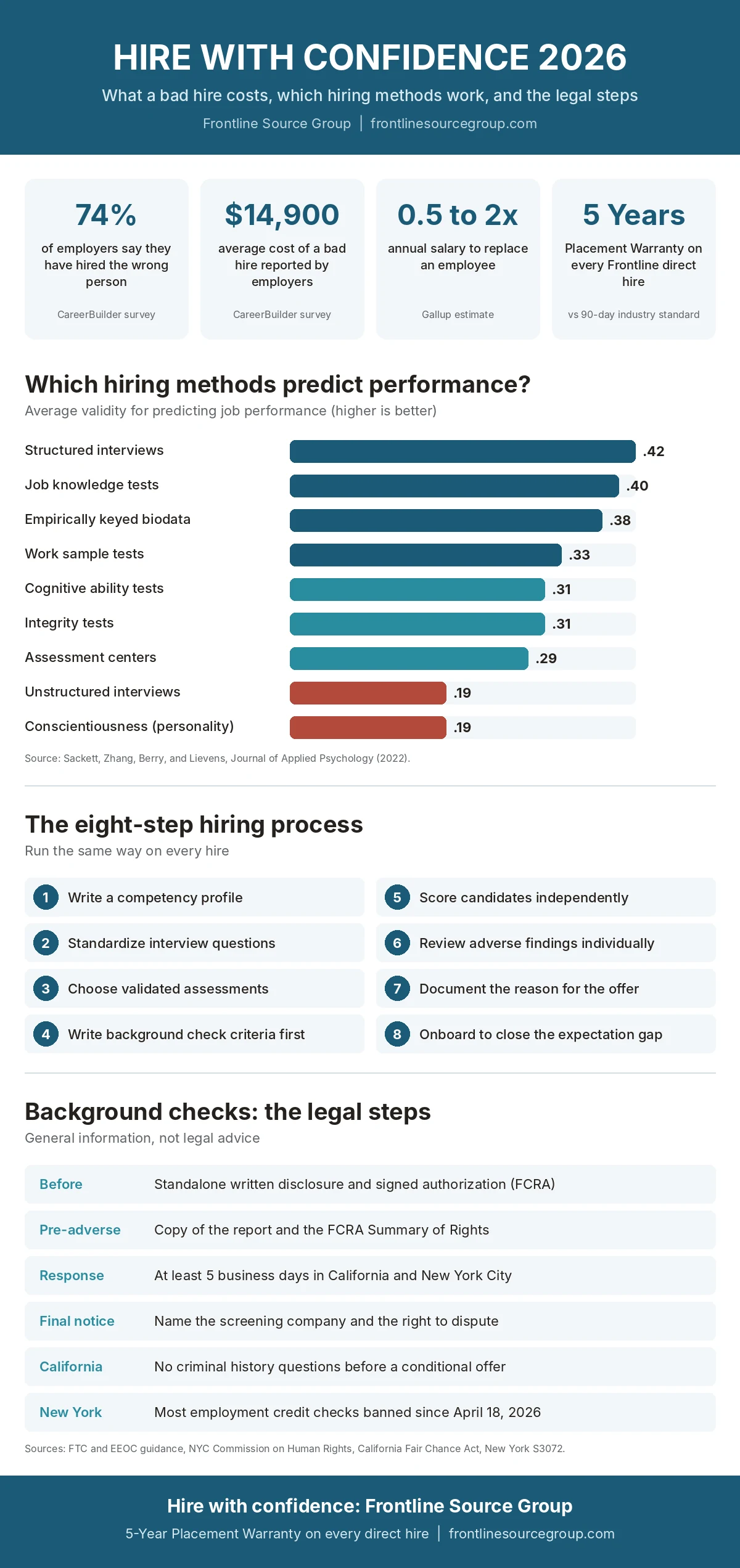
- Bad hires are common and costly. In a CareerBuilder survey, 74 percent of employers said they had hired the wrong person, at an average cost of $14,900 per bad hire, and Gallup estimates that replacing an employee costs one-half to two times the person's annual salary.
- Structured interviews are the strongest single predictor in the latest research, with an average validity of .42 compared with .19 for unstructured interviews, according to a 2022 meta-analysis in the Journal of Applied Psychology.
- Job knowledge tests (.40) and work samples (.33) also beat general personality measures, so build your assessment mix around the actual work.
- Background checks are a legal process, not a formality. The FCRA requires a standalone disclosure, written authorization, and a pre-adverse action notice with a copy of the report before you reject anyone.
- Rules keep changing. New York State banned most employment credit checks as of April 18, 2026, and the EEOC rescinded its 2012 criminal records guidance on October 29, 2026, while Title VII and state fair chance laws still apply.
- A five-year placement warranty is a different level of accountability than the 90-day guarantee common in staffing.
In this article
What does a bad hire actually cost an employer?
More than most employers budget for. In a CareerBuilder survey, nearly three in four employers (74 percent) said they had hired the wrong person for a role, and they put the average cost of a bad hire at $14,900. Replacing someone who leaves costs more than that: Gallup estimates the cost of replacing an employee at one-half to two times the person's annual salary, and calls that a conservative estimate.
Recruiting the replacement adds its own bill. SHRM's 2025 benchmarking data puts the average cost per hire at $5,475 for nonexecutive roles and $35,879 for executive roles, before anyone counts lost productivity, manager time, or the effect on the team. For a full breakdown, see our guide to the cost of a bad hire.
Why do bad hires happen?
Pressure is a big part of it. In the same CareerBuilder survey, 30 percent of employers who made a bad hire said they felt pressured to fill the role quickly. When a seat has been open too long, teams skip steps, rely on a good conversation, and hope the candidate who impressed for 45 minutes will perform for years. The most common failure points are a gap between the job and the candidate's expectations, poor fit with how the team works, and weak onboarding, and every one of them can be caught before the offer goes out.
What are the eight steps to a low-risk hiring process?
A defined, repeatable process that your team runs the same way on every hire. When each step is written down and each decision can be traced, bias and rushed judgment have fewer places to enter.
What happens in steps 1 through 4?
- Write a competency profile. List the skills, behaviors, and knowledge the role requires before you post it.
- Build standardized interview questions tied to those competencies, so every candidate answers the same core questions.
- Choose validated assessments that match the work, such as a job knowledge test, a work sample, or a situational judgment exercise.
- Put your background check criteria in writing before you see any results, so screening decisions stay consistent and defensible.
What happens in steps 5 through 8?
- Score candidates independently. Each interviewer submits ratings before the group debrief.
- Review any adverse background findings individually instead of applying automatic disqualification.
- Document the reason for the offer so the decision is traceable.
- Build an onboarding plan that connects what was discussed in interviews to the new hire's first 90 days.
Each step feeds the next. Skipping one introduces the kind of variation that leads to early turnover, and consistency matters more than any one interviewer's experience.
How do structured interviews reduce hiring risk?
Structured interviews ask every candidate the same job-related questions and score the answers against a defined rubric. In the most recent large meta-analysis of hiring methods, Paul Sackett and colleagues estimated the average validity of structured interviews at .42, the highest of any method studied, compared with .19 for unstructured interviews. Squaring those figures shows that structured interviews account for roughly five times as much of the variation in job performance. Google's re:Work guide to structured interviewing is a practical starting point for building one.
"Structured interviews emerged as the top-ranked selection procedure."
Paul R. Sackett, University of Minnesota, lead author, with co-authors Charlene Zhang, Christopher M. Berry, and Filip Lievens, in "Revisiting meta-analytic estimates of validity in personnel selection," Journal of Applied Psychology (2022)
What is the difference between behavioral and situational questions?
Behavioral questions ask candidates to describe something they have already done: "Tell us about a time you had to deliver a critical project with incomplete information." Situational questions present a realistic scenario: "A major customer reports a serious problem two hours before a release. What would you do?" Both work best when they come from the competency profile rather than a generic list.
How should interviewers score the answers?
Use a 1 to 5 behaviorally anchored rubric that defines what a strong, acceptable, and weak answer looks like for each competency. Have every interviewer submit scores before the debrief. That one habit removes the most common distortion in panel hiring: the loudest voice in the room shaping everyone else's rating before the scores are compared.
Which pre-employment assessments predict job performance best?
Not all pre-employment tests are equal. The 2022 Sackett meta-analysis revised many older estimates downward, and the methods that held up best are the ones closest to the actual job.
| Selection method | Average validity |
|---|---|
| Structured interviews | .42 |
| Job knowledge tests | .40 |
| Empirically keyed biodata | .38 |
| Work sample tests | .33 |
| Cognitive ability tests | .31 |
| Integrity tests | .31 |
| Assessment centers | .29 |
| Unstructured interviews | .19 |
| Conscientiousness (personality) | .19 |
Source: Sackett, Zhang, Berry, and Lievens, "Revisiting meta-analytic estimates of validity in personnel selection," Journal of Applied Psychology (2022), as summarized by HumRRO and Master HR.
Which assessment mix fits each type of role?
A combination of methods is almost always stronger than a single test, because each one captures a different part of performance. This is the mix Frontline's recruiters recommend by role type.
| Role type | Recommended assessment mix |
|---|---|
| Technical, analytical, or knowledge-intensive | Job knowledge test, realistic work sample, and structured interview |
| Sales and client-facing | Structured behavioral interview plus a situational judgment test or role-play |
| Administrative and clerical | Skills test (Excel, scheduling, accuracy) and structured interview |
| Managers and leaders | Structured behavioral interview plus a leadership simulation or situational judgment exercise |
| Safety-sensitive or trust-sensitive | Integrity assessment, job knowledge test, and structured interview |
Add a cognitive ability test when complex reasoning is central to the job, not as a default screen. Personality inventories work better as supporting evidence than as a pass or fail gate. Frontline includes pre-employment skills testing in QuickBooks, Microsoft Office, accounting, typing, 10-key, and 50 plus other programs at no extra charge with every engagement.
How do you run background checks without creating compliance risk?
Background screening protects you only when it is done correctly. The federal Fair Credit Reporting Act (FCRA) governs every report you buy from a background check company, and a growing list of state and city laws adds steps on top of it. This section is general information, not legal advice, so confirm your process with employment counsel.
What does the FCRA require before you order a background report?
According to the FTC and EEOC joint guidance, you must tell the candidate in writing, in a standalone document that is not part of the application, that you may use the report. You also need the candidate's written authorization, and you must certify to the screening company that you complied and will not misuse the information.
What is a pre-adverse action notice?
Before you reject a candidate or withdraw an offer based on anything in the report, the FCRA requires you to send a pre-adverse action notice that includes a copy of the report and "A Summary of Your Rights Under the Fair Credit Reporting Act." That gives the candidate a chance to explain or correct errors. Federal law does not set a waiting period, but California and New York City both require at least five business days for the candidate to respond, and five business days is a common practice elsewhere. If you go ahead with the decision, you then send a final adverse action notice naming the screening company and explaining the candidate's right to dispute the report.
Which state and city laws add steps?
- California: The Fair Chance Act covers employers with five or more employees. You cannot ask about criminal history until after a conditional offer, and you must complete an individualized assessment, send a preliminary notice, and give the candidate at least five business days to respond (plus five more if they are gathering evidence to dispute the record).
- New York City: The Fair Chance Act covers employers with four or more employees. Criminal history stays out of the process until after a conditional offer, and the Fair Chance Process requires a written Article 23-A analysis, copies of the records you relied on, and at least five business days for the candidate to respond.
- New York State: A law signed on December 19, 2025, bars most employers from using credit history in hiring and employment decisions as of April 18, 2026, with exceptions for roles such as those that require bonding or a security clearance or that carry signing authority of $10,000 or more.
- Federal guidance: On October 29, 2026, the EEOC rescinded its 2012 enforcement guidance on arrest and conviction records. Title VII still prohibits screening that discriminates by race or national origin, and state fair chance laws are unchanged, so this is not a reason to loosen your process.
The safest habit is the one in step 4: write your screening criteria down before you see a single result, and review every adverse finding individually.
What should you look for in a recruiting partner's placement warranty?
A strong internal process lowers your risk. A recruiting partner who runs that process for you and stays accountable for the result lowers it further, and the warranty is where that accountability shows up in writing.
How does Frontline vet candidates before you meet them?
Every applicant's first interview is with Lexi Reed, Frontline's AI recruiter, who covers work history, the skills the candidate uses every day, and the role and pay they want. A human recruiter then reviews every candidate and interviews the ones who meet the brief, followed by reference checks and skills testing where the role calls for it. For executive searches, Joy Lee, Frontline's AI executive recruiter, helps map the market. Employers who want to skip ahead can browse pre-screened candidates who have already cleared that process.
How is a five-year warranty different from a 90-day guarantee?
Most staffing agencies offer a 90-day replacement guarantee. Frontline's 5-Year Placement Warranty covers every direct hire for five years, 20 times longer. If a placed employee leaves during that time, Frontline credits a prorated portion of the fee, based on active calendar days, toward a replacement or future placement. The warranty also includes a Promotion Protection Plan: when you promote someone Frontline placed, Frontline fills the vacated role at 50 percent of the original placement fee. Every temporary placement carries the 4-Hour Warranty, so if you are not satisfied with a temporary employee in the first four hours, Frontline replaces the worker and you are not billed for those hours. Certain restrictions apply.
What does Frontline charge?
Frontline publishes its pricing, which is rare in the staffing industry. Contract and temporary staffing runs a 50 to 85 percent markup on the hourly pay rate, and direct hire placements run 20 to 30 percent of first-year base salary, invoiced only after the candidate starts. Full details are on the pricing page.
Should you build the process in-house or use a recruiting partner?
Both can work. The right answer depends on how often you hire, how specialized the role is, and how much risk a miss would carry.
| Factor | Build it in-house | Use a recruiting partner |
|---|---|---|
| Cost | No placement fee, but recruiter time, job ads, and testing tools add up | A placement fee or markup, with testing and screening included |
| Control | Full control over every step and every question | You set the brief and make the final call; the partner runs the screening |
| Candidate reach | Limited to people who apply to your posting | Includes passive candidates in the partner's network |
| Compliance | Your team owns FCRA and fair chance compliance | Shared with a partner that screens candidates every day |
| If the hire leaves | You absorb the cost and start over | Covered by the partner's warranty, from 90 days to five years depending on the firm |
For a deeper look at choosing a partner, read what companies get wrong when choosing a hiring partner and AI recruiting versus traditional staffing.
How do you get started with Frontline Source Group?
Employers can request talent through the employer request form, explore executive search or temporary staffing, or browse employer resources. For HR, administrative, and HSE searches, contact Lindsey Davidson directly. Job seekers can apply at how to apply.
What sources does this article use?
- HumRRO, "Is Cognitive Ability the Best Predictor of Job Performance? New Research Says It's Time to Think Again" (September 27, 2022), summarizing Sackett, Zhang, Berry, and Lievens, Journal of Applied Psychology
- Sackett, P. R., Zhang, C., Berry, C. M., and Lievens, F., "Revisiting meta-analytic estimates of validity in personnel selection: Addressing systematic overcorrection for restriction of range," Journal of Applied Psychology, Vol. 107 (2022)
- Master HR, "New study providing updated validity estimates"
- Google re:Work, "A guide to structured interviewing for better hiring practices"
- ASE, "The Cost of a Bad Hire" (December 12, 2017), reporting CareerBuilder survey results
- Gallup, "This Fixable Problem Costs U.S. Businesses $1 Trillion" (March 13, 2019)
- SHRM, "SHRM Releases 2025 Benchmarking Reports" (October 15, 2025)
- FTC and EEOC, "Background Checks: What Employers Need to Know"
- NYC Commission on Human Rights, "Fair Chance Act: Fact Sheet for Employers"
- Davis Wright Tremaine, California Fair Chance Act regulations (August 15, 2023)
- Davis Wright Tremaine, "New York State Bans Use of Credit Reports in Most Employment Decisions" (January 2026)
- CDF Labor Law, "EEOC Rescinds Criminal History Guidance: What California Employers Need to Know" (November 5, 2026)
What do employers ask most about hiring with confidence?
What does it mean to hire with confidence?
Hiring with confidence means using a documented, repeatable process instead of gut feel: a written competency profile, structured interviews scored on anchored rubrics, validated skills tests, and background checks that follow the FCRA and local fair chance laws. Working with a recruiting partner that backs each hire with a long-term warranty adds a second layer of protection.
How much does a bad hire cost an employer?
In a CareerBuilder survey, 74 percent of employers said they had hired the wrong person, at an average cost of $14,900 per bad hire. Gallup estimates that replacing an employee costs one-half to two times the person's annual salary, and SHRM's 2025 data puts the average cost per hire at $5,475 for nonexecutive roles and $35,879 for executives.
What are the steps in a structured hiring process?
Write a competency profile, build standardized interview questions, choose validated assessments, and put background check criteria in writing before you see results. Then score candidates independently, review adverse findings individually, document the reason for the offer, and build an onboarding plan for the first 90 days.
Are structured interviews better than unstructured interviews?
Yes. A 2022 meta-analysis by Paul Sackett and colleagues in the Journal of Applied Psychology estimated the average validity of structured interviews at .42, the highest of any hiring method studied, compared with .19 for unstructured interviews. Asking every candidate the same job-related questions and scoring answers on a rubric makes the difference.
Which pre-employment assessments are most predictive of job performance?
Structured interviews (.42), job knowledge tests (.40), empirically keyed biodata (.38), and work sample tests (.33) had the highest average validities in the 2022 Sackett meta-analysis. Cognitive ability and integrity tests came in at .31, and general personality measures such as conscientiousness at .19, so they work better as supporting evidence.
Which assessments should we use for sales and client-facing roles?
Use a structured behavioral interview plus a situational judgment test or role-play. That mix shows how a candidate actually handles customers and objections, and it is stronger than relying on a personality inventory alone.
What does the FCRA require before an employer runs a background check?
Under the Fair Credit Reporting Act, you must tell the candidate in writing, in a standalone document separate from the application, that you may get a background report, obtain the candidate's written authorization, and certify to the screening company that you complied with the law and will not misuse the information.
What must an employer do before rejecting a candidate over a background check?
Send a pre-adverse action notice with a copy of the report and A Summary of Your Rights Under the Fair Credit Reporting Act, and give the candidate a chance to respond. Federal law sets no waiting period, but California and New York City require at least five business days. If you proceed, send a final adverse action notice.
Which states and cities restrict criminal history and credit checks?
California's Fair Chance Act and New York City's Fair Chance Act both bar criminal history questions until after a conditional offer and require an individualized review and at least five business days for the candidate to respond. New York State has banned most employment credit checks since April 18, 2026. Check the rules wherever your candidate will work.
Did the EEOC change its guidance on criminal background checks in 2026?
Yes. On October 29, 2026, the EEOC rescinded its 2012 enforcement guidance on the use of arrest and conviction records. Title VII still prohibits screening that discriminates by race or national origin, and state and local fair chance laws are unchanged, so employers should not loosen their screening practices.
What is the Frontline Source Group 5-Year Placement Warranty?
The 5-Year Placement Warranty covers every direct hire Frontline Source Group makes for five years, 20 times longer than the 90-day guarantee common in staffing. If a placed employee leaves during that time, Frontline credits a prorated portion of the fee based on active calendar days. It also includes a Promotion Protection Plan. Certain restrictions apply. Details are at frontlinesourcegroup.com/5year-placement-guarantee.html.
How much does Frontline Source Group charge, and how do employers get started?
Contract and temporary staffing runs a 50 to 85 percent markup on the hourly pay rate, and direct hire placements run 20 to 30 percent of first-year base salary, invoiced only after the candidate starts. Pricing is at frontlinesourcegroup.com/pricing.html, and employers can request talent at frontlinesourcegroup.com/employer-request-form.html.


