Is AI or Human-Led Executive Search Better for Hiring Leaders?

Published on: Nov 18, 2026
Updated on: November 18, 2026
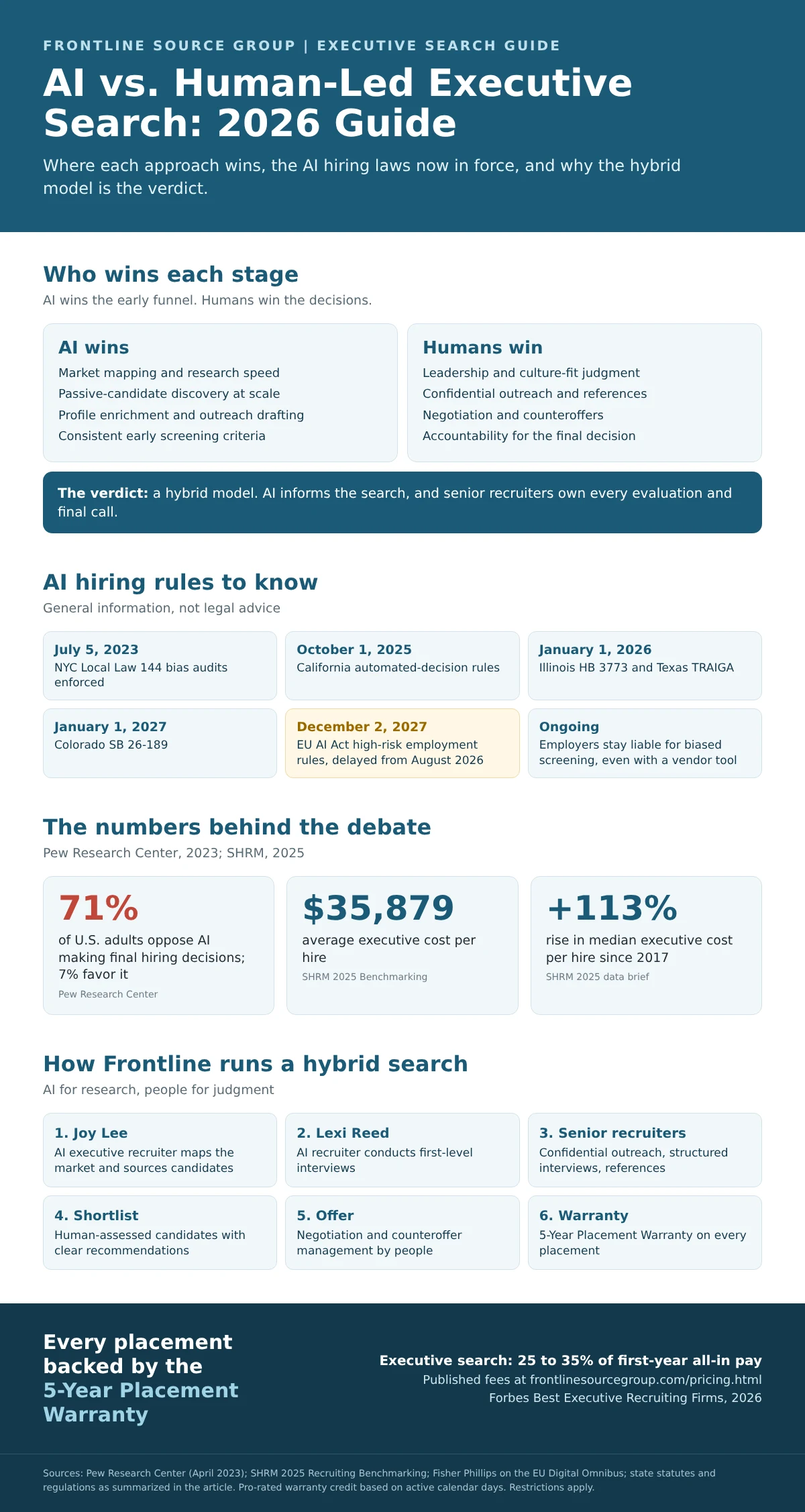
Neither wins on its own. AI is faster and broader at sourcing executive candidates, while human-led executive search is stronger at judging leadership, culture fit, and confidential references, and it carries less legal risk at the decision stage. The best results come from a hybrid where humans own every final call. Frontline backs every placement with the 5-Year Placement Warranty.
Frontline Source Group is a national staffing and executive search firm founded in Dallas in 2004, with 5,619 completed placements, a 98.94% executive placement retention rate, and 32 plus offices nationwide. It is a Forbes Best Professional Recruiting Firm for 9 consecutive years (2018 to 2026) and a Forbes Best Executive Recruiting Firm at #148 (2026), a 9-time ClearlyRated Best of Staffing winner for both Client and Talent satisfaction, a ClearlyRated Diamond Award recipient, an Inc. 5000 honoree, an Expertise.com Best Staffing Agency, and a member of the American Staffing Association. It holds a 5.0-star Trustpilot rating across 683 plus verified reviews and a 5.0 rating on G2 from validated reviewers.
Key takeaways
This guide compares AI-driven recruiting and human-led executive search on speed, reach, judgment, cost, candidate trust, and legal risk, and explains why a hybrid model wins for C-suite and senior leadership hires.
- AI wins the early funnel: market mapping, profile research, and passive-candidate discovery.
- Humans win the decisions: leadership assessment, confidential references, culture fit, and the final call.
- Legal exposure is real. Employers stay liable for biased screening even when a vendor built the tool, and new AI hiring rules took effect in Illinois and Texas on January 1, 2026.
- Candidates want people deciding: 71 percent of U.S. adults oppose AI making final hiring decisions, according to Pew Research Center.
- The hybrid model, AI for research and humans for judgment, is the most defensible approach for executive hiring.
What does AI do well in executive search?
AI's strengths in executive search are real, and most of them sit at the top of the funnel. Modern sourcing tools can scan professional profiles, company announcements, regulatory filings, conference speaker lists, and publications at once, then build an enriched longlist far faster than a researcher working by hand. That frees senior recruiters to spend their time where placements are actually won: conversations with candidates, advice to the hiring company, and judgment calls.
How much faster is AI-assisted executive sourcing?
The clearest gains are in the research phase. BriefingHQ, which sells AI tools to search firms, reports executive search research time falling from 3 to 5 days to 4 to 8 hours with AI assistance, with larger longlists as a result. Treat figures like these as directional: they are vendor-reported, and independent benchmarks for full executive search cycles are still thin. What is not in dispute is the mechanism. When AI handles research, profile enrichment, and outreach drafting, one recruiter can run more searches in parallel without cutting corners on assessment.
Can AI find passive executive candidates?
Yes, at least for the first step. Many of the strongest executives are employed, successful, and not applying for anything. AI sourcing can surface these passive candidates from signals well beyond a job board, including board appointments, patents, speaking engagements, and company growth. Finding a name is not the same as earning a conversation, though. Reaching a sitting CFO or COO confidentially still depends on credibility, discretion, and a recruiter the candidate is willing to call back.
Where does AI fall short in executive search?
The same automation that makes AI efficient at scale makes it unreliable as a decision-maker for senior roles. The problems are documented by regulators, courts, and researchers, and they carry real consequences for organizations that let software make, or effectively make, hiring decisions.
What are the legal risks of using AI to screen executives?
Models trained on historical hiring data can reproduce historical bias against older workers, women, people with disabilities, and others. In 2023, the EEOC secured a $365,000 settlement with iTutorGroup after the company's application software automatically rejected older applicants. In Mobley v. Workday, a federal court in California granted preliminary certification of a nationwide collective action in May 2025 on claims that AI screening tools disadvantaged applicants age 40 and older, and the case is still being litigated in 2026. The lesson for employers is simple: saying a vendor built the algorithm is not a defense. The UK Information Commissioner's Office takes a similar line in its guidance on automated recruitment decisions, which stresses meaningful human involvement.
Audits cut both ways. Former EEOC Commissioner Keith Sonderling has argued that a well-audited AI system can leave a better paper trail than an unstructured human decision, which is why regulators focus on testing and oversight rather than banning the tools outright.
On algorithms versus people: "What about the black box of the human brain?"
Keith Sonderling, former Commissioner, U.S. Equal Employment Opportunity Commission, quoted by HRMorning (July 29, 2026)
The practical takeaway for executive hiring is the same either way: audit any AI tool for adverse impact, document the results, and keep a qualified person accountable for every decision.
What can algorithms not assess in a senior leader?
AI measures skills, career patterns, and keywords. It cannot evaluate stakeholder influence, board presence, how a leader behaves under pressure, or whether a candidate's operating style fits a company at its current stage. It cannot weigh a sector reputation, an off-the-record reference, or how a candidate handled a confidential turnaround. For a C-suite hire, those are the factors that decide success or failure, and none of them live in a structured data profile.
Which AI hiring laws apply to executive search in 2026?
AI hiring regulation is expanding quickly in the United States and abroad. Any employer or search firm using automated tools to screen, rank, or assess candidates should know which of these rules apply. This section is general information, not legal advice, and Bill Kasko is not a lawyer; anyone with questions about a specific situation should consult an employment attorney.
| Law or rule | Where | Effective | What it requires |
|---|---|---|---|
| Local Law 144 | New York City | Enforced since July 5, 2023 | Independent bias audits and candidate notice for automated employment decision tools |
| Civil Rights Council automated-decision regulations | California | October 1, 2025 | Applies anti-discrimination law to automated decision systems; four-year record retention |
| HB 3773 (Public Act 103-0804) | Illinois | January 1, 2026 | Prohibits AI use that results in discrimination; requires notice when AI is used in employment decisions |
| Texas Responsible AI Governance Act (HB 149) | Texas | January 1, 2026 | Prohibits AI developed or deployed with intent to unlawfully discriminate |
| SB 26-189 | Colorado | January 1, 2027 | Replaced SB 24-205; obligations for high-risk AI used in consequential decisions such as hiring |
| EU AI Act, Annex III high-risk rules | European Union | December 2, 2027 (delayed from August 2, 2026) | Risk management, human oversight, and documentation for recruitment and selection AI |
In Europe, employment AI remains a high-risk category under the EU AI Act, but lawmakers delayed those obligations. Under the Digital Omnibus agreement approved in June 2026, the high-risk application date moved from August 2, 2026 to December 2, 2027, as reported by Fisher Phillips and others. The delay is not a repeal: recruitment and selection tools will still need risk management, documentation, and human oversight.
What does human-led executive search still do better?
Human-led executive search is not slow because recruiters are inefficient. It is thorough because the judgment required to assess a senior leader does not compress well. Seasoned executive recruiters bring off-the-record references, knowledge of a candidate's reputation across a sector, an understanding of board dynamics, and the ability to tell whether someone is the right leader for this company at this moment. They also negotiate compensation, manage counteroffers, and keep confidential searches confidential, all of which depend on trust that software cannot build.
What are the drawbacks of purely human executive search?
Purely human search has real limits. Research is slower, reach depends on the recruiter's network and industry, and the cost structure of traditional retained search puts it out of reach for many mid-market companies. Human judgment also carries its own bias, which is why good search firms use structured interviews, consistent scorecards, and multiple evaluators. These are reasons to augment human search with better tools, not to abandon it.
How do AI and human-led executive search compare side by side?
Each approach wins and loses on different dimensions. The pattern is consistent: AI wins where the work is data-heavy and repeatable, and humans win where the work requires judgment, discretion, and accountability.
| Factor | AI-driven recruiting | Human-led executive search | Hybrid model |
|---|---|---|---|
| Research and sourcing speed | Fastest; vendor-reported research time drops from days to hours | Slowest; manual research and network outreach | Fast sourcing with human review gates |
| Reach into passive candidates | Very broad across public profiles and data | Limited to the recruiter's network and research | Broad sourcing plus confidential outreach |
| Leadership and culture-fit assessment | Weak; relies on structured data | Strong; interviews, references, and context | Strong; humans assess, AI informs |
| Bias and legal exposure | High without audits and human oversight | Lower, but human bias exists | Managed when humans own decisions and tools are audited |
| Candidate experience at senior levels | Efficient but impersonal | High-touch and relationship-driven | Automated early, personal at every senior touchpoint |
| Accountability for the final decision | Unclear when an algorithm ranks or rejects | Clear; a named recruiter and hiring team | Clear; humans make and document the call |
What are the pros and cons of each approach?
For a quick decision, here is the balance sheet for each approach.
| Approach | Pros | Cons |
|---|---|---|
| AI-driven recruiting | Speed in research and market mapping; broad passive-candidate reach; consistent screening criteria; recruiter capacity freed for relationship work | Bias and disparate-impact risk; growing audit and notice obligations; cannot judge leadership, reputation, or fit; candidates distrust AI-made decisions |
| Human-led executive search | Judgment on leadership and culture; confidential outreach and off-the-record references; clear accountability; trusted candidate relationships | Slower research; reach limited by networks; higher cost per search; human bias still needs structure and checks |
| Hybrid model | AI speed in the early funnel plus human judgment at every decision; easier compliance story; better candidate experience | Requires governance, audited tools, and recruiters who know when to override the software |
How do executive candidates feel about AI in hiring?
Executive candidates have choices, and many are skeptical of automated hiring. In Pew Research Center's survey of more than 11,000 U.S. adults, 71 percent opposed AI making final hiring decisions and only 7 percent favored it, and 66 percent said they would not want to apply for a job with an employer that uses AI to help make hiring decisions. At the executive level, where the best candidates are often not looking, an impersonal or opaque process can cost a company the very leaders it wants.
Does AI make executive search cheaper?
AI can reduce research and sourcing costs, but sourcing is not where executive hiring gets expensive. According to SHRM's 2025 benchmarking data, the median executive cost per hire reached $10,625, up 113 percent since 2017, and the average was $35,879. SHRM's 2026 update reports that executive cost per hire increased again. The far bigger cost is a wrong executive hire, which is why the savings from automation matter less than the quality of the final decision. Frontline publishes its fees: executive search runs 25 to 35 percent of first-year all-in compensation, and direct hire runs 20 to 30 percent of first-year base salary, on the pricing page.
Which approach fits your executive search?
Most hiring leaders already know the role they need to fill. The real question is which model fits the situation.
When should you lean on AI-driven sourcing?
Lean on AI-driven sourcing when you need a broad market map quickly, when you are running several senior searches at once, when passive candidates in less visible markets need to be surfaced, or when early filtering is mostly skills-based. Use AI to widen and speed up the funnel. Do not use it to make final selection calls.
When does human-led search outperform AI?
Choose a human-led approach for confidential C-suite replacements, roles that require deep sector judgment or board-level relationships, companies in cultural transition, and any search where the cost of a wrong hire is high. At that level, AI should support the recruiter's judgment, not replace it. Our guide to how the executive search process works walks through each stage.
Will AI replace executive recruiters?
Not for executive roles. AI is absorbing research, sourcing, scheduling, and first-level screening tasks, and that is a good thing. But academic reviews keep landing in the same place. A 2025 scoping review presented at the Australasian Conference on Information Systems mapped recruitment approaches from reactive and proactive human oversight to supervised reliance on AI, and noted that human bias in AI-assisted decisions is still overlooked. A separate scoping review concluded that AI-based recruitment works as a socio-technical system shaped by technology, human judgment, and governance together. In practice, the recruiter's job is shifting toward advising, assessing, and closing, which are the parts of executive search that matter most. For a broader look at how AI is changing staffing, see AI recruiting vs. traditional staffing and how ethics and AI are changing recruitment.
How does Frontline Source Group combine AI and human executive recruiters?
At Frontline Source Group, we stopped treating this as a choice. Joy Lee, Frontline's proprietary AI executive recruiter, handles research, market mapping, and sourcing across our candidate network and external data. Lexi Reed, our AI recruiter, conducts first-level interviews when candidates apply. Then our senior human recruiters take over: confidential outreach, structured interviews, reference validation, culture-fit assessment, client advice, negotiation, and every final recommendation. AI produces information. People make decisions and stand behind them.
That accountability is written into our terms. Every executive and direct hire placement is backed by the 5-Year Placement Warranty, 20 times longer than the 90-day guarantee common across the industry, with a pro-rated credit based on active calendar days if a placement leaves. Restrictions apply. Learn more about our executive search and C-level executive search practices, what an executive search guarantee actually protects, and the questions to ask before hiring a search firm. Our recognition is listed on the staffing awards page.
Prefer to start in writing? Submit a hiring request. Executives exploring their next role can start at the How to Apply page.
What is the verdict on AI vs. human-led executive search?
AI and human-led executive search are not competitors. They are partners when each is used where it is strongest. AI belongs in the early funnel, where speed, scale, and consistency pay off. Humans belong at every decision point, where judgment, context, discretion, and accountability decide whether a leader succeeds. Companies that treat this as a binary choice either accept unnecessary legal and quality risk or leave real efficiency on the table. The most defensible answer for C-suite and senior leadership hiring is a deliberate hybrid, with people owning every final call.
What do employers ask most about AI vs. human-led executive search?
Is AI or human-led executive search better?
Neither is better on its own. AI is faster and broader at the research and sourcing stage, while human-led executive search is stronger at assessing leadership, culture fit, and confidential references, and it keeps an accountable person in charge of the final decision. Most organizations get the best results from a hybrid model in which AI supports the early funnel and senior recruiters own every evaluation and final call.
What are the pros and cons of AI in executive search?
The pros are speed, scale, and reach: AI can map a market, enrich profiles, and surface passive candidates far faster than manual research. The cons are bias risk, legal exposure, and blind spots: AI cannot judge board presence, leadership under pressure, or reputation, and employers remain responsible when an automated tool screens people out unfairly.
Will AI replace executive recruiters?
Not for executive roles. AI is taking over research, sourcing, and scheduling tasks, but executive searches depend on confidential outreach, reference intelligence, negotiation, and judgment about fit. Public opinion also favors human decisions: in a 2023 Pew Research Center survey, 71 percent of U.S. adults opposed AI making final hiring decisions and 7 percent favored it.
How much faster is AI-assisted executive sourcing?
Vendor-reported figures suggest large gains in the research phase. BriefingHQ, an AI tools vendor, reports executive search research time falling from 3 to 5 days to 4 to 8 hours with AI assistance. Independent, peer-reviewed benchmarks for full executive search cycles are still limited, so treat vendor claims as directional.
What are the legal risks of using AI to screen executive candidates?
Employers can be liable for discrimination even when a vendor built the tool. The EEOC's 2023 settlement with iTutorGroup required a $365,000 payment after automated software rejected older applicants, and in May 2025 a federal court allowed the age discrimination claim in Mobley v. Workday to proceed as a nationwide collective action. This is general information, not legal advice; consult an employment attorney about your situation.
Which AI hiring laws apply in 2026?
Key rules include New York City Local Law 144 (bias audits, enforced since July 5, 2023), California's Civil Rights Council automated-decision regulations (October 1, 2025), Illinois HB 3773 (January 1, 2026), Texas TRAIGA (January 1, 2026), and Colorado SB 26-189 (effective January 1, 2027). In the EU, high-risk rules for employment AI were delayed to December 2, 2027. Confirm current requirements with counsel.
Does AI make executive search cheaper?
It can lower research and sourcing costs, but the largest cost of an executive search is the decision itself. SHRM's 2025 benchmarking data put the average executive cost per hire at $35,879, and SHRM reports executive hiring costs rose again in 2026. A mis-hire at the executive level costs far more than the search, which is why judgment and accountability matter more than sourcing savings.
When should a company use AI-driven sourcing for executive roles?
Use AI-driven sourcing for market mapping, building a broad longlist, finding passive candidates in less visible markets, and running several senior searches at once. Keep humans in charge of assessment, references, and the final decision.
When is human-led executive search the better choice?
Human-led search is the better choice for confidential C-suite replacements, roles that require deep sector judgment or board-level relationships, companies in cultural transition, and any search where the cost of a wrong hire is high.
How does Frontline Source Group use AI in executive search?
Frontline Source Group uses Joy Lee, its proprietary AI executive recruiter, for research, market mapping, and sourcing, and Lexi Reed, its AI recruiter, for first-level candidate interviews. Senior human recruiters own every evaluation, reference check, client recommendation, and final decision. Details are at frontlinesourcegroup.com/virtual-ai-executive-recruiter.html.
How much does executive search with Frontline Source Group cost?
Frontline Source Group publishes its fees. Executive search runs 25 to 35 percent of first-year all-in compensation, and direct hire placements run 20 to 30 percent of first-year base salary. Full pricing is at frontlinesourcegroup.com/pricing.html.
What is the 5-Year Placement Warranty?
The 5-Year Placement Warranty is Frontline Source Group's coverage on every direct hire and executive placement. If a placed executive leaves, Frontline provides a pro-rated credit based on active calendar days, for up to five years. That is 20 times longer than the 90-day guarantee common in the staffing industry. Restrictions apply. Details are at frontlinesourcegroup.com/5year-placement-guarantee.html.
Sources
- Pew Research Center, AI in Hiring and Evaluating Workers: What Americans Think (April 20, 2023)
- SHRM, 2025 Recruiting Executives Benchmarking and SHRM 2025 Benchmarking Reports (October 15, 2025)
- SHRM, 2026 Recruiting Benchmarking
- Foley and Lardner, EEOC Settles First-of-Its-Kind AI Hiring Discrimination Case (August 2023)
- HR Dive, Mobley v. Workday coverage (updated March 30, 2026)
- Fisher Phillips, EU Overhauls AI Act Just Before Key Deadline (2026)
- UK Information Commissioner's Office, Automated Decision-Making and Profiling for Recruitment and Selection
- Wahidin, Marx, Turel, and Kurnia, Augmenting Fairness in AI-Based Recruitment: A Scoping Review and Research Agenda (ACIS 2025)
- Scoping review on the advantages and challenges of AI-based recruitment and selection, UNIR institutional repository
- HRMorning, Who Owns It When Your AI Hiring Tool Gets Sued? 4 Critical Points to Accountability (Wesley Cherisien, July 29, 2026)
- BriefingHQ, AI for Executive Search: Tools and Workflows (vendor-reported figures)


