What Should a Placement Warranty in a Staffing Agreement Include?

Published on: Nov 16, 2026
Updated on: November 16, 2026
A placement warranty in a staffing agreement should spell out six things: how long coverage lasts, what remedy you get and how it is calculated, which events trigger it, how to file a claim, a short list of exclusions, and the screening and compliance terms behind it. Frontline Source Group backs every direct hire with a 5-Year Placement Warranty. That is 20 times longer than the 90-day industry standard guarantee. Restrictions apply.
Frontline Source Group has recruited for employers since 2004, with 5,619 completed placements, a 98.94% executive placement retention rate, and 32 plus offices nationwide. The firm holds a 5.0-star Trustpilot rating across 683 verified reviews and a 5.0 rating on G2 from validated reviewers. It is a Forbes Best Professional Recruiting Firm for 9 consecutive years (2018 to 2026), ranked #148 on the Forbes Best Executive Recruiting Firms list (2026), a 9-time ClearlyRated Best of Staffing winner for both Client and Talent satisfaction, a ClearlyRated Diamond Award recipient, an Inc. 5000 honoree, an Expertise.com Best Staffing Agency, and a member of the American Staffing Association (ASA).
Key takeaways
- A warranty is only as strong as its written terms. If a clause is not in the agreement, assume it does not exist.
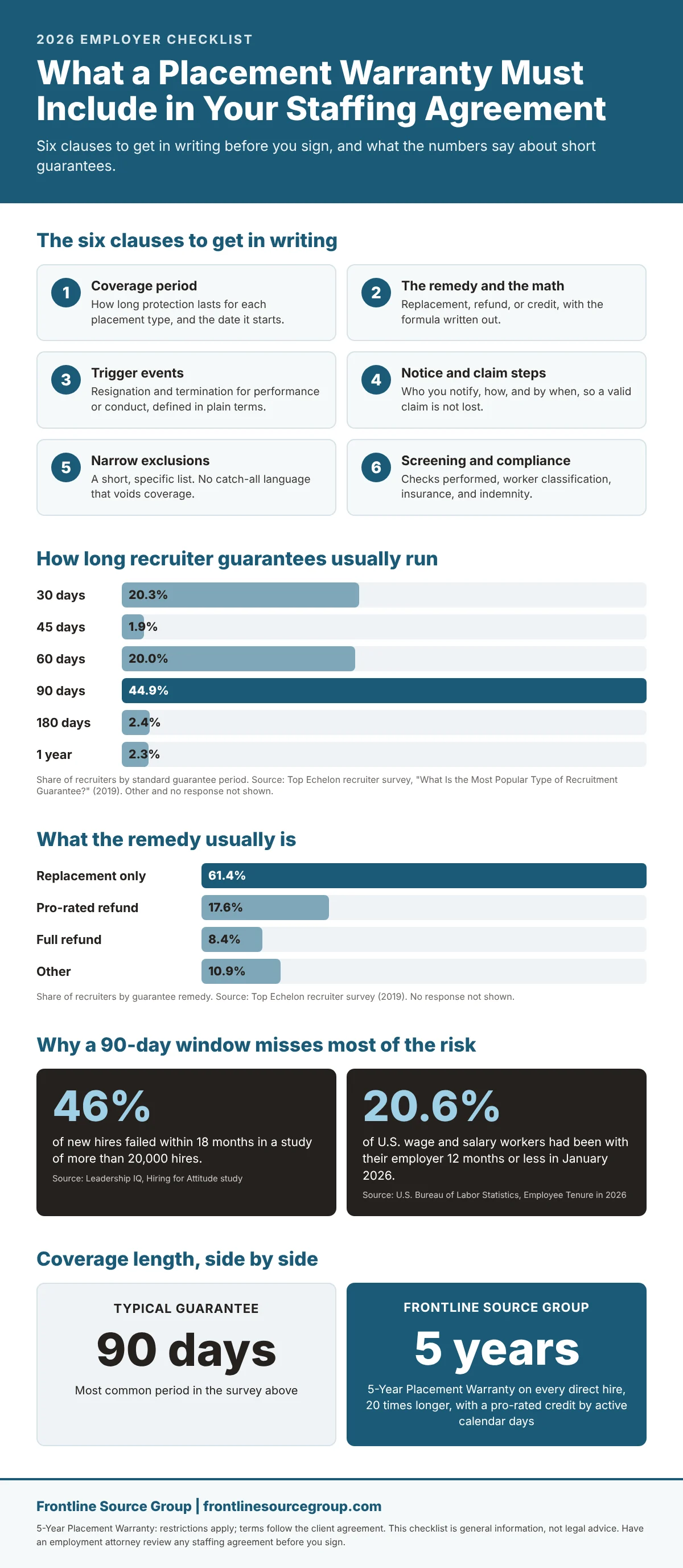
- 90 days is the most common guarantee period, chosen by 44.9 percent of recruiters in a 2019 Top Echelon survey, yet many hiring problems surface later.
- Get the remedy math in writing. Replacement, refund, and credit models pay out very differently once a few months have passed.
- Define "cause," list the trigger events, and put the notice steps in the contract so a valid claim is never lost on a technicality.
- Keep exclusions narrow and specific. Catch-all language can void coverage whenever a situation gets complicated.
- Screening, worker classification, insurance, and indemnity terms belong next to the warranty, because they decide who pays when something goes wrong.
On this page
What six clauses should a placement warranty in a staffing agreement include?
Most employers read the fee line closely and skim the warranty section. That is backwards. The fee tells you what a hire costs when it works out. The warranty tells you what happens when it does not, and that is the part of the agreement you will actually need to enforce. Use the six clauses below as a checklist against any draft agreement. If a clause is missing or vague, ask for it in writing before you sign.
| Clause | What the agreement should say | Red flag |
|---|---|---|
| 1. Coverage period | Length of coverage for each placement type and the date the clock starts | "Standard terms apply" with no number attached |
| 2. Remedy and calculation | Replacement, refund, or credit, with the formula and how the remedy can be used | "A replacement will be provided" and nothing more |
| 3. Trigger events | Resignation and termination for performance or conduct, with "cause" defined | Coverage only if the agency agrees the hire "failed" |
| 4. Notice and claim steps | Who to notify, in what form, by when, and what the agency owes in response | No notice process at all, or one buried in a separate document |
| 5. Exclusions | A short, specific list such as layoffs, role elimination, and changes you make to the job | "Any termination for any reason" or "any workplace dispute" |
| 6. Screening and compliance | Checks performed, worker classification, insurance, and indemnity | "Thorough screening" with no list of checks |
This post is the clause-by-clause contract checklist. For a plain-language overview of what placement warranties typically cover and leave out, read what a staffing agency placement warranty actually covers. For the broader due diligence that comes before the contract, see how to evaluate a staffing agency before you sign.
How long should a placement warranty last?
Long enough to cover the period when hiring problems actually show up. In a 2019 Top Echelon survey of recruiters, 95.9 percent said they offer some kind of guarantee, and 90 days was the most common period at 44.9 percent. Another 20.3 percent offered 30 days and 20.0 percent offered 60 days. Only 2.4 percent offered 180 days and 2.3 percent offered a full year.
The trouble is timing. In a Leadership IQ study of more than 20,000 new hires, 46 percent failed within 18 months, and most of those failures came down to attitude and fit rather than technical skill. Those problems rarely surface in the first quarter. Turnover early in a job is common too: the U.S. Bureau of Labor Statistics found that 20.6 percent of wage and salary workers had been with their current employer for 12 months or less in January 2026. A warranty that ends at day 90 leaves most of that window uncovered.
What is a typical recruiter guarantee period?
Ninety days is the closest thing the industry has to a standard for direct hire placements, with 30 and 60 days close behind. Contract staffing often carries no replacement guarantee at all, because the worker stays on the agency's payroll. Treat any period as a starting point for negotiation rather than a fixed rule, and compare it against how long it usually takes you to know whether a hire is working out.
Should coverage differ for temporary, direct hire, and executive placements?
Yes, and the agreement should say so by placement type. A temporary worker's fit is usually clear within the first day, so the useful protection there is a replacement with no billing for the hours that did not work. A direct hire or executive needs far longer coverage, because leadership and judgment problems take months to show. Frontline Source Group's 4-Hour Warranty covers temporary placements, and its 5-Year Placement Warranty covers qualifying direct hire and executive search placements.
When should the coverage clock start?
On the hire's first day of work, not the offer date or the invoice date. If a candidate accepts in March and starts in May, a clock that starts at the offer quietly takes two months off your coverage. Ask for the start date to be the trigger in writing.
Should the remedy be a replacement, a refund, or a credit?
Each model can work, but they pay out very differently, and the agreement should state which one applies. The same Top Echelon survey found that 61.4 percent of recruiters offer a replacement with no money back, 17.6 percent offer a pro-rated refund, and 8.4 percent offer a full refund. Whatever the model, the calculation and the rules for using it belong in the contract, not in a follow-up email.
| Remedy | How it usually works | What to pin down |
|---|---|---|
| Replacement search | One new search for the same role, usually inside a short window | Number of searches, same role and pay band, what happens if no one is hired |
| Refund | Cash back, often in full early on and stepping down after | The exact schedule, and when the refund is paid |
| Pro-rated credit | A share of the original fee, scaled to the time the hire stayed | The formula, the coverage length, whether it applies to a future placement, and any expiration |
How should a pro-rated credit be calculated?
The cleanest formula prorates the original fee by days of service, so the longer the hire stays, the smaller the credit. Stepped bands (for example, a set percentage back in each 30-day block) are also common. Either is fine as long as the method is written into the agreement before you sign. The table below shows why coverage length matters more than the remedy label. It uses a 20,000 dollar fee, which is 20 percent of a 100,000 dollar salary, and a simple straight-line proration over five years. It is an illustration only; the actual credit always follows the signed client agreement.
| If the hire leaves at | Typical 90-day guarantee | Illustrative 5-year pro-rated credit |
|---|---|---|
| Day 60 | Usually one replacement search | About 19,340 dollars |
| Day 120 | Nothing; coverage has ended | About 18,680 dollars |
| 1 year | Nothing | About 16,000 dollars |
| 20 months | Nothing | About 13,340 dollars |
| 3 years | Nothing | About 8,000 dollars |
What makes a replacement search clause enforceable?
Specifics. The clause should state how many replacement searches are included, that the replacement covers the same role, seniority, location, and pay band, and what happens if you do not hire anyone the agency presents. Without those details, "one replacement" can mean a single resume sent months later for a slightly different job.
Which credit terms should you read twice?
Four of them. First, the formula: by calendar day, by month, or by stepped band. Second, the length of coverage, because a credit that runs for years is worth far more than one that ends at day 90. Third, where the credit can be used: a replacement for the same role only, or any future placement. Fourth, whether the credit expires. A long, day-by-day credit that can go toward a future hire is a strong remedy; a short credit that expires quickly and only applies to the identical role is a weak one.
What events should trigger the warranty?
At minimum, the warranty should apply if the placed employee resigns or is let go for performance or conduct during the coverage period. Those are the two situations where you have paid for a hire and lost them through no decision of your own. The agreement should also define "cause" in plain terms, because agencies and employers often read that word differently. If the contract says the warranty applies only to a "failed placement" and leaves the agency to decide what failed means, push for objective triggers instead.
Candidate misrepresentation deserves its own line. If a placed employee is found to have misstated credentials, licenses, or work history that the agency was supposed to verify, the warranty should apply regardless of when it comes to light within the coverage period. For more contract warning signs beyond the warranty itself, see staffing agency red flags to watch for before signing.
What notice and claim steps should the contract spell out?
A valid claim can still be lost on process. Some agreements set a short written notice window after the employee's last day, and missing it can forfeit the remedy entirely. Read this section before you sign, not the week someone gives notice.
- Who to notify: a named role or address, not "your account representative."
- How: email or written notice, and what counts as received.
- By when: a window measured from the employee's separation date that your HR team can realistically meet.
- What to include: the separation date and reason, and any documents the agency needs.
- What the agency owes back: confirmation of the claim and the remedy in writing.
Payment terms often sit next to the warranty. It is normal for a warranty to apply only once the placement fee has been paid. What is not reasonable is language that lets an agency void coverage over any billing question. Ask that the warranty stay in force for undisputed amounts and that a disputed invoice go through a defined resolution step before coverage is affected.
Which warranty exclusions are fair, and which ones gut your protection?
Every placement warranty has exclusions, and some are reasonable. An agency should not be on the hook when you eliminate the role or change the job after the hire starts. The problem is exclusions written so broadly that almost any departure qualifies.
| Usually fair | Push back |
|---|---|
| Layoffs, restructuring, or role elimination | "Any termination for any reason" |
| Material changes you make to duties, pay, or location | "Any change in the role," with no threshold for what counts |
| Termination unrelated to the employee's performance or conduct | "Any workplace dispute" or "any conflict with management" |
| Fee not paid under the agreed terms | Coverage voided over any billing question, disputed or not |
One more exclusion to watch: some agreements drop coverage if the employee is promoted or moved to a different role. A promotion is a sign the hire worked. Ask how the agreement treats it, and whether there is any help backfilling the original seat.
What screening, classification, and indemnity terms belong next to the warranty?
A long warranty means little if the screening behind it is thin or the legal risk lands on you. These terms decide who pays when something goes wrong, so they belong in the same agreement.
What screening commitments should be written down?
List the checks the agency performs for each role: background checks, employment and education verification, license confirmation where the role needs one, reference checks, and any skills testing. A role-by-role screening list attached to the agreement is enforceable. "We conduct thorough checks" is not. The agreement should also say the agency keeps a dated record of each check, so you can confirm what was done if a question comes up later.
Who carries worker classification risk?
For contract and temporary workers, the agency should warrant that it classifies, pays, and manages its employees in line with federal and state law, including wage and hour rules, payroll taxes, and workers' compensation. The U.S. Department of Labor looks at the actual working relationship, not the label in a contract. Federal standards also keep shifting: in February 2026 the department proposed rescinding its 2024 independent contractor rule, and some states apply stricter tests of their own. That is why the agreement should require compliance with whatever standard applies, rather than naming one.
What should the indemnity and insurance language cover?
The indemnity should cover claims, penalties, taxes, and attorneys' fees that arise from the agency's own employees, payroll obligations, or a failed or incomplete screening. Ask for proof of workers' compensation, general liability, and employment practices liability coverage, and read what each policy actually covers. The scope is where agreements differ most.
"Indemnification clauses may vary drastically in scope of the costs they cover."
David Schelberg, Member, McDonald Hopkins LLC, in a 2019 client alert on staffing agency agreements
This article is general information, not legal advice. Have an employment attorney review any staffing agreement, and especially its indemnity and insurance terms, before you sign.
What questions should you ask an agency before you sign?
Bring these to the final call with any agency you are considering. Good answers are specific and come in writing.
- How long is coverage for temporary, direct hire, and executive placements, and when does the clock start?
- Is the remedy a replacement, a refund, or a credit, and what is the exact formula?
- Can a credit go toward a future placement, and does it expire?
- Which events trigger the warranty, and how does the agreement define "cause"?
- What is the notice process, and how long do we have to file a claim?
- What are the exclusions, and what happens if we promote the person you placed?
- Which checks do you run for this role, and will you attach that list to the agreement?
- What insurance do you carry, and what does your indemnity cover?
Agencies that publish their fees and terms make this conversation easier. Frontline Source Group posts its direct hire, executive search, and contract staffing fees publicly, and its Trustpilot and G2 reviews let you check what other employers say before you call. Read them on the testimonials page.
How does Frontline Source Group's 5-Year Placement Warranty measure up to this checklist?
Here is how the 5-Year Placement Warranty lines up against the six clauses, so you can hold it to the same standard as any other offer.
- Coverage period: five years on qualifying direct hire and executive search placements, 20 times the 90-day industry standard. Temporary placements carry the 4-Hour Warranty: if a worker is not the right fit in the first four hours, Frontline replaces them and those hours are not billed.
- Remedy and calculation: a pro-rated credit of the original placement fee based on active calendar days of service, applied toward a replacement or a future placement.
- Promotions: the Promotion Protection Plan backfills a promoted placement's original seat at 50 percent of the original placement fee percentage.
- Written terms: warranty terms are set out in the client agreement, and restrictions apply. Fees are published on the pricing page before the first call.
- Screening: candidates go through background checks, skill assessments and testing, and reference verification, backed by a 98.94% executive placement retention rate.
For the full story on why Frontline built a five-year warranty instead of a short guarantee, read why the 5-Year Placement Warranty changes hiring strategy. Frontline's recognition is documented on the staffing awards page.
How do you get started with Frontline Source Group?
Employers can submit a staffing request, review published fees, or contact a local office to talk through warranty terms for a specific role. Job seekers can apply online, and there is never a fee to candidates.
What do employers ask most about placement warranties in staffing agreements?
What should a placement warranty in a staffing agreement include?
It should include six things in writing: the coverage period for each placement type, the remedy and how it is calculated, the events that trigger it, the notice and claim steps, a short list of specific exclusions, and the screening, worker classification, insurance, and indemnity terms behind it. If any of the six is missing, ask for it before you sign.
How long is a typical staffing agency placement guarantee?
Ninety days is the most common. In a 2019 Top Echelon survey of recruiters, 44.9 percent offered 90 days, 20.3 percent offered 30 days, and 20.0 percent offered 60 days. Only 2.4 percent offered 180 days and 2.3 percent offered a full year. Frontline Source Group's 5-Year Placement Warranty runs 20 times longer than the 90-day standard.
Is a replacement guarantee better than a refund?
Not by itself. A replacement is only as good as its details, such as the number of searches, the role and pay band covered, and what happens if no one is hired. A refund is only as good as its schedule. Coverage length usually matters more than the label, because most remedies end after a few months.
How is a pro-rated placement credit calculated?
A pro-rated credit returns a share of the original placement fee scaled to how long the hire stayed. The cleanest method prorates by days of service, so the credit shrinks as time passes. Stepped bands are also common. Whatever the method, the formula, the coverage length, and where the credit can be used should all be written into the agreement.
What events should trigger a placement warranty?
At minimum, resignation and termination for performance or conduct during the coverage period, with "cause" defined in plain terms. Candidate misrepresentation of credentials or work history the agency was supposed to verify should also trigger it. Avoid wording that lets the agency alone decide whether a placement failed.
Which placement warranty exclusions are reasonable?
Layoffs, restructuring, role elimination, material changes you make to the job, and terminations unrelated to the employee's performance or conduct are usually fair. Push back on catch-all wording such as "any termination for any reason" or "any workplace dispute," which can void coverage in almost any situation.
Can an unpaid invoice void a placement warranty?
Often, yes. It is normal for a warranty to apply only after the placement fee is paid under the agreed terms. Ask that coverage stay in force for undisputed amounts and that any disputed invoice go through a defined resolution step before the warranty is affected.
What happens if you miss the warranty notice deadline?
You can lose the remedy, even on an otherwise valid claim. Some agreements set a short written notice window after the employee's last day. Before you sign, confirm who to notify, how, and by when, and make sure the window is one your HR team can realistically meet.
Should temporary staff be covered by a warranty?
Yes, but the protection looks different. A temporary worker's fit is usually clear early, so the useful remedy is a replacement with no billing for the hours that did not work. Frontline Source Group's 4-Hour Warranty replaces a temporary worker who is not the right fit in the first four hours, and those hours are not billed. Restrictions apply.
What is the difference between a placement guarantee and a placement warranty?
The terms are often used loosely, so the written terms matter more than the name. In practice, most agency guarantees offer a fixed remedy for a short window, usually 90 days or less. Frontline Source Group calls its offering a warranty because it is a long-term written commitment: five years of coverage on qualifying direct hires with a pro-rated credit by active calendar days.
What is Frontline Source Group's 5-Year Placement Warranty?
It covers qualifying direct hire and executive search placements for five years, 20 times the 90-day industry standard. If a placed employee leaves within that time, Frontline applies a pro-rated credit of the original fee, based on active calendar days, toward a replacement or a future placement. Restrictions apply. Details are at frontlinesourcegroup.com/5year-placement-guarantee.html.
Should a lawyer review a staffing agreement before you sign?
Yes. Warranty, indemnification, insurance, and worker classification terms carry real legal and financial weight, and the rules vary by state. This article is general information, not legal advice, so have an employment attorney review any staffing agreement before you sign it. Frontline Source Group's fees are published at frontlinesourcegroup.com/pricing.html.
Sources: Top Echelon, "What Is the Most Popular Type of Recruitment Guarantee?" (March 18, 2019); Leadership IQ, Hiring for Attitude study, as summarized by ICMA Public Management (March 2006); U.S. Bureau of Labor Statistics, Employee Tenure in 2026 (September 24, 2026); U.S. Department of Labor, Wage and Hour Division, misclassification guidance and February 26, 2026 proposed rule release; David Schelberg, McDonald Hopkins LLC (February 28, 2019); Frontline Source Group 5-Year Placement Warranty and pricing pages.
About the author: Shelly Hubble, CSP is Senior Vice President of Operations at Frontline Source Group and a Certified Staffing Professional through the American Staffing Association. With more than 19 years at the firm, she leads day-to-day operations and the executive recruiting team, and she oversees the delivery standards behind the 5-Year Placement Warranty.


