What Does a Staffing Agency Placement Warranty Actually Cover?

Published on: Jun 25, 2026
Updated on: August 9, 2026
A staffing agency placement warranty typically covers a free replacement candidate or a partial refund if a placed hire leaves within the warranty period, usually just 90 days. Frontline Source Group backs every direct hire with a 5-Year Placement Warranty instead, 20 times the industry standard, supported by a 98.94% executive placement retention rate. Most employers never read the placement warranty until they need it, and by then the candidate is gone, the role is open again, and the agency is pointing to three lines of fine print that void everything. A warranty is only as valuable as what it commits to in writing, and most agency guarantees are built around limiting liability, not protecting employers.
This article breaks down exactly what a staffing agency placement warranty covers, what it excludes, how to tell the difference between real protection and a marketing line, and why the benchmark for this industry looks nothing like what most agencies are offering. It draws on Frontline Source Group's experience across 5,619 plus placements since 2004, a track record recognized by Forbes Best Professional Recruiting Firms for 9 consecutive years (2018 to 2026), Forbes Best Executive Recruiting Firms #148 (2026), 9-time ClearlyRated Best of Staffing awards for both Client and Talent satisfaction, the ClearlyRated Diamond Award, Inc. 5000, and Expertise.com, along with a 5.0-star Trustpilot rating across 678 plus verified reviews. Frontline is a member of the American Staffing Association (ASA).
What Does a Standard Placement Warranty Typically Cover?
Replacement, Refund, or Pro-Rated Credit
A standard direct-hire guarantee from most staffing agencies covers one of two remedies if a placed candidate leaves or is terminated within the warranty period: a free replacement candidate or a refund of the placement fee. The replacement option is more common. Agencies prefer to keep the relationship intact, so they lead with that offer. A full cash refund is typically only available within a shorter initial window, often the first 30 to 90 days from the start date, after which the remedy shifts to a replacement or a pro-rated credit.
How Pro-Rated Credit Structures Work
Some agencies, particularly those offering longer warranty periods, structure their coverage as pro-rated credits rather than flat replacements. If a candidate placed under a longer warranty leaves partway through, the employer receives a credit toward a replacement based on the remaining warranty days. That credit is calculated against the original placement fee, so the longer the hire stayed, the smaller the remaining credit. Understanding whether your warranty provides a flat replacement or a pro-rated structure is one of the first questions to ask before any agreement is signed.
When a Warranty Actually Triggers
Most placement warranties only trigger if the candidate quits voluntarily or is terminated for performance reasons. The agency's position is that it delivered a qualified person, and if that person is let go due to underperformance, the warranty holds. The wording of "terminated for cause" matters here, and employers should pin down a specific definition before signing rather than assuming it covers every termination scenario.
What Exclusions Void Most Placement Warranties?
Layoffs, Restructuring, and Business Closure
This is where most employers get caught off guard. If you lay off the placed candidate due to budget cuts, company restructuring, or a business closure, the warranty is void in virtually every agency contract. The agency's logic is straightforward: it delivered a qualified hire, and your decision to eliminate the role is outside its control. Some agencies reference WARN Act exclusion language in their exclusion clauses, particularly for larger-scale layoffs, and the U.S. Department of Labor publishes WARN Act compliance guidance explaining when the federal notification rules apply, which gives the exclusion legal grounding that is difficult to challenge.
Changed Job Duties and Inaccurate Role Information
If the employer significantly changes the job responsibilities after placement, most warranties treat the original agreement as null. Similarly, if the employer provided inaccurate information about the role, compensation, team culture, or growth path during the search process, the agency will typically cite that as grounds to deny a warranty claim. This dynamic cuts both ways. If the candidate misrepresented credentials and the employer's own onboarding process failed to catch it, the agency may also use that as an exclusion depending on how vetting responsibilities were defined in the contract. The determining factor is how clearly those responsibilities appear in writing before the search begins.
Issues Discovered After Pre-Employment Screening
Placement warranties generally do not cover failures discovered after pre-employment screening. If a background check clears a candidate and a credential issue surfaces six months into employment, that sits outside the warranty's scope, and employers commonly assume otherwise until a claim is denied. Under FCRA accuracy standards, legal responsibility for vetting accuracy falls on the background check provider and the employer's compliance process, not on the staffing agency's placement guarantee. Employers need to understand this boundary clearly before assuming a warranty backstops every hiring risk.
How Do Warranty Lengths and Remedies Vary Across the Industry?
Why Is 90 Days the Industry Standard?
Ninety days is the industry norm for a direct-hire placement guarantee. For an individual contributor role, 90 days is barely past onboarding. For a senior or executive hire, where ramp time alone can stretch six to twelve months, a 90-day window provides little meaningful protection. That standard exists because it limits agency liability, not because it genuinely protects the hiring employer, and many employers rightly view the 90-day norm as a hedge rather than a commitment.
How Do Role-Tiered Warranties Work?
Some agencies differentiate their warranty terms based on role level. Executive search engagements may carry longer guarantees, sometimes up to one year, because both parties understand the stakes and the ramp time involved. General staffing placements for individual contributors typically default to the shorter 30- to 90-day window. Employers placing senior leadership should specifically negotiate for extended terms and confirm whether the warranty length is consistent across all roles or tiered by seniority.
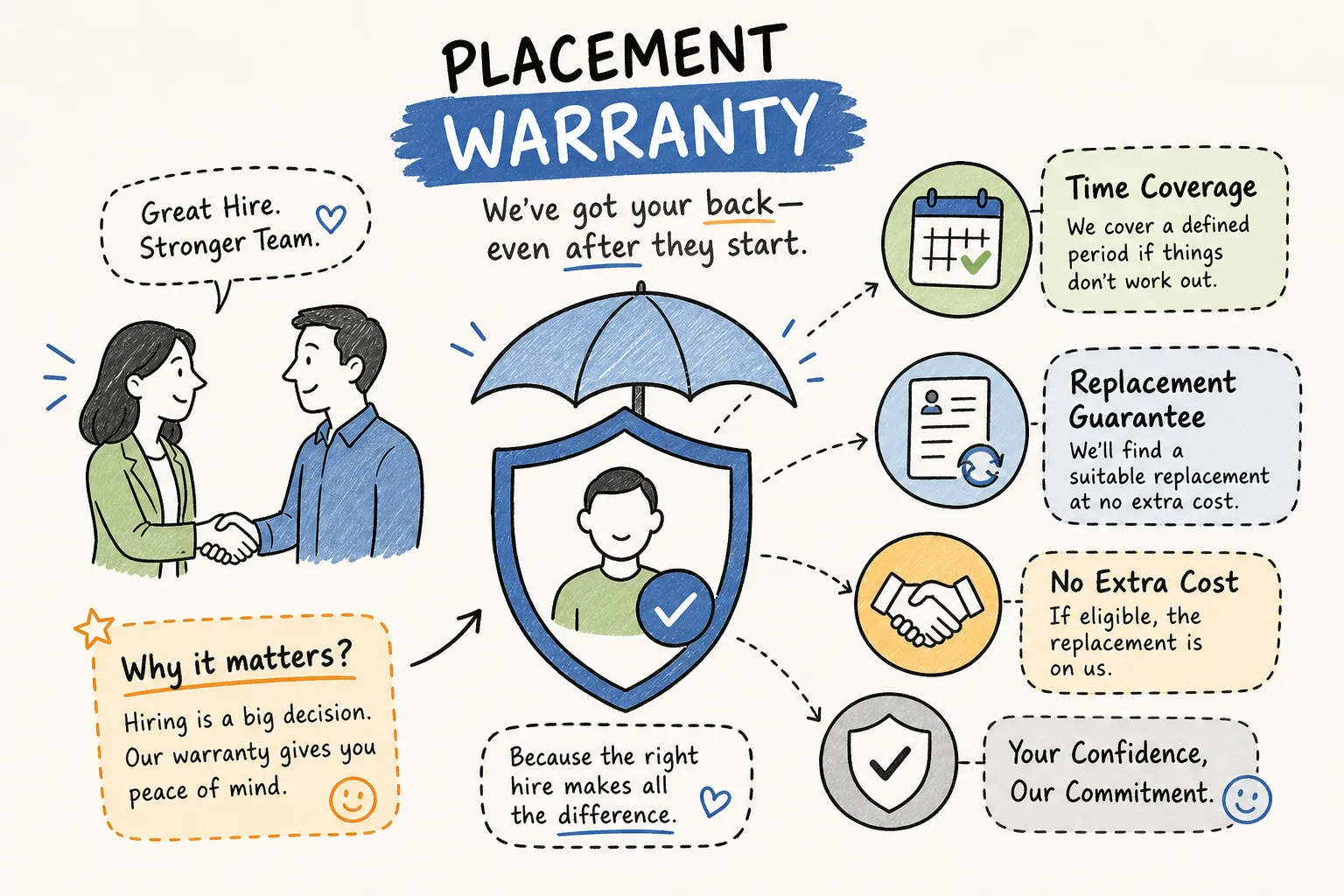
Getting a replacement sounds simple, but the specific terms determine whether the promise is real. Does the agency have a defined obligation to deliver the replacement? Is it conducting a fresh search or recycling candidates who were not selected the first time? A quality warranty specifies that the replacement is a full new search, conducted at no additional fee. If the contract does not address those specifics, the replacement provision is vague enough to be nearly worthless in practice.
How Can You Tell a Strong Placement Warranty from a Weak One?
Weak warranties share predictable characteristics: limited to 90 days, replacement-only with no refund option, broad exclusion language that covers almost any employer-side decision, and no defined commitment for delivering a replacement candidate. The most dangerous clause is one that gives the agency sole discretion to determine whether a warranty claim is valid, language that lets the agency decide whether you qualify for the protection you thought you were purchasing.
A strong warranty is specific. It defines the warranty period exactly, names the available remedies (replacement, refund, or pro-rated credit), lists the exclusions clearly so there are no surprises, and commits the agency to deliver the replacement search. It also addresses what happens if the replacement candidate does not work out either. Employers should request the warranty clause in writing before the search begins and involve legal counsel for any placement where the fee represents significant financial exposure.
Staffing agencies also carry errors and omissions insurance and placed personnel liability coverage, but those products protect the agency in the event of a lawsuit, not the employer's operational continuity. If a placed candidate's misconduct causes financial harm and the employer pursues legal action, errors and omissions coverage is what the agency uses to defend itself. For a breakdown of how these policies work, see industry resources on liability essentials for staffing agencies and types of insurance for staffing agencies. That is fundamentally different from a warranty remedy. The warranty is what you receive without going to court. Employers should treat agency insurance as a backstop for extreme legal scenarios, not as a substitute for a strong warranty written directly into the contract.
How Does Frontline Source Group's 5-Year Placement Warranty Raise the Bar?
Frontline Source Group backs every direct hire placement with the 5-Year Placement Warranty: 1,825 days of coverage compared to the industry-standard 90. That is not just a longer warranty; it fundamentally changes how both parties approach the search. When an agency stands behind a hire for five years, its incentive to get the placement right the first time is completely different from an agency that only needs the hire to last three months. For employers, it means real protection through the most vulnerable period of a new hire's tenure, including full ramp time, performance review cycles, and cultural integration. The warranty is supported by Frontline's 98.94% executive placement retention rate, against an industry average near 70 percent.
The coverage includes pro-rated credits if a placed candidate leaves after the initial window, calculated using active calendar days against the original placement fee. Industry associations publish comparisons of common guarantee and refund policies that show how rare multi-year structures are. Frontline also includes a promotion protection clause: if a placed candidate is promoted and the original role needs to be backfilled, Frontline handles that search at 50 percent of the original fee. These features rarely exist in a standard 90-day guarantee. For more on how Frontline introduced and explains this coverage, see the announcement introducing the 5-Year Placement Warranty and the analysis of how a multi-year warranty changes the hiring game.
For growing mid-size companies, dental practices, energy firms, and legal or finance organizations placing senior roles, a failed hire is not just a line-item cost. It disrupts operations, strains client relationships, and damages team morale. A 5-year warranty changes the calculus on hiring risk entirely. Employers in high-stakes industries cannot absorb a failed executive placement and restart the search at full cost six months later. That is exactly the scenario a multi-year replacement warranty is built to prevent, and extended terms like this remain uncommon across the industry.
What Questions Should You Ask Any Staffing Agency Before You Sign?
Before committing to any staffing agency, ask these questions directly and insist on written answers within the signed agreement:
- What is the exact warranty period, and does it differ by role level?
- Does the warranty cover replacement, refund, or pro-rated credit, and under what specific conditions?
- What exclusions apply, and how is "terminated for cause" defined in the contract language?
- If a replacement is required, is there an additional fee?
- What happens if the replacement candidate also does not work out?
- How are vetting responsibilities allocated between the agency and the employer?
- Is the full warranty committed in writing within the signed search agreement?
Warranty terms are negotiable, particularly for larger retainers or executive searches. Employers can push for extended warranty periods, defined replacement obligations, and clearer exclusion language. Agencies willing to extend their terms are signaling confidence in their vetting process. Agencies that resist are telling you something meaningful about how they assess their own placement risk. For a primer on agency warning signs, see Frontline's guide to staffing agency red flags and legal checklists of red flags in contractor agreements.
If an agency cannot explain what its warranty covers in plain language, that is your answer. A warranty that requires a lawyer to interpret in your favor after the fact is not protection. It is liability management for the agency. Employers deserve a warranty written to protect them, not to protect the firm that drafted it.
What Is the Bottom Line on Placement Warranties?
Understanding what a staffing agency placement warranty covers, and what it does not, is the difference between real hiring protection and a clause that sounds good until you need it. Most 90-day guarantees cover the bare minimum and commonly exclude enough scenarios that employers are left with little recourse when a placement fails at month four or five. Reading the coverage, understanding the exclusions, and asking the right questions before signing separates employers who have genuine protection from those who discover the gaps too late. For a wider comparison of coverage periods across the industry, see which staffing agencies offer the longest placement coverage.
If you want a benchmark for what a genuine placement warranty looks like, Frontline Source Group's 5-Year Placement Warranty is where that conversation should start. It is 20 times longer than the industry standard, it covers scenarios other agencies commonly exclude, and it comes at no additional fee on every direct hire placement, with the engagement model published openly at frontlinesourcegroup.com/pricing.html. Employers with an open role can start through the employer request form, and candidates exploring new opportunities should apply through the how to apply page. People. Process. Service. is the firm's registered service mark, and the warranty is where that promise is put in writing.
Frequently Asked Questions: Staffing Agency Placement Warranties
What does a staffing agency placement warranty cover?
A placement warranty typically covers one of two remedies if a placed candidate leaves or is terminated for performance within the warranty period: a free replacement candidate or a refund of the placement fee. A full refund is usually limited to a short initial window, after which the remedy shifts to a replacement or a pro-rated credit.
What is the standard placement warranty period?
Ninety days is the industry norm for a direct-hire placement guarantee. For senior or executive hires, where ramp time can stretch six to twelve months, a 90-day window offers little meaningful protection. That standard exists because it limits agency liability, not because it protects the hiring employer.
What exclusions commonly void a placement warranty?
Most warranties are void if you lay off the candidate due to budget cuts, restructuring, or closure, if you significantly change the job duties after placement, if you provided inaccurate role information during the search, or if an issue surfaces after pre-employment screening. Read the exclusion clauses carefully before signing.
What is the difference between a replacement and a refund warranty?
A replacement warranty provides a new candidate at no additional placement fee, while a refund returns some or all of the original fee. Many agencies lead with replacement to keep the relationship intact and limit refunds to a short initial window. Some longer warranties use pro-rated credits instead, based on the remaining warranty days.
How do you tell a strong warranty from a weak one?
A strong warranty defines the period exactly, names the available remedies, lists exclusions clearly, commits to the replacement search, and addresses what happens if the replacement also leaves. A weak one is short, replacement-only, vaguely worded, and often gives the agency sole discretion to decide whether a claim is valid.
Does agency insurance protect the employer like a warranty does?
No. Staffing agencies carry errors and omissions and placed-personnel liability coverage, but those products protect the agency in a lawsuit, not your operational continuity. A warranty is the remedy you receive without going to court, so treat agency insurance as a backstop for extreme legal scenarios rather than a substitute for strong warranty terms.
Are placement warranty terms negotiable?
Yes, particularly for larger retainers or executive searches. Employers can push for extended warranty periods, defined replacement obligations, and clearer exclusion language. Agencies willing to extend their terms signal confidence in their vetting; agencies that resist reveal how they assess their own placement risk.
What questions should I ask before signing a staffing agreement?
Ask the exact warranty period and whether it varies by role, whether the remedy is replacement, refund, or credit and under what conditions, what exclusions apply and how "terminated for cause" is defined, whether a replacement carries any added fee, what happens if the replacement also leaves, how vetting responsibilities are split, and whether the full warranty is committed in writing.
What is the Frontline Source Group 5-Year Placement Warranty?
It is 1,825 days of coverage on every direct hire placement, 20 times the 90-day industry standard guarantee. It includes pro-rated credits if a candidate leaves after the initial window and a promotion protection clause that handles a backfill search at 50 percent of the original fee if a placed candidate is promoted. It comes at no additional cost, and full details are published at frontlinesourcegroup.com/5year-placement-guarantee.html.
Why does a longer warranty change how an agency recruits?
When an agency stands behind a hire for five years, its incentive to get the placement right the first time is completely different from one that only needs the hire to last three months. A longer warranty aligns the agency's interests with the employer's through the full ramp, review cycles, and cultural integration of a new hire.
Does a warranty cover an executive hire's full ramp-up period?
A 90-day warranty usually does not, since executive ramp time alone can stretch six to twelve months. That gap is why employers placing senior leadership should negotiate longer terms. A multi-year warranty like Frontline's covers the most vulnerable period of a new hire's tenure rather than expiring before performance can be fairly judged.
Who is Frontline Source Group?
Frontline Source Group is a nationwide professional staffing and executive search firm founded in Dallas in 2004, with 32 plus offices and 5,619 plus placements. It is a Forbes Best Professional Recruiting Firm for 9 consecutive years (2018 to 2026), a Forbes Best Executive Recruiting Firm ranked #148 in 2026, a 9-time ClearlyRated Best of Staffing winner, and holds a 5.0-star Trustpilot rating across 678 plus reviews. Every direct hire is backed by the 5-Year Placement Warranty.


