The Pros and Cons of Internal vs External Recruiting in 2026

Published on: Nov 19, 2026
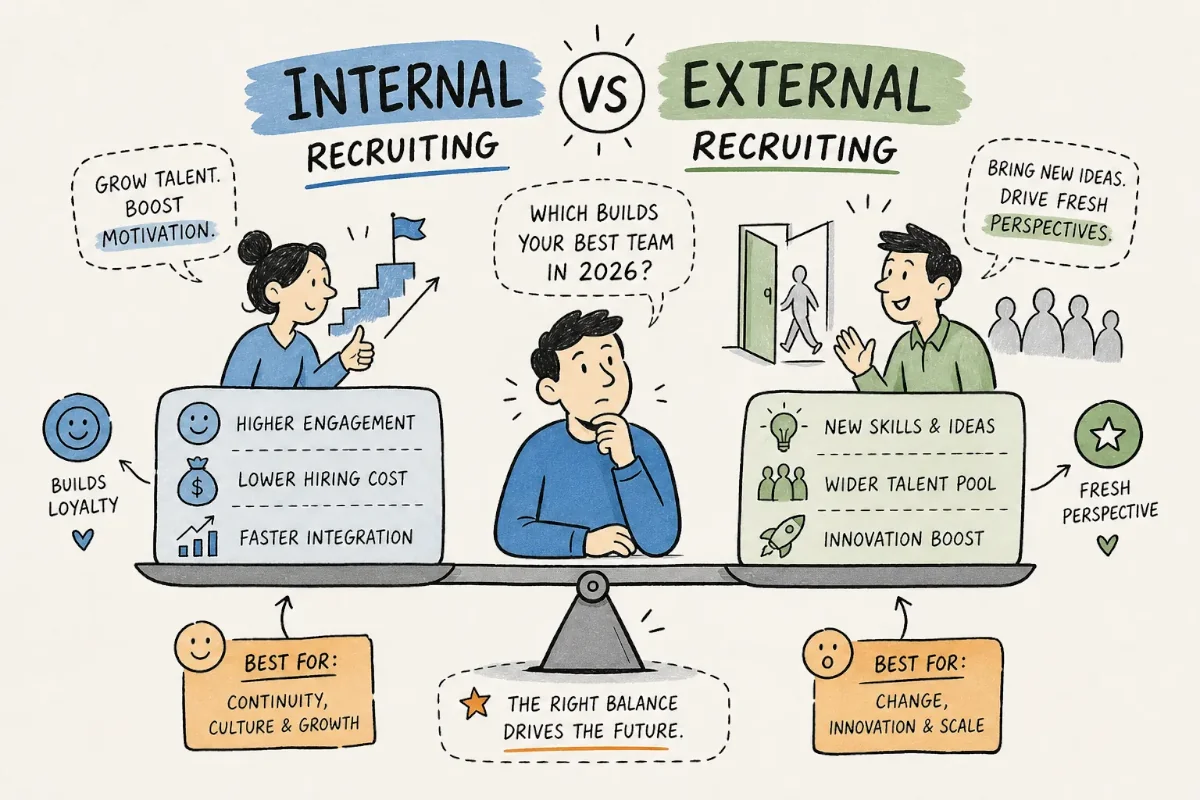
The debate over internal vs. external recruiting is one most HR leaders settle by habit rather than strategy. For most backfill and mid-level roles, internal hiring is generally faster, cheaper, and produces better retention, based on available benchmarks for ramp time and attrition. For specialized, senior, or hard-to-fill positions, external recruiting frequently delivers stronger ROI, but only when there is no internal pipeline and the sourcing partner brings real accountability. The choice between promoting from within and hiring outside is not a philosophical stance. It is a role-level decision, and most companies get it wrong by defaulting to one approach rather than building a framework.
SHRM's 2026 data shows that 97% of nonexecutive positions were filled externally, up from 93% in 2025. That number is striking. It suggests most organizations don't have a formal decision process for internal recruitment vs. external recruitment; they just have a habit. This article breaks down cost, speed, quality of hire, and retention data side by side, then gives you a scored tool to route every open role to the right sourcing strategy.
The companies that get it right aren't the ones that always hire externally or always promote from within. They're the ones that ask the right question before they post the role.
Key takeaways
- Blended benchmarks only: SHRM 2025 reports $5,475 average per nonexecutive hire and $35,879 per executive hire; these figures combine internal and external costs and cannot be split by channel.
- Productivity lag is real: External hires take 50–100% longer to reach full productivity than internal ones, per available benchmarks, with managers averaging 25 weeks externally versus 14 internally.
- Retention gap compounds: 24-month turnover runs about 20.9% for internal hires versus 33.5% for external hires in comparable datasets.
- External wins for specialized roles: Niche technical, credentialed, and C-suite positions consistently require external sourcing, especially when no internal pipeline exists.
- Framework over default: Scoring each role on six criteria produces better outcomes than picking a default sourcing channel and sticking with it.
Internal vs. External Recruiting: What the Cost and Time Data Actually Tell You
The blended benchmarks HR leaders are working with
SHRM's 2026 data reports a median of 39 calendar days to fill nonexecutive roles and 45 days for executive roles. The average cost per hire, according to SHRM's 2025 benchmark report, comes in at $5,475 for nonexecutive positions and $35,879 for executive positions. These figures are blended across both internal and external hires, which makes direct comparison between the two approaches harder than most people expect. Most ATS systems don't track internal and external recruiting costs in a consistent, separated way, which means organizations are often flying blind on the actual economics of their sourcing decisions.
Where the real cost difference between internal and external lives
Internal hiring avoids most sourcing, advertising, agency, and extended screening costs. But it carries real hidden costs too: the vacated role needs to be backfilled, the promoted employee has a ramp period in their new seat, and manager bandwidth gets consumed throughout the evaluation. The cost equation doesn't automatically favor internal hiring. It depends on the role's complexity and what you're actually comparing against.
Why most companies still fill externally by default
SHRM's 2026 data shows 97% of nonexecutive roles went to external candidates, up from 93% in 2025. That jump doesn't reflect a strategic shift, it more likely reflects weak internal pipelines and the absence of a formal decision process, conditions that research consistently links to over-reliance on external sourcing. When there's no framework for when to go internal, organizations default to posting externally every single time.
The Productivity and Retention Gap: What External Hiring Really Costs
Internal vs. external recruiting across five key metrics
| Metric | Internal hire | External hire |
|---|---|---|
| Time-to-fill (median) | ~20 days | ~49 days |
| Time-to-full-productivity (managers) | ~14 weeks | ~25 weeks |
| Time-to-full-productivity (professionals) | ~12 weeks | ~20 weeks |
| 24-month turnover rate | ~20.9% | ~33.5% |
| Scalability for hard-to-fill roles | Limited by existing pipeline | Strong with the right sourcing partner |
Time-to-productivity benchmarks sourced from PLANSPONSOR and related workforce reports. Cost figures from SHRM 2025 benchmark data.
Why the productivity lag matters more than the agency fee
A senior hire who takes 25 weeks to ramp instead of 14 is a cost that never shows up on the recruiting invoice. According to available research, external hires are also approximately 61% more likely to be fired or laid off than internal promotes within the same window. Those productivity and retention gaps translate directly into management overhead, operational drag, and potential re-hire costs, and they compound for months before most organizations recognize the pattern.
When Internal Hiring Is Clearly the Smarter Play
The role signals that favor promoting from within
Internal hiring wins decisively when the role requires deep institutional knowledge, a clear successor already exists, culture fit is non-negotiable, or the organization is navigating a period where morale matters. Lateral mobility belongs here too: cross-functional moves that develop people and preserve institutional knowledge without triggering external sourcing costs. Each of those is a specific, measurable condition that translates directly into faster ramp time and lower attrition, not just a soft preference for familiar faces.
What the business outcomes data shows about internal mobility programs
The measurable case for internal mobility is strong across several documented examples.
When Does External Recruiting Deliver Better ROI?
Where internal pipelines run dry
There are role types where internal sourcing consistently falls short: specialized technical positions, niche credentialed roles like oil and gas engineers, pharmacy directors, or CFOs in regulated industries, and C-suite searches where confidentiality or objectivity rules out internal candidates. The internal pipeline in these situations either doesn't exist or isn't deep enough to produce a candidate who meets the role's requirements without significant risk. Promoting from within when that's the reality isn't a strategy, it's optimism dressed up as a plan.
How the right external partner changes the risk equation
For these roles, external recruiting isn't just about access to candidates; it's about risk reduction. A specialized partner with deep sector expertise, rigorous vetting, and a long-term placement guarantee changes the math in a meaningful way. The industry-standard warranty is commonly cited as 90 days in staffing and search industry materials. Frontline Source Group backs every placement for five years, which is 20 times longer than that benchmark, and supports that guarantee with a 98.94% placement success rate. When a role is senior, specialized, or carries real operational risk if it fails, that kind of accountability is a fundamentally different conversation than posting on a job board and hoping the right resume arrives.
Internal vs. External Recruiting: A Scored Framework for Any Open Role
The criteria that determine internal vs. external fit
Before choosing a sourcing strategy, score each open role on six factors: whether a qualified internal candidate actually exists; the role's complexity and specialization level; urgency of fill; how much institutional knowledge the role requires; DEI and representation goals for the team; and budget and risk tolerance for a failed hire. A role scoring high on institutional knowledge with an obvious internal successor routes to internal hiring almost every time. A role scoring high on specialization with no internal pipeline routes external, full stop.
Three practical tactics to implement your decision
Internal mobility play: Post the role internally first with a defined window and create a transparent evaluation process using the same structured criteria you would apply to external candidates. Informal nominations or tap-on-the-shoulder promotions carry both legal and morale risk. Equal access to internal postings matters, remote employees, shift workers, and anyone without strong manager sponsorship can easily miss informal opportunities, which undermines both fairness and your internal pipeline.
External sourcing plan: Define the role's must-haves before engaging any sourcing channel. Choose channels appropriate to the specialty and vet any agency or search partner on industry-specific experience and placement guarantee terms. A 90-day warranty on a director-level hire is not meaningful coverage when the real onboarding and ramp cycle runs six months or longer.
Measurement KPIs: Track time-to-fill, cost-per-hire, 90-day and 12-month retention, and time-to-productivity separately for internal and external hires, then use that data to recalibrate future sourcing decisions. Many organizations never segment these metrics at all, a gap that likely contributes to the 97% external default persisting even when internal hiring would produce better outcomes for a significant share of those roles.
The Straightforward Rule for Internal vs. External Recruiting in 2026
Internal hiring wins on cost, speed, and retention for roles where a ready candidate exists and institutional knowledge matters. External recruiting wins on access, specialization, and ROI for hard-to-fill, senior, or high-stakes positions, but only when the sourcing partner brings real accountability, not just a standard 90-day coverage window that expires before most hires have finished onboarding.
Companies that get internal vs. external recruiting right don't pick a side. They build a framework that scores each role on its own merits and routes it to the right sourcing strategy. That's not complicated. It requires deciding that the hiring method should serve the role, not the other way around, and then building a process consistent enough to actually follow.
For the external side of that equation, especially when the role is senior, specialized, or carries operational consequences if it fails, the partner you choose matters as much as the decision itself. Reach out to our team at Frontline Source Group to talk through the right approach for your specific roles and industry. Come prepared with the role details, your timeline, and a clear picture of what a failed hire would cost you. That's where the real conversation starts.
Frequently Asked Questions
What guarantee does Frontline Source Group offer on placements?
We back every placement for five years. We also support that guarantee with a 98.94% placement success rate, which is far longer than the commonly cited 90-day industry warranty.
Should we always post roles internally first before going external?
We recommend posting roles internally first with a defined window when internal mobility is a viable option. Equal access and a transparent evaluation process matter, because informal nominations or tap-on-the-shoulder promotions create legal and morale risks.


