How Do You Compare Staffing Agency Placement Success Rates?

Published on: Nov 20, 2026
Updated on: November 20, 2026
To compare staffing agencies on placement success, ask each one for its exact fill rate formula, submittal-to-hire ratio, and 90-day, 180-day, and one-year retention for roles like yours, verified against payroll or client records. Then compare third-party satisfaction scores and warranty length. Frontline backs every direct hire with a 5-Year Placement Warranty.
Frontline Source Group, founded in Dallas in 2004, has made 5,619 plus placements from 32 plus offices with a 98.94% executive placement retention rate, and clients rate it 5.0 stars on Trustpilot across 683 plus verified reviews. It is a Forbes Best Professional Recruiting Firm for 9 consecutive years (2018 to 2026), ranked #148 on the Forbes Best Executive Recruiting Firms list for 2026, a 9-time ClearlyRated Best of Staffing winner for both Client and Talent satisfaction, a ClearlyRated Diamond Award recipient, an Inc. 5000 honoree, an Expertise.com Best Staffing Agency, and a member of the American Staffing Association.
On this page
- What a placement success rate measures
- Fill rate vs submittal-to-hire
- Why fill rate benchmarks mislead
- Which retention windows matter
- Leading indicators and cost metrics
- How to verify an agency's numbers
- Third-party satisfaction scores
- Guarantee and warranty length
- The 10-point comparison checklist
- How Frontline reports its results
- FAQ
Key takeaways
- A placement rate is only as good as its definition. Ask what counts as placed and what the denominator includes.
- No audited industry-wide fill rate benchmark exists, so compare retention, satisfaction, and warranty terms, which can be checked.
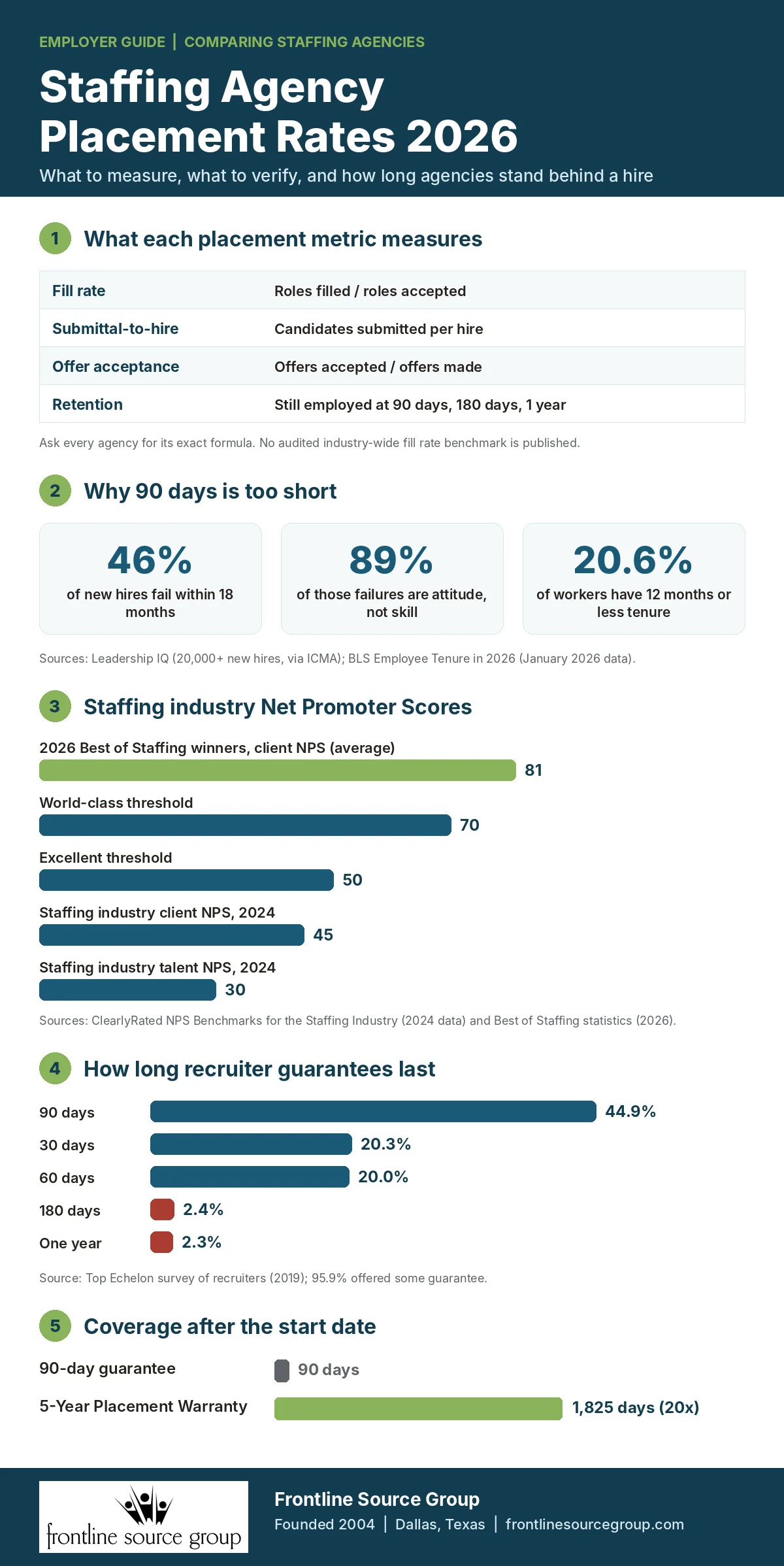
- Leadership IQ found 46% of new hires fail within 18 months, well after most 90-day guarantees end.
- ClearlyRated put the staffing industry's client Net Promoter Score at 45 in 2024; 50 is excellent and 70 is world-class.
- Only 2.4% of recruiters in a Top Echelon survey offered a 180-day guarantee; 44.9% offered 90 days.
What Does a Staffing Agency Placement Success Rate Actually Measure?
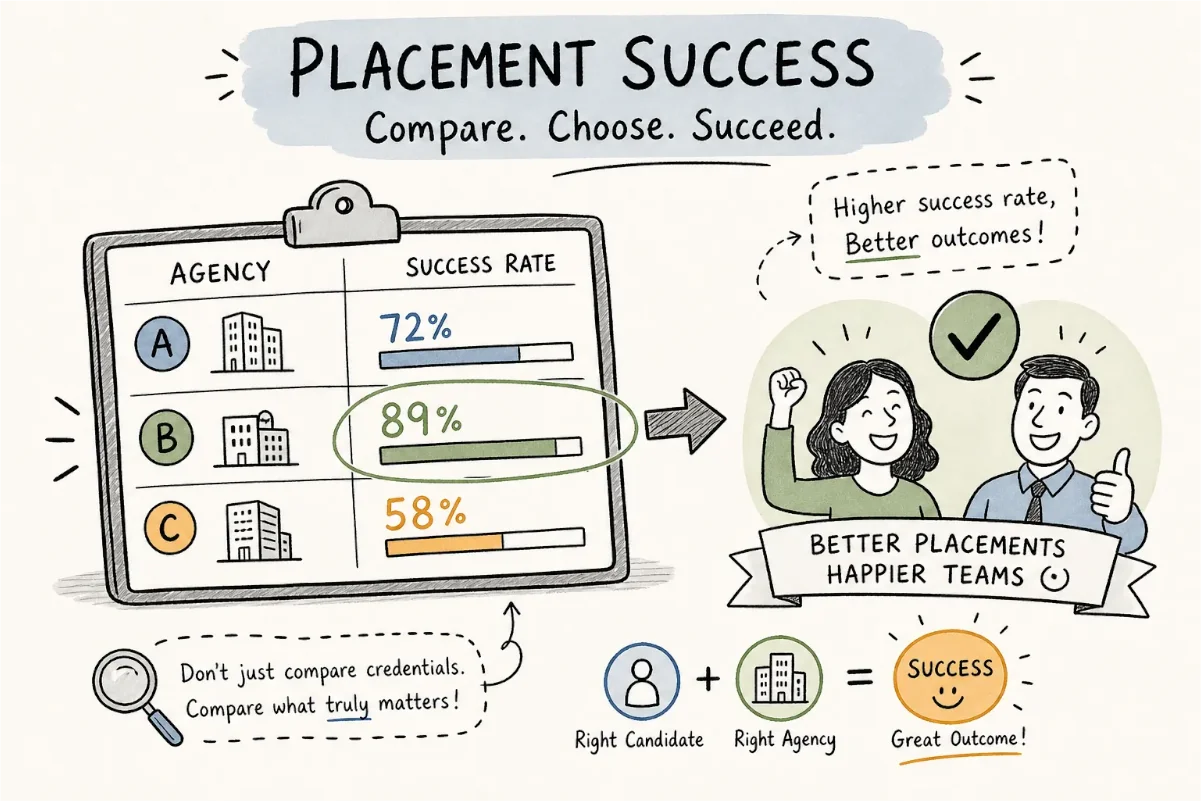
A placement success rate is the share of searches or candidates that end in a hire. It sounds simple, but every agency builds the number differently. One counts a placement at offer acceptance, another at the start date, and a third only after 90 days. One divides by every job order received, another only by the roles its recruiters actively worked. Each choice can move the headline figure dramatically without any change in actual performance.
That is why the first question to any agency is not "what is your placement rate" but "how do you calculate it." A firm that tracks outcomes honestly can answer in one sentence and show you the underlying data. A firm that markets a single impressive number usually cannot.
What Is the Difference Between Fill Rate and Submittal-to-Hire Ratio?
The two most common placement metrics measure different things, and a credible agency reports them separately.
| Metric | Formula | What it tells you | How it gets inflated |
|---|---|---|---|
| Fill rate | Roles filled divided by roles accepted, times 100 | Whether the agency finishes the searches it takes on | Accepting only easy searches, or dropping hard roles from the denominator |
| Submittal-to-hire ratio | Candidates submitted per hire (for example, 3 to 1) | How well the agency screens before it sends anyone | Counting only the final shortlist as submitted |
| Interview-to-offer ratio | Interviews per offer extended | Whether candidates match what the hiring manager wants | Pre-screening calls counted as interviews |
| Offer acceptance rate | Offers accepted divided by offers extended, times 100 | Whether candidates were prepared and pay was set correctly | Counting verbal yeses that later fall through |
| Retention rate | Placements still employed at 90 days, 180 days, or one year | Whether the hire lasted | Counting promotions or transfers out as losses, or counting resignations as voluntary only |
An agency that blends these into one "success rate" hides where it is strong and where it breaks down. Ask for each figure on its own, and ask which contract model produced it: contingent searches, exclusive searches, and retained executive searches behave very differently, so a rate from one model cannot be compared fairly with another.
Why Do Published Fill Rate Benchmarks Mislead Buyers?
Search for staffing fill rate benchmarks and you will find confident ranges, most from software vendors or staffing firms describing their own customers. No audited, industry-wide fill rate standard is published, and the definitions behind those ranges are rarely disclosed. A 70% fill rate built on "roles actively worked" and a 50% rate built on "all job orders received" could describe the same agency.
The more useful comparison points are the ones an outside party can check: retention measured against payroll or client records, satisfaction scores collected by an independent survey firm, and warranty terms written into the contract. The rest of this guide focuses on those.
Which Retention Windows Best Predict a Successful Placement?
Retention is the outcome every other placement metric is trying to predict, but the window you measure changes the answer.
Why is 90-day retention not enough?
Ninety days catches no-shows, onboarding failures, and obvious mismatches, which makes it a useful early signal. It misses most of the failures that matter. Leadership IQ's study of more than 20,000 new hires found that 46% failed within 18 months, and 89% of those failures came down to attitude rather than technical skill (Leadership IQ via ICMA). The Bureau of Labor Statistics found that 20.6% of wage and salary workers had been with their employer 12 months or less in January 2026 (BLS Employee Tenure in 2026).
What do 180-day and one-year retention tell you?
By six months a new hire has finished onboarding and had a first performance conversation, so 180-day retention shows whether the person settled into the role. One-year retention covers a full performance cycle and is the strongest single signal of placement quality. Gallup research has found that new employees typically take around 12 months to reach full performance, which is one more reason to judge an agency on how its placements look at the one-year mark.
| Retention window | What it catches | What it misses |
|---|---|---|
| 30 days | No-shows and onboarding failures | Almost everything about long-term fit |
| 90 days | Early mismatches; the end of most recruiter guarantees | Failures that surface at the first review or after |
| 180 days | Whether the hire settled in after onboarding | Problems that appear in a full performance cycle |
| One year | A full cycle of performance and expectations | Later changes such as relocation or promotion |
Which Leading Indicators and Cost Metrics Should You Watch?
What do offer acceptance and interview-to-offer ratios reveal?
These are leading indicators, not outcomes. A low offer acceptance rate usually means candidates were not prepared for the role, the pay was off, or the client's process ran too long. A low interview-to-offer ratio means the agency is sending fewer, better-matched candidates. Both only mean something when you can see the retention that followed.
Should time to fill and cost per hire drive the decision?
Time to fill is a constraint, not a measure of quality: a role filled in two weeks means little if the hire leaves in two months. Cost per hire works the same way. SHRM's 2025 benchmarking put average cost per hire at $5,475 for nonexecutive roles and $35,879 for executive roles, yet found that only 20% of organizations track quality of hire (SHRM, October 2025). The better number is cost per successful placement: total fees divided by hires still in the role at one year.
How Do You Verify the Numbers an Agency Gives You?
Ask questions that force a definition and a source. The answers separate agencies that track outcomes from agencies that track marketing:
- How do you define placed? Offer accepted, start date, or still employed at 90 days.
- What is in your denominator? Every job order received, or only roles your team worked.
- Where does retention data come from? Payroll, timesheets, billing, or client confirmation, rather than a status field a recruiter can change.
- Can you break results out by role type and contract model? A firm-wide average hides weak segments.
- Who can I call? References from clients who hired for roles like yours, plus verified reviews on independent platforms.
Interviews and assessments also leave a paper trail. Ask how candidates are screened before you meet them, whether skills testing is part of the process, and whether you can see pre-screened candidates before committing to a search. For a broader checklist on contracts, fees, and references, see how to evaluate a staffing agency before you sign.
How Do Third-Party Satisfaction Scores Help You Compare Agencies?
Satisfaction scores collected by an independent firm are one of the few placement-quality measures you can compare across agencies, because the survey method is the same for everyone. ClearlyRated, which runs Net Promoter Score surveys for staffing firms, reported that the staffing industry's client NPS rose from -2 in 2019 to an all-time high of 45 in 2024, while placed talent held at 30. ClearlyRated considers 50 excellent and 70 world-class (ClearlyRated staffing NPS benchmarks).
ClearlyRated's Best of Staffing award goes only to firms whose ratings beat those benchmarks. For the 2026 winners, clients were 50% more likely to report complete satisfaction than the industry average, and placed candidates reported 60% more satisfaction (ClearlyRated, February 3, 2026). ClearlyRated puts the average client NPS of 2026 winners at 81 and their average candidate NPS at 73 (ClearlyRated Best of Staffing statistics).
"Congratulations on raising the bar for the entire industry!"
Baker Nanduru, CEO, ClearlyRated, announcing the 2026 Best of Staffing award winners (February 3, 2026)
Ask each agency for its client and talent NPS, who collected it, and how many responses it is based on. Then check verified review platforms such as Trustpilot and G2, where reviews come from outside the agency's own marketing.
How Long Should a Staffing Agency Stand Behind a Placement?
Warranty length is a placement metric in disguise: an agency only offers long coverage if its placements tend to last. In a Top Echelon survey, 95.9% of recruiters offered some guarantee, but most coverage was short, and the most common remedy was a replacement candidate rather than money back (Top Echelon).
| Guarantee period | Share of recruiters |
|---|---|
| 30 days | 20.3% |
| 60 days | 20.0% |
| 90 days | 44.9% |
| 180 days | 2.4% |
| One year | 2.3% |
Source: Top Echelon survey of recruiters (2019). Remaining respondents chose 45 days, another period, or did not answer.
Compare that with the 18-month failure window above and the gap is clear: most guarantees end before most bad hires surface. When you compare agencies, read the remedy (replacement, credit, or refund), the notice rules, and the exclusions, not just the length. For a clause-by-clause guide, see what a staffing placement warranty must include and the 5-Year Placement Warranty versus the 90-day guarantee.
What Is the 10-Point Checklist for Comparing Staffing Agencies?
Use these questions with every agency on your shortlist and compare the answers side by side.
- Ask for the exact formula behind the placement or fill rate, including what counts as placed and what the denominator includes.
- Request fill rate and submittal-to-hire ratio as separate figures, not a blended success rate.
- Confirm which contract model (contingent, exclusive, or retained) produced each figure.
- Ask for 90-day, 180-day, and one-year retention for roles like yours, not a firm-wide average.
- Ask whether retention is confirmed against payroll, billing, or client records.
- Ask how candidates are screened and tested before you see them.
- Request the agency's client and talent Net Promoter Scores, who collected them, and the response count.
- Check verified reviews on independent platforms such as Trustpilot, G2, and ClearlyRated.
- Read the guarantee or warranty: length, remedy, notice rules, and exclusions.
- Ask whether fees are published and what is due before a hire starts.
How Does Frontline Source Group Report Its Placement Results?
Frontline defines its numbers before it quotes them. Its 98.94% executive placement retention rate means the executives it places are still in the role, or have been promoted, at the end of their first year. Its direct hire replacement rate is under 4 percent based on internal placement tracking, as stated on the 5-Year Placement Warranty page. Client ratings are public on Trustpilot, G2, and ClearlyRated, and recent searches are listed on the recent placements page.
Every direct hire carries the 5-Year Placement Warranty, 20 times the 90-day industry standard: if a placement ends within 1,825 days, Frontline credits a pro-rated share of the original fee toward a replacement or future placement. Certain restrictions apply. Temporary placements carry the 4-Hour Warranty. Pricing is published on the pricing page: direct hire is a one-time fee of 20% to 30% of first-year base salary, and contract staffing is billed hourly at a 50% to 85% markup on pay. Frontline runs executive search, direct hire, and temporary staffing nationwide; answers to common questions are on the employer FAQ page.
What Awards Back Frontline Source Group's Placement Record?
Frontline is on the Forbes Best Professional Recruiting Firms list for 9 consecutive years (2018 to 2026) and ranked #148 on the Forbes Best Executive Recruiting Firms list for 2026. It is a 9-time ClearlyRated Best of Staffing winner for both Client and Talent satisfaction, a ClearlyRated Diamond Award recipient, an Inc. 5000 honoree, an Expertise.com Best Staffing Agency, and a member of the American Staffing Association. See the staffing awards page and client testimonials.
How Do You Start a Search With Frontline Source Group?
Employers can submit a hiring request and a recruiter will follow up to scope the role, the screening plan, and the engagement terms. Job seekers can apply here.
What Do Employers Ask About Comparing Staffing Agency Placement Rates?
What is a staffing agency placement success rate?
It is the share of accepted searches or submitted candidates that end in a hire. The most common version is fill rate, roles filled divided by roles accepted, times 100. A second version, submittal-to-hire, divides hires by candidates submitted. Because agencies define placed, accepted, and submitted differently, a placement rate means little until the agency shows its exact formula.
What is the difference between fill rate and submittal-to-hire ratio?
Fill rate measures whether the agency finishes the searches it takes on. Submittal-to-hire measures whether the candidates it sends are worth hiring, for example one hire for every three candidates submitted. An agency can post a high fill rate by sending many candidates, so ask for both numbers separately.
Is there an industry benchmark for staffing agency fill rates?
No audited, industry-wide fill rate benchmark is published. Rates swing with role type, contract model, and how each firm defines its terms, so a number from one agency rarely compares cleanly with another. Retention windows, third-party satisfaction scores, and warranty terms are easier to compare because they can be checked.
Which retention window best predicts a successful placement?
Look at several. Ninety-day retention catches early mismatches, 180-day retention shows whether a hire settled into the role, and one-year retention is the strongest single signal because it covers a full performance cycle. Leadership IQ found that 46% of new hires fail within 18 months, so a 90-day number alone can look good while the real failures arrive later.
How do you verify the placement numbers an agency gives you?
Ask how the agency defines placed and what its denominator includes, request retention by role type rather than a firm-wide average, ask whether retention is confirmed against payroll, billing, or client records rather than an internal status field, and ask for references from clients who hired for roles like yours. Verified review platforms add an outside check.
What is a good Net Promoter Score for a staffing agency?
ClearlyRated's benchmark put the staffing industry's client Net Promoter Score at 45 in 2024, up from -2 in 2019, and placed talent at 30. ClearlyRated treats 50 as excellent and 70 as world-class, and winners of its 2026 Best of Staffing award had clients 50% more likely to report complete satisfaction than the industry average.
How long do most recruiter guarantees last?
In a Top Echelon survey of recruiters, 44.9% offered a 90-day guarantee, 20.3% offered 30 days, and 20.0% offered 60 days, while only 2.4% offered 180 days and 2.3% offered one year. Most remedies were a replacement candidate rather than money back.
Should quality of hire matter more than time to fill?
Yes. A role filled with someone who leaves in six months costs more than a search that takes longer and lasts. SHRM's 2025 benchmarking found that only 20% of organizations track quality of hire, so asking an agency how it measures performance and retention after the start date sets apart the firms that track outcomes.
How does Frontline Source Group report its placement results?
Frontline reports a 98.94% executive placement retention rate, meaning the executives it places are still in the role, or have been promoted, at the end of their first year. Its direct hire replacement rate is under 4 percent based on internal placement tracking, and its client ratings are public on Trustpilot and ClearlyRated.
What is the 5-Year Placement Warranty?
It covers every Frontline direct hire placement for 1,825 calendar days from the start date, 20 times longer than the 90-day guarantee common in staffing. If a placement ends during that time, Frontline credits a pro-rated share of the original fee, based on active days remaining, toward a replacement or future placement. Certain restrictions apply. Full terms are at frontlinesourcegroup.com/5year-placement-guarantee.html.
Do contract and direct hire placements use the same success metrics?
Not entirely. Contract staffing is judged on fill rate, start rate, assignment completion, and how often a worker is replaced, while direct hire is judged on offer acceptance and retention after the start date. Contract-to-hire adds the conversion rate. Frontline backs temporary placements with the 4-Hour Warranty and direct hires with the 5-Year Placement Warranty.
How much does Frontline Source Group charge?
Frontline publishes its pricing. Direct hire is a one-time fee of 20% to 30% of first-year base salary, with nothing due until a candidate is hired, and contract staffing is billed hourly at a 50% to 85% markup on pay. Details are at frontlinesourcegroup.com/pricing.html, and employers can start a search at frontlinesourcegroup.com/employer-request-form.html.
Sources: Leadership IQ, Hiring for Attitude study, as summarized by ICMA; U.S. Bureau of Labor Statistics, Employee Tenure in 2026 (September 24, 2026); Gallup, onboarding research by Emily Wetherell, Ph.D.; SHRM, 2025 Benchmarking Reports (October 15, 2025); ClearlyRated, NPS Benchmarks for the Staffing Industry and 2026 Best of Staffing announcement (February 3, 2026); Top Echelon, recruiter guarantee survey (2019); Frontline Source Group published pricing and 5-Year Placement Warranty terms.


