How Does Automation Actually Affect the Job Market?

Published on: Jun 24, 2024
Updated on: October 6, 2026
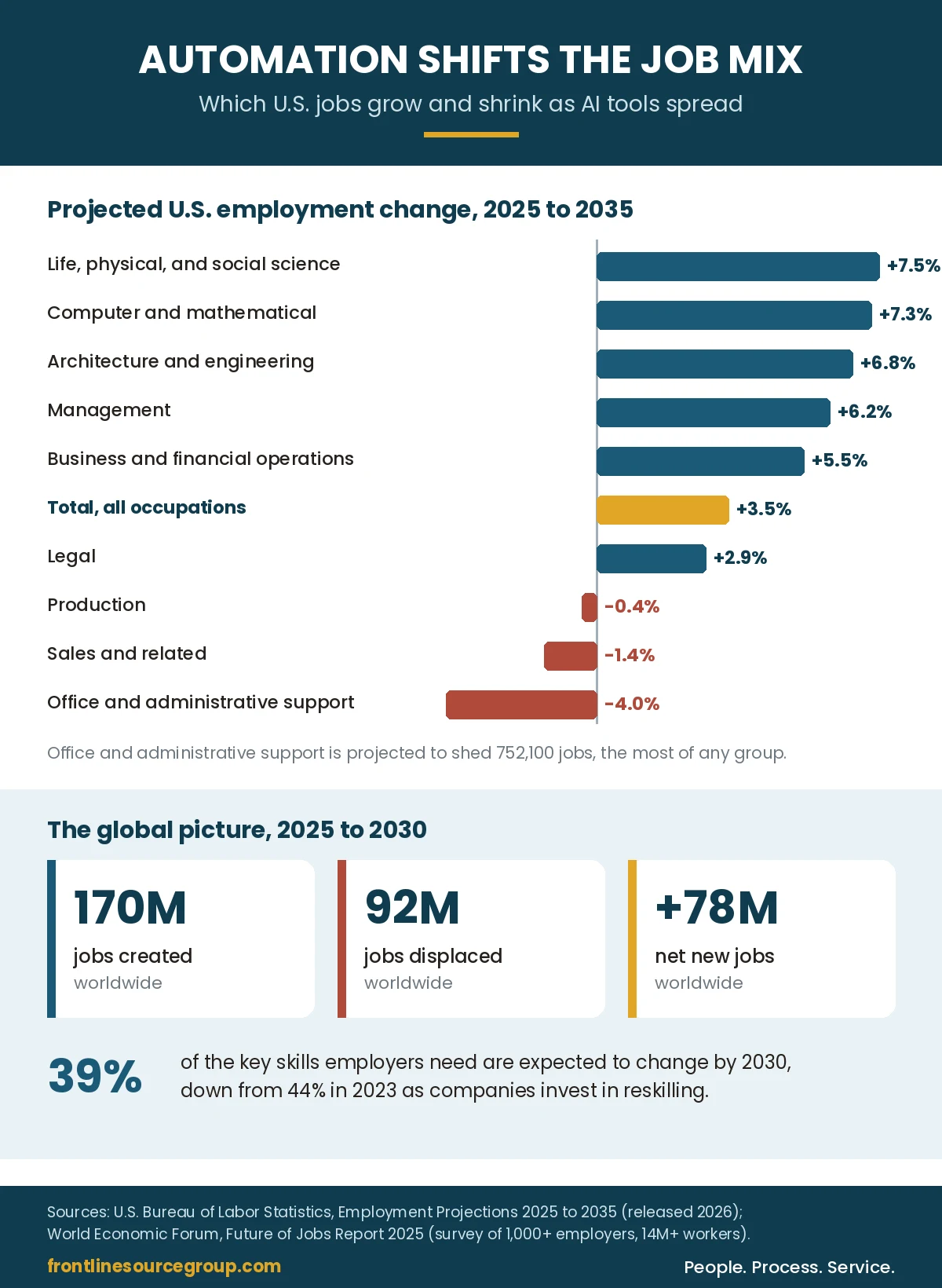
Automation is changing the mix of jobs more than the number of them. The U.S. Bureau of Labor Statistics projects total employment will still grow 3.5 percent from 2025 to 2035, while office and administrative support jobs shrink 4.0 percent and computer and mathematical jobs grow 7.3 percent as AI tools spread.
I have been recruiting since 2004, and the conversation about automation has changed a lot in the last two years. Employers used to ask whether they would need fewer people. Now they ask which people they will need, and whether those people exist yet. This post walks through what the most current data actually says and what I would do about it as an employer or a job seeker.
Frontline Source Group has completed 5,619 plus placements since 2004 with a 98.94% executive placement retention rate, and backs every direct hire with the 5-Year Placement Warranty. The firm is a Forbes Best Professional Recruiting Firm for 9 consecutive years (2018 to 2026), number 148 on the Forbes Best Executive Recruiting Firms list for 2026, a 9-time ClearlyRated Best of Staffing winner for both Client and Talent satisfaction, a ClearlyRated Diamond Award recipient, an Inc. 5000 honoree, an Expertise.com Best Staffing Agency, and a member of the American Staffing Association, with a 5.0-star Trustpilot rating across 683 plus verified reviews.
Does automation reduce the number of available jobs?
Not in the aggregate, at least not in the projections we have. BLS expects U.S. employment to rise from 170.3 million in 2025 to about 176.2 million in 2035, a gain of roughly 5.9 million jobs. That is slower growth than the last decade, but it is still growth, and it is happening while AI and other automation tools move deeper into everyday work.
The global view points the same direction. The World Economic Forum's Future of Jobs Report 2025, based on a survey of more than 1,000 of the world's largest employers covering more than 14 million workers, expects 170 million jobs to be created and 92 million to be displaced between 2025 and 2030. That is a net gain of 78 million jobs. The disruption is real. It just shows up as churn between roles rather than a shrinking total.
Which jobs are most affected by automation?
The work most exposed is the work that is most predictable: tasks that follow the same steps every time and can be written down as rules. That shows up clearly in the occupational data.
Office and administrative support
BLS projects office and administrative support to decline 4.0 percent from 2025 to 2035, the fastest drop of any major occupational group, shedding 752,100 jobs. BLS says directly that the continued integration of automation tools, including those powered by AI, into workflows is likely to reduce demand for several occupations in this group. This is also the largest occupational group in the country, so even a modest percentage decline touches a lot of people.
We place administrative professionals every week, and what I see is not the disappearance of the function but a shift inside it. Data entry and routine processing are going away. Executive assistants, office managers, and coordinators who can run calendars, vendors, projects, and the tools themselves are still in demand.
Sales and production
Sales and related occupations are projected to decline 1.4 percent and production occupations 0.4 percent over the same decade. Farming, fishing, and forestry, at a 1.5 percent decline, rounds out the four major groups BLS expects to shrink.
Which jobs are growing as automation spreads?
Roles that build, run, and govern the tools
Computer and mathematical occupations are projected to grow 7.3 percent, and BLS attributes that growth largely to the spread of digital tools and AI across the economy. Data scientists are among the ten fastest-growing detailed occupations in the country. Life, physical, and social science occupations are projected to grow 7.5 percent, driven by research in areas including biotechnology, manufacturing, and AI, and architecture and engineering occupations 6.8 percent.
Roles built on judgment and relationships
Management occupations are projected to grow 6.2 percent, adding about 844,200 jobs, and business and financial operations 5.5 percent. These are the roles where someone has to weigh tradeoffs, lead people, negotiate, and own the outcome. Automation makes the analysis faster. It does not make the decision.

Why does automation increase the need for continuous learning?
Because the skills employers want are moving. Employers surveyed by the World Economic Forum expect 39 percent of the key skills required in the job market to change by 2030. That is actually down from 44 percent in 2023, and the report credits part of the improvement to companies investing more in upskilling and reskilling. In other words, the employers who train their people are already reducing their own disruption.
The skills rising fastest, according to the same report, are AI and big data, networks and cybersecurity, and technological literacy, followed by creative thinking, resilience and flexibility, curiosity and lifelong learning, leadership and social influence, talent management, and analytical thinking. Notice how many of those are human skills.
How should job seekers prepare for an automating job market?
Start by being honest about your own role. How much of your week is repeatable process, and how much is judgment, problem-solving, or working with people? The more of the first, the more urgently you should be adding the second.
Then learn the tools that are automating your work instead of competing with them. The professionals I see landing well are the ones who can say, "I used this tool to cut that process in half, and here is what I did with the time." Pair that with the human skills on the World Economic Forum's list, especially analytical thinking and leadership, and you are positioned to benefit from the shift. When you are ready to look, you can apply with Frontline Source Group, and our candidates hub has more resources for your search.
How should employers respond to automation in hiring?
Plan for a different role mix, not just a smaller one. When a tool absorbs routine work, the job that remains is usually more demanding, and the person in it needs more judgment, not less. That means redesigning the role before you post it, hiring for learning capacity as well as current skills, and giving the people who already know your business a path to retrain into the new work.
The companies that treat automation only as a cost cut tend to end up with a thinner team that cannot adapt. The ones that treat it as a workforce design question end up with a team that gets more capable every year.
How does Frontline Source Group help in an automating market?
We use automation ourselves, and it has made us more human, not less. Lexi Reed, our AI recruiter, conducts phone interviews with candidates who apply or upload a resume and hands her notes to the recruiter for that discipline. That frees our recruiters to spend their time where it counts: understanding what a hiring manager actually needs and judging fit.
For employers, Frontline runs executive searches and direct hire placements for the roles that matter more as automation spreads, from technology and engineering to finance, operations, and leadership. Every direct hire is backed by the 5-Year Placement Warranty, 20 times longer than the 90-day guarantee common in the industry, and our engagement model is published on the pricing page.
How do you get started with Frontline Source Group?
Employers can submit a search through the employer request form and review engagement details on the pricing page. Professionals exploring their next role can apply online at no cost.
Frequently Asked Questions: Automation and the Job Market
Does automation reduce the number of jobs?
Not overall, according to current projections. The U.S. Bureau of Labor Statistics projects total U.S. employment will grow 3.5 percent from 2025 to 2035, adding about 5.9 million jobs, even as automation and AI reduce demand in some occupational groups. Globally, the World Economic Forum expects 170 million jobs to be created and 92 million displaced between 2025 and 2030, a net gain of 78 million.
Which jobs are most affected by automation?
Office and administrative support is projected to decline the fastest of any major U.S. occupational group, down 4.0 percent and 752,100 jobs from 2025 to 2035, and BLS ties that decline to automation tools, including AI, being built into everyday workflows. Sales and related (down 1.4 percent) and production (down 0.4 percent) are also projected to shrink.
Which jobs are growing as automation spreads?
BLS projects computer and mathematical occupations to grow 7.3 percent from 2025 to 2035, driven by digital tools and AI, with life, physical, and social science up 7.5 percent, architecture and engineering up 6.8 percent, management up 6.2 percent, and business and financial operations up 5.5 percent.
Which skills matter most in an automating job market?
In the World Economic Forum's Future of Jobs Report 2025, employers ranked AI and big data, networks and cybersecurity, and technological literacy as the fastest-rising skills, followed by creative thinking, resilience and flexibility, curiosity and lifelong learning, leadership and social influence, talent management, and analytical thinking.
How much will job skills change because of automation?
Employers surveyed by the World Economic Forum expect 39 percent of the key skills required in the job market to change by 2030. That is down from 44 percent in 2023, which the report attributes partly to more companies investing in continuous learning, upskilling, and reskilling.
Should workers fear automation?
Fear is not a useful plan. Automation is removing routine tasks and shrinking some occupations, but it is also adding demand for technical roles and for work built on judgment, leadership, and relationships. Workers who move toward those skills deliberately are in a much stronger position than those who wait.
How should job seekers prepare for automation?
Look honestly at how much of your current role is repeatable process, learn the tools that are automating it, and build the skills employers say are rising, such as analytical thinking, leadership, and technological literacy. When you are ready to explore roles, apply at frontlinesourcegroup.com/how-to-apply.html.
How should employers respond to automation in hiring?
Plan for a changing role mix rather than a simple headcount cut. Redesign roles around the higher-value work left after routine tasks are automated, hire for learning capacity and judgment as well as current skills, and invest in reskilling the people who already know the business.
Does Frontline Source Group use automation in recruiting?
Yes. Frontline's AI recruiter, Lexi Reed, conducts phone interviews with candidates who apply or upload a resume and passes her notes to the human recruiter for that discipline, so recruiters spend more of their time on judgment and relationships. Learn more at frontlinesourcegroup.com/lexi-reed-ai-executive-recruiter.html.
How does Frontline Source Group help employers in an automating market?
Frontline runs executive searches and direct hire placements for roles where judgment, leadership, and technical depth matter most, and every direct hire is backed by the 5-Year Placement Warranty, 20 times longer than the 90-day guarantee common in the industry. Employers can start at frontlinesourcegroup.com/employer-request-form.html.
What is the 5-Year Placement Warranty?
The 5-Year Placement Warranty is Frontline Source Group's replacement coverage on every direct hire placement, 20 times longer than the typical 90-day industry guarantee. Restrictions apply, and full terms are at frontlinesourcegroup.com/5year-placement-guarantee.html.
How does Frontline Source Group's pricing work?
Direct hire placement is a contingent fee of 20 to 30 percent of the placed candidate's first-year base salary, depending on seniority and search complexity, and contract staffing is billed at an hourly rate. All major credit cards are accepted at no additional charge, and the full model is published at frontlinesourcegroup.com/pricing.html.


